



The Open-Plan Problem — open office plant dividers
You have felt it. You can hear the entirety of your neighbour’s phone call. You are attempting to concentrate while twenty people move across your line of sight. The ambient noise is continuous, and the sense of any personal territory is entirely theoretical. Open-plan offices promise collaboration and deliver, alongside it, an inexhaustible supply of distraction.
The conventional solution is the partition panel. Those grey plastic screens install quickly and immediately make the space feel smaller, darker, and more oppressive — a filing cabinet, but designed for people.
Plants, considered as spatial elements rather than decoration, offer something entirely different.
Why Plants Outperform Panels as Dividers
Visual character: A partition says “stop.” A plant says “transition.” A row of Snake Plants between two work zones signals that someone is in the adjacent space — but it does not create enclosure. That particular quality of semi-privacy is precisely what makes open-plan offices tolerable: territory without isolation.
Air quality: Panels do not absorb CO₂. Plants do. In a large sealed space with centralised air conditioning and many people breathing in proximity, air quality is a genuine and measurable concern. More plants always improve it.
The psychological dimension
Greenery and grey plastic both signal something to the nervous system. One signals safety; the other signals constraint. The distinction does not require a study to register — it is felt immediately.
The counterargument is maintenance, which is real. But maintenance is outsourceable. The sense of being partitioned into a box is not something a service contract can dissolve.
Three Green Screen Solutions
Option 1: Tall Plants as Soft Partitions The most direct approach — specimens at 1.2 to 1.5 metres in height (including planter), arranged in a line between departments or along corridor edges.
The height is calculated: at seated eye level, it interrupts the sightline to the adjacent desk and creates a clear sense of territory. Standing, the full floor remains visible. The effect is belonging to a defined zone without feeling sealed within it.
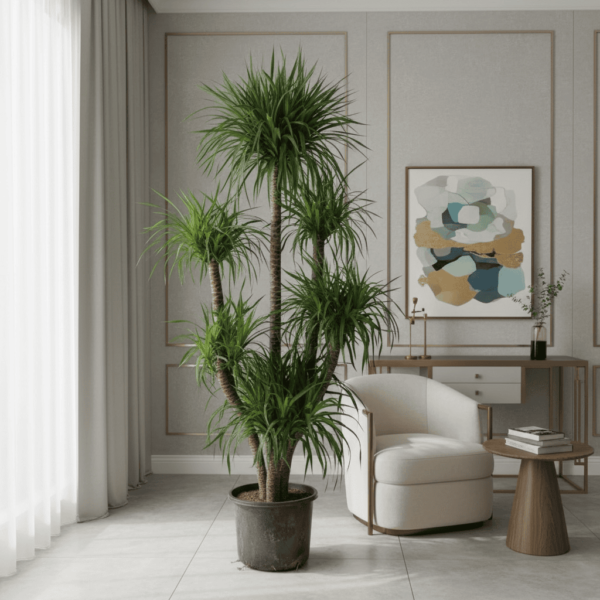
Recommended plants: Madagascar Dragon Tree — upright and vertical, occupying barely one square foot of floor space; tolerant of variable light Burgundy Rubber Plant — large, lacquered leaves provide more substantial visual blocking Areca Palm — the fronds fan outward, producing a sense of tropical corridor without creating a solid wall
Arrangement: Planters with casters, spaced approximately one metre apart, arranged in a gentle arc or S-curve. A perfectly straight line reads as institutional. A gentle curve reads as considered.
Option 2: Low Plants as Desk Boundaries For separating individual workstations where tall plants would consume too much of the available area, use 30–50cm specimens on stands or in low planters placed between desks.
Recommended plants: Snake Plant — vertical growth that does not expand sideways; a composed presence that does not encroach Small ferns — soft foliage that releases the rigidity of the desk environment without asserting dominance Succulent arrangements — where light permits, a row of small succulents along a dividing shelf carries a quality of deliberate calm
Key principle: the height must allow straightforward eye contact when standing. Open-plan offices function on communication. The plants should not require colleagues to stand on chairs to see each other.
Option 3: Hanging Plants as Overhead Curtains In offices with ceiling heights exceeding three metres, the ceiling is consistently underused. Install hooks or suspended racks and allow trailing plants — Pothos, Ivy — to cascade downward in living curtains. Zero floor space consumed; greenery descending from above adds depth and layering that floor specimens cannot achieve.
Recommended plants: Pothos — fast-growing, trails at length, visible results within weeks Ivy — dense fine-leafed growth produces a thicker curtain effect String of Pearls — plump bead-like leaves with genuine visual personality, where light is adequate
A Practical Starting Point
A typical open-plan office, a modest budget, and the intention to test the approach before committing to a full spatial redesign:
Step one: Identify the corridor that carries the most foot traffic — the natural boundary between two departments, for example. Step two: Acquire three Madagascar Dragon Trees at approximately 1.2–1.3 metres in height including pot. Add three dark grey or black long planters with casters. Step three: Arrange in a gentle arc along one side of the corridor, maintaining clear walking clearance.
The investment is a few thousand dollars. The felt quality of that zone shifts immediately. Colleagues will slow as they pass it — and register, without being able to name the reason, that the space feels less relentless.
Three Design Principles
Do not create full enclosure. Plant screens are intentionally semi-transparent. Leave visual pathways. Complete enclosure defeats the collaborative premise of an open-plan floor.
Choose slow-growing varieties for floor screens. Madagascar Dragon Tree and Areca Palm maintain their form over time. Pothos placed on the floor will sprawl well beyond its intended footprint and become a circulation hazard.
Do not neglect the light. The interior depths of open-plan floors are often dark. Position plants near windows or directly beneath ceiling lights. If a position is chronically dim, be honest about it and choose Snake Plant or Peace Lily rather than placing something that will not survive.
One Starting Point Worth Stealing
Identify one corridor, one corner, one shared desk boundary — and begin with a row. The most successful open-plan greening projects we have worked on began the same way: one person tried a small grouping near their own position. Colleagues registered it, asked about it, and the greening extended organically from there — without a formal initiative, without a top-down mandate. Start with a row. The plants will do what they are placed there to do.
PlantShop specialises in 130–180cm medium-to-large plants, with corporate consultants available from species selection through to installation placement. WhatsApp for a direct reply. Every plant is hand-selected before delivery. 3–7 business day delivery, free shipping to Hong Kong urban areas.
Related Products
Below are the plants mentioned in this article, available for direct purchase. Each comes with a real-person care card:



FAQs
The Open-Plan Problem
You have felt it. You can hear the entirety of your neighbour's phone call. You are attempting to concentrate while twenty people move across your line of sight. The ambient noise is continuous, and the sense of any personal territory is entirely theoretical. Open-plan offices promise collaboration and deliver, alongside it, an inexhaustible supply of distraction.
Why Plants Outperform Panels as Dividers
Visual character: A partition says "stop." A plant says "transition." A row of Snake Plants between two work zones signals that someone is in the adjacent space — but it does not create enclosure. That particular quality of semi-privacy is precisely what makes open-plan offices tolerable: territory without isolation.
Three Green Screen Solutions
Option 1: Tall Plants as Soft Partitions The most direct approach — specimens at 1.2 to 1.5 metres in height (including planter), arranged in a line between departments or along corridor edges.
A Practical Starting Point
A typical open-plan office, a modest budget, and the intention to test the approach before committing to a full spatial redesign:
