



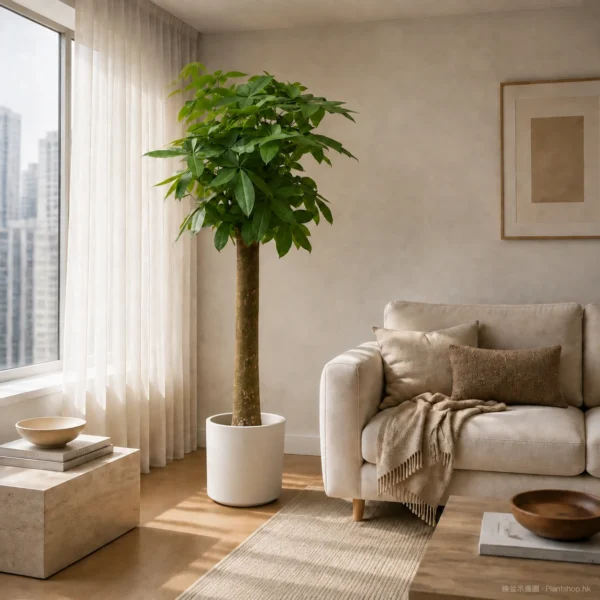
The Money Tree (Pachira aquatica) is among Hong Kong’s most beloved indoor plants, and its appeal is not merely decorative. It carries the symbolism of prosperity and good fortune — a welcome gesture that resonates with business owners and employees alike. It adapts to the rhythms of indoor life with quiet ease, its lush green palms unfurling steadily in conditions that would defeat more demanding specimens.
Today we share how to care for your Money Tree with minimal effort, ensuring it remains vigorous and vibrant for years to come.
Money Tree Basic Information — money tree care
The Money Tree (Pachira aquatica), also known as Malabar Chestnut, originates from the wetlands of Central and South America. Its natural habitat is quite moist, yet its trunk stores water, making it far more drought-tolerant than most people realise. This is the most common misconception among beginners — assuming it needs lots of water, then drowning the roots.
- Ideal temperature: 15–30°C (most Hong Kong indoor environments are fine)
- Light needs: Bright, indirect light — no direct sun required
- Growth rate: Moderate; faster in spring and summer
Watering: Less Is More
How to Tell When It Needs Water
Remember one simple action: press your finger into the soil to a depth of about 2cm and feel the moisture.
- Finger feels dry — water thoroughly
- Finger feels slightly cool or moist — wait a few more days
- Soil feels wet — do not water
How Often to Water?
Rather than watering on a fixed schedule, let the soil guide you. Here are general guidelines:
- Spring & Summer (growing season): Soil dries faster — usually every 7–10 days
- Autumn & Winter (dormant period): The plant drinks less — perhaps every 10–14 days
- Air-conditioned rooms: AC dries the air, but soil may not dry as quickly — always test with your finger
- Humid days: When humidity is high, soil stays moist longer — be more conservative
Watering Best Practices
- Water slowly and thoroughly until water drains from the bottom of the pot
- Wait 5 minutes, then empty the drainage saucer (this step is crucial — standing water causes root rot)
- Water the entire root zone evenly, not just the surface
Tip: The Money Tree’s principal enemy is overwatering. Root rot claims more specimens than drought ever does. When uncertain, err toward restraint. A dry plant recovers; a rotted root system rarely does.
Placement: Bright but Stable
Best Positions
- 1–2 metres from a window with natural but not direct light
- Beside glass softened by sheer curtains
- Office lobbies, living room corners
Positions to Avoid
- Directly in front of air conditioning vents (leaves will dry and curl)
- Strong midday sun through an unshaded window (will scorch the leaves)
- Dark corners with no natural light (stems will stretch and leaves shrink)
Signs of Insufficient Light
- New leaves grow progressively smaller and paler
- Stems elongate with sparse foliage (reaching toward light)
- Growth slows to a near halt
If you notice these signs, move the plant a little closer to a window and observe for one to two weeks.
Fertilising: Feed During Growing Season Only
- Spring & Summer (growing season): Apply a balanced liquid fertiliser every 2 months, diluted to half the recommended strength
- Autumn & Winter (dormant period): Stop fertilising entirely — let the plant rest
- Slow-release fertiliser: A convenient option — one application lasts approximately 3 months
Tip: When it comes to fertiliser, less is more. Weak and frequent is far safer than strong and occasional. Fertiliser burn (yellowing leaf edges) is difficult to reverse.
Repotting: When and How
Repot every 1–2 years, or when you notice the following signals:
- Roots growing out of the drainage holes
- Water runs straight through the pot without soaking in (soil has become exhausted)
- Growth has noticeably slowed
Choose a new pot 2–3 inches larger than the current one, and use a well-draining potting mix. After repotting, place the plant in a shaded spot for about a week to let the roots settle.
Common Problems
Leaves turning yellow?
First check if it’s the lower, older leaves — if so, this is likely natural aging, simply remove them. If multiple leaves are yellowing, overwatering is the most probable cause. Allow the soil to dry out completely before watering again, and repot to inspect the roots if necessary.
Leaves dropping?
Environmental disruption after moving, temperature stress, or irregular watering can all cause leaf drop. Stabilise the environment. Resist moving the plant repeatedly — it will recover and push new growth once settled.
Stem softening?
A softening stem is almost invariably root rot, and root rot almost invariably traces to overwatering. Act immediately: cease watering, examine the roots, excise any rotten sections, repot in fresh, dry soil, and move to a well-ventilated position.
Choose a Healthy Money Tree from PlantShop
At PlantShop, we specialise in large specimen plants from 130–180cm. Every Money Tree is hand-selected by our team — we inspect the form, leaf density, and root health. No plant leaves our nursery unless it meets our standards. Each plant comes with a personalised care card detailing the ideal watering schedule and placement for your specific environment. Have questions? Reach us anytime on WhatsApp — a real person will respond, never a bot.
Caring for a Money Tree is straightforward: water sparingly, provide bright indirect light, and don’t fuss over it. In return, it will reward you with lush green foliage and an upright, elegant presence for years to come.
Related Products
Browse the plants mentioned in this article:

7-day health guaranteeFree delivery over HK$1,500WhatsApp help from a real person
FAQs
Money Tree Basic Information
The Money Tree (Pachira aquatica), also known as Malabar Chestnut, originates from the wetlands of Central and South America. Its natural habitat is quite moist, yet its trunk stores water, making it far more drought-tolerant than most people realise. This is the most common misconception among beginners — assuming it needs lots of water, then drowning the roots.
Watering: Less Is More How to Tell When It Needs Water
Remember one simple action: press your finger into the soil to a depth of about 2cm and feel the moisture.
How Often to Water?
Rather than watering on a fixed schedule, let the soil guide you. Here are general guidelines:
Common Problems Leaves turning yellow?
First check if it's the lower, older leaves — if so, this is likely natural aging, simply remove them. If multiple leaves are yellowing, overwatering is the most probable cause. Allow the soil to dry out completely before watering again, and repot to inspect the roots if necessary.
