


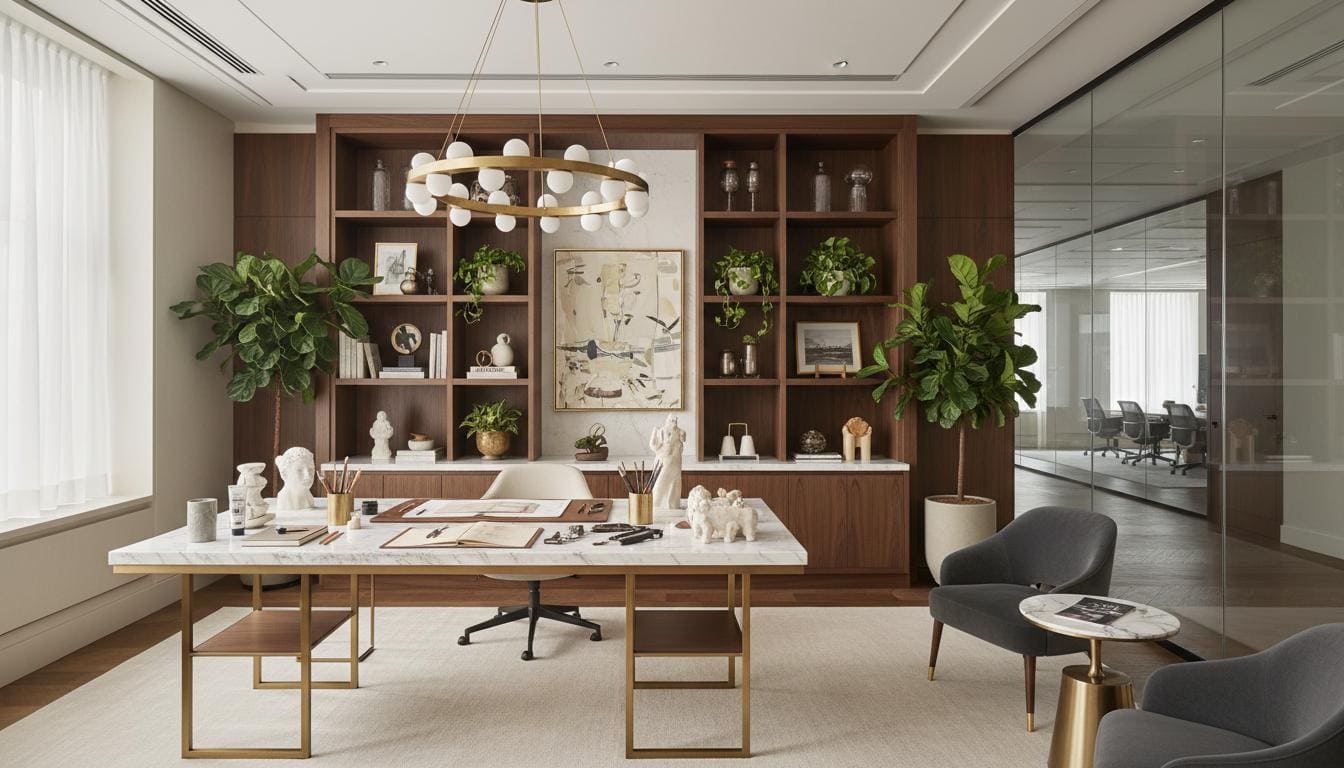

Amy, an HR director at a law firm in Central, ran an informal experiment last month. She placed twelve large plants across the open-plan work area on the twentieth floor — Areca Palm, Peace Lily, and Snake Plant, all shade-tolerant, undemanding varieties. Three months later, she reviewed the data. Sick leave days in that area had fallen by approximately 10% against the equivalent period the previous year. She will not attribute the entire movement to the plants. But she has decided to extend the experiment to the full floor. “At the very least,” she said, “when people’s eyes are exhausted from the screen, they have something green to rest on.”
——
Hong Kong Offices Are Hostile Environments — office plants employee health
We spend more concentrated waking hours in the office than anywhere else — and the typical Hong Kong commercial office is, by any environmental standard, a difficult place to inhabit. Centralised air conditioning running continuously. Sealed windows. Dozens of computers operating in proximity. Formaldehyde off-gassing from renovation materials. Ozone from photocopiers and laser printers. Particulate matter from synthetic carpets. The body processes all of this steadily, without registering it consciously, and the accumulation is real.
A 2024 AXA survey found that 77% of Hong Kong employees surveyed had experienced mental health issues attributable to work, with nearly half having taken sick leave specifically for mental health reasons. A separate multinational study found that offices incorporating biophilic design elements recorded an average 12% reduction in sick leave. These figures do not establish a clean causal line between “plant in the corner” and “one fewer sick day.” But they confirm that the relationship between working environment quality and health outcomes is both real and closer than most organisations are prepared to act on.
——
After NASA: What Was established?
The 1989 NASA Clean Air Study is frequently cited as evidence that plants purify indoor air. The context matters: those experiments were conducted in sealed laboratory chambers — conditions with no meaningful resemblance to a functioning commercial office. In real-world conditions with active ventilation, opening a window or running an air purifier outperforms any number of potted plants in terms of direct air quality impact.
But that finding does not reduce plants to irrelevance. Their mechanisms operate at a different register — and probably a more consequential one:
Plants regulate humidity through transpiration, introducing moisture into air that Hong Kong’s year-round air conditioning reduces to near-arid levels; the physical comfort improvement is perceptible. They provide visual rest — a genuine interruption in the unrelenting cycle of screen exposure that characterises office work. And most significantly: green registers as safety to the nervous system. It is not a designed response. It is a biological one, calibrated across millions of years of evolutionary experience in natural environments.
A 2024 Terrapin Bright Green study found that offices incorporating plant walls and natural elements recorded cortisol level reductions of approximately 10–18% among employees. Gensler’s 2024 Global Workplace Survey found that biophilic design can improve productivity by approximately 15% and enhance cognitive performance — specifically focus and decision-making — by 12–20%.
These are not inflated claims. The mechanism is straightforward: human beings did not evolve to sustain focus in sealed rooms staring at illuminated screens. Provide the eye with a green surface to rest on; provide the nervous system with something it recognises as safe; and the physiological response follows.
——
How HR Can Begin
A full green wall is not the starting point. Start considerably smaller: A 2-metre Areca Palm positioned in one meeting room corner Each team taking turns with responsibility for a shared plant
Employees invited to select the variety for their own desk
The return on this investment may never surface as a clean metric in a quarterly report. It may simply be one employee saying: “The space feels less suffocating.” That is already a sufficient return.
PlantShop specialises in 130–180cm medium-to-large plants, each hand-selected by our horticulturists. Corporate clients — WhatsApp for a direct reply. We are available to advise on species selection and spatial placement. 3–7 business day delivery, free shipping to Hong Kong urban areas.
Related Products
Below are the plants mentioned in this article, available for direct purchase. Each comes with a real-person care card:


FAQs
Hong Kong Offices Are Hostile Environments
We spend more concentrated waking hours in the office than anywhere else — and the typical Hong Kong commercial office is, by any environmental standard, a difficult place to inhabit. Centralised air conditioning running continuously. Sealed windows. Dozens of computers operating in proximity. Formaldehyde off-gassing from renovation materials. Ozone from photocopiers and laser printers. Particula
After NASA: What Was established?
The 1989 NASA Clean Air Study is frequently cited as evidence that plants purify indoor air. The context matters: those experiments were conducted in sealed laboratory chambers — conditions with no meaningful resemblance to a functioning commercial office. In real-world conditions with active ventilation, opening a window or running an air purifier outperforms any number of potted plants in terms
How HR Can Begin
A full green wall is not the starting point. Start considerably smaller: A 2-metre Areca Palm positioned in one meeting room corner Each team taking turns with responsibility for a shared plant
Related Products
Below are the plants mentioned in this article, available for direct purchase. Each comes with a real-person care card:


