



Plantshop.hk · Care Encyclopedia
How to Care for Croton in Hong Kong
From HK$882 · Hong Kong delivery
Hong Kong care guide — useful before you buy and after it arrives.
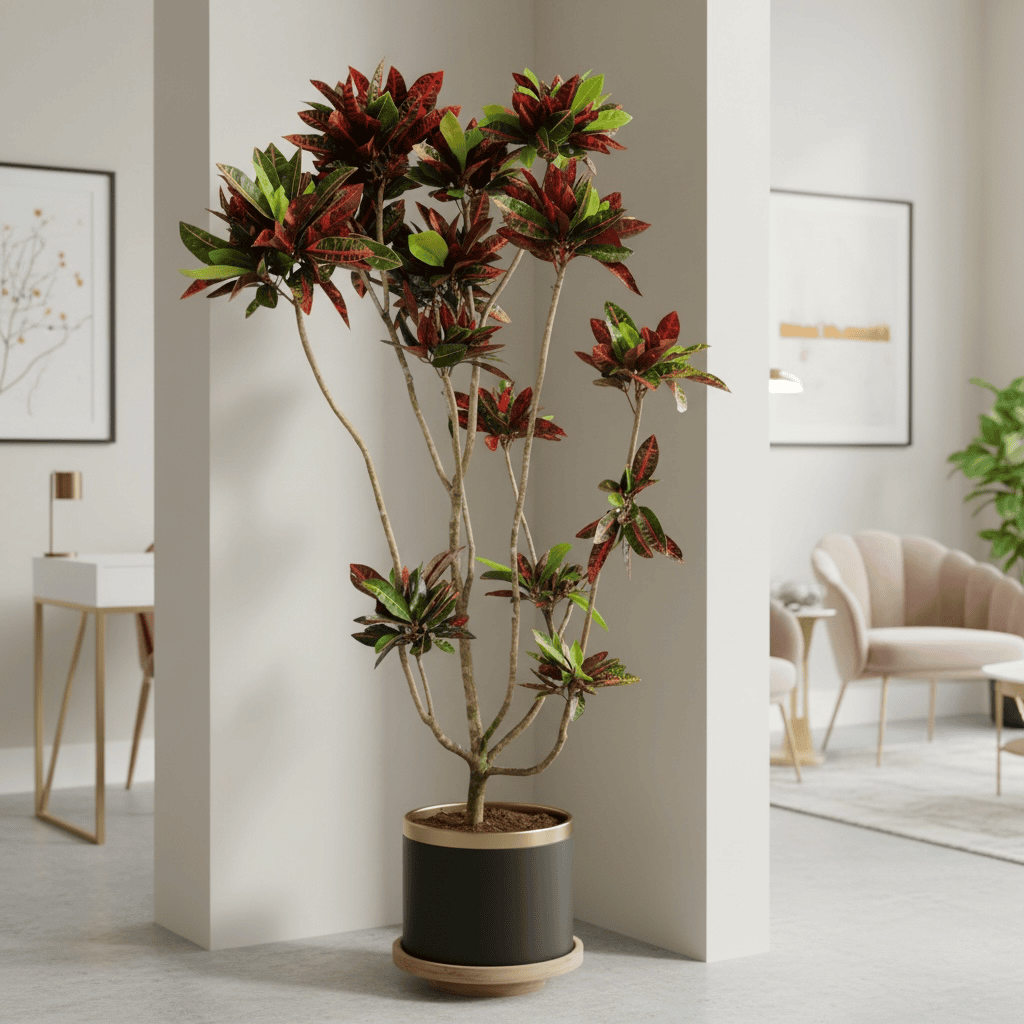
Shop this plant at PlantShop.hkThe most outrageously colourful foliage plant for Hong Kong homes: one leaf can show red, orange, yellow, green and purple at once. The rule that matters most: give it bright light for colour and humidity to keep the leaf tips intact.
LightBright, indirect light; east/south window, shade from summer west sun
WateringWater when top 1–2 cm is dry; every 3–5 days in summer
Best spot in HKBrightest indoor window, away from cold drafts and air-con
PetsToxic to cats, dogs & people — keep out of reach
Care in a nutshell
To grow a croton in Hong Kong, place it at your brightest indoor window and it will reward you with spectacular colour, but shade it from harsh western summer sun or the leaves will scorch. It loves a humid environment, so mist the surrounding air or use a pebble tray during dry winter months when the air conditioning is running. It is happiest at 18–35°C, and growth stalls if it stays below 15°C. When you first bring it home, do not keep moving it around: find a spot and leave it there until it settles in, because crotons hate sudden environmental changes.
Origin & characteristics
Croton, scientifically known as Codiaeum variegatum, belongs to the spurge family (Euphorbiaceae) and is native to the tropical rainforest regions of Malaysia, Indonesia, northern Australia, and the Pacific islands. In its native habitat, it can grow into an evergreen shrub up to 3 metres tall, but in container cultivation it is typically maintained between 30 cm and 1 metre. Croton has a long horticultural history, with hundreds of cultivars developed — making it one of the world's most popular colourful foliage ornamentals.
The most captivating aspect of croton is its extraordinarily rich leaf colour variation. Leaf shapes range from oval, fiddle-shaped, spiral, to linear, and the colour combinations are virtually unlimited — deep green backgrounds adorned with golden yellow, orange-red, pink-purple, wine red, and even near-black markings or veining. Some cultivars display a metallic sheen. These colours are not random; they are determined by the distribution and proportions of different pigments (chlorophyll, carotenoids, and anthocyanins) within the leaf. Notably, light intensity directly affects colour vibrancy — bright light produces the most spectacular colours, while low light causes leaves to revert to green (Wisconsin Horticulture, 2024).
Common cultivars include:
- 'Petra': One of the most common varieties, with broad oval deep green leaves bearing vivid yellow, orange, and red veining
- 'Gold Dust': Bright green leaves sprinkled with golden yellow spots
- 'Mammy': Narrow, twisted leaves in green, purple, and red
- 'Oakleaf': Oak tree-shaped leaves with multicoloured patterns
- 'Zanzibar': Extremely narrow leaves in red, orange, purple, and gold
In Hong Kong's climate, croton can be grown outdoors year-round in semi-shaded positions (during summer) or indoors in bright locations (during winter). Its tropical heritage means it has high temperature requirements, and Hong Kong's occasional winter cold snaps present the greatest challenge.
Light
Croton's light requirements are relatively complex and need to be adjusted according to season and environment:
- Ideal light: Bright, indirect light or filtered direct sun. An east-facing or south-facing window with sheer curtains is optimal. Adequate light maintains vivid leaf colours and compact growth.
- Summer caution: Hong Kong summer sun streaming through glass can scorch croton leaves, especially west-facing afternoon sun from 11 am to 3 pm, which may cause grey-brown scald spots and faded colour (RHS, 2024). In summer, move the plant 1–2 metres back from the window or install shade cloth.
- Winter strategy: Hong Kong winter light is weaker, so move croton closer to the window — even a small amount of direct morning sun helps maintain winter colour. If kept in low light for extended periods, leaves gradually revert to green, patterns fade, and leaves may drop.
- Even lighting: Rotate the pot 90 degrees every 1–2 weeks to ensure all sides receive equal light, preventing one-sided growth and uneven colour distribution.
Watering
Croton prefers evenly moist soil but is sensitive to both overwatering and underwatering:
- Watering principle: Water when the top 1–2 cm of soil has dried. In summer heat, water every 3–5 days; in winter, every 7–10 days. Water thoroughly until it drains from the bottom, then discard saucer water.
- Key warning: Avoid dramatic wet-dry cycles — prolonged drought causes heavy leaf drop, while waterlogging leads to root rot. Both cause severe plant stress.
- Water quality: Like most tropical plants, croton prefers slightly acidic water. Long-term use of hard water causes brown leaf tips. Use settled tap water, filtered water, or rainwater (RHS, 2024).
- Watering technique: Avoid pouring water directly onto leaves, especially during dark, humid weather, as this encourages fungal leaf spot disease. Water slowly around the pot perimeter instead.
Soil & pot
- Soil mix: Light, well-draining, organic-rich, slightly acidic medium (pH 5.5–6.5). Suggested mix: peat-free potting mix 3 parts + perlite or coarse sand 1 part + coco peat 1 part + a small amount of organic compost. Poor drainage is the number one cause of croton death.
- Repotting: Generally every 1–2 years, with spring being the optimal time. Choose a new pot only 3–5 cm larger in diameter. Croton has relatively fine roots; handle gently during repotting, keeping the root ball as intact as possible.
- Fertiliser management: During the growing season (April–September), apply half-strength balanced liquid fertiliser (such as 20-20-20) every 2–4 weeks. Over-fertilising, especially excess nitrogen, produces soft, weak leaves with faded colour. Stop fertilising in autumn and winter when growth slows.
Temperature & humidity
Croton has high temperature and humidity requirements — aspects that Hong Kong growers need to pay particular attention to:
- Optimal temperature: 18–35°C. Maintaining this range year-round is ideal, and Hong Kong's temperatures from April through October align perfectly.
- Minimum tolerable temperature: Approximately 13–15°C. Prolonged exposure below 15°C stalls growth; below 10°C may cause cold damage and leaf drop (RHS, 2024). Hong Kong's indoor urban winter temperatures are generally safe, but plants near windows with cold drafts or on exposed rooftops need protection.
- Humidity requirements: Croton hails from tropical rainforest and prefers high humidity (60%+). Hong Kong summers are generally humid enough, but winter heating or continuous air conditioning can drop humidity below 40%, causing leaf tip scorching. Humidity-boosting methods include:
- Placing the pot on a tray of wet pebbles (water should not touch the pot base)
- Misting the surrounding air daily or every other day (avoid spraying directly on leaves)
- Grouping plants together to create a humid microclimate
- Using a humidifier
Cleaning care: Every 1–2 weeks, gently wipe leaves with a slightly damp soft cloth to remove dust and oils, helping maintain leaf gloss and photosynthetic efficiency. Wear gloves when doing this, as the plant's sap can irritate skin.
Common problems
| Issue | Likely cause | What to do |
|---|---|---|
| Heavy leaf drop | Temperature too low, cold drafts, improper watering, or sudden environmental change | Move away from cold air vents; check soil moisture and adjust watering; avoid frequently moving the plant |
| Faded colours, reverting to green | Insufficient light | Move to a brighter position; gradually increase light to avoid scorching |
| Leaf tips brown or scorched | Air too dry, hard water, or fertiliser burn | Increase humidity; switch to filtered or rainwater; reduce fertiliser concentration |
| Brown spots or water-soaked lesions on leaves | Fungal leaf spot (usually from prolonged wet foliage or poor ventilation) | Improve ventilation; avoid wetting leaves; prune severely affected leaves; apply organic fungicide if necessary |
| Leggy branches, sparse foliage | Severely insufficient light or excess nitrogen | Increase light; reduce nitrogen; prune in spring to encourage branching |
Not sure your spot gets enough light, or something looks off? Send us a photo on WhatsApp 4492 9648 and we’ll take a look.
Questions people ask
Why is my croton losing its colour and turning green?
Usually because it is not getting enough light. Bright light gives the most vivid colours, while prolonged low light makes leaves revert to green, patterns fade and leaves may drop. Move it somewhere brighter, increasing the light gradually to avoid scorching.
How do I look after a croton in a Hong Kong winter?
Move it closer to the window, as winter light is weaker. Growth stalls below 15°C and cold damage with leaf drop is possible below 10°C, so protect it from cold drafts and exposed rooftops.
How often should I water a croton?
Water when the top 1–2 cm of soil has dried: roughly every 3–5 days in summer and every 7–10 days in winter. Water until it drains from the bottom, then discard the saucer water, and avoid dramatic wet-dry cycles.
Is a croton safe for cats and dogs?
No. Croton is toxic to people and pets, and is significantly toxic to cats and dogs, causing severe gastrointestinal symptoms, drooling and even neurological effects. Keep it well out of reach and wear gloves when pruning.
Fun facts
The "white blood" of the spurge family: Croton belongs to Euphorbiaceae, a family whose members typically produce a milky latex sap when leaves or stems are damaged. This sap contains various chemical compounds (including 5-deoxyingenol and other diterpenes) that are irritating to human skin and eyes, and ingestion can cause gastrointestinal upset (RHS, 2024). Interestingly, in traditional medicine, the latex of some Euphorbiaceae species has been used to treat skin conditions or warts, but this must only be done by trained practitioners — self-treatment is extremely dangerous.
The genus name Codiaeum derives from the Greek word "kodiai," meaning "a plant eaten by goats" — supposedly because ancient observers noted goats feeding on croton shoots. Modern research confirms that croton is toxic to most animals, so this ancient name likely stems from a misunderstanding.
In horticultural history, croton was introduced to Europe from Southeast Asia by the Dutch in the 19th century and quickly became a sensation in Victorian greenhouses and parlours. Breeders began developing new varieties in large numbers, creating the hundreds of cultivars available today. In the mid-20th century, croton rode the wave of the indoor plant craze into American homes, becoming an iconic fixture of 1960s–70s middle-class living rooms. It was even nicknamed the "jeep plant" — because American soldiers returning from the Pacific after World War II frequently brought this vividly coloured plant home with them.
References (expand to view sources)
References
- Royal Horticultural Society (RHS). (2024). How to grow Codiaeum. https://www.rhs.org.uk/plants/codiaeum/growing-guide
- Wisconsin Horticulture. (2024). Croton, Codiaeum variegatum. University of Wisconsin-Madison Division of Extension. https://hort.extension.wisc.edu/articles/croton-codiaeum-variegatum/
- Gardenia.net. Codiaeum variegatum (Croton). https://www.gardenia.net/plant/codiaeum-variegatum-croton
- Missouri Botanical Garden. Codiaeum variegatum. https://www.missouribotanicalgarden.org/
- Grimme, S. (1998). Codiaeum variegatum (croton). In: Proceedings of the Conference on the Culture of Ornamental Plants, University of Hawaii.
⚠️ Pet / toxicity: Croton is toxic to both humans and pets. The white latex sap is irritating to skin and eyes, causing redness, itching, or allergic reactions upon contact. Ingestion can cause burning sensation in the mouth, vomiting, and diarrhoea. It is significantly toxic to cats and dogs — ingestion may cause severe gastrointestinal symptoms, excessive drooling, and even neurological effects. Strongly recommended: keep croton completely out of reach of children and pets. Always wear gloves when pruning or repotting, and wash hands thoroughly afterwards, avoiding contact with eyes.
Shop at Plantshop
View all Plants →

For Hong Kong homes and offices. Stock and pricing follow the product page.
FAQs
Origin & characteristics
Croton, scientifically known as Codiaeum variegatum, belongs to the spurge family (Euphorbiaceae) and is native to the tropical rainforest regions of Malaysia, Indonesia, northern Australia, and the Pacific islands. In its native habitat, it can grow into an evergreen shrub up to 3 metres tall, but in container cultivation it is typically maintained between 30 cm and 1 metre. Croton has a long hor
Watering
Croton prefers evenly moist soil but is sensitive to both overwatering and underwatering:
Fun facts
The "white blood" of the spurge family: Croton belongs to Euphorbiaceae, a family whose members typically produce a milky latex sap when leaves or stems are damaged. This sap contains various chemical compounds (including 5-deoxyingenol and other diterpenes) that are irritating to human skin and eyes, and ingestion can cause gastrointestinal upset (RHS, 2024). Interestingly, in tradition
Keywords
Croton, Codiaeum variegatum, variegated foliage, colourful houseplant, tropical shrub, indoor container plant, Hong Kong home plant, high-humidity plant, Petra cultivar, Gold Dust cultivar, foliage colour, Euphorbiaceae, low-light tolerant
