



Plantshop.hk · Care Encyclopedia
How to Care for Ficus Altissima in Hong Kong
From HK$880 · Hong Kong delivery
Hong Kong care guide — useful before you buy and after it arrives.
Shop this plant at PlantShop.hkA glossy, commanding fig that thrives in Hong Kong homes with just a bright window. The one rule that matters most: check the soil first, and only water thoroughly once it feels dry.
LightBright indirect light from an east or west window; avoid harsh noon sun
WateringWater when top 1–2 cm is dry; every 5–7 days in spring/summer
Best spot in HKNear a bright window in a living room or office
PetsMilky sap is mildly toxic — keep on a high shelf
Care in a nutshell
The Council Tree is one of the best large foliage plants for Hong Kong homes: it tolerates typical indoor conditions with just some window light and doesn't need constant fussing. Stick your finger a knuckle deep into the soil and only water when it feels dry, which prevents root rot, the main thing that kills these plants. Like all figs, it has a white milky sap, so wear gloves when pruning and keep it on a high shelf or stand if you have pets. It is happiest at 18–30°C, which matches typical Hong Kong indoor temperatures. Once you find a good bright spot, try not to move it around too much.
Shop · Ficus Altissima (from HK$880)
Origin & characteristics
Ficus altissima Blume was first described in 1825 by the Dutch botanist Carl Ludwig Blume. Commonly known as Council Tree, Lofty Fig, False Banyan, or Mountain Fig, it belongs to the mulberry family (Moraceae) and the fig genus (Ficus). Its native distribution spans southern China (Guangdong, Guangxi, Hainan, Yunnan, Sichuan), Southeast Asia (Thailand, Vietnam, Myanmar, Malaysia, Indonesia, the Philippines), and extends as far as India, Nepal, and Bhutan, where it grows in humid tropical and subtropical forests at elevations of 100–2,000 metres.
A tree with dramatic beginnings:
Botanically, the Council Tree is a hemi-epiphytic strangler fig — a life strategy that reads like a botanical thriller. Seeds are dispersed by birds and bats that consume the fig fruits. When a seed lands in the canopy of an existing tall tree or in a crevice of its branches, it germinates and begins life as an epiphyte, surviving on atmospheric moisture and decaying leaf matter. It then sends aerial roots downward along the host trunk at speeds of up to 5 metres per year. Once these roots reach the ground, they rapidly lignify and wrap around the host. The roots gradually fuse into a net-like "pseudo-trunk" that eventually encases and "strangles" the host tree, depriving it of light and nutrients until it dies and decays. The Council Tree then stands in its place as an independent giant — often with a massive hollow core where the host once stood, creating a unique micro-ecosystem.
The Hong Kong Development Bureau's greening information website records that the Council Tree is an exotic species in Hong Kong. The city's largest specimen stands in Choi Hung Estate, Wong Tai Sin — 15 metres tall, with a trunk diameter of 3 metres and a canopy spread of 22 metres. It is listed in the "Old and Valuable Trees" register (reference HD WTS/1) and is truly one of Hong Kong's arboreal giants. The easiest way to distinguish it from the more common Chinese Banyan (Ficus microcarpa) is by its larger leaves with more prominent, three-dimensional venation, and its thicker, more sparsely arranged aerial roots.
The 'Yellow Gem' cultivar:
Most "Council Trees" sold as houseplants are actually the Ficus altissima 'Yellow Gem' cultivar — a variegated form with striking golden-yellow and emerald-green marbled patterns on the leaf surface. When sunlight filters through the leaves, it casts beautiful shadow patterns on walls, adding rich visual depth. Indoor plants typically reach 1–2 metres, though vigorous specimens can grow taller. The leaves are thick and leathery, broadly ovate to elliptical, 10–19 cm long and 8–11 cm wide, with excellent dust-trapping capability that contributes to indoor air quality.
Feng shui significance: The very name "Council Tree" carries connotations of wisdom and authority. Its broad, palm-like leaves symbolise stability and prosperity, and placing one in a prominent position in the living room or office is believed to gather positive energy and attract wealth.
Light
The Council Tree is a medium-to-high light foliage plant that is somewhat sensitive to direct, intense sunlight.
- Ideal placement: East- or west-facing windows in Hong Kong homes work best, providing bright indirect light. A position 1–2 metres back from a south-facing window is also suitable, avoiding the harsh midday sun that can burn leaves and cause brown patches.
- Low light consequences: Long-term placement in a dark position leads to smaller leaves, faded variegation, slow growth, and etiolation (stems elongating with wider leaf spacing).
- Office environments: Offices with constant air conditioning and limited natural light should place the plant near a window or rotate the pot every two weeks (a quarter turn each time) to ensure even light exposure and maintain a symmetrical shape.
- Supplemental lighting: If light is clearly inadequate during winter or the rainy season, LED grow lights can provide 2–3 hours of supplemental light daily, ideally at 4,000–6,500K colour temperature.
Worth noting: The Council Tree is generally quite adaptable and will maintain reasonable health in typical indoor indirect light. However, the 'Yellow Gem' variegated cultivar specifically requires adequate light to maintain its golden variegation — in too-dark a position, the yellow fades back to plain green, significantly reducing its ornamental value.
Watering
The Council Tree's watering philosophy can be summarised in four words: "water when dry, soak when watering."
- How to tell: Insert your finger 1–2 cm into the soil (about one knuckle deep). Water only when the surface feels dry; if still slightly moist, wait a few more days.
- Watering method: Each time you water, do so thoroughly until water flows from the drainage holes, ensuring the deeper root zone receives moisture. Avoid "half-watering" that only wets the surface, which encourages shallow root development.
- Frequency guide:
- Spring & summer (peak growth): Hong Kong's hot, humid weather means approximately every 5–7 days, adjusted for indoor ventilation
- Autumn & winter (slow growth): Approximately every 10–14 days, as soil takes longer to dry
- Air-conditioned environments: AC removes moisture from the air and soil dries faster — may need watering every 4–5 days
- Standing water alert: Empty the saucer within 30 minutes of watering. Prolonged standing water leads to root rot and yellowing, dropping leaves.
- Water temperature: In winter, use water at room temperature to avoid shocking the roots with cold water.
Practical tip: The Council Tree is somewhat sensitive to environmental changes. Keep your watering schedule as consistent as possible. Sudden changes in position or watering habits can trigger a "leaf drop protest" — the plant may shed several leaves at once, but will grow new ones once conditions stabilise.
Soil & pot
Soil mix:
The Council Tree is not particularly fussy about soil — a good quality potting mix will generally suffice. The key requirements are good drainage combined with adequate water retention.
- Basic option: General-purpose indoor plant potting mix
- Improvement: Blend in approximately 20% perlite or coarse coco coir to enhance drainage and aeration
- pH: Slightly acidic to neutral (pH 5.5–6.5) is ideal, reflecting the red lateritic soils of its native range in Guangxi and Hainan
Pot selection:
- Drainage holes are non-negotiable: The pot must have drainage holes. Never plant directly into a decorative container without drainage, no matter how attractive it looks.
- Repotting timing: When roots begin to emerge from drainage holes or circle the inside of the pot (becoming root-bound), it's time to repot — typically every 1–2 years.
- Pot size: Choose a new pot only 3–5 cm larger in diameter than the current one. Going too big too fast leads to soil that stays wet too long and encourages root rot.
- Best repotting season: Spring (March–April) is ideal, as the plant enters its active growth phase and recovers more quickly from transplanting.
Fertilising:
- Growing season (April–September): Apply a balanced liquid fertiliser (such as NPK 10-10-10 or 20-20-20) monthly, diluted to half strength.
- Autumn & winter (October–March): Growth slows — either stop fertilising or apply at half strength every two months.
- Caution: Over-fertilising causes leaf edge burn. When in doubt, "less is more" applies.
Temperature & humidity
Temperature:
- Optimal range: 18–30°C, which aligns perfectly with typical Hong Kong indoor temperatures
- Minimum tolerance: Approximately 10°C; below 5°C risk of frost damage
- Hong Kong winter note: During brief cold snaps when temperatures drop below 8°C, avoid placing the plant near air conditioning vents, doorways, or windows where cold drafts can cause chilling injury (water-soaked spots on leaves)
- Environmental stability: The Council Tree is sensitive to sudden temperature and humidity changes. When moving the plant, do so gradually, avoiding abrupt transitions from an air-conditioned room to a hot, stuffy corner
Humidity:
- General conditions: Hong Kong's year-round humidity (70–85%) is generally sufficient for this tropical species
- Air-conditioned environments: Long-term air conditioning can drop humidity below 50%. Countermeasures include:
- A humidity tray (pebble tray): fill a saucer with pebbles and water, placing the pot on the pebbles ensuring the base does not touch the water
- Occasional light misting of the leaf surface (avoid leaving water droplets sitting on leaves for extended periods, which encourages fungal infection)
- Using a room humidifier
Common problems
| Issue | Likely cause | What to do |
|---|---|---|
| Leaves dropping without obvious cause | Environmental shock (repositioning, sudden temperature/light changes) or overwatering | Stabilise the plant's position; wait for soil surface to dry before watering again; avoid drastic environmental changes |
| Leaves turning yellow (not normal ageing) | Overwatering causing root rot, or poor drainage | Check drainage holes are clear; reduce watering frequency; in severe cases, unpot, trim rotted roots, and repot in fresh soil |
| Variegation fading to green | Insufficient light, especially in 'Yellow Gem' cultivar | Move closer to a window with bright indirect light; rotate pot regularly for even exposure |
| Leaf tips or margins turning brown and dry | Low humidity, dry air, or fertiliser burn | Increase humidity (pebble tray/humidifier); dilute fertiliser to half strength; never fertilise dry soil |
| Brown spots on leaves | Direct sun scorch | Move away from intense direct sunlight, or filter light through a curtain |
| Stunted growth, small new leaves | Root-bound (roots filling the pot) or nutrient deficiency | Repot in spring into a slightly larger container with fresh soil; begin regular fertilising |
| Fine webbing or brown stippling on leaves | Spider mite infestation, common in dry conditions | Wipe leaves with a damp cloth; increase humidity around the plant; treat with insecticidal soap if severe |
Not sure your spot gets enough light, or something looks off? Send us a photo on WhatsApp 4492 9648 and we’ll take a look.
Questions people ask
Can a Council Tree grow indoors in Hong Kong?
Yes. It copes well with bright indirect light from a window; growth is just slower than in brighter spots. The variegated 'Yellow Gem' form loses its golden marbling if the light is too weak.
How often should I water a Council Tree?
Roughly every 5–7 days in spring and summer and every 10–14 days in autumn and winter, or every 4–5 days in an air-conditioned room. Check that the top 1–2 cm of soil is dry before watering.
Why is my Council Tree dropping leaves?
Usually a sudden change, such as moving it or a quick shift in temperature or light, or overwatering. Keep it in one stable spot and let the soil dry between waterings, and new leaves will grow back.
Is a Council Tree safe for cats and dogs?
No. The white sap can upset the stomach and irritate skin and mouth in cats and dogs, so keep the plant out of their reach.
Fun facts
1. Hong Kong's mightiest Council Tree lives in Choi Hung Estate: The largest Council Tree in Hong Kong stands in Wong Tai Sin's Choi Hung Estate — 15 metres tall, with a trunk diameter of 3 metres and a canopy spreading 22 metres across. Listed in the government's "Old and Valuable Trees" register, it is truly a king among trees.
2. A "dust-trapping champion" according to science: Hong Kong's Development Bureau greening website cites research showing that Council Trees, along with Chinese Banyans and Weeping Figs, possess significant dust-trapping capability. Their thick, leathery leaves with fine surface hairs help capture airborne particulate matter, contributing to improved air quality.
3. An "ecosystem engineer": In tropical rainforests, mature strangler figs create hollow trunks after their host decays, providing micro-habitats for up to 45 species of animals and plants — including birds nesting, insects colonising, and even small mammals seeking shelter. This is why strangler figs are called "ecosystem engineers."
4. One seed can transform a forest: When a Council Tree's fig fruits ripen to red or yellow, they attract birds and bats that disperse the seeds. A single seed landing on a tall tree may, over decades, "strangle" its host and ultimately replace it as a dominant canopy species — a phenomenon that deeply impressed Alfred Russel Wallace during his observations in the Malay Archipelago.
5. Aerial roots in traditional medicine: According to Hong Kong government greening information, both the Council Tree and Chinese Banyan's aerial roots have been used in traditional Chinese medicine for their believed heat-clearing and detoxifying properties.
References (expand to view sources)
References
- Wu, Z. & Raven, P.H. (eds.) (2003). Flora of China Vol. 5. eFloras. http://www.efloras.org/florataxon.aspx?flora_id=2&taxon_id=200006347
- Plants of the World Online (POWO). Ficus altissima Blume. Royal Botanic Gardens, Kew. https://powo.science.kew.org/taxon/urn:lsid:ipni.org:names:852369-1
- Harrison, R.D., et al. (2003). The diversity of hemi-epiphytic figs (Ficus subgenus Urostigma) in a Bornean lowland rain forest. Journal of Tropical Ecology, 19, 149–153. https://www.cambridge.org/core/journals/journal-of-tropical-ecology/
- Hong Kong Development Bureau – Greening. (2020). Tree Labels with QR Codes — Ficus altissima. https://www.greening.gov.hk/en/community-outreach/qrcode-tree-labels/index_id_30.html
- Proven Winners. How to Grow and Care for Ficus Indoors. https://www.provenwinners.com/learn/houseplants/ficus
- ASPCA Animal Poison Control Center. Toxic and Non-toxic Plants: Fig (Ficus). https://www.aspca.org/pet-care/aspca-poison-control/toxic-and-non-toxic-plants/fig
- Jim, C.Y. (2018). Epiphytic strangler trees colonizing extreme habitats of building envelopes in Hong Kong. Urban Forestry & Urban Greening, 34, 85–95. https://www.sciencedirect.com/science/article/abs/pii/S1618866717301584
⚠️ Pet / toxicity: The Council Tree is mildly toxic. All parts contain a milky latex sap that includes the enzymes ficin and psoralen/ficusin.
- For pets: If cats or dogs ingest leaves, symptoms may include gastrointestinal upset (vomiting, diarrhoea), oral irritation, and excessive drooling. Skin contact with the sap may cause redness or allergic reactions. Keep the plant out of reach of pets — on a tall cabinet or plant stand.
- For humans: The white sap may irritate skin or eyes during pruning or repotting. Wear gloves when handling, and wash hands thoroughly afterward. If sap gets into the eyes, rinse immediately with water and seek medical attention.
- Special note: Individuals with latex allergy should avoid contact with all Ficus species, as severe reactions including anaphylactic shock are possible.
Shop at Plantshop
View all Plants →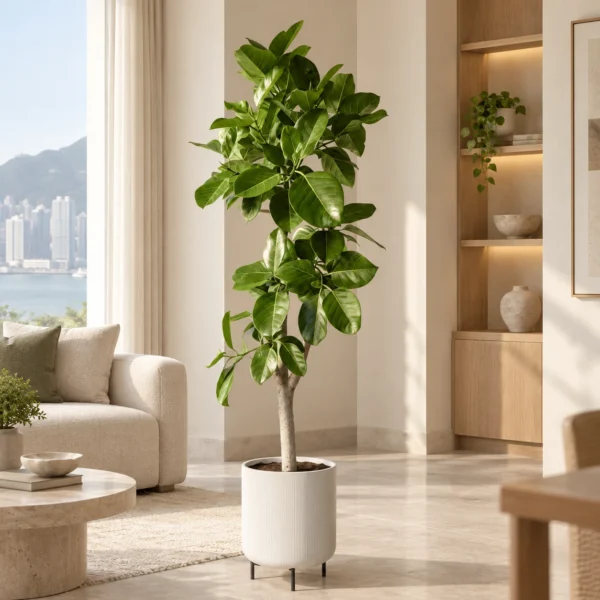
For Hong Kong homes and offices. Stock and pricing follow the product page.
FAQs
Origin & characteristics
Ficus altissima Blume was first described in 1825 by the Dutch botanist Carl Ludwig Blume. Commonly known as Council Tree, Lofty Fig, False Banyan, or Mountain Fig, it belongs to the mulberry family (Moraceae) and the fig genus (Ficus). Its native distribution spans southern China (Guangdong, Guangxi, Hainan, Yunnan, Sichuan), Southeast Asia (Thailand, Vietnam, Myanmar, Malaysia, Indonesia, the Ph
Watering
The Council Tree's watering philosophy can be summarised in four words: "water when dry, soak when watering."
Fun facts
1. Hong Kong's mightiest Council Tree lives in Choi Hung Estate: The largest Council Tree in Hong Kong stands in Wong Tai Sin's Choi Hung Estate — 15 metres tall, with a trunk diameter of 3 metres and a canopy spreading 22 metres across. Listed in the government's "Old and Valuable Trees" register, it is truly a king among trees.
Keywords
Council Tree, Lofty Fig, Ficus altissima, 'Yellow Gem', variegated fig, large foliage plant, indoor decorative plant, feng shui plant, wealth-attracting plant, Hong Kong home plant, balcony plant, hardy plant, strangler fig, hemi-epiphyte, dust-trapping plant, Moraceae, Ficus
