



Plantshop.hk · Care Encyclopedia
How to Care for New Home Collection in Hong Kong
From HK$1,394 · Hong Kong delivery
Hong Kong care guide — useful before you buy and after it arrives.
Shop this plant at PlantShop.hkThree wishes for your Hong Kong new home in one set: ward off negative energy and attract prosperity, absorb renovation fumes, and stay easy enough for a first-time plant owner. The one rule that matters most: water only once the soil has dried out.
LightEntryway plant is shade-tolerant; purifier 1–3 m from a window
WateringWater when soil is dry 3–5 cm down; every 5–7 days in summer
Best spot in HKEntryway, bright living room, living-room wealth corner
PetsSome plants in the set are toxic to cats & dogs
Care in a nutshell
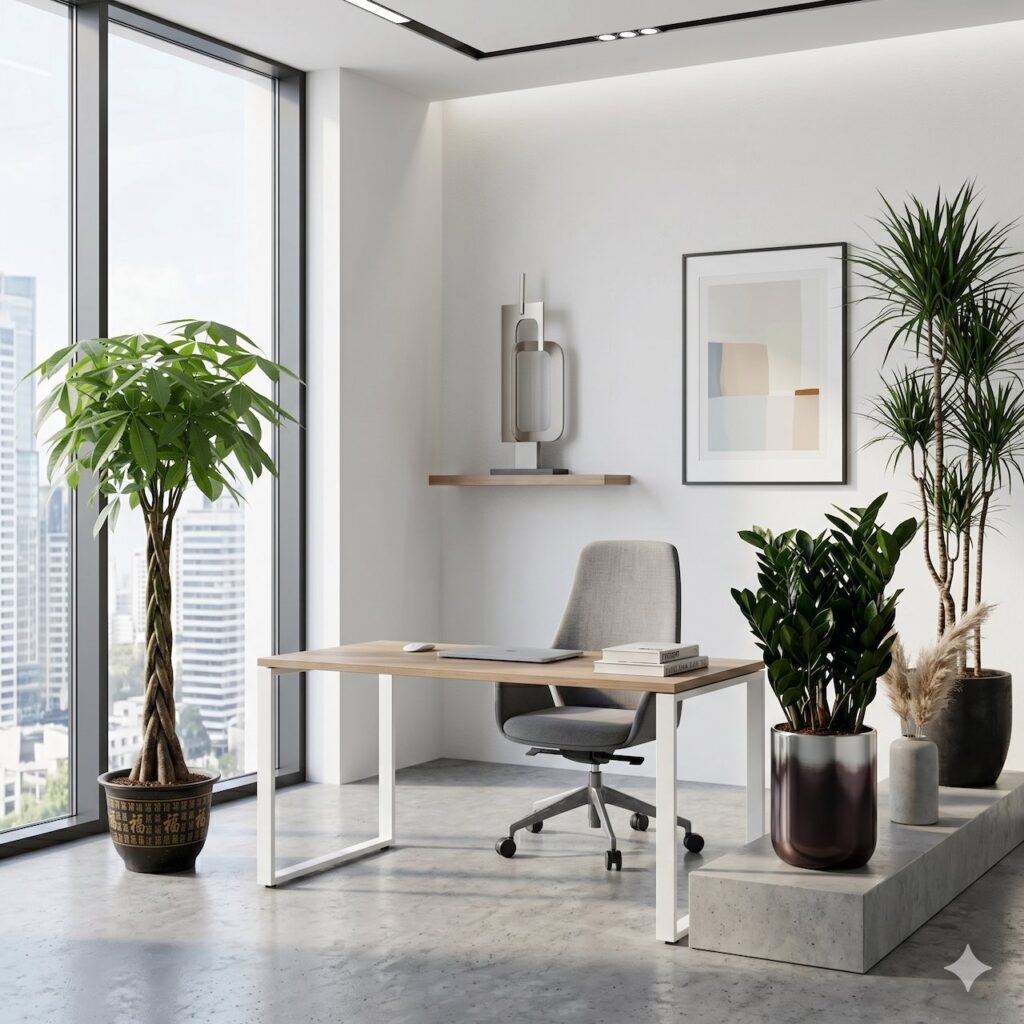
The most important things for a new home in Hong Kong are fresh air and good fortune, and this “Three Treasures” set covers both. A guardian plant at the entryway wards off negative energy, a purifier in the living room absorbs renovation formaldehyde, and a prosperity plant at the wealth corner boosts your luck. For watering, just remember “dry out before watering”: push a finger 3–5 cm into the soil to check. Treat the first month as a time to watch how the plants settle in, and it gets easy from there.
Combination rotates seasonally, featuring three core plants with auspicious feng shui symbolism, proven air-purifying ability, and high care tolerance — specially curated for newly renovated homes and housewarming celebrations.
Shop · New Home Collection (from HK$1,394)
Origin & characteristics
In Hong Kong, as in Chinese culture worldwide, moving into a new home has always been accompanied by rituals and symbolic gestures, with plants playing an essential role. Traditionally, new homes feature money trees (Pachira aquatica), kumquats (Citrus microcarpa), or lucky bamboo (Dracaena sanderiana), symbolising "wealth from all directions," "great luck," and "prosperity." Modern urbanites face a new challenge: volatile organic compounds (VOCs) from renovation — formaldehyde, benzene, toluene, and xylene — emitted by plywood, paint, carpet adhesive, and cleaning products.
The World Health Organization (WHO, 2021) classifies formaldehyde as a Group 1 carcinogen. Long-term exposure to low concentrations above 0.08 ppm can cause eye and respiratory irritation, headaches, and increased risk of nasopharyngeal cancer. Hong Kong Environmental Protection Department surveys show formaldehyde levels in newly renovated homes can reach 0.2–0.5 ppm — far exceeding safety standards.
Plantshop.hk's "New Home Auspicious Trio" merges traditional feng shui wisdom with modern scientific needs:
- First treasure — the guardian: A robust, upright foliage plant positioned at the entryway or main door, symbolising "protection of the household, warding off negative energy and welcoming fortune," while serving as a visual focal point for the entrance.
- Second treasure — the purifier: Varieties proven by NASA's Clean Air Study to efficiently remove VOCs, specifically targeting formaldehyde and benzene from renovation residue, improving indoor air quality.
- Third treasure — the prosperity bringer: A round-leaved, thick-leaved, upward-growing plant placed in the living room's wealth corner, symbolising "abundant fortune and rising career success."
The three treasures each fulfil their role across feng shui, health, and aesthetics. The combination rotates seasonally to ensure plants are at peak condition during housewarming peak periods (around Lunar New Year and summer graduation season).
Light
New home lighting conditions vary enormously — high-floor units may have excellent natural light, while older buildings or inward-facing units can be perpetually dim. The trio selection prioritises broad adaptability to ensure survival across different light conditions.
Placement and light matching
- First treasure (entryway/main door): Entryways typically lack natural light, relying solely on indoor lighting. The set uses extremely shade-tolerant varieties that maintain growth at 50–200 lux of diffused light. If the entryway is completely lightless, move the plant to a window for 1–2 days each week, or install a full-spectrum LED light (6–8 hours daily).
- Second treasure (living room centre/near window): Air-purifying plants need adequate light to drive photosynthesis and transpiration, which powers their air-cleaning function. Place 1–3 metres from a window, receiving 1,000–3,000 lux of diffused light. If the living room has no window (as in some open-plan interior areas), move to a room with light or supplement with a grow light.
- Third treasure (wealth corner/study): Traditional feng shui identifies the "wealth position" as the diagonal corner from the entrance, which typically receives moderate light. The set uses medium-to-low light tolerant varieties that maintain rich green colour 2–4 metres from windows.
New home lighting tips
- New home windows with thermal film or permanently closed curtains may deliver less light than expected. Use a smartphone light meter app for rough measurement (50–200 lux = low light; 200–1,000 lux = medium light; >1,000 lux = high light).
- If the home runs air conditioning constantly (especially during summer off-gassing periods), plants will be in weaker growth states with correspondingly lower light needs.
Watering
During the move-in period, residents are typically busy settling in and may neglect plant care. The trio watering design centres on "forgiveness and simplicity."
Basic principles
- Finger test: Insert index finger 3–5 cm into soil; water only when dry. This is the only rule you need to remember.
- Seasonal frequency (Hong Kong indoor environment):
- Spring/Summer (March–October): Every 5–7 days
- Autumn/Winter (November–February): Every 7–10 days
- Air-conditioned periods: Air conditioning accelerates soil drying but also slows plant growth; maintain every 7 days
- Renovation off-gassing period special note: New homes are typically kept ventilated with open windows, and increased airflow accelerates soil moisture evaporation. Increase finger-test frequency during this period — plants may need watering 1–2 days earlier than normal.
Individual watering characteristics
- First treasure (guardian): Typically a more drought-tolerant variety. Only water when soil is completely dry; overwatering causes root rot.
- Second treasure (purifier): Air-purifying plants need moderate moisture to maintain transpiration, but cannot sit in water. On top of the finger test, observe leaf condition — if leaf tips begin to droop slightly, this is the thirst signal.
- Third treasure (prosperity): Mostly thick-leaved varieties with good water storage capacity, tolerating brief dry spells.
Water quality
- Hong Kong tap water is safe for these plants. If leaf tips persistently brown (a sign of chlorine or calcium accumulation), switch to filtered water or leave water standing overnight.
- New home plumbing may carry impurities during initial use; use bottled or filtered water for the first month.
Soil & pot
Pot feng shui and practicality
New home pot selection must balance feng shui principles with modern home aesthetics:
- Materials:
- Terracotta (unglazed clay): Feng shui element "Earth" — stability and wealth accumulation. Best breathability, ideal for beginners.
- White ceramic: Clean and versatile, suiting Nordic or Japanese interior styles.
- Concrete pot: Industrial aesthetic, ideal for loft or open-plan units.
- Colour feng shui:
- Gold/Yellow: Element "Metal" — activates wealth energy, ideal for the third treasure (prosperity).
- Red/Purple: Element "Fire" — passionate and celebratory, matching the housewarming atmosphere.
- Green/Wood tones: Element "Wood" — vitality and growth, ideal for the second treasure (purifier).
- White/Cream: Element "Metal" — purity and freshness, suitable for any position.
- Shape: Round symbolises completeness and is the first choice for housewarming gifts; square represents "Earth" — stability and groundedness. Avoid pots with sharp angles or irregular shapes.
- Size: The three treasures each use medium pots (15–20 cm diameter), appropriate for Hong Kong's compact new homes without overwhelming the space.
Soil formula
- Base formula: Premium organic potting mix 50% + perlite 25% + vermiculite 15% + organic compost 10%
- New home special edition: Additional activated charcoal granules 5–10% — charcoal improves soil structure and adsorbs trace harmful gases, providing some benefit to the root zone environment (though effects are far below professional air purification equipment).
- Pre-blended slow-release fertiliser: Soil contains 3-month effective slow-release fertiliser (Osmocote or equivalent), so no additional feeding is needed for the first 3 months after move-in.
Temperature & humidity
Special conditions in newly renovated homes
- Formaldehyde release peak: Formaldehyde emission from new renovations can continue for 3–15 years (depending on material quality), with the first 6 months being the peak period. Maintain ventilation (open windows at least 2–4 hours daily) during this time; plants serve as auxiliary purification.
- Temperature fluctuation: During renovation or initial move-in, prolonged window-opening can bring indoor temperatures close to outdoor conditions (summer 30°C+, winter below 10°C). Plants experience physiological stress from these fluctuations. Recommend gradual acclimatisation — place plants in more stable interior positions first, then adjust placement once daily living patterns stabilise.
- Dust problem: Post-renovation dust clogs plant leaf stomata, reducing photosynthesis and air purification efficiency. Wipe leaves gently with a damp cloth weekly after move-in.
Temperature management
- Optimal range: 18–27°C, overlapping with human comfort temperature.
- Summer: If windows are kept open for off-gassing, ensure plants are not beside west-facing windows where afternoon temperatures can exceed 40°C.
- Winter: During cold snaps, new homes may have less insulation than established residences (larger door/window gaps). Keep plants away from cold drafts directly beside windows.
Humidity management
- New home humidity: Extensive new paint and furniture may create higher initial humidity, especially in summer. Reduce watering frequency under high humidity and ensure good ventilation to prevent mould.
- Long-term air conditioning: Air-conditioned rooms maintain 40–50% humidity, which most set varieties tolerate. If leaf tips brown, use a pebble tray or occasional misting.
- Grouping effect: Placing the three treasures together (within 1 metre of each other) mutually raises ambient humidity by 5–10% while creating an attractive green corner.
Common problems
| Issue | Likely cause | What to do |
|---|---|---|
| Plant declines rapidly after move-in | High VOC concentration causing phytotoxicity, or over-ventilation causing excessive dryness | Ensure the unit has been ventilated for 2–4 weeks; place plants away from new furniture; increase leaf misting to relieve dryness stress |
| Unsure where to place the three treasures | Feng shui placement depends on unit layout | First treasure (guardian) at entryway or right side of entrance; Second treasure (purifier) near living room window; Third treasure (prosperity) at the diagonal from entrance (wealth corner). Plantshop.hk offers free placement advice |
| New home runs air conditioning for off-gassing — will plants get cold? | Air conditioning set to 23–25°C is harmless to plants, but direct outlet airflow causes localised cold and dryness | Keep plants at least 1 metre from air-con outlets; use deflectors to avoid direct airflow; regularly check soil moisture |
| How often to fertilise the three treasures? | Set soil contains 3-month slow-release fertiliser | No additional feeding needed for the first 3 months; thereafter apply diluted liquid fertiliser every 2 weeks (spring/summer) or monthly (autumn/winter). Lazy option: use 6-month slow-release formula, applying only twice yearly |
| When can you confirm plants have adapted? | Most plants complete environmental acclimatisation within 2–4 weeks | Some yellowing or leaf drop during adaptation is normal. If persistent wilting or heavy leaf loss continues after 1 month, check watering, lighting, and pest conditions |
Not sure your spot gets enough light, or something looks off? Send us a photo on WhatsApp 4492 9648 and we’ll take a look.
Questions people ask
What does the New Home Auspicious Trio do?
Each of the three plants has its own role: a guardian plant at the entryway for feng shui protection, a purifier in the living room that absorbs renovation fumes such as formaldehyde and benzene, and a prosperity plant at the living-room wealth corner.
Will the trio survive in a dim new flat?
Yes, the set is chosen for broad adaptability. The entryway plant is very shade-tolerant and grows in 50–200 lux of diffused light; if your entryway gets no light at all, move it to a window for 1–2 days a week or add a full-spectrum LED.
What water should I use in the first month?
Bottled or filtered water, because the pipes in a new home may carry impurities when first used. After that, ordinary tap water is fine; if leaf tips keep yellowing, switch to filtered water or let tap water stand overnight.
Are the Three Treasures safe for cats and dogs?
Not entirely. Some varieties in the set, such as snake plant, peace lily and pothos, are toxic to cats and dogs, so place them on a high shelf out of reach.
Fun facts
NASA and feng shui: an unexpected convergence
The top-performing plants in NASA's Clean Air Study — snake plant, pothos, and peace lily — happen to also be the most commonly used "negative energy transformation" plants in feng shui. This may reflect the accumulated wisdom of ancient observation: these plants are exceptionally hardy and thrive indoors, which led to their reputation for "strong life force energy"; modern science now confirms they genuinely possess powerful air-purifying abilities.
Another interesting intersection concerns the "bedroom plant" debate. Traditional feng shui advises against placing too many plants in bedrooms (competing for oxygen at night), but modern research shows that CAM-type plants like snake plants actually release oxygen at night. Wolverton (1996), in his book How to Grow Fresh Air, recommended placing 1–2 snake plants per bedroom to improve sleep quality — although the gas exchange contribution of a single potted plant is minimal, the psychological comfort and subtle humidity regulation genuinely enhance the sleep experience.
References (expand to view sources)
References
- Wolverton, B.C. (1996). How to Grow Fresh Air: 50 Houseplants that Purify Your Home or Office. Penguin Books.
- Wolverton, B.C., Johnson, A. & Bounds, K. (1989). Interior Landscape Plants for Indoor Air Pollution Abatement. NASA Stennis Space Center, NTRS Document 19930073077. https://ntrs.nasa.gov/api/citations/19930073077/downloads/19930073077.pdf
- World Health Organization (2021). WHO Global Air Quality Guidelines. WHO Press. https://www.who.int/publications/i/item/9789240034228
- Hong Kong Environmental Protection Department (2023). Hong Kong Air Quality Guidelines — Indoor Air Quality Management Edition. https://www.epd.gov.hk/
- Hong Kong Agriculture, Fisheries and Conservation Department. Hong Kong Indoor Plant Cultivation Guide. https://www.afcd.gov.hk/
- Hong Kong Leisure and Cultural Services Department. Greening Hong Kong: Home Planting Handbook. https://www.lcsd.gov.hk/
⚠️ Pet / toxicity: Some varieties in the new home trio set (snake plant, peace lily, pothos) are toxic to cats and dogs. Snake plant contains saponins causing vomiting and diarrhoea; peace lily and pothos contain calcium oxalate crystals causing oral burning, drooling, and difficulty swallowing. If your household includes pets, place plants on elevated surfaces or select Plantshop.hk's pet-friendly trio alternative (using calathea, fern, and other non-toxic varieties). Refer to the ASPCA official plant toxicity list for details.
Shop at Plantshop
View all Bundle Deals →


For Hong Kong homes and offices. Stock and pricing follow the product page.
FAQs
Origin & characteristics
In Hong Kong, as in Chinese culture worldwide, moving into a new home has always been accompanied by rituals and symbolic gestures, with plants playing an essential role. Traditionally, new homes feature money trees (Pachira aquatica), kumquats (Citrus microcarpa), or lucky bamboo (Dracaena sanderiana), symbolising "wealth from all directions," "great luck," and "prosperit
Fun facts
NASA and feng shui: an unexpected convergence
Keywords
new home plants, auspicious trio, new renovation air purification, housewarming plants, feng shui placement, formaldehyde-absorbing plants, move-in gift, Hong Kong new home renovation, indoor air quality, prosperity plants, guardian plants, air-purifying plants, green home
