



Plantshop.hk · Care Encyclopedia
How to Care for Bird of Paradise in Hong Kong
From HK$680 · Hong Kong delivery
Hong Kong care guide — useful before you buy and after it arrives.
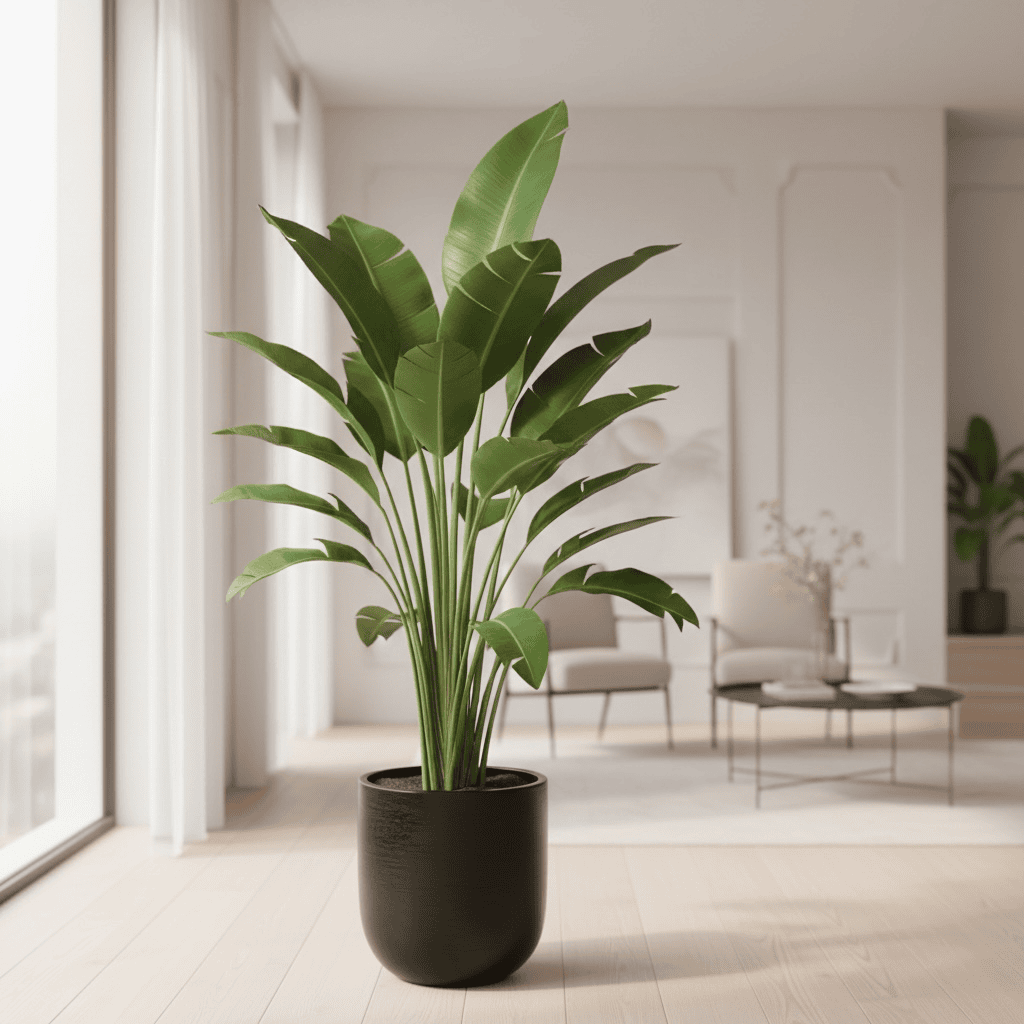
Shop this plant at PlantShop.hkThe Bird of Paradise (Strelitzia reginae) is one of the most recognisable flowers on Earth, with orange-and-blue blooms shaped like a bird in flight and a real showpiece for Hong Kong living rooms and balconies. The one rule that matters most: give it 4–6 hours of direct sun a day if you want flowers.
Light4–6 hrs direct sun; south/east balcony
WateringMoist in spring-summer, less in autumn-winter
Best spot in HKSunny south- or east-facing balcony or garden
PetsSeeds & fruit toxic — keep out of reach
Care in a nutshell
To grow a Bird of Paradise in Hong Kong, it all comes down to light: if you want those spectacular flowers, give it a spot with direct sun, ideally a south-facing or east-facing balcony. By an indoor window it works for foliage, but flowering will be limited. Water more generously in summer and ease off in winter, only watering once the top layer of soil has dried.
Be patient: young plants usually take three to five years before their first bloom. It grows best at 18–27°C and copes with summer heat of 35°C; for a newly bought plant, soften the midday sun (11 am–3 pm) with 30–50% shade cloth. Before a typhoon, move it indoors or secure it well, as those large leaves are easily damaged by strong wind.
Shop · Bird of Paradise (from HK$680)
Origin & characteristics
The Bird of Paradise, also known as the Crane Flower, belongs to the bird-of-paradise family (Strelitziaceae) and is a perennial herbaceous plant (though it develops a woody base with age). It is native to the eastern coastal region of South Africa, from the Eastern Cape through to KwaZulu-Natal. In 1773, the English botanist Sir Joseph Banks introduced it to the Royal Botanic Gardens, Kew, naming the genus Strelitzia in honour of Queen Charlotte of Mecklenburg-Strelitz, consort of King George III.
The Bird of Paradise is most famous, of course, for its extraordinary flowers. Each bloom consists of three upright orange sepals and three horizontal blue-purple petals, with one petal modified into an arrow-shaped structure that conceals the reproductive parts. The entire flower emerges from a stiff, boat-shaped spathe 15–20 cm long, coloured reddish-brown to green. Flowers open sequentially from the spathe, with each inflorescence lasting several weeks to several months. The flower's true brilliance lies in its pollination mechanism — its native pollinators are sunbirds. When a sunbird lands to drink nectar, the arrow-shaped petal deposits pollen onto the bird's body, which is then transferred to the stigma of the next flower the bird visits.
The foliage consists of large, leathery, oblong leaves 25–70 cm long, borne on stout petioles and arranged like those of a banana or traveller's palm. They are deep green and glossy with prominent parallel venation. Under favourable conditions, mature plants reach 1.5–2 metres in height with a spread of 1–1.5 metres, making a truly impressive medium-sized specimen.
In Hong Kong, the Bird of Paradise is a popular ornamental plant, suitable for outdoor gardens (as a perennial) or container cultivation on balconies and indoors. However, note that indoor plants flower much less readily — abundant sunlight and ample space are generally needed for consistent blooming. Growth rate is moderate; it typically takes 3–5 years for a young plant to reach flowering size.
It is worth clarifying that the family Strelitziaceae contains three genera: Strelitzia (Bird of Paradise), Ravenala (Traveller's Palm), and Phenakospermum. Ravenala madagascariensis, the Traveller's Palm, is often mistaken for Bird of Paradise, but it produces none of the iconic orange-and-blue flowers — its appeal lies in its enormous fan-shaped leaf arrangement.
Light
The Bird of Paradise is a strong light-loving plant — to flower, it absolutely requires abundant sun. Ideally, provide at least 4–6 hours of direct sunlight daily, preferably in a south-facing or east-facing balcony or an open garden position. In Hong Kong, during spring, autumn, and winter, full sun is perfectly acceptable. Summer midday sun (11 am–3 pm) can be moderated with 30–50% shade cloth, especially for newly purchased plants that have not yet acclimatised to intense light.
If you plan to keep your Bird of Paradise indoors, you must choose the brightest window position available — within 30 cm of a south-facing window is optimal. Bear in mind that while the plant can survive on diffused light indoors, maintaining green and healthy foliage, flowering will be significantly reduced. If your main reason for buying this plant is to enjoy its blooms, you must provide sufficient sunlight. North-facing flats or offices with no natural light are unsuitable for long-term cultivation.
The Bird of Paradise shows strong phototropism — leaving it in one position will cause the plant to lean toward the light. Rotate the pot 90 degrees every two weeks to maintain an upright, balanced form. Insufficient light produces thinner, longer, paler leaves that lose their gloss — a clear signal to reposition the plant.
Watering
The Bird of Paradise is native to South Africa's coastal regions, where the climate is subtropical to Mediterranean — warm, wet summers and mild, dry winters. The watering principle follows this pattern: keep moist during the active growing season (spring-summer), reduce watering during the dormant period (autumn-winter).
When to water: Insert your finger 5 cm into the soil; water when dry. In summer (May–September), when Hong Kong is hot, the Bird of Paradise grows actively and transpires heavily — water every 3–5 days; outdoor plants may need watering every 2–3 days. In winter (December–February), when growth slows, extend to every 7–10 days, allowing the soil to remain slightly dry between waterings.
Watering method: Use the drench technique — slowly and evenly water around the pot perimeter until it drains from the bottom, wait five minutes, then discard saucer water. The Bird of Paradise has thick, robust roots with reasonable drought tolerance — short dry spells are not fatal, but prolonged drought will cause leaf curling and browning at the edges. Root rot from waterlogging is far more damaging, so ensure drainage holes are never blocked.
An advanced tip: Bird of Paradise appreciates cool roots. In summer, apply a 3–5 cm layer of organic mulch (such as bark chips, coco peat, or leaf mould) on the soil surface to help retain moisture, lower soil temperature, and suppress weeds.
For water quality, the Bird of Paradise adapts well to tap water, though slightly acidic to neutral water is preferred. Hong Kong tap water is alkaline, which can gradually raise soil pH over time; an occasional application of diluted acidic liquid fertiliser every few months helps maintain balance.
Soil & pot
The Bird of Paradise prefers fertile, well-draining, slightly sandy soil.
Container mix: Quality potting mix 50%, coarse sand or perlite 25%, leaf mould or compost 20%, and a small amount of coco peat 5%. The higher proportion of coarse sand or perlite is important because the Bird of Paradise has thick roots that require good aeration — without it, root rot becomes a serious risk.
For pH, the ideal range is 6.0–7.5. The plant tolerates mildly alkaline conditions, but long-term alkalinity affects nutrient uptake. If leaves develop chlorosis (veins remain green while leaf tissue turns yellow), the soil may be too alkaline, causing iron or manganese deficiency — correct with acidic fertiliser.
Pot selection: The Bird of Paradise is moderately fast-growing but eventually becomes quite large, so start with a pot at least 30 cm in diameter. Plastic pots are lightweight, durable, and retain moisture well — a good choice. Terracotta pots offer the best drainage and aeration but are heavier, making them suitable for windy outdoor positions where added stability is welcome. The most important factor: the pot must have adequate drainage holes.
Repotting: Every 2–3 years, ideally in spring (March–April). The new pot should be 8–12 cm larger in diameter than the old one. The Bird of Paradise has thick roots; handle carefully during repotting, preserving the root ball as much as possible and avoiding excessive root damage. After repotting, place in a shaded spot for one to two weeks, then gradually reintroduce to brighter light.
It is worth noting that the Bird of Paradise actually prefers "slightly snug" root conditions — mild root restriction can sometimes stimulate flowering. So there is no need to move it to an oversized pot each time; as long as the roots are not completely pot-bound, it can remain in its current container.
Temperature & humidity
The Bird of Paradise grows best at 18–27°C and adapts well to Hong Kong's climate. It is highly heat-tolerant — summer temperatures of 35°C are not a problem as long as water is adequate. For cold tolerance, it can briefly withstand light frosts down to approximately -4°C, but prolonged temperatures below 5°C will cause frost damage with water-soaked spots on leaves. Hong Kong winters rarely stay below 5°C for extended periods, so outdoor cultivation is generally safe, though protection during unusual cold snaps is advisable.
For flowering, the Bird of Paradise benefits from temperature differential — day-night temperature swings of 8–10°C help induce flower bud development. Hong Kong's autumn through spring (October–March) typically provides this range, making it the main flowering season. If the plant is kept in constant-temperature air conditioning (for example, 24°C day and night), flowering may be reduced.
For humidity, the Bird of Paradise prefers 50–70% relative humidity. Hong Kong's outdoor humidity is usually adequate, but air-conditioned indoor environments may be too dry. For indoor plants, regularly mist the surrounding air (avoid spraying directly on open flowers, which shortens their lifespan), or use a humidity tray to increase local humidity.
The plant also appreciates good air circulation, especially during hot, humid Hong Kong summers. A stuffy corner encourages fungal problems. Ensure air can move around the plant while avoiding strong drafts that could damage the large leaves.
Common problems
| Issue | Likely cause | What to do |
|---|---|---|
| Plant never flowers, produces only leaves | Insufficient light, plant too young, or night temperatures too high | Move to a full sun position; ensure cool nights (15–18°C); young plants typically need 3–5 years before flowering |
| Yellow-brown spots or scorched leaf edges | Strong sun scorch or overwatering | Check light intensity and provide shade if needed; check soil drainage and ensure no standing water |
| Leaves yellowing and withering from edges | Chronic underwatering or air too dry | Increase watering frequency; check soil more often in summer; increase humidity around the plant |
| Leaves torn or damaged | Strong wind, moving mishaps, or physical damage | Move to a more sheltered position; handle with care when moving; trim severely damaged leaves |
| New leaves small, pale, growth stalled | Nutrient deficiency or roots pot-bound | Apply balanced liquid fertiliser during growing season; check if repotting is needed |
| White powder or small insects on leaf undersides | Whitefly or scale insect infestation | Wipe off with damp cloth; apply horticultural oil or insecticidal soap for severe cases |
Not sure your spot gets enough light, or something looks off? Send us a photo on WhatsApp 4492 9648 and we’ll take a look.
Questions people ask
Can a Bird of Paradise grow indoors in Hong Kong?
Yes, but it will rarely flower. By the brightest window, ideally within 30 cm of a south-facing one, it keeps healthy green leaves, yet flowering is significantly reduced. North-facing flats and offices with no natural light are unsuitable.
How often should I water a Bird of Paradise in a Hong Kong summer?
Usually every 3–5 days, or every 2–3 days outdoors, whenever the soil is dry when you insert a finger 5 cm deep. In winter (December–February) you can stretch this to every 7–10 days.
How often does a Bird of Paradise need repotting?
About every 2–3 years, ideally in spring (March–April), moving up to a pot 8–12 cm wider. It actually likes slightly snug roots, so there is no need to upsize if it is not completely pot-bound.
Is a Bird of Paradise safe for pets and children?
Not entirely. The seeds and fruit are toxic and can cause vomiting, diarrhoea and dizziness if eaten, and large quantities of leaf may upset the stomach. Keep it out of reach of young children and pets.
Fun facts
The Bird of Paradise flower is an extraordinarily precise "mechanical device." When a sunbird lands to feed on nectar, its body weight depresses the arrow-shaped petal, causing the concealed pollen to explode outward and stick precisely to the bird's body. When the bird flies to another flower that has entered its "female phase," the pollen-covered body contacts the stigma and completes pollination. The entire process requires no electricity or batteries — purely mechanical engineering perfected through millions of years of evolution. Outside its native range, where sunbirds are absent, Bird of Paradise usually requires hand pollination to produce seeds.
The seeds have a peculiar appearance — the seed coat carries a bright orange aril (a fleshy appendage) with an irregular shape resembling a tiny caterpillar. This vivid colour attracts birds that help disperse the seeds. If you successfully get your Bird of Paradise to set seed, you can try germinating them, but note that the seed coat is hard — lightly sand it or soak seeds in warm water for 24 hours before sowing to improve germination rates.
In the cut flower trade, the Bird of Paradise is one of the most important floral crops. Its strong stems and long-lasting blooms (cut flowers can last two weeks or more in a vase), combined with its unique, instantly recognisable form, make it a favourite in luxury floral design and hotel lobby decorations. South Africa remains a leading exporter of Bird of Paradise cut flowers to this day.
The family name Strelitziaceae commemorates Queen Charlotte of Mecklenburg-Strelitz, who was herself a keen botanist. The Royal Botanic Gardens, Kew, first successfully cultivated the Bird of Paradise in 1773, causing a sensation in European horticultural circles that was described as "one of the most magnificent floral discoveries ever made."
References (expand to view sources)
References
- Royal Botanic Gardens, Kew. Strelitzia reginae — Plants of the World Online. https://powo.science.kew.org/taxon/urn:lsid:ipni.org:names:797451-1
- Missouri Botanical Garden. Strelitzia reginae Plant Finder. https://www.missouribotanicalgarden.org/PlantFinder/PlantFinderDetails.aspx?taxonid=276438
- Royal Horticultural Society (RHS). Strelitzia reginae. https://www.rhs.org.uk/plants/16917/strelitzia-reginae/details
- Frost, S. K. & Frost, P. G. H. (1981). Sunbird pollination of Strelitzia nicolai. Oecologia, 49(3), 379–384.
- Rowland, J. (2005). The Art of Plant Evolution. Royal Botanic Gardens, Kew.
- Leisure and Cultural Services Department, Hong Kong. Hong Kong Park and Botanic Gardens — Ornamental Plant Information. https://www.lcsd.gov.hk
⚠️ Pet / toxicity: The seeds and fruit of Bird of Paradise are toxic, containing hydrocyanic acid glycosides. Ingestion can cause vomiting, diarrhoea, and dizziness. Leaves have lower toxicity, but consumption of large quantities may still cause gastrointestinal upset. Homes with young children or pets should prevent contact or chewing of the plant. Cut flower arrangements should also be placed out of reach of pets.
Shop at Plantshop
View all Plants →

For Hong Kong homes and offices. Stock and pricing follow the product page.
FAQs
Origin & characteristics
The Bird of Paradise, also known as the Crane Flower, belongs to the bird-of-paradise family (Strelitziaceae) and is a perennial herbaceous plant (though it develops a woody base with age). It is native to the eastern coastal region of South Africa, from the Eastern Cape through to KwaZulu-Natal. In 1773, the English botanist Sir Joseph Banks introduced it to the Royal Botanic Gardens, Kew, naming
Watering
The Bird of Paradise is native to South Africa's coastal regions, where the climate is subtropical to Mediterranean — warm, wet summers and mild, dry winters. The watering principle follows this pattern: keep moist during the active growing season (spring-summer), reduce watering during the dormant period (autumn-winter).
Soil & pot
The Bird of Paradise prefers fertile, well-draining, slightly sandy soil.
Temperature & humidity
The Bird of Paradise grows best at 18–27°C and adapts well to Hong Kong's climate. It is highly heat-tolerant — summer temperatures of 35°C are not a problem as long as water is adequate. For cold tolerance, it can briefly withstand light frosts down to approximately -4°C, but prolonged temperatures below 5°C will cause frost damage with water-soaked spots on leaves. Hong Kong winters rarely
