



Plantshop.hk · Care Encyclopedia
How to Care for Blueberry in Hong Kong
From HK$680 · Hong Kong delivery
Hong Kong care guide — useful before you buy and after it arrives.
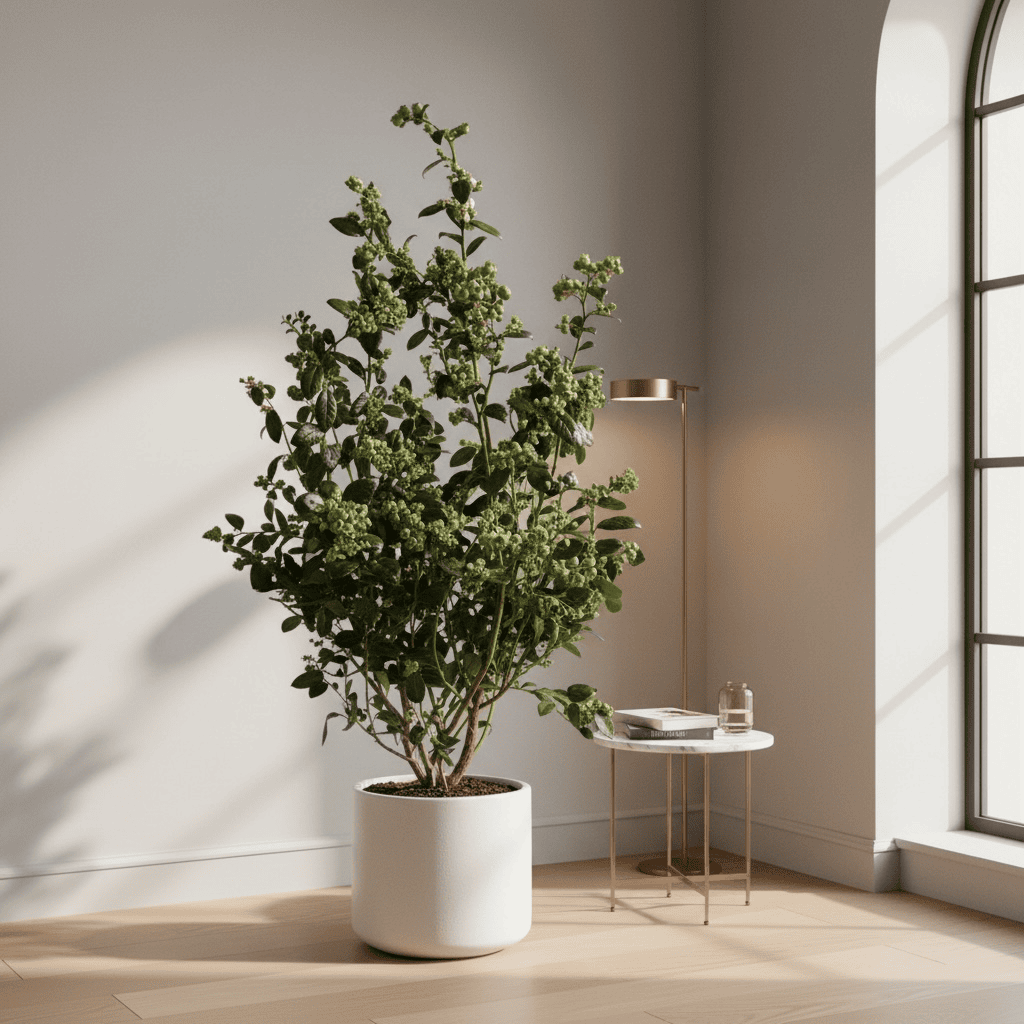
Shop this plant at PlantShop.hkPlump, juicy blueberries are well within reach on a Hong Kong balcony — and they start fruiting while the bush is still small. The two rules that decide success: choose a low-chill variety and grow it in acidic soil (pH 4.0–5.5).
Light6–8 hrs direct sun; south- or east-facing balcony
WateringWater when top 2–3 cm is dry; use slightly acidic water
Best spot in HKSunny south- or east-facing balcony or rooftop
PetsNon-toxic to cats & dogs; avoid large amounts
Care in a nutshell
To grow blueberries in Hong Kong, three things matter: acidic soil, plenty of sun, and the right variety. Buy a low-chill Southern Highbush such as ‘Sharpblue’ or ‘Misty’ — Hong Kong’s winters are only cold enough to trigger flowering in these specially bred types. Your soil needs to be around pH 4.5, so skip ordinary potting mix and use peat moss blended with pine bark. Rainwater is the best thing to water with, as tap water is too alkaline and will degrade the soil over time. Blueberries grow best at 15–25°C, and summer heat above 30°C slows them down. If you can, plant two different varieties so they cross-pollinate, and shade the pot in summer so the soil does not bake. It takes some effort, but picking your own sweet blueberries on a Sunday morning makes it all worthwhile.
Shop · Blueberry (from HK$680)
Origin & characteristics
Blueberries belong to the heath family (Ericaceae), genus Vaccinium, a group of deciduous or evergreen shrubs native to North America and East Asia. Most commercially available cultivars are derived from the North American Highbush Blueberry (Vaccinium corymbosum) and Lowbush Blueberry (V. angustifolium). After more than a century of careful breeding, over a hundred cultivars have been developed, each suited to different climatic conditions.
For growing blueberries in Hong Kong, the single most important factor is selecting a low-chill variety. Blueberries require a period of cold temperatures (0–7°C) to break bud dormancy — a process called "chilling accumulation," measured in "chill hours." Northern varieties need 800–1,000+ chill hours and are completely unsuitable for Hong Kong. However, breeders have developed Southern Highbush varieties requiring only 100–200 chill hours, such as 'Sharpblue', 'Misty', 'Sunshine Blue', 'Gulf Coast', and 'O'Neal'. These varieties can typically satisfy their chilling requirement during a normal Hong Kong winter, giving them a realistic chance of fruiting successfully.
Blueberry bushes typically grow 0.5–2 metres tall (depending on cultivar), with slender but upright branches. Leaves are oval to elliptic, green, turning orange-red or purple-red in autumn (in some cultivars), adding ornamental value. The flowers are bell-shaped or urn-shaped, white to pink-tinged, opening in spring and attracting bees and other pollinating insects. The fruit is a blue-black berry covered with a silvery-grey waxy bloom, 1–2 cm in diameter, ripening from green to red to deep blue.
Blueberries are celebrated as a "superfood," rich in anthocyanins, vitamin C, vitamin K, dietary fibre, and multiple antioxidants. Research shows that regular blueberry consumption supports cardiovascular health, enhances cognitive function, and helps stabilise blood sugar. Blueberries picked fresh from your own plant and eaten immediately surpass anything that has spent days in refrigerated transport.
Growing blueberries in Hong Kong presents some challenges — mainly soil acidity management, chill hour requirements, and coping with summer heat — but with the right approach, variety selection, and a sunny balcony or rooftop, successful harvests are entirely achievable.
Light
Blueberries are strong light-loving plants. Adequate sunlight is essential for vigorous growth, flowering, and fruiting. Ideally, provide at least 6–8 hours of direct sun daily. A south-facing or east-facing balcony is optimal. Ample light not only drives photosynthesis but also increases fruit sugar content and anthocyanin levels, producing sweeter, more flavourful berries.
If light is insufficient (less than 4 hours of direct sun daily), blueberries will become leggy with thin, weak branches, produce few flowers, and yield small, sour fruit. West-facing balconies, though receiving harsh afternoon sun, are acceptable if you use 30–50% shade cloth during summer midday to prevent the pot from overheating and leaves from scorching.
Indoor blueberry cultivation is almost impossible for fruit production, as light intensity is far too low. If indoor growing is your only option, you would need professional grow lights (full-spectrum LED, minimum 50W) running 12–16 hours daily to even approximate outdoor light conditions.
Note that blueberry leaves require decreasing day length and sufficient day-night temperature variation in autumn to trigger their colour change. Hong Kong's autumn temperature swings are usually adequate, but if grown in constant air conditioning, this process may be disrupted.
Watering
Blueberry roots are extremely fine and lack root hairs — water and nutrient absorption relies heavily on symbiotic mycorrhizal fungi. This makes blueberries particularly sensitive to water management: they need consistently moist soil but absolutely cannot tolerate waterlogging.
When to water: Check the soil with your finger or a moisture meter; water when the top 2–3 cm has dried. In summer (May–September), when Hong Kong is hot, potted blueberries transpire quickly and may need watering every 1–2 days. To prevent the pot from overheating in summer, apply a 3–5 cm layer of organic mulch (pine bark chips, coco peat, or leaf mould) on the soil surface — this helps retain moisture and lower soil temperature. In winter (December–February), reduce to every 3–5 days.
Watering method: Use the drench technique — slowly and evenly water around the pot perimeter until it drains from the bottom. Discard saucer water after five minutes. Never let the pot sit in standing water — once blueberry roots rot, recovery is very difficult.
Water quality is a critical factor for blueberry success. Blueberries require acidic water (pH 4.5–5.5), but Hong Kong tap water is generally alkaline (pH 7.5–8.5). Long-term use will alkalise the soil and cause severe growth problems. Solutions:
- Best option: Collect rainwater (Hong Kong rain is naturally slightly acidic, pH approximately 5.5–6.5, which is ideal for blueberries).
- Second best: Use diluted vinegar water (5–10 ml white vinegar per litre of water) or citric acid solution to adjust tap water pH to around 5.5.
- Third option: Purchase distilled or reverse-osmosis water, then add a tiny amount of vinegar to acidify.
Use garden pH test strips or an electronic pH pen to monitor your water source and ensure it stays within the 4.5–6.0 range.
Soil & pot
Soil is the single most important — and non-negotiable — element of blueberry cultivation. Blueberries require strongly acidic, organic-rich, well-draining, highly aerated soil, with a strict pH range of 4.0–5.5, optimally 4.5–5.0. This is far more acidic than most foliage plants, and you cannot cut corners with ordinary potting mix.
Recommended soil mix: Peat moss (or acidic coco peat) 50%, pine bark fines (3–10 mm size) 30%, perlite 20%. Peat moss is the traditional blueberry growing medium — naturally highly acidic (pH 3.5–4.5) with excellent moisture retention and aeration. Pine bark fines provide organic matter and slow-release nutrients, while perlite improves drainage. This formula, known as "pine bark mix," is the gold standard used by blueberry growers worldwide.
If you prefer not to use peat moss (for environmental reasons), you can use 100% pine bark fines with a small amount of coco peat, but you will need to monitor and adjust pH more frequently.
Pot selection: Blueberry roots spread horizontally, so they prefer wide, relatively shallow pots. Choose a pot at least 30–40 cm in diameter for one plant. Plastic pots are durable and retain moisture well; lighter-coloured pots reduce summer heat absorption. Terracotta pots offer the best aeration but dry faster, requiring more frequent watering in summer. Regardless of material, drainage holes are absolutely essential.
Repotting: Every 1–2 years, in spring (February–March). Each time, replace about one-third of the old soil on the outer perimeter with fresh acidic mix. If soil pH has risen above 5.5, replace all the soil immediately.
Regular pH monitoring is essential. Test soil pH every 2–3 months. If pH begins to rise, water with a dilute sulphur solution (1 gram sulphur powder per litre of water, left to stand overnight before use), or use fertiliser formulated specifically for azaleas and blueberries.
Temperature & humidity
Blueberries grow best at 15–25°C, which aligns well with Hong Kong's autumn, winter, and spring temperatures. Summer heat above 30°C slows growth, but with adequate water and some shading, it is not a serious problem. A critical consideration is pot temperature — black or dark-coloured pots can reach over 50°C on the sides in direct sun, literally cooking the roots. Solutions: use light-coloured pots in summer, wrap pots with reflective insulation (such as aluminium foil), or use a double-pot system (larger outer pot filled with insulating material between the two).
Chill hours are the core challenge for Hong Kong blueberry growing. As mentioned, select Southern Highbush varieties needing only 100–200 chill hours. Hong Kong winters (December–February) typically range between 10–20°C, which is usually sufficient for low-chill varieties. If you live at higher elevations in the New Territories (such as near Tai Mo Shan or Sai Kung), where winter temperatures are lower, you may even succeed with varieties needing 200–400 chill hours.
If a particular winter is unusually warm (minimum temperatures staying above 15°C), blueberries may not receive sufficient chill hours to break dormancy, resulting in poor or no flowering the following spring. In this situation, you can artificially assist: place the plant in your refrigerator vegetable drawer (approximately 4°C) for 8–12 hours daily for 2–3 weeks to help accumulate chill hours. Alternatively, move the plant outdoors during cold spells to "catch the cold."
For humidity, blueberries prefer 60–80% relative humidity. Hong Kong's outdoor humidity is generally adequate, but long-term air-conditioned environments can be too dry. Hot, dry conditions increase the risk of spider mites, so maintain adequate humidity and good ventilation.
Pollination is key to fruit set. Blueberries are technically self-fertile, but cross-pollination significantly improves fruit set rate and berry quality. Planting two different varieties (such as 'Sharpblue' with 'Misty') allows bees and other pollinators to transfer pollen between them. On a balcony, you can gently shake flowering branches to simulate wind pollination, or use a small paintbrush to transfer pollen from flower to flower.
Common problems
| Issue | Likely cause | What to do |
|---|---|---|
| Leaves yellowing with veins remaining green | Soil too alkaline causing iron deficiency | Test soil pH immediately; water with acidic water (vinegar water); replace with acidic soil; apply specialised acidic fertiliser |
| Many flowers but few fruits | Insufficient pollination or variety chill requirement too high | Plant two different varieties to encourage cross-pollination; gently shake flowering branches; confirm your variety's chill requirement suits Hong Kong |
| Fruit small and sour | Insufficient light, nutrient deficiency, or irregular watering | Move to full sun position; apply potassium-rich fruiting fertiliser; maintain consistent moisture |
| Red-brown spots on leaves with webbing | Spider mite infestation (common in hot, dry conditions) | Increase humidity around the plant; wash leaf undersides with strong water jet; apply horticultural oil or miticide if severe |
| Branch tips wilt, leaves curl | Summer pot overheating or severe underwatering | Insulate pots in summer (wrap with foil or use light-coloured pots); increase watering frequency; provide some shade |
| Growth stalled, sparse foliage | Soil pH too high or root ageing | Test and adjust soil pH to 4.5–5.5; consider repotting with fresh soil; prune old branches to stimulate new shoots |
Not sure your spot gets enough light, or something looks off? Send us a photo on WhatsApp 4492 9648 and we’ll take a look.
Questions people ask
Can you grow blueberries in Hong Kong?
Yes, if you choose a low-chill Southern Highbush variety needing only 100–200 chill hours. A normal Hong Kong winter can usually satisfy that, giving the plant a realistic chance of fruiting.
Can I water blueberries with Hong Kong tap water?
Not for long. Tap water here is typically alkaline (pH 7.5–8.5) and gradually raises your soil pH. Rainwater is best; otherwise dilute white vinegar in water to bring it to around pH 5.5.
Do I need two blueberry plants to get fruit?
Blueberries can self-pollinate, but two different varieties (for example ‘Sharpblue’ and ‘Misty’) cross-pollinate and give noticeably more and better fruit.
How do I protect a blueberry plant in a Hong Kong summer?
Keep the root zone cool: dark pots can reach over 50°C in strong sun and scorch the roots. Use a light-coloured pot, wrap it in reflective insulation, mulch 3–5 cm deep and give some shade at midday.
Fun facts
The commercial cultivation of blueberries has a surprisingly short history. Before the early 20th century, blueberries were purely a wild-foraged berry — no one had succeeded in growing them commercially. In 1911, USDA botanist Frederick Coville discovered that blueberries required acidic soil to thrive (his experiments were initially aimed at proving blueberries could not be commercially cultivated). Meanwhile, entrepreneur Elizabeth White invited Coville to collaborate at her Whitesbog farm in New Jersey, where they selected superior wild blueberry plants for hybridisation. In 1916, they launched the first commercial blueberry varieties, creating an entire industry from scratch. Today, global blueberry production exceeds 800,000 tonnes annually — all from a collaboration between a scientist and an entrepreneur just over 100 years ago.
Blueberries belong to the genus Vaccinium, which contains over 450 species, many producing edible berries, including cranberry (V. macrocarpon), bilberry (V. myrtillus), and lingonberry (V. vitis-idaea). The entire Vaccinium family is celebrated for its high antioxidant content and is often referred to as the "superfood family."
In Hong Kong, although blueberry growing presents challenges, dedicated gardeners in parts of the New Territories — particularly at higher elevations with slightly cooler winters — have already succeeded in producing delicious homegrown blueberries. The formula remains: choose the right variety, get the acidity right, and give them plenty of sun.
References (expand to view sources)
References
- Missouri Botanical Garden. Vaccinium corymbosum Plant Finder. https://www.missouribotanicalgarden.org/PlantFinder/PlantFinderDetails.aspx?taxonid=275536
- University of California, Davis. Blueberry Cultivation Guidelines. https://fruitandnuteducation.ucdavis.edu/fruitnutproduction/Blueberry
- University of Florida IFAS Extension. Blueberry Gardener's Guide. https://gardeningsolutions.ifas.ufl.edu/plants/edibles/fruits/blueberries.html
- Hancock, J. F., & Lyrene, P. M. (2015). Blueberries (Crop Production Science in Horticulture Series). CABI.
- Retamales, J. B., & Hancock, J. F. (2012). Blueberries (2nd ed.). CABI.
- Agriculture, Fisheries and Conservation Department, Hong Kong. Hong Kong Crop Growing Guidelines. https://www.afcd.gov.hk
⚠️ Pet / toxicity: Blueberry fruit is non-toxic to cats and dogs, and small quantities can even be a healthy treat. However, large quantities may cause gastrointestinal upset due to high fibre content. Blueberry leaves are not highly toxic, but should not be consumed in large amounts by pets. If pesticides or chemical fertilisers have been used, pet ingestion poses a risk. Organic growing methods are recommended, and pots should be placed out of reach of pets.
Shop at Plantshop
View all Plants →
For Hong Kong homes and offices. Stock and pricing follow the product page.
FAQs
Origin & characteristics
Blueberries belong to the heath family (Ericaceae), genus Vaccinium, a group of deciduous or evergreen shrubs native to North America and East Asia. Most commercially available cultivars are derived from the North American Highbush Blueberry (Vaccinium corymbosum) and Lowbush Blueberry (V. angustifolium). After more than a century of careful breeding, over a hundred cultivars have been developed,
Watering
Blueberry roots are extremely fine and lack root hairs — water and nutrient absorption relies heavily on symbiotic mycorrhizal fungi. This makes blueberries particularly sensitive to water management: they need consistently moist soil but absolutely cannot tolerate waterlogging.
Soil & pot
Soil is the single most important — and non-negotiable — element of blueberry cultivation. Blueberries require strongly acidic, organic-rich, well-draining, highly aerated soil, with a strict pH range of 4.0–5.5, optimally 4.5–5.0. This is far more acidic than most foliage plants, and you cannot cut corners with ordinary potting mix.
Temperature & humidity
Blueberries grow best at 15–25°C, which aligns well with Hong Kong's autumn, winter, and spring temperatures. Summer heat above 30°C slows growth, but with adequate water and some shading, it is not a serious problem. A critical consideration is pot temperature — black or dark-coloured pots can reach over 50°C on the sides in direct sun, literally cooking the roots. Solutions: use light-colou
