



Plantshop.hk · Care Encyclopedia
How to Care for Dracaena Marginata in Hong Kong
From HK$680 · Hong Kong delivery
Hong Kong care guide — useful before you buy and after it arrives.
Shop this plant at PlantShop.hkA slim, red-edged dragon tree that gives a Hong Kong flat instant Nordic or tropical-resort height without eating floor space. The one rule that matters most: let the soil dry out before you water.
LightBright indirect light; copes with medium to low light
WateringWater when top 2–3 cm is dry; every 7–10 days in spring/summer
Best spot in HKLiving room near a window, or beside a desk with window light
PetsToxic to cats & dogs — keep out of reach
Care in a nutshell
The Madagascar Dragon Tree suits Hong Kong’s compact flats: its slim silhouette takes hardly any floor space, yet in a corner it adds instant height and drama. The red-edged ‘Tricolor’ is the most popular and looks good with any furniture style. Remember four words — “dry first, then water” — and you will succeed nine times out of ten. It is happiest at 18–27°C, suffers if it stays below 13°C, and is at serious risk below 10°C, so keep it away from air-con vents.
Shop · Dracaena Marginata (from HK$680)
Origin & characteristics
Dracaena marginata belongs to the Asparagaceae family and is native to Madagascar — one of the world's most biodiverse regions, where approximately 90% of wild plant and animal species are found nowhere else on Earth. In English-speaking countries, it is known as the "Madagascar Dragon Tree," placing it alongside the Socotra and Canary Islands dragon trees as one of the arborescent (tree-like) species within the Dracaena genus.
The Madagascar Dragon Tree is one of the most popular indoor Dracaena species, and its popularity rests on several distinctive features. Its stems are slim and elegant, becoming woody and pale grey with age, resembling palm trunks but far easier to manage indoors. The leaves are long and sword-shaped, 30–90 cm in length but only 2–3 cm wide, with eye-catching purple-red or pink edges against a deep green to grey-green face — a colour combination with unmistakable contemporary appeal.
Popular varieties:
- Species form: Red-purple leaf edges with deep green centres
- 'Tricolor': Awarded the Royal Horticultural Society's Award of Garden Merit (AGM), with cream, green, and pink colouration. The most popular variety
- 'Colorama': Predominantly pink and cream with less green — the most vivid and striking of the colour forms
- 'Bicolor': A two-tone variety with cream and green
- 'Tarzan': A more robust variety with thicker stems and broader leaves for those wanting a larger specimen
The Madagascar Dragon Tree grows at a moderate rate, adding 15–30 cm of height per year indoors. New leaves continuously emerge from the stem tips, while older bottom leaves naturally drop with age, exposing the bare stems and creating a distinctive "palm-like" silhouette. If the growing tip is removed, the plant responds by producing side shoots, becoming bushier and more compact. Multiple plants of varying heights are often planted together in one pot to create a layered, multi-level display — a presentation commonly seen in nurseries and garden centres.
In feng shui, the upright, ascending stems symbolise rising career fortune and progressive improvement, while the sword-like leaves pointing skyward are believed to ward off negative energy. This makes the Madagascar Dragon Tree a popular choice for Hong Kong offices and commercial spaces.
Light
The Madagascar Dragon Tree prefers bright indirect light but adapts well to medium and even lower light levels — it is among the more shade-tolerant Dracaena species. In brighter conditions, the red leaf margins and variegation become more vivid. In too-dark a position, colours fade, the red edges disappear, new leaf spacing elongates, and the plant becomes sparse and unattractive.
Ideal placement is near an east- or north-facing window, or 1.5–2 metres back from a south- or west-facing window. In a full-sun position, sheer curtains are needed to filter direct rays, otherwise leaf edges may scorch or colours bleach.
Hong Kong placement guide:
- Best spots: Living room near a window, beside a desk with window light, corridor ends with natural light
- Acceptable: Indoor spaces 2–3 metres from a window, commercial spaces with supplemental lighting
- Avoid: Directly in air conditioning airflow, storage rooms with lights rarely on
Variegated varieties need more light: 'Tricolor' and 'Colorama' have higher light requirements than the species form because the cream and pink portions of their leaves contain less chlorophyll and need more light for photosynthesis. In insufficient light, variegation fades and new leaves emerge almost entirely green.
Watering
The Madagascar Dragon Tree shares the classic Dracaena drought tolerance — its somewhat succulent stems store water, and an occasional missed watering is not catastrophic. However, it is extremely sensitive to overwatering, and root rot from excess moisture is the most common cause of death.
Watering frequency guide:
- Spring & summer (growing season): Approximately every 7–10 days, waiting until the top 2–3 cm of soil is dry
- Autumn & winter (slow growth): Approximately every 10–14 days
- Air-conditioned environments: The drier air may require checking every 5–7 days
Proper watering technique:
- Use room-temperature water (avoid cold water that can shock the roots)
- Water slowly onto the soil surface until water flows from the drainage holes
- Let the pot sit for 10–15 minutes, then empty the saucer completely
- Never let the pot sit in standing water
Water quality: The Madagascar Dragon Tree is particularly sensitive to fluoride and boron in tap water, which accumulate at the leaf tips and cause characteristic brown scorching. If leaf tips persistently turn brown despite appropriate humidity, switch to filtered water, overnight-settled water, or rainwater. Also avoid "super strength" fertiliser solutions — excess salts likewise cause tip burn.
Soil & pot
The Madagascar Dragon Tree needs a free-draining, airy growing medium that retains some moisture while allowing excess water to escape.
Recommended mix:
- Quality potting mix: 40%
- Perlite or coarse sand: 30%
- Coco peat or coconut husk chips: 20%
- Peat moss: 10%
If using a commercial pre-mixed soil, choose a standard indoor plant mix and add 25–30% perlite. The higher proportion of inorganic particles helps prevent waterlogging, which is critical for this plant's health.
Pot selection:
- Material: Terracotta is ideal due to its breathability; plastic or ceramic are fine with careful attention to drainage
- Size: Choose a pot approximately 5–8 cm larger in diameter than the root ball. Oversized pots hold too much moisture
- Style: The slim, upright stems look elegant in tall, cylindrical pots that emphasise the vertical lines
Repotting: Generally every 2–3 years, in spring. The Madagascar Dragon Tree has relatively shallow roots and does not need a very large pot. Signs that repotting is needed include roots growing from drainage holes, or water taking a long time to soak in.
Propagation tip: The Madagascar Dragon Tree propagates easily from stem cuttings. In spring, cut a 15–20 cm section from the top of the stem and root it in clean water or moist perlite — new roots should appear within 3–6 weeks. The original plant will produce 1–2 new side shoots from the cut point, becoming bushier. This is also an excellent way to reduce the height of an overly tall plant and increase the number of stems.
Temperature & humidity
Temperature: The ideal range is 18–27°C, which suits Hong Kong indoor environments well. Cold tolerance is limited — prolonged exposure below 13°C may cause chilling injury, and temperatures below 10°C risk serious damage. Summer temperatures above 30°C are tolerated provided adequate watering is maintained. Avoid direct air conditioning airflow, as sudden temperature changes can cause leaf drop or brown spots.
Humidity: The Madagascar Dragon Tree adapts well to a range of humidity levels, with 40–60% relative humidity being optimal. Hong Kong summer humidity frequently runs high — ensure good ventilation. Winter air conditioning can dry the air, in which case:
- Group multiple plants together
- Use a pebble water tray to increase local humidity
- Occasionally wipe leaves with a damp soft cloth
Note: Avoid frequent misting of the foliage, especially in poorly ventilated spaces, as this encourages fungal leaf spot diseases.
Common problems
| Issue | Likely cause | What to do |
|---|---|---|
| Leaf tips scorching brown | Fluoride/chlorine/boron in water, dry air, salt buildup | Switch to filtered or rainwater; occasionally flush soil with copious clean water to leach salts; increase humidity |
| Leaves yellowing and dropping overall | Overwatering/root rot, poor drainage, cold damage | Check drainage; reduce watering; move to a warmer position; if stem base is soft, unpot and trim |
| Stem base turning soft and black | Severe root rot, bacterial soft rot | Cut away rotted tissue, keep healthy stem sections for propagation |
| New leaf spacing elongated, plant sparse | Insufficient light | Move to a brighter position; consider supplemental grow lights |
| Variegated variety reverting to all green | Severe light deficiency | Increase light intensity; variegation recovery takes time, but new leaves will gradually regain colour |
| Water-soaked brown spots on leaves | Cold air from AC, low temperature, poor ventilation | Move away from AC vents; improve air circulation |
| Bottom older leaves naturally yellowing and dropping | Normal ageing | No concern — gently remove; if dropping too rapidly, check environmental conditions |
| White cottony masses on leaf surface | Mealybug infestation | Wipe with cotton swab dipped in rubbing alcohol; apply organic insecticidal soap for severe cases |
Not sure your spot gets enough light, or something looks off? Send us a photo on WhatsApp 4492 9648 and we’ll take a look.
Questions people ask
Can a Madagascar Dragon Tree grow in a dim Hong Kong flat?
Yes, within limits. It is one of the more shade-tolerant dracaenas and copes with medium to low light, but colours fade and the plant becomes sparse in dark spots. Variegated varieties such as ‘Tricolor’ need a spot near a window.
How often should I water a Madagascar Dragon Tree?
Roughly every 7–10 days in spring and summer and every 10–14 days in autumn and winter, always once the top 2–3 cm of soil is dry. In air-conditioned rooms the air is drier, so check every 5–7 days.
My Madagascar Dragon Tree is too tall. Can I cut it?
Yes. Removing the growing tip makes it produce side shoots, so it becomes bushier. The 15–20 cm tip you cut off can be rooted in clean water or moist perlite, and new roots should appear within 3–6 weeks.
Is a Madagascar Dragon Tree safe for cats and dogs?
No. It contains saponins that are toxic to cats and dogs and may cause vomiting, diarrhoea, drooling and loss of appetite. Place it well beyond jumping reach, especially if you have a cat.
Fun facts
RHS Award of Garden Merit winner: The 'Tricolor' variety has been awarded the Royal Horticultural Society's Award of Garden Merit (AGM) — one of the horticultural industry's most respected certifications. AGM status means a plant performs reliably well in appropriate conditions, shows good resistance to pests and diseases, and is relatively easy to grow. The award is given only after rigorous garden trials. 'Tricolour' won for its stunning three-colour foliage, adaptability, and relatively undemanding care requirements.
Madagascar's "immortal" tree: In its native dry forests of Madagascar, the dragon tree has evolved remarkable survival capabilities. Its stems contain water-storing tissue that sustains it through droughts lasting several months. When forest fires occur, the thick stems can withstand moderate burning, and the tree resprouts from the scorched tip once the rains return. This ability to "rise from the ashes," combined with its extreme longevity, has led local people to regard it as a sacred plant with mystical powers.
Nature's air freshener: Like the corn plant, the Madagascar Dragon Tree was included in NASA's list of potential air-purifying plants. Research indicates it can absorb formaldehyde, benzene, xylene, and trichloroethylene. While the practical air-cleaning effect of a single plant in a real home is debated, there is no doubt that a large, healthy Madagascar Dragon Tree improves indoor humidity, reduces dust, and provides visual relaxation. In Hong Kong's air-conditioned offices, it is both a beautiful and practical choice.
References (expand to view sources)
References
- Royal Horticultural Society. (2024). Dracaena marginata 'Tricolor' — Award of Garden Merit. https://www.rhs.org.uk/plants/dracaena-marginata/
- Missouri Botanical Garden. Dracaena marginata — Plant Finder. https://www.missouribotanicalgarden.org/PlantFinder/PlantFinderDetails.aspx?taxonid=279540
- Royal Horticultural Society. (2024). How to grow dracaena — RHS Growing Guide. https://www.rhs.org.uk/plants/dracaena/growing-guide
- Wolverton, B. C., et al. (1989). Interior Landscape Plants for Indoor Air Pollution Abatement (NASA Technical Report TM-101766). https://ntrs.nasa.gov/citations/19930073014
- Plants of the World Online (POWO). (2024). Dracaena marginata Lem. https://powo.science.kew.org/
- American Society for the Prevention of Cruelty to Animals (ASPCA). Toxic and Non-Toxic Plants: Dracaena. https://www.aspca.org/pet-care/animal-poison-control/toxic-and-non-toxic-plants/dracaena-marginata
⚠️ Pet / toxicity: The Madagascar Dragon Tree contains saponins and is toxic to cats and dogs. Ingestion may cause vomiting, diarrhoea, excessive drooling, and loss of appetite. In severe cases, depression and dilated pupils may occur. Cats are particularly drawn to this plant and should be prevented from accessing it — place the plant well beyond jumping reach, or choose a pet-safe alternative such as a parlor palm or bamboo palm. For humans, the plant is not highly toxic, but consumption is not recommended, and the sap may cause minor skin irritation.
Shop at Plantshop
View all Plants →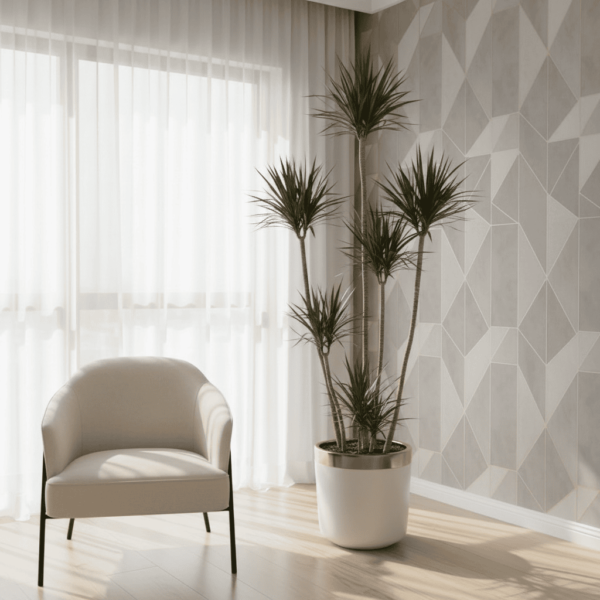
For Hong Kong homes and offices. Stock and pricing follow the product page.
FAQs
Origin & characteristics
Dracaena marginata belongs to the Asparagaceae family and is native to Madagascar — one of the world's most biodiverse regions, where approximately 90% of wild plant and animal species are found nowhere else on Earth. In English-speaking countries, it is known as the "Madagascar Dragon Tree," placing it alongside the Socotra and Canary Islands dragon trees as one of the arborescent
Watering
The Madagascar Dragon Tree shares the classic Dracaena drought tolerance — its somewhat succulent stems store water, and an occasional missed watering is not catastrophic. However, it is extremely sensitive to overwatering, and root rot from excess moisture is the most common cause of death.
Soil & pot
The Madagascar Dragon Tree needs a free-draining, airy growing medium that retains some moisture while allowing excess water to escape.
Temperature & humidity
Temperature: The ideal range is 18–27°C, which suits Hong Kong indoor environments well. Cold tolerance is limited — prolonged exposure below 13°C may cause chilling injury, and temperatures below 10°C risk serious damage. Summer temperatures above 30°C are tolerated provided adequate watering is maintained. Avoid direct air conditioning airflow, as sudden temperature changes can cause leaf drop o
