



Plantshop.hk · Care Encyclopedia
How to Care for Song of India in Hong Kong
From HK$580 · Hong Kong delivery
Hong Kong care guide — useful before you buy and after it arrives.
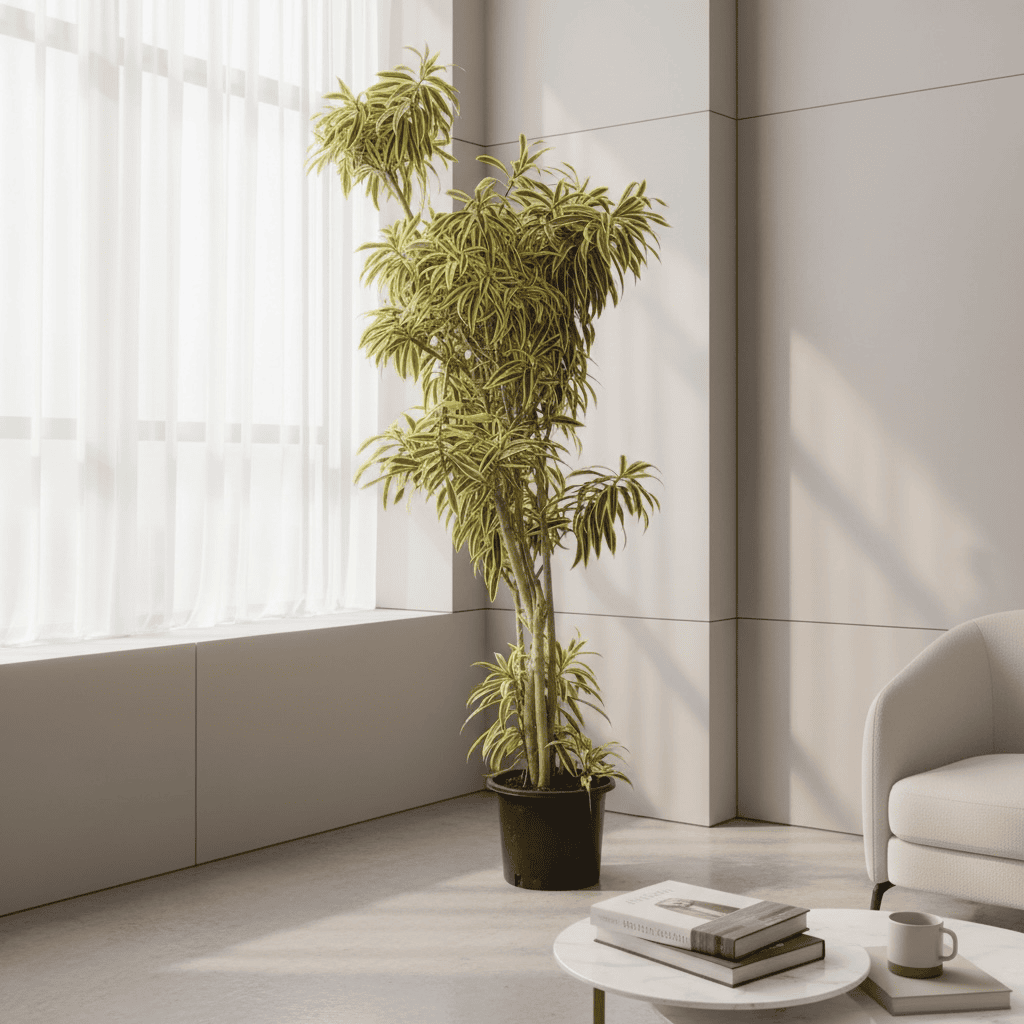
Shop this plant at PlantShop.hkGolden-edged leaves on deep green give a Hong Kong entrance hall or living room an instant luxury look. The one rule that matters most: give it bright, diffused light and let the soil dry out between waterings.
LightBright diffused light, at least 4–6 hrs a day
Watering“Better dry than wet”; every 7–10 days in spring/summer
Best spot in HKBright living room near a window, or a lit entryway
PetsToxic to cats & dogs — keep out of reach
Care in a nutshell
Song of India is a favourite for a reason: those golden leaf edges give it an elegant, luxurious look that transforms a Hong Kong room. It likes its light, at least 4–6 hours of bright, diffused light a day, so give it a spot near a window rather than a dark corner, or the gold edging will fade. Don’t kill it with kindness: let the soil dry out between waterings, because root rot is the one thing it struggles to recover from. It is happiest at 18–27°C and copes with summer rooms above 30°C, but suffers below 13°C. Air-conditioned dry air suits it fine; it is Hong Kong’s humid, sticky days that call for careful drainage.
Shop · Song of India (from HK$580)
Origin & characteristics
Dracaena reflexa 'Variegata' belongs to the Asparagaceae family and is a variegated cultivar of the Reflexed Dracaena (Dracaena reflexa). The species has a remarkably wide natural distribution across the Indian Ocean basin, from eastern Africa and Madagascar through the Seychelles, Sri Lanka, and tropical Asia to Indonesia. The precise origin of the 'Variegata' cultivar has been lost to history, but it is believed to have been selected from a naturally variegated sport discovered in a European or Southeast Asian nursery during the early 20th century. Today, it is the most commonly seen form of D. reflexa in the global horticultural trade.
In English-speaking markets, this plant is widely known as "Song of India" — a poetic name that evokes the plant's distribution across the Indian Ocean region, combined with the gold-and-green colour scheme that suggests the luxurious texture of Indian silk. The Chinese common name translates to "golden-edged lily bamboo," referring to the bamboo-like leaf shape and the elegant way the leaves unfurl like lily petals — though botanically, the plant is related to neither bamboo nor lily.
Key characteristics:
The stems of Song of India grow upright and gradually become woody. Young shoots are green and relatively pliable, which allows them to be trained into decorative braided forms — the "braided Song of India" commonly seen in the trade is created by weaving multiple young stems together, which then harden into permanent artistic shapes as they mature. The leaves are narrow and lance-shaped, 10–20 cm long and 2–3 cm wide, densely clustered at branch tips. The leaf face is deep green and glossy, with wide golden-yellow to cream margins and striping along the midrib, creating a striking and stable colour contrast.
A distinctive feature is the whorled leaf arrangement (whorled phyllotaxy) — viewed from above, leaves radiate around the stem like spokes on a wheel, creating a spiral pattern that is unique among common houseplants. The leaves are also shorter and broader than those of other dracaenas, with a thicker, more substantial texture.
Growth is moderate, adding approximately 20–40 cm of height per year indoors. Mature specimens typically reach 1.5–3 metres, but height can be controlled through pruning. Like all dracaenas, the plant naturally drops its oldest bottom leaves over time, exposing bare stems. To maintain a leafy appearance at the base, the growing tip can be removed to encourage branching, or multiple plants of different heights can be grouped in one container.
Song of India was also included in NASA's study of potential air-purifying plants, with research indicating it can absorb formaldehyde and other volatile organic compounds from indoor air.
Light
Song of India has higher light requirements than most other dracaena species because the golden-yellow portions of its leaves contain less chlorophyll and need ample light for photosynthesis. It requires bright indirect light, with at least 4–6 hours of illumination daily to maintain healthy growth and vivid colouration.
In too-dark a position, the golden margins fade to green, new leaves emerge small and weak, and the plant becomes leggy and droopy. However, direct afternoon sun can scorch the leaves, causing brown burned patches — summer sun in Hong Kong is particularly strong and should be filtered.
Hong Kong placement guide:
- Best spots: Living room near a window, south-facing window with sheer curtain, north-facing terrace
- Acceptable: Indoor spaces 1.5–3 metres from a window (provided there is sufficient ambient light)
- Avoid: Rooms where lights are rarely on, bathrooms (too humid), directly in air conditioning airflow
Tip: Song of India is phototropic — its stems and leaves will lean toward the light source. Rotate the pot 90 degrees every 2–3 weeks to ensure even growth on all sides and maintain an upright, symmetrical form.
Watering
Song of India follows the same watering principles as other dracaenas: "better dry than wet." Its stems have some water-storing capacity and can tolerate brief dry spells, but it is extremely sensitive to waterlogged soil and root rot.
Watering frequency guide:
- Spring & summer (growing season): Approximately every 7–10 days, waiting until the top 2–3 cm of soil is dry
- Autumn & winter (slow growth): Approximately every 10–14 days
- Air-conditioned environments: The drier air means checking every 5–7 days
Proper watering technique:
- Water slowly onto the soil surface until water flows from the drainage holes
- Let the pot sit for 10–15 minutes, then empty the saucer completely
- Never let the pot sit in standing water
Water quality: Song of India is sensitive to fluoride and chlorine in tap water, which accumulate at the leaf tips and cause brown scorching. If leaf tips keep browning, switch to filtered water, overnight-settled water, or rainwater. Water temperature matters too — avoid using cold water straight from the tap, as low temperatures can shock the roots. Use water at room temperature.
How to tell if watering is needed: Insert your finger 2–3 cm into the soil — if it feels dry or only very slightly moist, it's time to water. If it still feels damp, wait a few more days.
Soil & pot
Song of India needs a free-draining, airy growing medium that also retains some moisture — not too dry.
Recommended mix:
- Quality potting mix: 50%
- Perlite or coarse sand: 25%
- Coco peat or coconut husk chips: 15%
- Leaf mould or peat moss: 10%
This mix drains well to prevent root rot while holding enough moisture for healthy root function. If using a commercial pre-mixed soil, choose a standard indoor plant mix and add 20–25% perlite for extra drainage.
Pot selection:
- Material: Terracotta offers the best breathability; glazed or plastic pots are fine with careful drainage management
- Size: Choose a pot approximately 5–8 cm larger in diameter than the root ball. Oversized pots hold too much moisture
- Style: The slim, elegant stems look beautiful in simple, modern pots — white or cement-finish cylindrical containers complement the gold-and-green foliage perfectly
Repotting: Generally every 2–3 years, in spring. Signs that repotting is needed include roots growing from drainage holes, or water taking a long time to soak in. When repotting, gently loosen the outer roots to encourage new growth.
Propagation: Song of India propagates readily from stem tip cuttings or stem section cuttings. In spring, cut a 15–20 cm section from the stem tip, remove lower leaves, and root in clean water or moist perlite — new roots should appear within 4–8 weeks. Stem section cuttings can also be made by cutting the stem into 10 cm sections, laying them horizontally on moist propagation medium, and waiting for buds to sprout new shoots.
Temperature & humidity
Temperature: The ideal range is 18–27°C, which aligns perfectly with Hong Kong indoor conditions. Cold tolerance is limited — prolonged exposure below 13°C may cause chilling injury, and temperatures below 10°C risk serious damage. Summer temperatures above 30°C are tolerated well with adequate watering. Avoid direct air conditioning airflow, as sudden temperature changes can cause leaf drop or brown spots.
Humidity: Song of India prefers moderate humidity, with 40–60% relative humidity being optimal. Hong Kong summer humidity frequently exceeds 80%, which is on the high side — ensure good ventilation to prevent fungal problems. Winter air conditioning can dry the air, in which case:
- Group multiple plants together to create a micro-humid zone
- Place the pot on a saucer filled with pebbles and water (ensure the pot base does not touch the water)
- Occasionally wipe leaves with a damp soft cloth to clean dust and boost local humidity
Note: Avoid frequent misting of the foliage, especially in poorly ventilated spaces, as this encourages fungal leaf spot diseases.
Common problems
| Issue | Likely cause | What to do |
|---|---|---|
| Leaf tips scorching brown | Fluoride/chlorine in water, dry air, salt buildup | Switch to filtered or rainwater; occasionally flush soil with copious clean water; increase humidity |
| Golden variegation fading to green | Insufficient light | Move to a brighter position; increase light gradually to avoid shocking the plant |
| Leaves yellowing and dropping overall | Overwatering/root rot, poor drainage, cold damage | Check drainage; reduce watering; move to a warmer position; if stem base is soft, unpot and trim |
| New leaves small, plant etiolated | Severe light deficiency | Increase light intensity; if severely leggy, consider topping and restarting |
| Stem base turning soft and black | Severe root rot, fungal infection | Cut away rotted tissue, keep healthy stem sections for propagation |
| Brown spots on leaf surface | Fungal leaf spot (high humidity) or sun scorch | Improve ventilation; remove affected leaves; avoid wetting foliage; if scorch, move to filtered light |
| White powdery material on leaves | Mealybug infestation | Wipe individually with cotton swab dipped in rubbing alcohol; apply organic insecticidal soap |
| Bottom older leaves naturally yellowing and dropping | Normal ageing | No concern — gently remove; if dropping too rapidly, check environmental conditions |
Not sure your spot gets enough light, or something looks off? Send us a photo on WhatsApp 4492 9648 and we’ll take a look.
Questions people ask
Can Song of India live in an air-conditioned Hong Kong flat?
Yes. The dry air of an air-conditioned room suits it well. Check the soil every 5–7 days and keep it out of the direct airflow from the vents, since sudden temperature swings cause leaf drop.
How often should I water Song of India?
About every 7–10 days in spring and summer and every 10–14 days in autumn and winter, once the top 2–3 cm of soil has dried. Its rule is “better dry than wet”, and the saucer should always be emptied.
Why is my Song of India losing its bottom leaves?
Shedding old bottom leaves is normal growth, so simply pick them off. To keep leaves lower down, prune the top to encourage branching or plant several stems of different heights in one pot.
Is Song of India safe for cats and dogs?
No. It contains saponins that are toxic to cats and dogs and may cause vomiting, diarrhoea, drooling and loss of appetite. Keep it well beyond jumping reach.
Fun facts
The mystery of "Song of India": The English name "Song of India" is wonderfully evocative, but its true origin is uncertain. One theory holds that in the early 1900s, a Dutch horticulturist working in the Dutch East Indies (now Indonesia) was so struck by the plant's striking gold-and-green colouring that it reminded him of the paradise forests described in the Indian epic Ramayana, inspiring the poetic name. Another theory suggests the plant was exported to Europe via the botanical gardens of Calcutta (now Kolkata), leading to the mistaken assumption that it was native to India. Either way, the name has stuck and become the standard worldwide.
The art of braiding: The braided Song of India commonly seen in shops is not a natural growth form but a work of horticultural art. The technique originates from traditional Chinese bonsai trunk-braiding methods: three or more young plants are grown in the same pot, and when their stems reach 30–50 cm in height, the still-flexible green stems are carefully woven together like a plait. Over time, as the stems lignify (become woody), the braid permanently sets into a unique spiral or woven trunk pattern. This technique is both decorative and practical — the intertwined plants share root resources, forming a stronger, more resilient plant overall. Braided specimens need regular rotation to ensure all sides receive equal light; otherwise, the plant will grow toward the light and compromise the symmetry of the braid.
Not bamboo, not lily: Despite what the Chinese common name suggests, Song of India is botanically unrelated to true bamboo (which belongs to the grass family Poaceae) and true lilies (Liliaceae). True bamboo has hollow stems and can grow metres in a single day; Song of India has solid, woody stems that grow slowly. The "bamboo" in the name simply refers to the long, narrow leaf shape and upright stem habit. Similarly, "lily" refers to the way the leaves unfurl like lily petals. These naming conventions are common in horticulture — just as "Dutch iron plant" is not actually an iron plant, and "Brazilwood" does not come from Brazil.
References (expand to view sources)
References
- Royal Horticultural Society. (2024). Dracaena reflexa 'Variegata' — RHS Plant Finder. https://www.rhs.org.uk/plants/dracaena-reflexa-variegata/
- Missouri Botanical Garden. Dracaena reflexa — Plant Finder. https://www.missouribotanicalgarden.org/PlantFinder/PlantFinderDetails.aspx?taxonid=279550
- Plants of the World Online (POWO). (2024). Dracaena reflexa (Jacq.) Lem. https://powo.science.kew.org/
- Wolverton, B. C., et al. (1989). Interior Landscape Plants for Indoor Air Pollution Abatement (NASA Technical Report TM-101766). https://ntrs.nasa.gov/citations/19930073014
- The Spruce. (2024). How to Grow and Care for Song of India. https://www.thespruce.com/song-of-india-plant-profile-5203365
- American Society for the Prevention of Cruelty to Animals (ASPCA). Toxic and Non-Toxic Plants: Dracaena. https://www.aspca.org/pet-care/animal-poison-control/toxic-and-non-toxic-plants/dracaena-reflexa
⚠️ Pet / toxicity: Song of India contains saponins and is toxic to cats and dogs. Ingestion may cause vomiting, diarrhoea, excessive drooling, and loss of appetite. Cats are especially curious about this plant and should be prevented from reaching it. For humans, it is not highly toxic, but consumption is not recommended and sap may cause minor skin irritation. Important note: despite the word "lily" in its common name, this plant is completely unrelated to true lilies (Lilium spp.), which pose a severe, potentially fatal risk of acute kidney failure to cats.
Shop at Plantshop
View all Plants →
For Hong Kong homes and offices. Stock and pricing follow the product page.
FAQs
Origin & characteristics
Dracaena reflexa 'Variegata' belongs to the Asparagaceae family and is a variegated cultivar of the Reflexed Dracaena (Dracaena reflexa). The species has a remarkably wide natural distribution across the Indian Ocean basin, from eastern Africa and Madagascar through the Seychelles, Sri Lanka, and tropical Asia to Indonesia. The precise origin of the 'Variegata' cultivar has bee
Watering
Song of India follows the same watering principles as other dracaenas: "better dry than wet." Its stems have some water-storing capacity and can tolerate brief dry spells, but it is extremely sensitive to waterlogged soil and root rot.
Soil & pot
Song of India needs a free-draining, airy growing medium that also retains some moisture — not too dry.
Temperature & humidity
Temperature: The ideal range is 18–27°C, which aligns perfectly with Hong Kong indoor conditions. Cold tolerance is limited — prolonged exposure below 13°C may cause chilling injury, and temperatures below 10°C risk serious damage. Summer temperatures above 30°C are tolerated well with adequate watering. Avoid direct air conditioning airflow, as sudden temperature changes can cause leaf drop or br
