



Plantshop.hk · Care Encyclopedia
How to Care for Golden Radiance Fig in Hong Kong
From HK$680 · Hong Kong delivery
Hong Kong care guide — useful before you buy and after it arrives.
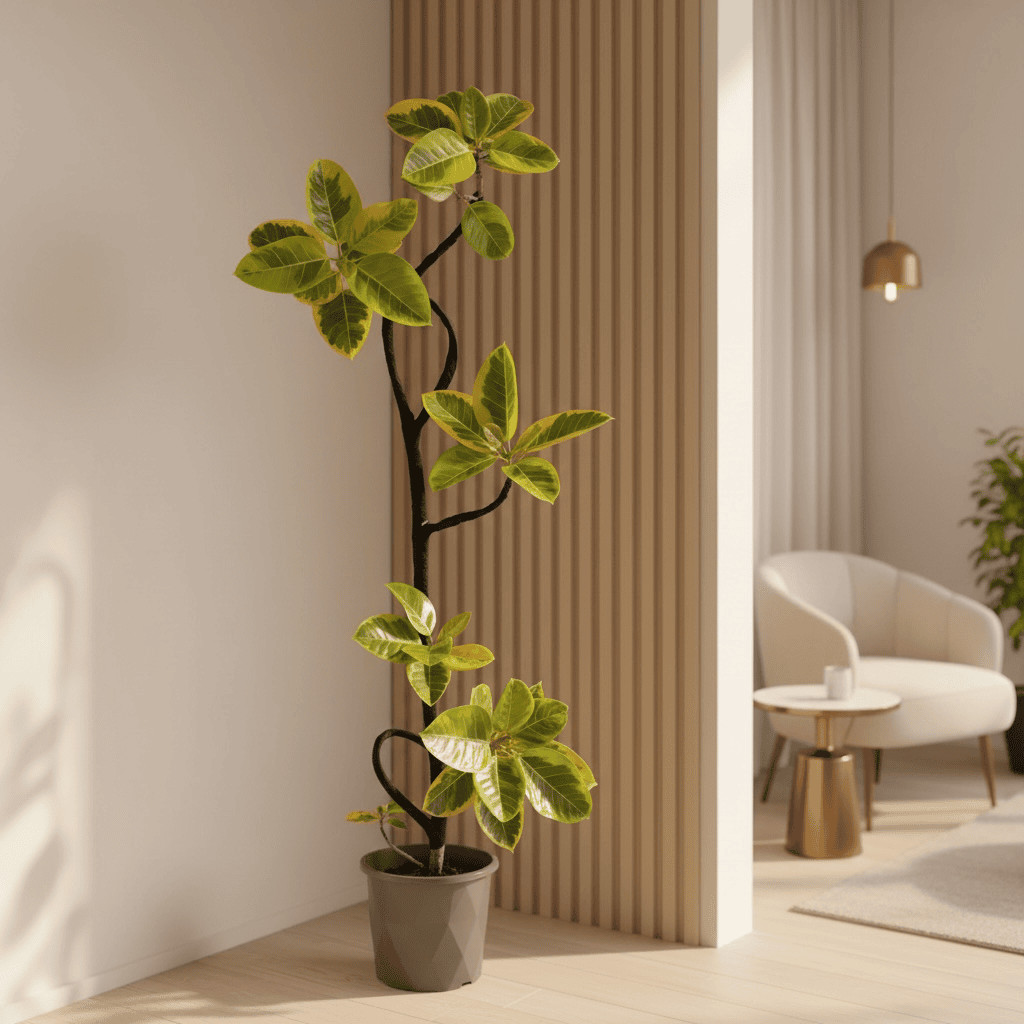
Shop this plant at PlantShop.hkA striking golden-and-emerald ornamental tree that lights up Hong Kong balconies and terraces all year and thrives in our subtropical climate. The one rule that matters most: give it 4–6 hours of bright indirect light so the leaves stay golden.
Light4–6 hrs bright indirect light or partial sun
WateringWater when top 3 cm is dry; every 5–7 days in spring–summer
Best spot in HKEast- or south-facing balcony; shade west sun in summer
PetsLatex sap toxic to cats & dogs — wear gloves pruning
Care in a nutshell
To grow a Golden Chinese Banyan in Hong Kong, start with light: it needs 4–6 hours of bright indirect light or partial sun daily, ideally on an east- or south-facing balcony, to keep its colour vivid — in dim light, new leaves emerge green. Check the soil with your finger and water when the top 3 cm feels dry, typically every 5–7 days in spring and summer and every 7–10 days in autumn and winter. Use general-purpose potting mix 50% + perlite or coarse sand 25% + coco peat 25%, adding 20% extra perlite if you use pure peat-based soil. It likes 20–30°C; if temperatures drop to 8°C or below, move it indoors or to a sheltered spot. It is tough and forgiving, and the more you prune, the bushier it gets. Its latex sap is toxic to cats and dogs, so wear gloves when pruning.
Shop · Golden Radiance Fig (from HK$680)
Origin & characteristics
Ficus microcarpa 'Golden Leaves' (also known as 'Golden') is a horticultural cultivar of the Chinese Banyan (Ficus microcarpa), belonging to the mulberry family (Moraceae). The Chinese Banyan is native to tropical and subtropical regions of Southeast Asia, Oceania, and the Indian subcontinent, and is a familiar native and street tree in Hong Kong. The 'Golden Leaves' cultivar was developed through natural mutation or artificial selection for its distinctive golden-yellow foliage, and is classified as an evergreen small tree or shrub.
The Golden Chinese Banyan's most striking feature is its dynamic leaf colour. New leaves emerge in vivid golden-yellow or lemon-yellow, gradually transitioning to yellow-green or deep green with yellow margins as they mature. In strong light, the colour is at its most brilliant; in insufficient light, the golden tones fade and may revert to green. Leaves are slightly smaller than the species form, thick and glossy, oval to elliptical, with clear venation. The plant has vigorous growth, tolerates pruning well, and is excellent for shaped topiary, hedges, or balcony shrubs.
Like all figs, the Golden Chinese Banyan produces white latex when damaged — a defensive characteristic shared by the Moraceae family that deters herbivores. It has a well-developed root system, tolerates wind and drought, and adapts well to Hong Kong's seasonal pattern of humid summers and relatively dry winters. It is also an excellent bonsai subject, with easily trained branches and tolerance for rough handling.
Light
The Golden Chinese Banyan has medium-to-high light needs — similar to the Fiddle-Leaf Fig but slightly more shade-tolerant. To maintain vivid golden colouration, it needs at least 4–6 hours of bright indirect light or partial sun daily. East- or south-facing balconies are ideal, where morning sun promotes bright leaf colour without excessive risk of scorching. West-facing positions in summer need afternoon shade to prevent leaf edge burn from harsh sun.
It is particularly important to note that the intensity of the golden colour is directly influenced by light levels. Long-term placement in a dim indoor position causes golden leaves to gradually turn green, losing the cultivar's distinctive appeal. If new leaves emerge green rather than golden, this is a clear signal of insufficient light — gradually move the plant to a brighter position. However, avoid suddenly moving a plant from a dark spot to strong direct sun; give it a 1–2 week adaptation period, otherwise sun-scald spots may appear.
Hong Kong summer sun is intense. When placing the Golden Chinese Banyan on an outdoor terrace, use 50% shade cloth to filter midday sun (11am–3pm) during July and August. Winter sun is gentler and the plant can accept full sun. For indoor cultivation, within 1 metre of a south-facing window is optimal; for north-facing windows, place as close to the glass as possible.
Watering
The Golden Chinese Banyan's watering strategy is "dry first, soak second." In spring and summer (growing season), when the top 3 cm of soil feels slightly dry, water — typically every 5–7 days. In autumn and winter (slow growth), extend to every 7–10 days. The Golden Chinese Banyan is more forgiving of occasional watering inconsistency than the Fiddle-Leaf Fig; brief dry spells will not cause immediate serious problems, though sustained waterlogging will still lead to root rot.
Hong Kong's summer storms can be intense. If the plant is on an outdoor terrace, ensure free drainage from the pot and promptly empty saucers after heavy rain. During consecutive overcast days, pause watering until the soil has partially dried. If the plant remains outdoors in winter, significantly reduce watering during cold surges (below 10°C), keeping the plant slightly dry to enhance cold hardiness.
The Golden Chinese Banyan prefers higher humidity but adapts to typical home environments. Hong Kong summer humidity is usually sufficient; winter heating may dry the air, in which case occasional leaf misting (avoid midday) can help. Dust accumulation on leaves affects photosynthesis and appearance — wipe leaves monthly with a damp cloth and inspect for pests at the same time.
Soil & pot
The Golden Chinese Banyan is highly adaptable and not fussy about soil, but the ideal medium is still loose, well-aerated, and free-draining. Recommended formula: general-purpose potting mix 50% + perlite or coarse sand 25% + coco peat 25%. This blend provides both moisture retention and aeration, suited to Hong Kong's hot, humid climate. If using pure peat-based soil, add 20% extra perlite to improve drainage.
For pot selection, terracotta, plastic, or cement pots are all suitable. Terracotta offers the best aeration, ideal for beginners who tend to overwater; plastic is lightweight, good for plants that need frequent moving; cement pots have a substantial, grounded aesthetic that suits modern balconies. All pots must have drainage holes — place a layer of clay pebbles or broken pottery shards at the bottom as a drainage layer.
Growth rate is moderately fast, adding 30–60 cm of height per year. Potted specimens should be repotted every 1–2 years, with spring being the optimal time. When repotting, root pruning and top trimming can be done simultaneously to encourage more branching and maintain a compact form. If you want to control plant size, trim some roots during repotting and return to the same pot size — this is called "soil refresh without upsizing."
Temperature & humidity
The Golden Chinese Banyan is a tropical to subtropical plant with an optimal temperature range of 20–30°C and a minimum tolerance of approximately 10°C. Hong Kong winters generally require no special protection, but during strong cold surges (temperatures dropping to 8°C or below), move potted plants indoors or to a sheltered position. Sustained cold causes leaves to redden or drop, and tender shoots may be damaged by frost.
Summer temperatures above 30°C have minimal impact on the plant, which will continue normal growth — just be mindful of increased evaporation and water accordingly. In air-conditioned environments, avoid direct cold air flow, which can cause leaves to dry and curl. The Golden Chinese Banyan adapts well to a broad humidity range of 40–70%, making it an excellent match for Hong Kong's climate.
Fertilising: During the growing season (March–October), apply a balanced slow-release or liquid fertiliser every 3–4 weeks, using formulations with NPK ratios of 10-10-10 or 20-20-20. Maintaining the golden colour requires adequate nitrogen, but excess nitrogen pushes leaves toward green, so choose a balanced fertiliser with trace elements. Stop fertilising in winter.
Pruning is key to maintaining the Golden Chinese Banyan's attractive appearance. It tolerates pruning extremely well — "the more you prune, the bushier it gets." New shoots emerge from leaf axils just below the cut, so pruning encourages branching and a fuller form. Perform major pruning in spring, with light trimming in summer. Use sharp pruning shears and make clean cuts to minimise wound area. The white latex that oozes from cuts can be wiped away with a damp cloth; it will dry naturally to form a protective layer.
Common problems
| Issue | Likely cause | What to do |
|---|---|---|
| Leaf colour changing from golden to green | Insufficient light | Gradually move to a brighter position with at least 4 hours of indirect light daily |
| Brown spots or scorched leaf edges | Direct midday sun or poor drainage | Provide midday shade in summer; check drainage holes are clear |
| Massive leaf drop | Sudden environmental change/moving/cold air blast | Fix the plant in one position; avoid frequent moving; keep away from AC vents |
| Stems leggy, leaf spacing widened | Insufficient light or excess nitrogen | Increase light exposure; switch to balanced fertiliser; trim growing tips |
| Leaves yellowing with brown spots and dropping | Overwatering causing root rot | Reduce watering; check root health; repot and trim roots if necessary |
| Black sooty coating on leaf surface | Scale insects or aphids secreting honeydew leading to sooty mould | Wipe away sooty mould with damp cloth; remove pests with alcohol-soaked cotton; treat with neem oil |
Not sure your spot gets enough light, or something looks off? Send us a photo on WhatsApp 4492 9648 and we’ll take a look.
Questions people ask
Can a Golden Chinese Banyan grow indoors in Hong Kong?
Yes, if it is bright enough. Indoors, keep it within 1 metre of a south-facing window; in long-term dim light the golden leaves gradually turn green.
How often should I water a Golden Chinese Banyan?
Typically every 5–7 days in spring and summer, and every 7–10 days in autumn and winter. Water when the top 3 cm of soil feels slightly dry.
Why are my Golden Chinese Banyan's new leaves green?
This is a clear sign of insufficient light. Move the plant gradually to a brighter position, allowing a 1–2 week adaptation period so the leaves do not sunburn.
Is a Golden Chinese Banyan safe for cats and dogs?
No. Like all figs, it exudes a white latex that is toxic to cats and dogs and can cause oral irritation, drooling, vomiting and diarrhoea. Keep it out of pets' reach.
Fun facts
The Chinese Banyan (Ficus microcarpa) is one of Hong Kong's most common native fig trees, found everywhere from urban parks and street plantings to stone walls. This remarkable resilience stems from its well-developed aerial root system — aerial roots descend from branches, thicken into pillar roots upon reaching the soil, and can eventually create the spectacular sight of "one tree becoming a forest." The famous Great Banyan Tree in Howrah Botanical Garden, India, is a massive F. microcarpa with over 2,500 pillar roots covering 1.5 hectares, considered one of the widest-spreading trees in the world.
The Golden Chinese Banyan, as a cultivar of this species, also has the potential to produce aerial roots, though they are less commonly seen in potted plants. Interestingly, the fig "fruit" of Ficus species is actually a syconium — a hollow, fleshy receptacle lined with tiny flowers on the inside. These flowers can only be pollinated by fig wasps measuring just 1–2 mm in length, which must enter through a small opening at the top. This specialised mutualistic relationship has evolved over more than 60 million years, representing one of nature's most exquisite examples of co-evolution.
References (expand to view sources)
References
- Missouri Botanical Garden. "Ficus microcarpa." Plant Finder. https://www.missouribotanicalgarden.org/PlantFinder/PlantFinderDetails.aspx?taxonid=277439
- Royal Horticultural Society. "Ficus microcarpa." https://www.rhs.org.uk/plants/110580/ficus-microcarpa/details
- Singapore National Parks Board. "Ficus microcarpa." Flora & Fauna Web. https://www.nparks.gov.sg/florafaunaweb/flora/2/9/2989
- Hong Kong Herbarium. "Ficus microcarpa." Check List of Hong Kong Plants. https://www.herbarium.gov.hk/
- Gardener's World. "Ficus: how to grow." BBC. https://www.gardenersworld.com/plants/ficus-how-to-grow/
⚠️ Pet / toxicity: The Golden Chinese Banyan, like all fig species, exudes a white milky latex when stems or leaves are damaged. This sap contains proteolytic enzymes and terpenoid compounds and is toxic to cats and dogs. Ingestion can cause oral irritation, excessive drooling, vomiting, and diarrhoea. People with sensitive skin may experience redness or itching from contact. Wear gloves when pruning. If your pet has a habit of chewing plants, place the Golden Chinese Banyan out of reach.
Shop at Plantshop
View all Plants →
For Hong Kong homes and offices. Stock and pricing follow the product page.
FAQs
Origin & characteristics
Ficus microcarpa 'Golden Leaves' (also known as 'Golden') is a horticultural cultivar of the Chinese Banyan (Ficus microcarpa), belonging to the mulberry family (Moraceae). The Chinese Banyan is native to tropical and subtropical regions of Southeast Asia, Oceania, and the Indian subcontinent, and is a familiar native and street tree in Hong Kong. The 'Golden Leaves'
Watering
The Golden Chinese Banyan's watering strategy is "dry first, soak second." In spring and summer (growing season), when the top 3 cm of soil feels slightly dry, water — typically every 5–7 days. In autumn and winter (slow growth), extend to every 7–10 days. The Golden Chinese Banyan is more forgiving of occasional watering inconsistency than the Fiddle-Leaf Fig; brief dry spells will
Soil & pot
The Golden Chinese Banyan is highly adaptable and not fussy about soil, but the ideal medium is still loose, well-aerated, and free-draining. Recommended formula: general-purpose potting mix 50% + perlite or coarse sand 25% + coco peat 25%. This blend provides both moisture retention and aeration, suited to Hong Kong's hot, humid climate. If using pure peat-based soil, add 20% extra perlite t
Temperature & humidity
The Golden Chinese Banyan is a tropical to subtropical plant with an optimal temperature range of 20–30°C and a minimum tolerance of approximately 10°C. Hong Kong winters generally require no special protection, but during strong cold surges (temperatures dropping to 8°C or below), move potted plants indoors or to a sheltered position. Sustained cold causes leaves to redden or drop, and tender sho
