



Plantshop.hk · Care Encyclopedia
How to Care for Indian Azalea in Hong Kong
From HK$980 · Hong Kong delivery
Hong Kong care guide — useful before you buy and after it arrives.
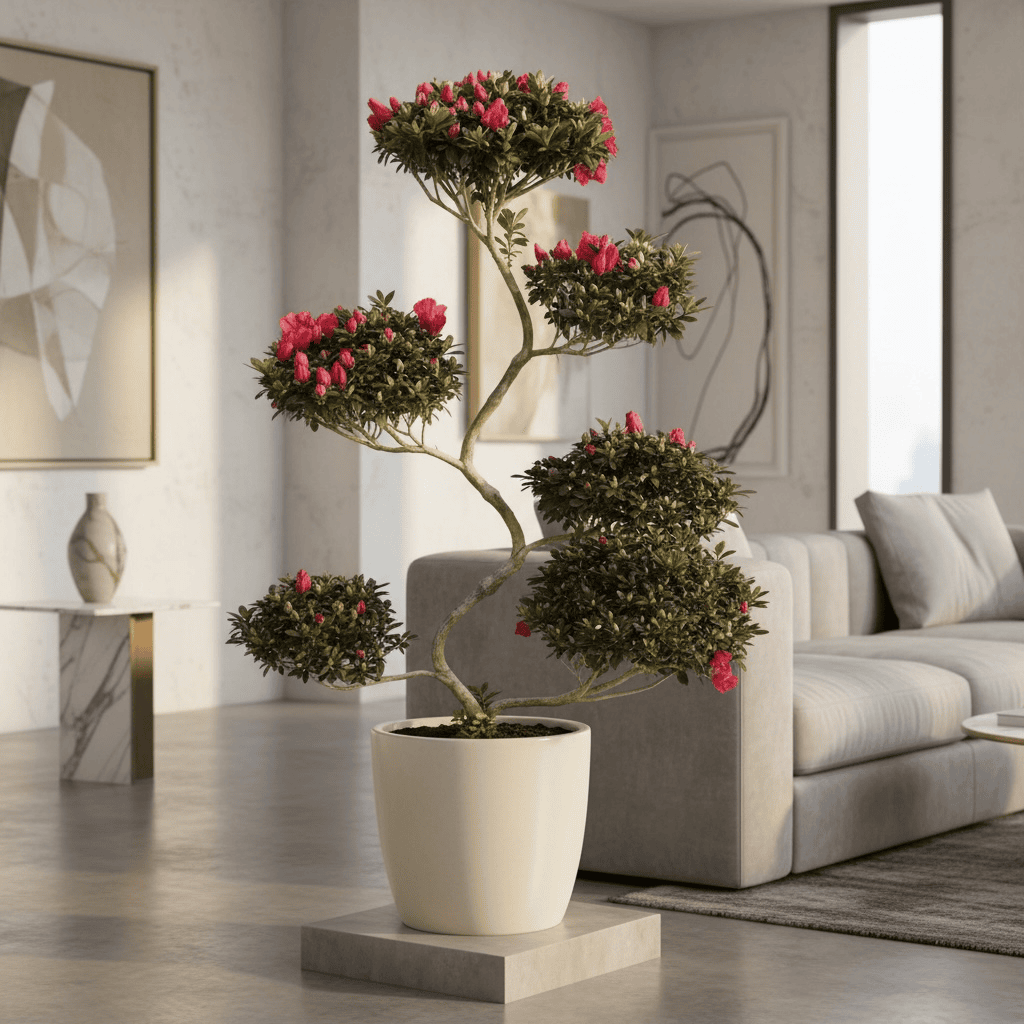
Shop this plant at PlantShop.hkA festive Hong Kong favourite: clustered blooms on artfully trained branches that bring the calm of an Oriental garden into your home. Three rules matter most: no harsh sun, no standing water, and slightly acidic water.
LightBright diffused light; east/north window, no harsh midday sun
WateringKeep moist, never soggy; every 2–3 days in summer
Best spot in HKEast- or north-facing window, or a shaded, airy balcony
PetsToxic to cats & dogs and people — keep out of reach
Care in a nutshell
The Styled Azalea is absolutely gorgeous in a Hong Kong home, but it has a delicate temperament. Remember three key things: keep it out of harsh sun, never let it sit in water, and always use slightly acidic water. Place it by a window with diffused light, touch the soil surface before watering, and always empty the saucer afterwards. If your tap water is alkaline, use a diluted vinegar solution every few waterings to keep the soil in the right range. After flowering, remember to fertilise and check whether repotting is needed — that is the only way to encourage blooming year after year. It grows best at 15–25°C and flowers best at 15–20°C. If the leaves turn yellow but the veins stay green, your soil has become too alkaline and needs immediate attention.
Shop · Indian Azalea (from HK$980)
Origin & characteristics
The Styled Azalea is botanically known as Rhododendron simsii, also called Belgian Azalea, Chinese Azalea, or Spring Azalea. It belongs to the heath family (Ericaceae) and is an evergreen shrub. Despite the name "Belgian Azalea," its true native range is southern, central, and southwestern China — including Guangdong, Guangxi, Fujian, and Yunnan provinces. In the 19th century, plant hunters introduced it to Europe, where Belgian horticulturists developed it through decades of selective breeding and hybridisation, creating an extraordinary range of richly coloured, large-flowered cultivars. Hence the "Belgian" designation.
In Hong Kong, azaleas are enormously popular as potted flowering plants, especially during Lunar New Year when they appear in virtually every home and shopping mall. The Styled Azalea takes this a step further — through years of meticulous pruning, wiring, and training by skilled horticultural artists, each plant is shaped into graceful forms. Some resemble layered clouds stacked upon one another (cloud-pad style); others evoke ancient, weathered trees (natural style); still others curve dramatically like a dragon in flight (cliff style). These forms require not only artistic branch lines but also evenly distributed flower clusters — a true marriage of horticultural skill and aesthetic sensibility.
Azaleas are shallow-rooted plants with hair-fine roots that are highly sensitive to soil, water, and fertiliser conditions. The leaves are oval to obovate, leathery, deep green and glossy, with brown glandular dots on the undersides. The flowers are funnel- or bell-shaped, reaching 5–8 cm in diameter, in shades of deep red, pink, rose, orange-red, and white, with some cultivars featuring picotee edges or speckled patterns. Under favourable conditions, the flowering period can extend from autumn through to spring, with January through March being the peak blooming season.
It is worth noting that the genus Rhododendron contains over 1,000 species worldwide, and some contain toxic compounds. R. simsii is grown purely for ornamental purposes and is harmless as long as it is not consumed.
Light
Azaleas are semi-shade loving plants that prefer bright but gentle light. In Hong Kong, an east-facing or north-facing windowsill is the ideal position — the soft morning sun promotes flower bud development and blooming, while the harsh midday light is blocked by walls or curtains. South-facing or west-facing windows without appropriate shading can cause sunscald, leaving yellow-white spots on leaves or even scorched edges.
If you purchased your Styled Azalea for its flowers, remember that light quality directly affects flowering. During the flower bud development period (approximately 1–2 months before blooming), adequate diffused light is essential; otherwise buds may fail to develop properly, produce small flowers, or drop prematurely. Once the plant is in full bloom, you can move it to a slightly cooler, shadier spot to extend the display period.
A common pitfall for indoor azaleas in Hong Kong: many offices and malls place azaleas in locations with no natural light whatsoever for festive decoration. While this is acceptable for a week or two, prolonged placement will cause rapid decline — leaves become thinner and paler, and flower buds drop. Even when displayed indoors, ensure at least 4–6 hours of bright indirect light daily.
If growing azaleas on an outdoor balcony, choose a well-ventilated but shaded position. In summer, use 50–70% shade cloth to filter midday sun; in winter, allow more direct light.
Watering
Watering is the most skill-demanding aspect of azalea care. The principle is to keep the soil moist but never waterlogged. Azalea roots are extremely fine — like hair — and sensitive to both drought and saturation.
When to water: Touch the soil surface lightly; water when it feels just barely dry, never wait until completely desiccated. An azalea "thirsts" when its leaves slightly droop and lose their gloss — but act quickly at this signal, as root damage from dehydration is difficult to reverse. In summer (May–September), water typically every 2–3 days; in winter (November–February), reduce to every 4–6 days, adjusting according to indoor temperature and ventilation.
Watering method: Use the drench method — slowly and evenly water around the pot perimeter until it drains from the bottom. Discard the saucer water after five minutes. Never use the soak-and-leave method for extended periods; azalea roots easily rot from oxygen deprivation.
Water quality is critical for azalea success. Azaleas prefer slightly acidic water (pH 5.0–6.0), but Hong Kong tap water is generally alkaline (pH 7.5–8.5). Long-term use will gradually alkalise the soil, causing leaf yellowing where veins remain green while leaf tissue turns yellow — a condition called "iron chlorosis." Solutions:
- Let tap water stand overnight (helps release some chlorine, though has limited effect on pH).
- Use rainwater (the best option — naturally slightly acidic).
- Use filtered or distilled water.
- Every two weeks, water with very dilute vinegar solution (1 ml white vinegar per litre of water).
- Use fertiliser formulated specifically for azaleas, which provides nutrients while helping regulate acidity.
Soil & pot
Azaleas demand strict soil conditions that must satisfy four criteria simultaneously: slightly acidic, well-draining, rich in organic matter, and highly aerated. Never use ordinary garden soil or heavy clay — poor drainage will cause fatal root rot.
Recommended mix: Peat moss or coco peat 40%, pine bark fines 30%, perlite 20%, and a small amount of leaf mould or coco peat 10%. This mix provides a favourable acidic environment, excellent drainage, and good aeration. For beginners, the simplest approach is to purchase an acidic potting mix formulated for azaleas or orchids, then fine-tune as needed.
For pH, azaleas prefer a range of 4.5–6.0. You can monitor this with garden pH test strips; if pH exceeds 6.5, take corrective action. Repotting should be done every 1–2 years, ideally in spring (March–April) after flowering has finished. Azalea roots are delicate — preserve the root ball during repotting and avoid damaging the fine root network. The new pot should only be 3–5 cm larger in diameter than the old one; oversized pots make it difficult for the soil to dry properly.
For pot material, plastic pots retain moisture well but offer less aeration; terracotta pots provide the best air circulation but dry out faster — each has pros and cons. Many horticulturists recommend glazed ceramic pots for azaleas — attractive for festive display, but ensure drainage holes are present. Regardless of material, drainage holes are essential.
Because Styled Azaleas have been trained over many years, their roots are often tightly integrated with the styling framework. Repotting requires extra care. If your Styled Azalea is planted in ordinary garden soil, do not rush to replace it all at once — instead, replace about one-third of the old soil each time over three consecutive years, gradually completing the transition with minimal root disturbance.
Temperature & humidity
Azaleas grow best at 15–25°C, with an ideal flowering temperature of 15–20°C. This range aligns well with Hong Kong's autumn, winter, and spring weather, making outdoor cultivation quite straightforward here. During summer (June–September), when temperatures regularly exceed 30°C, azaleas enter semi-dormancy and growth stalls — extra attention to shading and humidity is needed. If keeping azaleas in air-conditioned rooms over summer, ensure adequate light or flowering the following year will be affected.
To extend the flowering display after blooming, an ideal temperature of 10–15°C will help the flowers last longer. Placing the plant near heating or air-conditioning vents where temperatures fluctuate will accelerate flower drop. During cold snaps when temperatures fall below 5°C, azaleas may suffer frost damage — leaves develop water-soaked spots that turn brown. While R. simsii is more cold-tolerant than some alpine azalea varieties, potted plants have less root protection. Move plants indoors or provide cover during cold spells.
For humidity, azaleas prefer 60–80% relative humidity. Hong Kong's outdoor humidity in summer is usually sufficient, but air-conditioned rooms can drop below 40%. Increase humidity by grouping plants together, using humidity trays (shallow dishes with pebbles and water), or regularly misting the surrounding air (avoid spraying directly on flowers, as this shortens their lifespan). Balance humidity with ventilation — high humidity without airflow encourages fungal diseases.
Common problems
| Issue | Likely cause | What to do |
|---|---|---|
| Leaves yellowing with veins remaining green | Soil too alkaline causing iron deficiency | Water with acidic water (diluted vinegar or specialised acidic fertiliser); check soil pH; replace with acidic soil if necessary |
| Flower buds drop before opening | Insufficient light, temperature fluctuation, or irregular watering | Ensure adequate diffused light; avoid air-conditioning vents or heaters; maintain consistent watering |
| Brown, scorched leaf edges | Air too dry or strong sun exposure | Increase humidity; move away from intense light; trim damaged leaves |
| Plant weakens and growth stalls after flowering | Nutrient depletion or root ageing | Apply balanced liquid fertiliser after flowering; check if repotting or soil renewal is needed |
| White or brown insects on leaf undersides, sticky leaves | Scale insects or whitefly | Wipe insects with damp cloth or cotton bud dipped in alcohol; apply horticultural oil for severe infestations; isolate affected plants |
| Entire plant droops, soil constantly wet | Root rot (overwatering or poor drainage) | Stop watering immediately; inspect roots; prune away rotted roots and replant in fresh soil |
Not sure your spot gets enough light, or something looks off? Send us a photo on WhatsApp 4492 9648 and we’ll take a look.
Questions people ask
Where should I put a styled azalea in a Hong Kong home?
By an east- or north-facing window, where it gets soft morning light and misses harsh midday sun. Even on display indoors, give it at least 4–6 hours of bright indirect light a day.
How often should I water an azalea in Hong Kong?
Roughly every 2–3 days in summer and every 4–6 days in winter. Water when the soil surface feels slightly dry rather than waiting for it to dry out completely.
Why are my azalea leaves yellow with green veins?
The soil has probably become too alkaline, causing iron deficiency. Hong Kong tap water is alkaline, so use rainwater or diluted vinegar water and an acidic fertiliser.
Is an azalea safe for pets and children?
No. The leaves and nectar contain grayanotoxins that can cause vomiting, diarrhoea, dizziness and a slowed heart rate. Keep it out of reach and seek medical help if you suspect ingestion.
Fun facts
The genus Rhododendron is one of the largest genera of flowering plants in the world, with over 1,000 species distributed across Asia, Europe, North America, and Australia. Hong Kong actually has native wild azaleas, including Rhododendron championiae and R. simsii var. mesembrinum, which can be seen blooming on hillsides during spring. The Agriculture, Fisheries and Conservation Department has records of these on Tai Mo Shan and Ma On Shan.
The story behind the "Belgian Azalea" name is fascinating. In the mid-19th century, Europe was gripped by "azalea fever," with British and Belgian nurseries competing to develop new varieties. Breeders in Ghent, Belgium — notably Charles Vuylsteke — successfully hybridised R. simsii introduced from China with other Asian species, creating large-flowered, vividly coloured varieties suited to greenhouse cultivation. These became known collectively as "Belgian Azaleas" or "Ghent Azaleas." They later returned to Asia and now dominate the Lunar New Year markets in Hong Kong, Taiwan, and Japan.
In Chinese culture, azaleas carry deep symbolic significance. The Tang Dynasty poet Bai Juyi wrote: "Casually breaking two branches to hold in hand, I look closely and feel they do not belong to the mortal world," comparing them to flowers from heaven. Legend has it that azaleas were stained by the blood of the cuckoo bird's cries, giving them a poignant cultural resonance in classical poetry.
References (expand to view sources)
References
- Royal Horticultural Society (RHS). Rhododendron simsii Cultivation Guide. https://www.rhs.org.uk/plants/rhododendrons/azaleas/growing-guide
- Hong Kong Herbarium, Agriculture, Fisheries and Conservation Department. Rhododendron species in Hong Kong. https://www.herbarium.gov.hk
- Cullen, J. (2005). Hardy Geraniums and Azaleas: The Genus Rhododendron. Royal Horticultural Society.
- Chamberlain, D. F., Hyam, R., Argent, G., et al. (1996). The Genus Rhododendron: Its Classification and Synonymy. Royal Botanic Garden Edinburgh.
- Leisure and Cultural Services Department. Hong Kong Flower Show — Azalea Plant Information. https://www.lcsd.gov.hk/en/hkfs/
- Agriculture, Fisheries and Conservation Department. Hong Kong Herbarium — Rhododendron Specimen Records. https://www.herbarium.gov.hk
⚠️ Pet / toxicity: Azaleas (including Rhododendron simsii) contain grayanotoxins in their leaves and nectar. Ingestion can cause vomiting, diarrhoea, dizziness, and slowed heart rate. While not dangerous under normal ornamental use, homes with young children or pets should prevent contact or chewing of the plant. If ingestion is suspected, seek medical attention immediately.
Shop at Plantshop
View all Plants →
For Hong Kong homes and offices. Stock and pricing follow the product page.
FAQs
Origin & characteristics
The Styled Azalea is botanically known as Rhododendron simsii, also called Belgian Azalea, Chinese Azalea, or Spring Azalea. It belongs to the heath family (Ericaceae) and is an evergreen shrub. Despite the name "Belgian Azalea," its true native range is southern, central, and southwestern China — including Guangdong, Guangxi, Fujian, and Yunnan provinces. In the 19th century, plant hunt
Watering
Watering is the most skill-demanding aspect of azalea care. The principle is to keep the soil moist but never waterlogged. Azalea roots are extremely fine — like hair — and sensitive to both drought and saturation.
Soil & pot
Azaleas demand strict soil conditions that must satisfy four criteria simultaneously: slightly acidic, well-draining, rich in organic matter, and highly aerated. Never use ordinary garden soil or heavy clay — poor drainage will cause fatal root rot.
Temperature & humidity
Azaleas grow best at 15–25°C, with an ideal flowering temperature of 15–20°C. This range aligns well with Hong Kong's autumn, winter, and spring weather, making outdoor cultivation quite straightforward here. During summer (June–September), when temperatures regularly exceed 30°C, azaleas enter semi-dormancy and growth stalls — extra attention to shading and humidity is needed. If keeping aza
