



Plantshop.hk · Care Encyclopedia
How to Care for Blue Ice Cypress in Hong Kong
From HK$580 · Hong Kong delivery
Hong Kong care guide — useful before you buy and after it arrives.
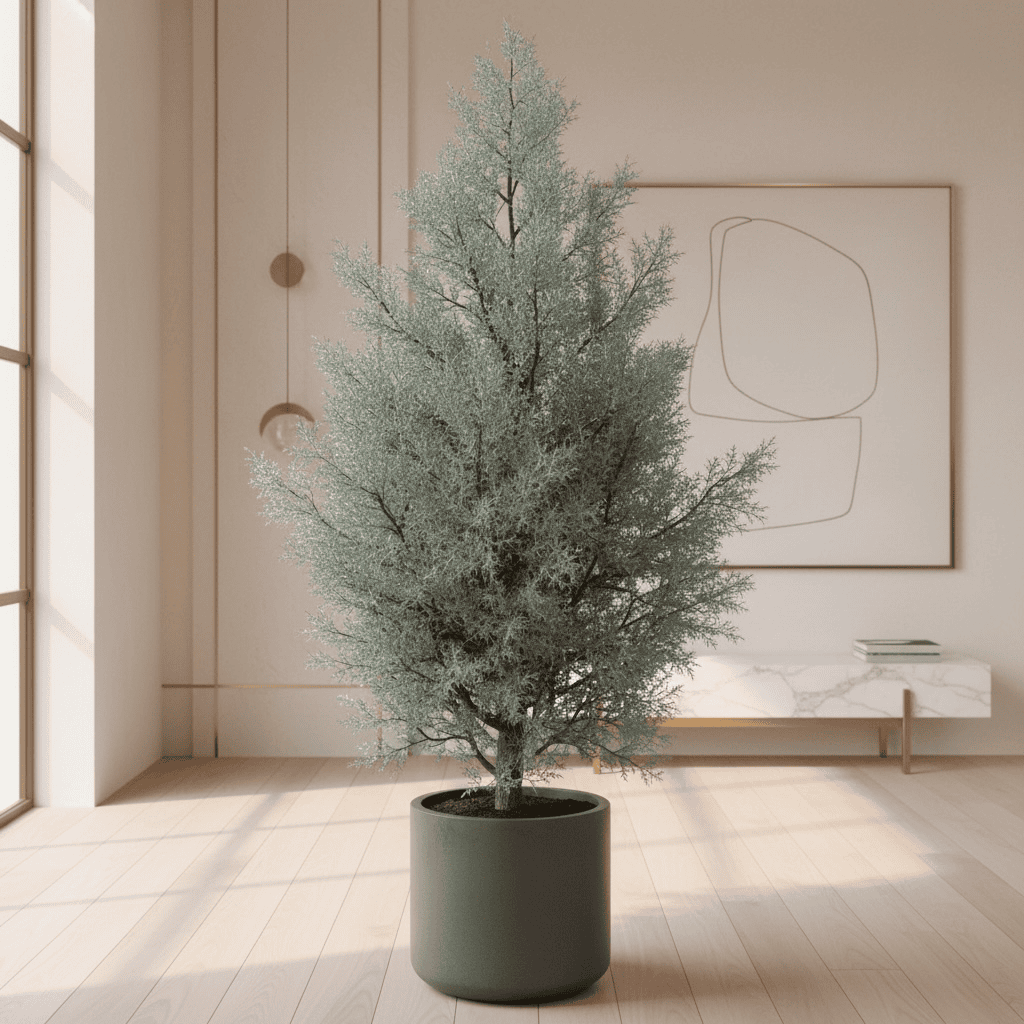
Shop this plant at PlantShop.hkA silver-blue conifer that brings an icy, Mediterranean look to Hong Kong gardens and terraces. The one rule that matters most: give it full sun and let it dry out between waterings.
Light6+ hrs direct sun; 8+ hrs is ideal
WateringPotted: soak once top soil is dry; every 5–7 days in summer
Best spot in HKSunny, airy garden, terrace or rooftop
PetsMild tummy upset if chewed — keep out of reach
Care in a nutshell
To grow Blue Ice Cypress in Hong Kong, give it the sunniest spot you have: at least six to eight hours of direct sun a day keeps that silver-blue colour strong. It is very drought-tolerant once established, so when in doubt, don't water. Hong Kong's humid summers are the real test, so keep it somewhere airy and open rather than in a stuffy corner, and you will avoid most pest and disease problems. Best of all, it holds a neat shape without any pruning.
Shop · Blue Ice Cypress (from HK$580)
Origin & characteristics
Blue Ice Cypress — botanically known as Cupressus arizonica var. glabra 'Blue Ice' (also classified under Hesperocyparis arizonica 'Blue Ice') — is a selected cultivar of the Smooth Arizona Cypress, belonging to the cypress family Cupressaceae. Its parent species, Cupressus arizonica, is native to the arid mountain regions of the southwestern United States (Arizona, New Mexico) and northern Mexico, where it grows at elevations of 1,000–2,000 metres on rocky slopes, adapted to hot, dry continental conditions with intense sunlight.
The cultivar's story carries a distinctly New Zealand imprint. In the 1960s, staff at the renowned Duncan and Davies Nurseries in New Plymouth, New Zealand, noticed a naturally occurring variant among a batch of Arizona cypress seedlings — a single individual with unusually silver-blue foliage and an unusually compact growth habit. After more than two decades of observation, testing, and vegetative propagation, this chance seedling was formally named 'Blue Ice' and released to the market in 1984. Its outstanding silver-blue colour, tidy habit, and vigorous growth quickly made it an international horticultural favourite, especially popular in Mediterranean-climate regions and the Southern Hemisphere.
Key identifying features:
- Foliage colour: The primary attraction is the intense, lasting silver-blue needle foliage. The leaves are tiny, scale-like, and pressed tightly to the stems, forming dense, flattened sprays. A waxy, powdery coating (glaucous bloom) covers the leaf surface, reflecting light to create a distinctive frost-like sheen. This blue colour persists year-round and does not fade with the seasons.
- Growth habit: Naturally forms a narrow pyramid or columnar shape with a compact, symmetrical outline that needs no pruning to look attractive. Mature trees can reach 12–15 metres in height with a 3–5 metre spread, though growth is moderate at approximately 30–45 cm per year.
- Bark character: Young stems are rounded; as the tree matures, the bark flakes away in patches to reveal attractive reddish-brown inner bark that contrasts beautifully with the silver-blue foliage.
- Fragrance: When crushed, the foliage releases a fresh, resinous cypress aroma with subtle citrus notes, which has natural insect-repellent properties.
In Hong Kong, Blue Ice Cypress works beautifully as a garden specimen tree, a hedge backdrop, or a large container plant. Its silver-blue tones provide striking contrast against the predominantly green tropical planting palette, adding a Mediterranean freshness and visual depth. It is particularly well-suited to modern minimalist, industrial, or Mediterranean-style outdoor spaces.
Light
Blue Ice Cypress is a full-sun tree with very high light requirements:
- Minimum requirement: At least 6 hours of direct sunlight daily. Insufficient light causes the canopy to become sparse and the signature silver-blue colour to fade to dull grey-green.
- Ideal conditions: Full sun (8+ hours of direct light daily). South- or west-facing, unshaded positions in Hong Kong are ideal.
- Air circulation: Good ventilation is essential. Avoid cramped, enclosed corners where stagnant air can encourage pests and disease.
While reference sources note that Blue Ice Cypress can theoretically tolerate any aspect (east, south, west, or north), in Hong Kong's actual conditions, north-facing positions are often too dim for good colour development. If growing on a rooftop or terrace, choose the brightest spot available. The tree's natural habitat of wide-open, sun-baked mountain slopes means it is built for maximum light exposure — anything less compromises its signature colour.
Watering
Blue Ice Cypress is native to arid regions and has excellent drought tolerance, making its watering requirements relatively forgiving:
- General principle: "Better dry than wet." Established trees in the ground rarely need supplemental watering and survive on rainfall alone. Container plants should be watered thoroughly when the top layer of soil feels dry — generally every 5–7 days in summer and every 10–14 days in winter.
- Establishment period: Newly planted trees need more frequent watering for the first 6–12 months (once or twice weekly) to encourage deep root development. Gradually reduce watering frequency once the root system is established.
- Rainy season: Hong Kong's summer downpours can be intense. Ensure the planting site or container has excellent drainage to prevent prolonged waterlogging. While Blue Ice Cypress tolerates drought well, it does not tolerate waterlogged soil.
- Winter watering: Growth slows to a near standstill in winter, and water demand is minimal. Overwatering in winter is one of the most common causes of tree death.
Soil & pot
- Soil requirements: Blue Ice Cypress adapts to almost any soil type — sand, loam, or clay — with one non-negotiable requirement: good drainage. The optimal pH range is slightly acidic to neutral (pH 6.0–7.5), though it can tolerate mildly alkaline conditions.
- In-ground planting: Dig a hole twice as wide as the root ball and the same depth. Backfill with native soil — no special amendments needed. If planting in heavy yellow clay common in some Hong Kong areas, consider raising the planting bed slightly or adding coarse sand to improve drainage.
- Container mix: Drainage is paramount. Recommended mix: coarse sand or volcanic rock 3 parts + quality potting mix 3 parts + coco peat 2 parts + perlite 2 parts. Place a 5 cm layer of gravel at the bottom of the pot for drainage.
- Pot selection: Large, deep containers (at least 40 cm in diameter and depth). Terracotta or cement pots offer better breathability for Hong Kong's humid conditions. Plastic pots require extra attention to drainage.
- Repotting: Every 2–3 years, moving up one pot size (approximately 5–10 cm larger in diameter).
- Fertilising: Blue Ice Cypress has very low fertiliser requirements. Excessive nitrogen causes leggy growth and green foliage that ruins the cultivar's signature colour. A single application of slow-release fertiliser in spring is sufficient, or skip feeding entirely. If growth appears stunted, a light application of balanced slow-release fertiliser in spring can help.
Temperature & humidity
Blue Ice Cypress has a broad temperature tolerance range, but Hong Kong's humid subtropical summers present its biggest challenge:
- Cold hardiness: Tolerates USDA Zones 7–9 (minimum temperatures approximately -18°C to -1°C). Hong Kong winters pose absolutely no problem.
- Heat tolerance: The parent species is adapted to the hot, dry climate of the American Southwest and can tolerate temperatures above 40°C. Hong Kong summer heat itself is not an issue.
- Humidity considerations: High humidity is what Blue Ice Cypress struggles with most. Its native habitat is dry, and prolonged exposure to high humidity encourages fungal diseases and mite infestations. Hong Kong summer humidity frequently exceeds 80%, so growers must take precautions:
- Choose a position with good airflow; avoid enclosed corners
- Ensure adequate spacing between plants to promote air circulation
- Avoid wetting the foliage when watering
- Regularly inspect for signs of pests or disease
This humidity sensitivity means Blue Ice Cypress is best suited to rooftop gardens, open terraces, and well-ventilated balconies rather than enclosed, sheltered courtyards.
Common problems
| Issue | Likely cause | What to do |
|---|---|---|
| Foliage colour fading from silver-blue to grey-green | Insufficient light or excess nitrogen | Move to a brighter position; stop feeding or switch to low-nitrogen fertiliser |
| Inner branches turning brown and dropping | Natural ageing (normal needle shed for conifers) | If outer foliage is healthy, this is normal — no action needed |
| White, cottony masses on branches | Cypress mealybug or aphid infestation | Blast with strong water jet; apply neem oil; use systemic insecticide for severe cases |
| Yellow-brown spots on foliage spreading outward | Fungal infection (common in high humidity) | Improve ventilation; prune affected branches; apply organic fungicide |
| Stunted growth, sparse branching | Severe light deficiency or poor drainage | Check light levels at planting position; inspect soil drainage |
Not sure your spot gets enough light, or something looks off? Send us a photo on WhatsApp 4492 9648 and we’ll take a look.
Questions people ask
Can Blue Ice Cypress grow in Hong Kong?
Yes. It tolerates Hong Kong's summer heat and winters without trouble. The main challenge is humidity, so plant it in full sun with good air circulation and well-draining soil.
How often should I water a Blue Ice Cypress in a pot?
Water thoroughly once the top soil has dried: roughly every 5–7 days in summer and every 10–14 days in winter. Newly planted trees need watering once or twice a week for the first 6 months to a year.
Why is my Blue Ice Cypress turning grey-green?
Usually too little light or too much nitrogen fertiliser. Move it to a brighter spot and ease off feeding, as it needs very little.
Is Blue Ice Cypress safe for cats and dogs?
It is not considered toxic, but chewing large amounts of the needles may cause mild vomiting or diarrhoea. If your pet likes to nibble plants, keep the pot up high or fenced off.
Fun facts
New Zealand's happy accident: The 'Blue Ice' cultivar was discovered entirely by chance. In the 1960s, a batch of Arizona cypress seedlings at Duncan and Davies Nurseries in New Plymouth produced one individual with unusually intense silver-blue colouring and a particularly compact form. This method of discovering superior plants from seed — called a "chance seedling" — is how many famous cultivars have come into being, including the Granny Smith apple and countless rose varieties.
Cypress canker immunity: One of Blue Ice Cypress's greatest strengths is its near-immunity to cypress canker, a devastating fungal disease caused by Seiridium cardinale that has killed cypress trees on a massive scale in New Zealand and Europe. Thanks to its Arizona cypress genetics, 'Blue Ice' shows exceptional resistance to this disease, making it the ideal choice in areas where cypress canker is prevalent.
Taxonomic musical chairs: The Arizona cypress has undergone several classification changes in recent years. Traditionally placed in Cupressus, some botanists have argued it should be moved to a separate genus, Hesperocyparis (making it Hesperocyparis arizonica 'Blue Ice'). In horticultural trade, however, the Cupressus name remains the most widely used.
References (expand to view sources)
References
- Royal Horticultural Society (RHS). (2024). Cupressus arizonica var. glabra 'Blue Ice'. https://www.rhs.org.uk/plants/74526/cupressus-arizonica-var-glabra-blue-ice/details
- The Spruce. (2024). How to Grow and Care for Arizona Cypress. https://www.thespruce.com/arizona-cypress-growing-tips-3269300
- The Tree Center. (2024). Blue Ice Arizona Cypress. https://www.thetreecenter.com/blue-ice-arizona-cypress/
- Leafland. (2026). Cupressus arizonica var. glabra 'Blue Ice'. https://leafland.co.nz/plants/cupressus-arizonica-var-glabra-blue-ice/
- Mr. Maple. (2024). Cupressus arizonica 'Blue Ice'. https://mrmaple.com/products/buy-cupressus-arizonica-blue-ice-blue-arizona-cypress
- Plants of the World Online (POWO). (2024). Cupressus arizonica Greene. https://powo.science.kew.org/
⚠️ Pet / toxicity: Blue Ice Cypress is non-toxic to humans. The foliage contains essential oils characteristic of the cypress family. If a pet consumes large quantities of needles, mild gastrointestinal upset (vomiting or diarrhoea) may occur. In general, pets show little interest in conifer foliage, but if your pet has a habit of chewing plants, consider placing the pot in a raised position or behind a barrier.
Shop at Plantshop
View all Plants →
For Hong Kong homes and offices. Stock and pricing follow the product page.
FAQs
Origin & characteristics
Blue Ice Cypress — botanically known as Cupressus arizonica var. glabra 'Blue Ice' (also classified under Hesperocyparis arizonica 'Blue Ice') — is a selected cultivar of the Smooth Arizona Cypress, belonging to the cypress family Cupressaceae. Its parent species, Cupressus arizonica, is native to the arid mountain regions of the southwestern United States (Arizona, New Mexico)
Watering
Blue Ice Cypress is native to arid regions and has excellent drought tolerance, making its watering requirements relatively forgiving:
Fun facts
New Zealand's happy accident: The 'Blue Ice' cultivar was discovered entirely by chance. In the 1960s, a batch of Arizona cypress seedlings at Duncan and Davies Nurseries in New Plymouth produced one individual with unusually intense silver-blue colouring and a particularly compact form. This method of discovering superior plants from seed — called a "chance seedling" — is
Keywords
Blue Ice Cypress, Cupressus 'Blue Ice', silver-blue conifer, Arizona cypress, garden tree, Hong Kong garden plant, ornamental conifer, full sun plant, drought-tolerant tree, Mediterranean garden, rooftop plant, terrace specimen, conifer care
