


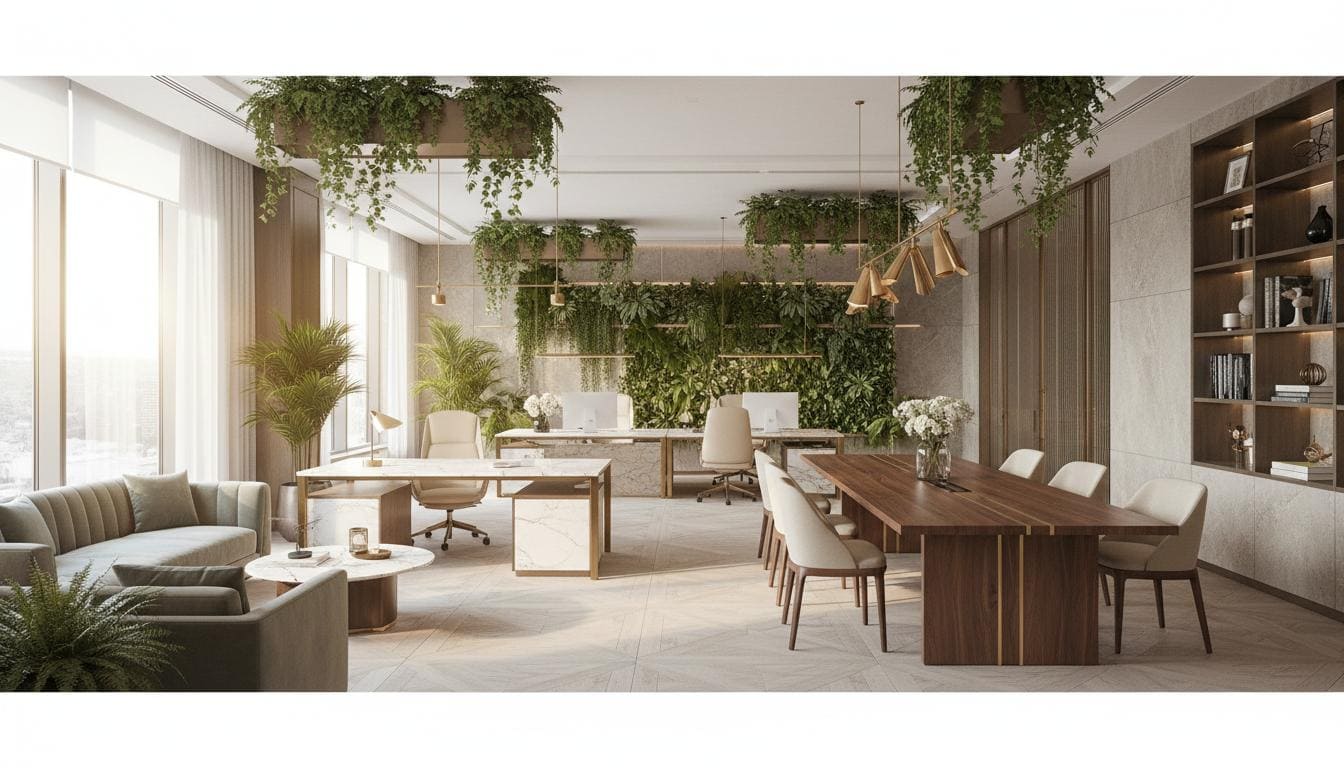

The office photographs that lodge in memory are rarely memorable for a sofa. They are memorable for that one tree in the corner — the specimen that shifts the entire spatial register around itself, and makes the room feel like someone thought carefully about it. A well-positioned plant transforms an ordinary interior into one that stays with you. Here are styling approaches that reflect how that works — not for the photograph, but for how the space feels on the Tuesday morning when nothing is going particularly well.
Reception: The First Impression Begins Before Anyone Speaks — instagram office plants
Fiddle-Leaf Fig — Sculptural Anchor
The Fiddle-Leaf Fig‘s broad, sweeping leaves carry the visual authority of a sculpture that costs significantly more than it does. In a reception area, position it slightly to one side of the entrance the eye will arrive there first without being directed. It should welcome rather than obstruct; let it stand to the side, composed and unhurried.
Styling note: Against matte white or pale grey walls, the Fiddle-Leaf Fig‘s deep green leaves advance with remarkable clarity. Pair with a matte-black ceramic or concrete-textured planter for a gallery register. Clean, considered, and quietly commanding.
Meeting Room: Where the Space Needs to Breathe
Monstera — Fenestrated Architecture
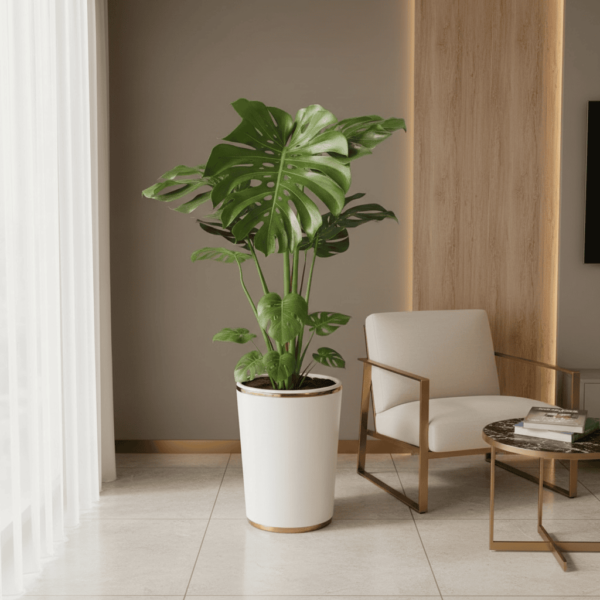
The Monstera‘s leaf perforations and splits are not incidental they are its defining visual grammar, and one of nature s more convincing arguments for organic over engineered form. When backlit, light filters through those apertures and projects shifting patterns across walls and floor. Mid meeting, the peripheral awareness of a shifting leaf shadow is a small but real reprieve the brain s equivalent of a breath.
Styling note: The Monstera‘s organic, irregular silhouette in direct conversation with the meeting room’s right angles and flat planes — the curves interrupt the uniformity precisely as needed. Choose a round pot to soften the geometry further.
Break Area: A Few Seconds of Somewhere Else
Giant Bird of Paradise — Immersive Transformation
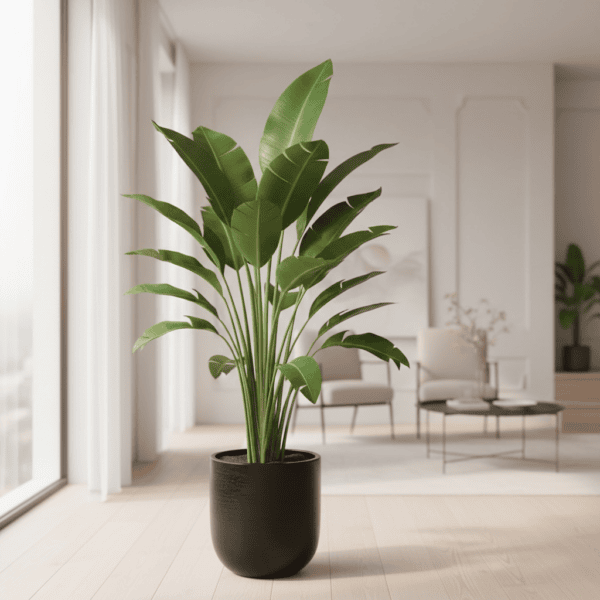
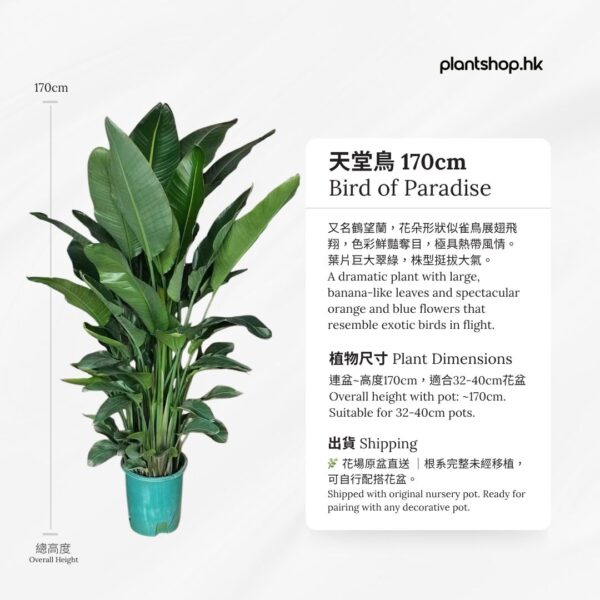
The Giant Bird of Paradise is a spatial event. Tall, broad leaved, and carrying the particular authority of tropical abundance, it can transform a pantry corner into something that reads as elsewhere. Pair it with a rattan chair or a timber table, and the colleagues who come for coffee will take an involuntary moment to be away from their screens before returning. That brief displacement three seconds, possibly five produces a measurable restoration effect.
Styling note: The Giant Bird of Paradise‘s deep, glossy leaves sit effortlessly alongside rattan furniture, pale timber, or a linen rug. The combination moves directly toward tropical retreat. Keep everything else in the vicinity edited — the plant is the composition, and it does not require assistance.
Personal Workspace: A Small, Specific Green
Snake Plant — Geometric Restraint
The Snake Plant’s upright lines do not encroach on desk space, and they do not spread the way trailing plants do. They occupy their position with a composed verticality that is, in its own way, a kind of architectural courtesy. When the eyes are strained from the screen and need somewhere to rest, those clean, geometric leaves offer a focus that does not demand anything in return.
Styling note: Snake Plant in a concrete pot for industrial precision; white ceramic for minimalist clarity. Three of them arranged on a low cabinet create the spatial psychology of a partition — privacy without walls, the quality that every open-plan office needs and few achieve.
Vertical Space: The Overlooked Dimension
Hanging Pothos — The Shelf That Softens Everything
Pothos is not a large plant, but its trailing character makes it capable of a quiet drama that belies its scale. Suspended from the top of tall bookshelves or allowed to cascade along shelf edges, it descends in long, loose arcs that soften every hard furniture line it encounters. In offices with generous ceiling height, hanging plants address the upper zone that floor specimens leave entirely vacant — and a room with inhabited vertical space feels more resolved, more complete.
Styling note: Pothos’s fine, tender green leaves in direct contrast with dark timber shelving — the tonal difference makes the layering read with particular sharpness. Resist the urge to over-prune; the trailing habit is the point.
How to Arrange Without Tipping into Chaos
The most common error is density — too many plants, or plants that are too small relative to the space they are meant to address. Large plants require breathing room: allow at least the width of a person’s body around them. Resist the impulse to mix too many species within a single zone — one to two large plant types per area is a considered limit. And treat the pot as a decision equal in weight to the plant itself: a planter chosen to suit the space’s visual language makes the plant feel deliberate rather than arrived at.
Identify the dullest position in your office. Place one plant there, and observe how long it takes before colleagues begin to slow their pace as they pass it. They will.
PlantShop specialises in 130–180cm large and medium plants, each inspected by a horticulturist. Corporate clients receive dedicated WhatsApp follow-up from a person. Orders delivered as early as Friday, free shipping to Hong Kong urban areas.
Related Products
Below are the plants mentioned in this article, available for direct purchase. Each comes with a personal care card and WhatsApp support from a real person:



FAQs
Reception: The First Impression Begins Before Anyone Speaks Fiddle-Leaf Fig — Sculptural Anchor
The Fiddle-Leaf Fig's broad, sweeping leaves carry the visual authority of a sculpture that costs significantly more than it does. In a reception area, position it slightly to one side of the entrance the eye will arrive there first without being directed. It should welcome rather than obstruct; let it stand to the side, composed and unhurried.
Meeting Room: Where the Space Needs to Breathe Monstera — Fenestrated Architecture
The Monstera's leaf perforations and splits are not incidental they are its defining visual grammar, and one of nature s more convincing arguments for organic over engineered form. When backlit, light filters through those apertures and projects shifting patterns across walls and floor. Mid meeting, the peripheral awareness of a shifting leaf shadow is a small but real reprieve the brain s equival
Break Area: A Few Seconds of Somewhere Else Giant Bird of Paradise — Immersive Transformation
The Giant Bird of Paradise is a spatial event. Tall, broad leaved, and carrying the particular authority of tropical abundance, it can transform a pantry corner into something that reads as elsewhere. Pair it with a rattan chair or a timber table, and the colleagues who come for coffee will take an involuntary moment to be away from their screens before returning. That brief displacement three sec
Personal Workspace: A Small, Specific Green Snake Plant — Geometric Restraint
The Snake Plant's upright lines do not encroach on desk space, and they do not spread the way trailing plants do. They occupy their position with a composed verticality that is, in its own way, a kind of architectural courtesy. When the eyes are strained from the screen and need somewhere to rest, those clean, geometric leaves offer a focus that does not demand anything in return.
