



12:30 PM, twenty-sixth floor of a commercial building in Central. Amy returns from lunch, but she does not open her computer with the immediacy that usually follows her back through the door. Instead, she reaches for a spray bottle and mists the Peace Lily on the windowsill — three slow arcs of water. The droplets slide down the leaves in the light. She watches for a minute without particular purpose.
“That minute is the calmest point in my entire day,” she tells me.
Amy is not a gardening enthusiast. She is an accountant who has spent eight years at a multinational corporation with a well-earned reputation for intensity, working upward of fifty hours a week. The Peace Lily arrived during the company’s greening programme the previous year. No one anticipated that it would become what colleagues on the entire floor came to treat as a communal charging station.
What the Science Establishes — office plants mental health
In 1989, environmental psychologists Rachel and Stephen Kaplan proposed Attention Restoration Theory. The argument is precise: the brain’s capacity for focused attention is a finite resource. Sustained cognitive effort depletes what they termed “directed attention,” producing the familiar compound of mental fatigue, diminished concentration, and declining output. Natural environments — including, at minimum, the visual experience of plants — provide what Kaplan and Kaplan called “soft fascination”: effortless engagement that allows directed attention to replenish without the exhausting quality of forced concentration.
This theory has been validated and built upon across more than thirty years of subsequent research.
In 2014, a team led by Dr. Craig Knight at the University of Exeter conducted long-term experiments in working offices across the UK and the Netherlands. Their findings challenged the prevailing “lean office” management philosophy directly: introducing plants increased employee productivity by 15%, improved reported air quality satisfaction, and significantly enhanced the quality of focus. Knight’s summary was unsparing: “If you put an ant in an empty glass jar, or a gorilla in a bare cage — they would suffer. Placing people in lean offices is the same.”
An experiment conducted at the 2013 Chelsea Flower Show produced figures that went further: workspaces that incorporated plant greenery and allowed employees a degree of participation in their environment produced a 47% increase in reported happiness and a 45% increase in creativity.
Why Does Simply Looking at Plants Restore Something?
Green is the least fatiguing colour for the human eye — not a poetic observation but a physiological one. The eye expends the least processing energy on green wavelengths; when the brain receives these signals, sympathetic nervous system activation eases. But at a deeper level, the mechanism may be the satisfaction of directed care itself. In an environment saturated with uncertainty — fluctuating metrics, shifting client demands, organisational restructuring — a plant is one of the few objects that returns precisely what you invest in it. Water it, and it grows. Neglect it, and it declines. The feedback loop is honest, immediate, and entirely legible. That reliability, in a context where so little else is, is itself a form of relief.
Practical Recommendations
For individuals: A single small plant on the desk is sufficient. It does not need to be significant in scale — a compact Pothos or an air plant provides the necessary visual anchor. When the work bears down, allow the gaze to rest there for thirty seconds. Those thirty seconds are not a loss of time. They are yours.
For companies: Do not distribute a hundred plants across neglected corners as a declaration of commitment to wellness. Buy fewer, and position them where people spend time and look. More importantly — give employees a voice in the selection. Which plant, where, and who cares for it. The engagement is where the sense of genuine wellbeing originates; the plant alone is only the vehicle.
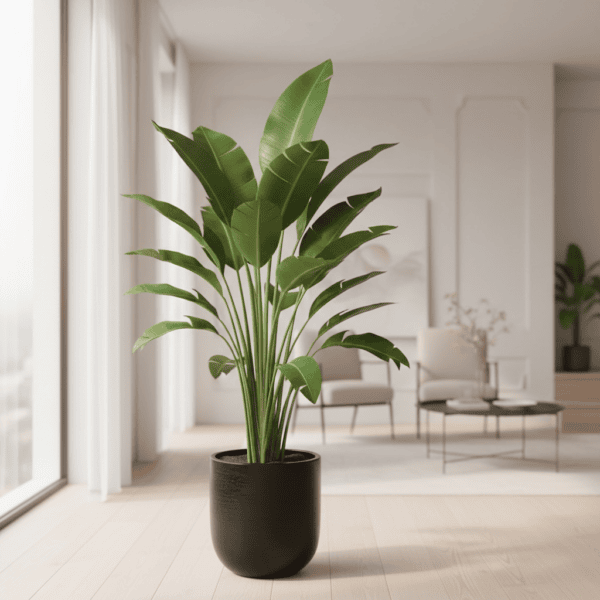
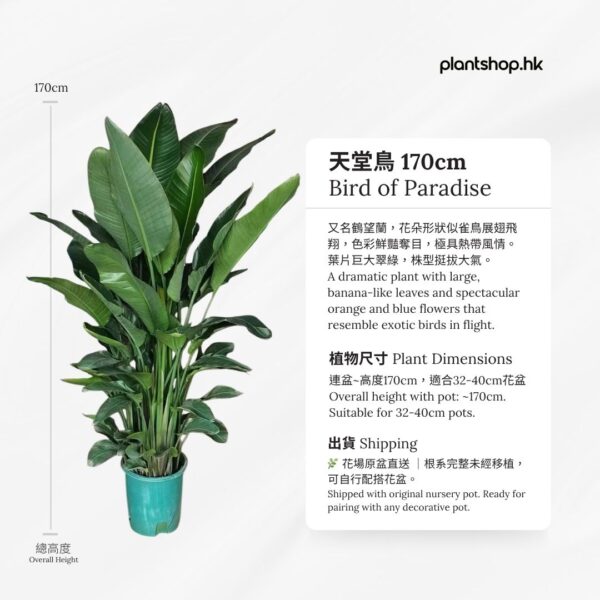
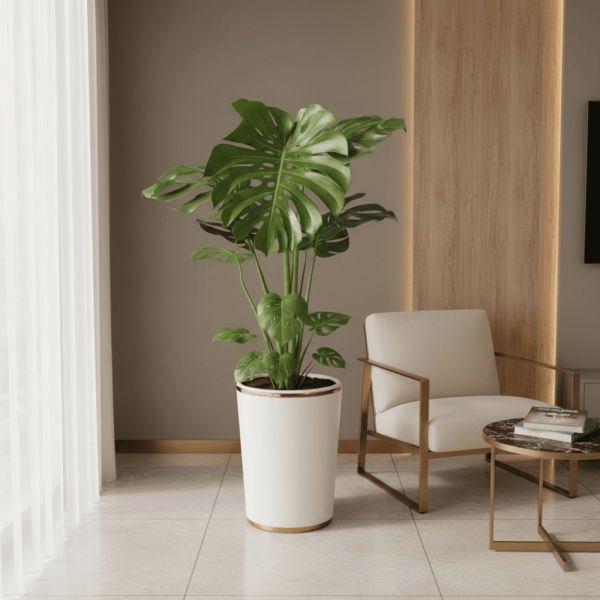
PlantShop carries 130–180cm large indoor plants — Monstera, Bird of Paradise, Areca Palm — suited to reception areas and meeting room corners. Each specimen comes with a personal care card covering watering, fertilising, and positioning. First time plant owners will find it sufficient.
Our Observation
In Hong Kong, 86% of employees working 45 to 54 hours per week report experiencing stress. At a certain threshold, any small release becomes disproportionately valuable. Plants will not resolve overtime. They will not ease a difficult client relationship, or alter the temperament of a demanding manager. But they extend one particular offer: a reason to pause.
When you water it in the morning. When you study the architecture of a leaf at noon. When you worry, before a long weekend, whether it will survive the days without you. In those moments — brief, unremarkable, accumulated — you are briefly and temporarily not at work. These pauses, layered over months and years, may be precisely what prevents the exhaustion from becoming permanent.
Contact us via WhatsApp for a direct reply — from a person, not a system. PlantShop Horticulture Team. We believe, unreservedly, in the use of plants.
Related Products
Below are the plants mentioned in this article, available for direct purchase. Each comes with a personal care card and WhatsApp support from a real person:



FAQs
What the Science Establishes
In 1989, environmental psychologists Rachel and Stephen Kaplan proposed Attention Restoration Theory. The argument is precise: the brain's capacity for focused attention is a finite resource. Sustained cognitive effort depletes what they termed "directed attention," producing the familiar compound of mental fatigue, diminished concentration, and declining output. Natural environments — including,
Why Does Simply Looking at Plants Restore Something?
Green is the least fatiguing colour for the human eye — not a poetic observation but a physiological one. The eye expends the least processing energy on green wavelengths; when the brain receives these signals, sympathetic nervous system activation eases. But at a deeper level, the mechanism may be the satisfaction of directed care itself. In an environment saturated with uncertainty — fluctuating
Practical Recommendations
For individuals: A single small plant on the desk is sufficient. It does not need to be significant in scale — a compact Pothos or an air plant provides the necessary visual anchor. When the work bears down, allow the gaze to rest there for thirty seconds. Those thirty seconds are not a loss of time. They are yours.
Our Observation
In Hong Kong, 86% of employees working 45 to 54 hours per week report experiencing stress. At a certain threshold, any small release becomes disproportionately valuable. Plants will not resolve overtime. They will not ease a difficult client relationship, or alter the temperament of a demanding manager. But they extend one particular offer: a reason to pause.
