



What Plants Say Before the Meeting Starts — luxury office greening
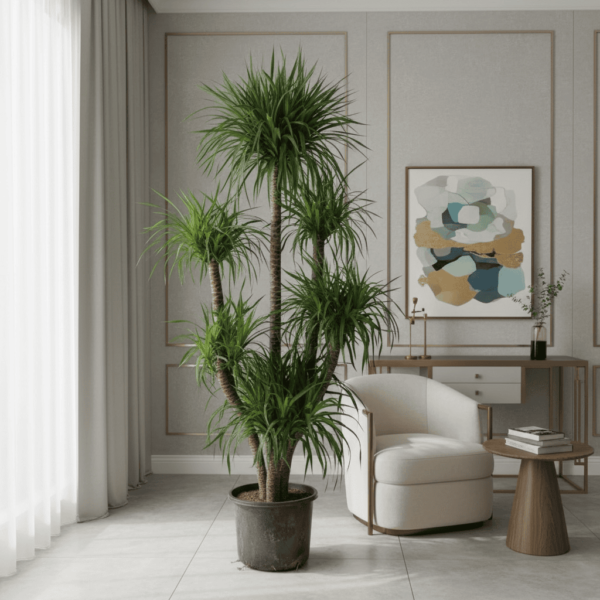
It was the reception area of a multinational law firm at Canary Wharf in London where I first understood, with real clarity, what plants can communicate. No statement artwork, no grand architectural gesture — simply a row of immaculately maintained Madagascar Dragon Trees in matte cement planters. The message arrived without ambiguity: we are organised, we attend to the details, we are understated and we mean it.
For a multinational company, the office is no longer merely where work occurs. It is an extension of the brand — the physical surface on which the company’s character is either confirmed or contradicted. Clients arrive for meetings and absorb the space before they open their briefcase. Employees inhabit it for eight hours or more each day. Partners fly in and form judgments that travel home with them. Every detail tells a version of the story, whether the company intended it or not.
Different Companies, Different Plant Languages Google’s offices deploy plants to project openness and creative abundance: many varieties, freely arranged, communicating *we welcome different thinking, we celebrate plurality*. Apple moves in the opposite direction — restrained greening, each plant chosen with precision, every planter a design decision — refinement and discipline rendered in living form. Airbnb once incorporated native plant varieties throughout their offices to embody a sense of belonging anywhere — the brand’s essential philosophical proposition made tangible in foliage.
Three companies, three entirely different strategies. One consistent principle: the choice and placement of plants must be true to the brand’s spirit.
First Impressions Are Not a Soft Concept Princeton University research established that the brain forms a judgment about a stranger’s face in one-tenth of a second. The same unconscious calculation applies to spaces. When a client walks through your door, the subconscious is already running its assessment: does this company have taste? Does it attend to its own environment? Can it be trusted with mine?
A commanding specimen in reception — a Burgundy Rubber Plant, a Madagascar Dragon Tree, a living wall — delivers a categorically different signal from a desiccated ficus standing unnoticed in a corner. We specialise in 130–180cm large greenery, each pot hand-selected to ensure a presence that registers as both striking and considered.
Spatial Strategy by Area Reception:
The assignment here is to impress and remain in memory. A distinctively formed large plant or a well-designed living wall ensures that visitors remember the company before the first word of the meeting has been spoken.
Meeting rooms: Understated, professional. Potted plants that clean the air and soften the geometry without competing for attention.
CEO’s office: A reflection of personal standard. A well-maintained bonsai or a single, elegantly proportioned medium plant communicates: I hold myself to high standards, and the detail shows.
Employee areas: Comfortable, energising. A varied composition that makes the space feel actively inhabited rather than maintained at minimum viability.
ESG: Structural Obligation, Not Optional Gesture From January 2026, the EU Carbon Border Adjustment Mechanism (CBAM) came into formal effect, with the first CBAM certificate priced at €75.36 per tonne of CO₂. For Hong Kong companies with European operations or supply chains, environmental accountability is no longer a reporting formality — it is a commercial reality. Office greening that improves air quality and reduces the carbon footprint of an interior becomes a tangible, documentable commitment within ESG disclosure.
The Value Runs Deeper Than the Price of the Plant The question we hear least often from multinational clients is “what will this cost?” — and the question we hear most rarely is “what value does this deliver?” These are different questions, and the gap between them matters. The value of considered greening is not in the invoice. It is in what the plants carry: the company’s commitment to its people, its precision across every detail, its environmental seriousness. Research confirms that employee productivity increases by 10–15% in green environments (University of Exeter, 2014), and that employees in offices incorporating natural elements consistently report higher satisfaction. These are not figures to be inflated into a formula, but directionally they make the case without ambiguity: the return on greening runs significantly deeper than decoration.
To choose the right large greenery for your company:
WhatsApp us for a direct reply, tailored species recommendations, and 3–7 business day delivery. — PlantShop Horticulture Team
Related Products
Below are the plants mentioned in this article, available for direct purchase. Each comes with a personal care card and WhatsApp support from our team:



FAQs
What Plants Say Before the Meeting Starts
It was the reception area of a multinational law firm at Canary Wharf in London where I first understood, with real clarity, what plants can communicate. No statement artwork, no grand architectural gesture — simply a row of immaculately maintained Madagascar Dragon Trees in matte cement planters. The message arrived without ambiguity: we are organised, we attend to the details, we are understated
Spatial Strategy by Area Reception:
The assignment here is to impress and remain in memory. A distinctively formed large plant or a well-designed living wall ensures that visitors remember the company before the first word of the meeting has been spoken.
To choose the right large greenery for your company:
WhatsApp us for a direct reply, tailored species recommendations, and 3–7 business day delivery. — PlantShop Horticulture Team
Related Products
Below are the plants mentioned in this article, available for direct purchase. Each comes with a personal care card and WhatsApp support from our team:
