



Plantshop.hk · Care Encyclopedia
How to Care for Money Tree (Pachira) in Hong Kong
From HK$480 · Hong Kong delivery
Hong Kong care guide — useful before you buy and after it arrives.
Shop this plant at PlantShop.hkThe Money Tree's braided trunk and five-fingered leaves make it the classic "good fortune" plant for Hong Kong living rooms. The one rule that matters most: let the soil dry out before you water.
Light1–2 m from an east/south window; bright indirect light
WateringWater when top 3 cm is dry: 7–10 days summer, 10–14 winter
Best spot in HKBright living room, away from air-con vents
PetsMildly toxic to cats & dogs; sap may irritate skin
Care in a nutshell
To grow a Money Tree in Hong Kong, place it 1–2 metres from an east- or south-facing window, where it gets bright indirect light without harsh midday sun. Insert a finger about 3 cm into the soil and water only when it is completely dry, then empty the saucer after 15 minutes. Its trunk stores water, so it is happier a little dry than sitting in soggy soil. Keep it out of the path of air-conditioning draughts, and repot only one size up every 2–3 years in spring.
Shop · Money Tree (Pachira) (from HK$480)
Origin & characteristics
Pachira aquatica — known as the Money Tree, Malabar Chestnut, or in Chinese as "fa cai shu" (literally "prosperity tree") — is native to the tropical wetlands of Central and northern South America, ranging from southern Mexico through Guatemala, Honduras, and into northern Brazil. In its natural habitat, it grows into a substantial evergreen tree reaching 18–20 metres tall, with a thick trunk that swells at the base to form a water-storage organ known as a caudex. The leaves are palmately compound, typically with 5–7 leaflets radiating from the tip of the petiole like an outstretched hand. Large, showy flowers bloom at night, with creamy-white petals marked with reddish-brown striations and a subtle fragrance; these develop into woody seed pods that split open when ripe to reveal edible seeds known locally as "Malabar chestnuts."
The Money Tree's history as an indoor plant dates to the 1980s. According to horticultural lore, a Taiwanese truck driver noticed several seedlings growing closely together and wove their flexible trunks into a braid. The resulting form was so visually appealing that it launched a commercial tradition. Today, virtually all Money Trees sold as houseplants are created by braiding 3–5 young seedlings together, producing the distinctive "plaited trunk" that symbolises interwoven fortunes and prosperity flowing from multiple sources.
In Hong Kong conditions, the Money Tree is a medium-difficulty large foliage plant. Its water-storing trunk provides some protection against occasional forgetfulness with watering, but prolonged waterlogging or placement in poorly ventilated, heavily air-conditioned environments can lead to root rot or yellowing foliage. Growth rate is moderate, with 2–3 flushes of new leaves each spring and summer; light pruning helps maintain a compact, attractive shape.
Light
The Money Tree thrives in bright, indirect light. The ideal position is 1–2 metres from an east- or south-facing window. Adequate light produces rich green foliage and sturdy stems; insufficient light results in small new leaves, elongated petioles, and gradual yellowing and loss of lower leaves. Avoid direct midday summer sun, which can scorch the leaves and produce brown patches.
For typical Hong Kong flats: if your living room only has north-facing windows or relies on artificial lighting, try moving the plant to a brighter location for a "holiday" of 2–3 days every week, or supplement with a grow light. In air-conditioned rooms, never position the Money Tree directly in the path of cold airflow — the dry, chilled air accelerates moisture loss from the leaf surface, causing brown, crispy leaf edges.
Watering
The guiding principle for watering a Money Tree is "dry thoroughly, water thoroughly." Insert your finger approximately 3 cm into the soil; only water when the soil feels completely dry at that depth. Water slowly and evenly until water flows from the drainage holes, then wait 15 minutes and discard any standing water from the saucer. The water-storing trunk gives the plant reasonable drought tolerance — a minor lapse in watering is rarely fatal. However, soil that remains constantly wet is the primary cause of root rot in this species.
Seasonal adjustments:
| Season | Frequency | Notes |
|---|---|---|
| Spring–Summer (growing season) | Every 7–10 days | Adjust based on pot size and ventilation |
| Autumn–Winter (semi-dormant) | Every 10–14 days | Allow soil to dry for an extra 2–3 days after feeling dry |
| Plum rain / returning humidity | Reduce frequency | Ensure saucer is emptied; pause watering if humidity is very high |
Hong Kong summers are hot and humid, but Money Trees in air-conditioned rooms dry out more slowly than you might expect — resist the urge to water on a fixed calendar schedule and always check the soil moisture first. In winter, if you use heating, the air will be drier; light misting around the plant (avoiding midday, which can leave water spots) can help prevent leaf tip browning.
Soil & pot
The Money Tree demands a loose, well-draining growing medium. Recommended recipe: 5 parts quality potting soil + 3 parts perlite or coarse sand + 2 parts coco coir. A small addition of bark chips can further improve aeration. The ideal pH is slightly acidic to neutral (6.0–7.0).
Pot selection:
- Terracotta or cement pots — Excellent breathability helps soil dry evenly; ideal for managing moisture in Hong Kong's climate
- Plastic pots — Lightweight and convenient, but require stricter watering discipline
- Drainage — Non-negotiable: every pot must have drainage holes, with a layer of clay pebbles or broken pottery shards at the base
- Size — Money Trees prefer slightly snug conditions; when repotting, move up only one size (3–5 cm larger in diameter). Oversized pots hold too much moisture and dramatically increase root rot risk
When repotting a braided Money Tree, handle with care — try to keep the root balls of the individual stems intact and avoid pulling or tearing the roots. Repot every 2–3 years in spring for best results.
Temperature & humidity
As a tropical plant, Pachira aquatica prefers temperatures of 18–27°C, which aligns well with indoor conditions throughout Hong Kong. Key temperature considerations:
- Minimum tolerance: Brief periods down to 10°C are survivable, but prolonged exposure below 15°C stops growth and may cause yellowing
- Air-conditioned rooms: Avoid direct cold airflow; if running AC at night, set the temperature no lower than 24°C
- Winter window positions: Nighttime temperatures near windows can drop significantly; on cold days (below 12°C), move the plant away from the glass
Humidity requirements are modest — the Money Tree adapts well to typical indoor humidity of 40–60%. Hong Kong summers provide ample ambient moisture naturally. During winter heating or continuous air conditioning, you can raise local humidity by:
- Grouping several plants together to create a shared humid microclimate
- Placing damp sphagnum moss or a humidity tray (pebbles with water below pot level) beneath the pot
- Light morning misting of the foliage, ensuring leaves dry completely during daylight hours
Common problems
| Issue | Likely cause | What to do |
|---|---|---|
| Lower leaves yellow and drop | Overwatering / poor drainage causing root rot | Check soil moisture, reduce watering; for severe cases, repot, trim rotten roots, and use a more aerated mix |
| Brown, dry leaf tips | Air too dry / cold AC draft / alkaline water | Move away from AC vents; increase humidity; use settled tap water or rainwater |
| Small new leaves with elongated stalks | Insufficient light | Move to a brighter position or add a grow light; rotate the pot regularly for even exposure |
| Brown spots on leaves | Sun scorch or fungal infection | Move to filtered light position; if fungal, remove affected leaves, improve airflow, apply organic fungicide |
| Soft, mushy base of braided trunk | Chronic overwatering causing trunk rot | Stop watering immediately, inspect roots; if rot is extensive, the affected stem may need to be cut away and propagated |
| All leaves drooping and wilting | Chronic underwatering or root damage | Check soil moisture; if bone dry, immerse the pot in water for 10 minutes to rehydrate thoroughly; if soil is wet, suspect root rot and repot |
Not sure your spot gets enough light, or something looks off? Send us a photo on WhatsApp 4492 9648 and we’ll take a look.
Questions people ask
How often should I water a Money Tree in Hong Kong?
About every 7–10 days in spring and summer and every 10–14 days in autumn and winter, adjusted for pot size and ventilation. The surest check is the soil: water only when it is dry about 3 cm down.
Can a Money Tree live in an air-conditioned room?
Yes, but keep it away from the vents, because dry cold air browns the leaf edges. If the air conditioning runs at night, set it no lower than 24°C. The plant prefers 18–27°C and can only briefly tolerate 10°C.
What soil and pot suit a Money Tree?
A loose, well-draining mix of 5 parts quality potting soil, 3 parts perlite or coarse sand and 2 parts coco coir, with a pH of 6.0–7.0. Choose a terracotta or cement pot with drainage holes.
Is a Money Tree safe for cats and dogs?
It is mildly toxic. Eating a large amount may cause vomiting or diarrhoea, so keep it where pets cannot nibble. The sap can also irritate sensitive skin, so wear gloves when pruning.
Fun facts
The botanical Chinese name for Pachira aquatica is "gua li", and the plant belongs to the mallow family (Malvaceae), which also includes hibiscus, cotton, and cacao. The genus name Pachira derives from a Venezuelan indigenous language, while the specific epithet aquatica accurately describes its native habitat along riverbanks and wetlands — a detail that surprises many growers, since the plant is often sold as being "afraid of water." In nature, P. aquatica can actually tolerate brief flooding, provided it has ample sunlight to drive transpiration. Indoors, where light is weaker and transpiration slower, the soil must be managed much more carefully to avoid waterlogging.
In feng shui practice, the five leaflets of Pachira aquatica correspond to the five elements (metal, wood, water, fire, earth), symbolising balance and completeness. Braided trunks are traditionally formed from three or five stems — three represents continuous growth ("continuous renewal"), while five invokes the blessing of "wu fu lin men" ("five blessings arriving at the door"). In the weeks surrounding Lunar New Year, sales of Money Trees surge across Hong Kong and Taiwan, with nurseries adorning the pots with red ribbons and decorative lai see packets to amplify the festive atmosphere.
The seeds of Pachira aquatica are genuinely edible in its native range — roasted, they taste similar to peanuts, which has earned the plant the nickname "French peanut" in some regions. However, ornamental cultivated varieties are not grown for consumption, and commercial plants may have been treated with pesticides, so eating the seeds from your houseplant is not recommended.
References (expand to view sources)
References
- Missouri Botanical Garden. Pachira aquatica – Plant Finder. https://www.missouribotanicalgarden.org/PlantFinder/PlantFinderDetails.aspx?taxonid=281173
- New York Botanical Garden. Money tree (Pachira aquatica) – Home Gardening Guide. https://libguides.nybg.org/pachira
- Patch Plants. Complete guide to money tree care. https://www.patchplants.com/pages/plant-care/complete-guide-to-money-tree-care/
- University of Florida IFAS Extension. Pachira aquatica – Malabar Chestnut. https://gardeningsolutions.ifas.ufl.edu/plants/trees-and-shrubs/small trees/pachira-aquatica.html
- The Spruce. "How to Grow and Care for a Money Tree." https://www.thespruce.com/grow-pachira-aquatica-indoors-1902779
⚠️ Pet / toxicity: Pachira aquatica is considered mildly toxic to cats and dogs. Ingestion of large quantities may cause mild gastrointestinal upset such as vomiting or diarrhoea. Position the plant where pets cannot nibble on it. The plant sap may cause skin irritation in sensitive individuals — wear gloves when pruning or repotting.
Shop at Plantshop
View all Plants →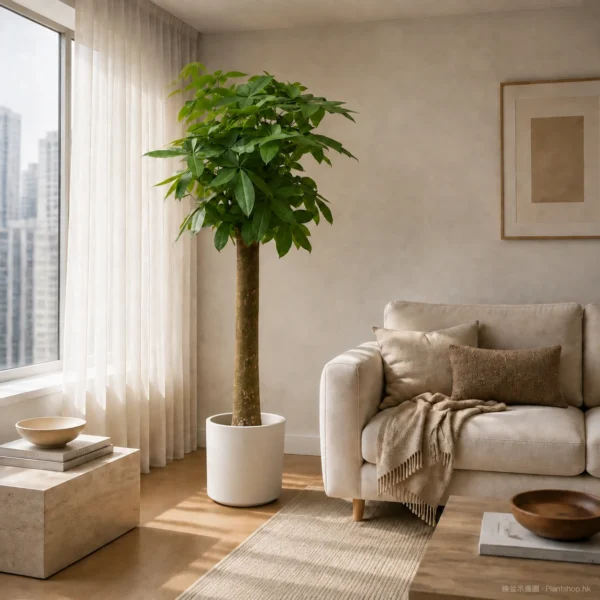

For Hong Kong homes and offices. Stock and pricing follow the product page.
FAQs
Origin & characteristics
Pachira aquatica — known as the Money Tree, Malabar Chestnut, or in Chinese as "fa cai shu" (literally "prosperity tree") — is native to the tropical wetlands of Central and northern South America, ranging from southern Mexico through Guatemala, Honduras, and into northern Brazil. In its natural habitat, it grows into a substantial evergreen tree reaching 18–20 metres tall
Watering
The guiding principle for watering a Money Tree is "dry thoroughly, water thoroughly." Insert your finger approximately 3 cm into the soil; only water when the soil feels completely dry at that depth. Water slowly and evenly until water flows from the drainage holes, then wait 15 minutes and discard any standing water from the saucer. The water-storing trunk gives the plant reasonable dr
Soil & pot
The Money Tree demands a loose, well-draining growing medium. Recommended recipe: 5 parts quality potting soil + 3 parts perlite or coarse sand + 2 parts coco coir. A small addition of bark chips can further improve aeration. The ideal pH is slightly acidic to neutral (6.0–7.0).
Temperature & humidity
As a tropical plant, Pachira aquatica prefers temperatures of 18–27°C, which aligns well with indoor conditions throughout Hong Kong. Key temperature considerations:
