



Plantshop.hk · Care Encyclopedia
How to Care for Umbrella Tree in Hong Kong
From HK$680 · Hong Kong delivery
Hong Kong care guide — useful before you buy and after it arrives.
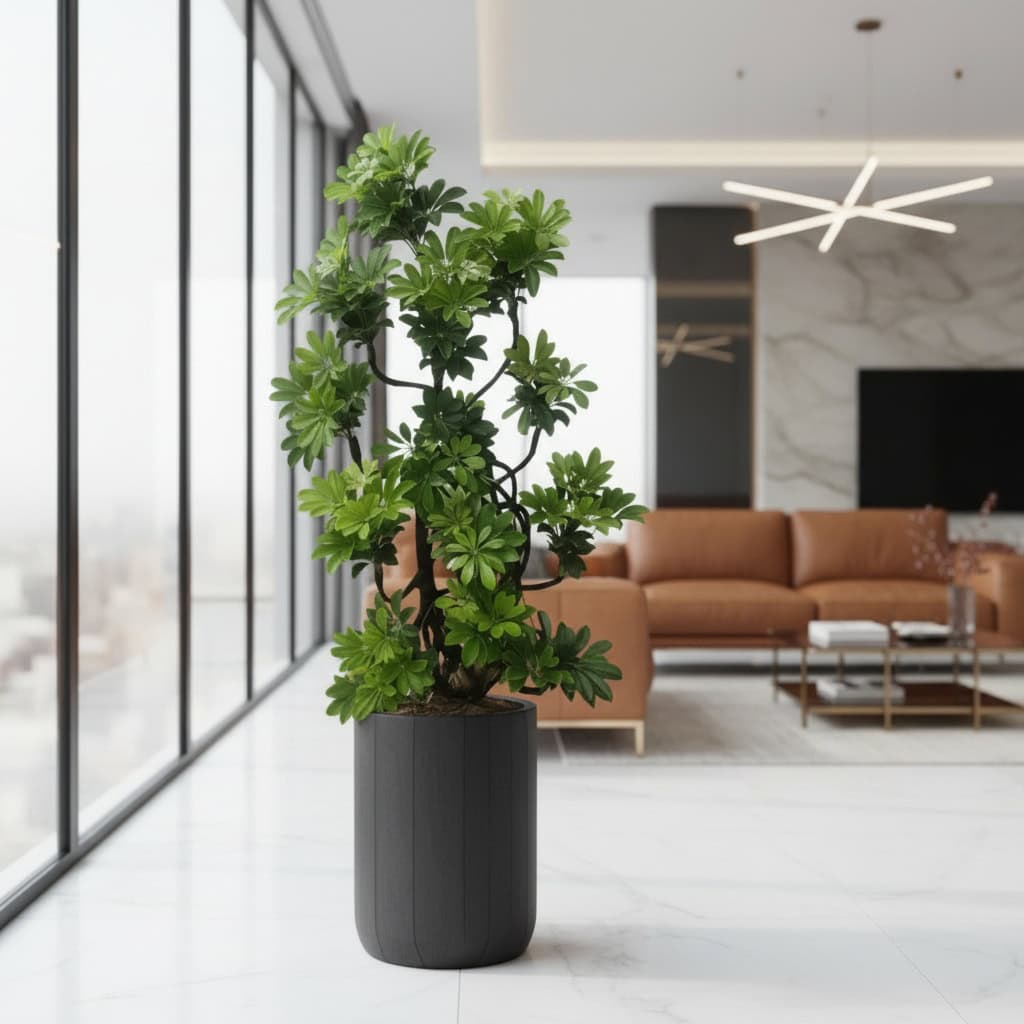
Shop this plant at PlantShop.hkThe styled dwarf umbrella tree (Schefflera arboricola) is a classic evergreen for Hong Kong offices and homes, with palmate leaves that spread like little umbrellas, trained as a bonsai-style or rock-mounted specimen. The one rule that matters most: bright indirect light, and water when the soil is half dry.
LightBright indirect light; 1–3 m from east/south window
WateringWater when top 3–5 cm is half dry; every 7–10 days
Best spot in HKNear a window in a living room or office; avoid air-con
PetsToxic to cats & dogs — keep out of reach
Care in a nutshell
The dwarf umbrella tree is one of the most rewarding styled plants you can own in Hong Kong: it doesn’t demand much attention, handles a range of light conditions, and suits busy lifestyles. Place it in bright indirect light near a window, away from summer west sun and air-con vents, and turn the pot occasionally so all sides get light.
Water when the soil is half dry, 3–5 cm down, until water drains from the bottom; it grows best at 18–24°C and 40–60% humidity. If you choose the rock-mounted version, it is even easier: just check whether the tray has water, and you barely need to think about watering. Its elegant leaves also bring some air-purifying benefits. A free-draining mix of 4 parts potting mix, 3 parts perlite or coarse sand, 2 parts coco coir and 1 part bark works well, and temperatures below 10°C stall growth, with cold damage possible below 5°C. Empty the saucer 10 minutes after watering.
Shop · Umbrella Tree (from HK$680)
Origin & characteristics
The dwarf umbrella tree, Schefflera arboricola, belongs to the ginseng family (Araliaceae), genus Schefflera, and is native to the evergreen broadleaf forests of Taiwan and Hainan Island, China. The genus name Schefflera commemorates 19th-century German botanist Jacob Christian Scheffler; the specific epithet arboricola derives from Latin "arbor" (tree) and "cola" (dweller), meaning "tree-dweller," reflecting its natural habit of growing as an epiphyte on tree trunks or in rock crevices. In Hong Kong and southern China, it is also commonly known as "goosefoot Schefflera" or "seven-leaf lotus."
In its native habitat, the dwarf umbrella tree is an evergreen shrub or small tree reaching 3–9 metres tall. Its leaves are palmately compound — typically 7–9 (occasionally 5 or more) leaflets radiating from the leaf tip like a duck's foot or an open umbrella, giving rise to the common names "duck foot tree" and "umbrella tree." Individual leaflets are oval to inverse egg-shaped, leathery in texture, deep green and glossy; some horticultural cultivars feature golden variegation or entirely yellow leaves (such as 'Gold Capella' and 'Trinette'). Flowers are small, greenish-white, borne in panicles; fruit is a small berry ripening to orange-red.
"Styled dwarf umbrella tree" refers to specimens that have undergone years of pruning and shaping, or been planted on special media (lava rock, coir poles) to create artistic bonsai forms. Common styling approaches include:
- Bonsai style: Through pruning, wiring, and pinching, the umbrella tree is shaped into a miniature tree form with a compact umbrella-like canopy and gradually lignifying stems that evoke aged trees.
- Rock-mounted style: The plant is grown on porous lava rock or water-absorbing stone, with roots gripping rock crevices, creating a "tree born from stone" natural artistic conception. This growing method offers exceptional drainage, effectively preventing root rot.
- Coir pole / moss pole style: Similar to pothos pole cultivation, aerial roots grip the pole and climb upward, suitable for narrow spaces.
The dwarf umbrella tree is exceptionally popular as an indoor plant because of its formidable adaptability: it tolerates a wide range of light conditions from bright diffused light to semi-shade; adapts to a broad humidity range; and possesses reasonable drought tolerance. These characteristics make it especially suited to Hong Kong's busy urban lifestyle.
Light
The styled dwarf umbrella tree prefers bright diffused light but tolerates a broad range from bright diffused light to semi-shaded conditions. Ideal placement is 1–3 metres from an east- or south-facing window, or behind sheer curtains. Under adequate light, leaves are deep green and glossy with a compact canopy; under weaker light, growth slows and leaf colour deepens, but the plant remains healthy.
Avoid prolonged strong direct sun, especially summer west-facing windows, which cause brown scorch spots on leaves. Variegated cultivars (such as 'Gold Capella') need more light to maintain crisp variegation — under weak light, patterning fades or disappears entirely.
Hong Kong indoor placement recommendations:
- Best positions: Bright living room near windows, behind sheer curtains, office corners near windows
- Acceptable positions: Indoor locations 3–5 metres from windows, corridors (with indirect light)
- Avoid: Completely lightless storage rooms, rooms with lights permanently off
Rotate the pot 180 degrees every two weeks for even light distribution, preventing the canopy from growing lopsided.
Watering
The styled dwarf umbrella tree follows the principle: "half-dry, then soak." Insert your finger approximately 3–5 cm into the soil; water when the soil is half-dry or nearly dry. Water until drainage flows from the bottom, wait 10 minutes, then empty the saucer. The umbrella tree tolerates brief dry spells — slightly forgetting to watering is rarely fatal — but chronically wet soil readily causes root rot.
Seasonal adjustments:
- Spring/Summer (growing season): Approximately every 7–10 days, adjusted for pot size and ventilation.
- Autumn/Winter (slow growth): Approximately every 10–14 days; the soil can dry an additional 2–3 days beyond that.
- Humid spring fog / rainy season: Extremely high humidity slows soil drying; extend to every 14 days.
Rock-mounted style (lava rock cultivation) watering: If the umbrella tree is planted on lava rock, watering differs from soil cultivation. Allow the tray beneath the lava rock to dry completely, then refill to approximately three-quarters full. The lava rock absorbs water from the tray to supply the roots. If roots grow directly into the tray water, trim them to prevent the plant from absorbing excessive moisture.
Air-conditioned room note: Long-term air conditioning dries the air and accelerates soil moisture evaporation. Check soil more frequently, mist leaves lightly, or group plants together to raise local humidity.
Soil & pot
The styled dwarf umbrella tree needs free-draining, aerated soil with moderate moisture retention. Recommended formula: quality potting mix 4 parts + perlite or coarse sand 3 parts + coir 2 parts + small amount of bark chips 1 part. This blend drains well and effectively prevents root rot.
Pot selection:
- Material: Terracotta or concrete pots offer good breathability and weight that complements the umbrella tree's Eastern aesthetic; plastic is lightweight but requires more careful watering control.
- Drainage: The pot must have drainage holes, with a layer of clay pebbles as a drainage base.
- Size: The umbrella tree grows at a moderate rate; repot every 2–3 years in spring, upgrading only one size (3–5 cm larger diameter) each time.
Rock-mounted cultivation medium selection: Choose porous, water-absorbing lava rock or water-stone, approximately 20–40 cm tall. When planting, spread the root system into rock crevices, securing with moss or coconut fibre wrapping. Once roots have naturally anchored firmly, remove the support materials. Rock-mounted umbrella trees have excellent root ventilation with lower root rot risk, but require more frequent tray watering.
Temperature & humidity
The styled dwarf umbrella tree grows best at 18–24°C, matching Hong Kong indoor conditions perfectly. Its cold tolerance is limited — prolonged temperatures below 10°C severely stall growth, and below 5°C may cause cold damage. Hong Kong winter indoor temperatures are generally not a concern, but during brief cold snaps, move the plant away from cold window drafts.
For humidity, the styled dwarf umbrella tree prefers moderate humidity (40–60%) but tolerates dry air better than most tropical foliage plants — it is one of the few foliage varieties that performs well in Hong Kong's chronically air-conditioned environments. During winter air conditioning or heating, consider:
- Light leaf misting in the morning (allowing leaves time to dry during the day)
- Pebble tray beneath the pot (water level below pot base)
- Grouping with other foliage plants to create a humid microclimate
- Avoiding positioning directly beside air-con outlets or heaters — although the umbrella tree tolerates dry conditions, continuous cold drafts still dry leaf edges
Common problems
| Issue | Likely cause | What to do |
|---|---|---|
| Lower leaves yellowing and dropping | Overwatering causing root rot, or natural old leaf senescence | Check soil moisture and drainage; if root rot, repot and trim roots; a few old leaves dropping is normal |
| Leaf tips turning brown and dry | Air too dry or cold draft exposure | Increase surrounding humidity; move away from air-con outlet; mist leaves lightly |
| New leaves small, stem internodes stretching | Insufficient light | Move to brighter position; rotate pot regularly for even light exposure |
| Variegated cultivar losing variegation | Light too weak triggering increased chlorophyll production | Move to slightly brighter position; variegation typically returns on new growth |
| Tree form becoming loose, branches leggy | Chronic low light or lack of pruning | Increase light; perform structural pruning in spring, cutting overlong branches back by one-third to one-half to encourage side bud development |
| Leaves covered with tiny brown spots or fine webbing | Spider mite or scale insect infestation | Wipe leaf undersides with damp cloth; for severe cases use neem oil or dedicated insecticide; raising humidity helps prevent spider mites |
Not sure your spot gets enough light, or something looks off? Send us a photo on WhatsApp 4492 9648 and we’ll take a look.
Questions people ask
Can a dwarf umbrella tree live in an air-conditioned room in Hong Kong?
Yes. It is one of the few foliage plants that does well with constant air conditioning, but keep it away from the vents, as sustained cold air still dries out the leaf edges.
How often should I water a styled dwarf umbrella tree?
About every 7–10 days in spring and summer and every 10–14 days in autumn and winter, when the soil is half dry 3–5 cm down. For the rock-mounted version, wait until the tray is dry, then refill to about 3/4 full.
How do I care for a rock-mounted dwarf umbrella tree?
Keep water in the tray and let the volcanic rock draw it up to the roots. The roots get excellent airflow, so root rot is less likely, but the tray needs topping up more often.
Is a dwarf umbrella tree safe for cats and dogs?
No. It contains saponins and calcium oxalate crystals, which can cause mouth irritation, drooling and vomiting, so keep it out of reach of pets.
Fun facts
The genus Schefflera underwent a massive "split" in botanical taxonomy. Traditionally, Schefflera was a large genus containing over 600 species distributed across tropical and subtropical regions worldwide. However, recent molecular systematics research revealed the genus was "polyphyletic" — species within it did not all share a single common ancestor. Consequently, many former Schefflera species were transferred to other genera including Heptapleurum, Plerandra, and Sciadophyllum. Schefflera arboricola remains in the original genus, one of the few "legitimate" umbrella tree members.
The dwarf umbrella tree's palmately compound leaf is botanically termed a "palmately compound leaf" — multiple leaflets radiating from a single point at the petiole tip like an open hand. This leaf form has functional significance in tropical rainforests: the palmate arrangement maximises capture of scattered light filtering through the canopy while reducing wind resistance, making the plant less likely to break in strong winds.
In Taiwan's indigenous cultures, umbrella tree leaves were traditionally used as natural "foil" for wrapping food — the leathery surface resists tearing and carries a subtle fragrance. Additionally, some regional traditional medicines attribute anti-inflammatory and pain-relieving properties to the umbrella tree, though these uses lack modern medical validation and are not recommended for self-treatment.
The umbrella tree also appeared in NASA's Clean Air Study, confirmed to absorb formaldehyde, benzene, and other volatile organic compounds. As noted in other contexts, the actual air purification effect of plants in real indoor environments is limited (room volume vastly exceeds experimental chamber volume), but as a large foliage plant, the umbrella tree's dense leaf surface does provide some air purification function while releasing oxygen and raising humidity — positive contributions to the indoor micro-environment.
References (expand to view sources)
References
- Missouri Botanical Garden. Schefflera arboricola – Plant Finder. https://www.missouribotanicalgarden.org/PlantFinder/PlantFinderDetails.aspx?taxonid=276245
- Patch Plants. Complete guide to schefflera care. https://www.patchplants.com/pages/plant-care/complete-guide-to-schefflera-care/
- PLNTS.com. Schefflera care (Umbrella plant) – Expert Advice. https://plnts.com/en/care/houseplants-family/schefflera
- Gardeners Path. When and How to Prune Umbrella Plants (Schefflera). https://gardenerspath.com/plants/houseplants/prune-schefflera/
- NASA Clean Air Study. Interior Landscape Plants for Indoor Air Pollution Abatement. https://ntrs.nasa.gov/citations/19930073077
- Hong Kong Agriculture, Fisheries and Conservation Department. Hong Kong Herbarium. https://www.herbarium.gov.hk/
⚠️ Pet / toxicity: The styled dwarf umbrella tree is toxic to cats and dogs, containing saponins and calcium oxalate crystals that cause oral irritation, drooling, vomiting, and difficulty swallowing if ingested. Pet owners should place the plant in positions inaccessible to cats and dogs. Plant sap may cause skin sensitivity in some individuals; wear gloves when pruning.
Shop at Plantshop
View all Plants →
For Hong Kong homes and offices. Stock and pricing follow the product page.
FAQs
Origin & characteristics
The dwarf umbrella tree, Schefflera arboricola, belongs to the ginseng family (Araliaceae), genus Schefflera, and is native to the evergreen broadleaf forests of Taiwan and Hainan Island, China. The genus name Schefflera commemorates 19th-century German botanist Jacob Christian Scheffler; the specific epithet arboricola derives from Latin "arbor" (tree) and "cola" (dweller), me
Watering
The styled dwarf umbrella tree follows the principle: "half-dry, then soak." Insert your finger approximately 3–5 cm into the soil; water when the soil is half-dry or nearly dry. Water until drainage flows from the bottom, wait 10 minutes, then empty the saucer. The umbrella tree tolerates brief dry spells — slightly forgetting to watering is rarely fatal — but chronically wet soil readi
Soil & pot
The styled dwarf umbrella tree needs free-draining, aerated soil with moderate moisture retention. Recommended formula: quality potting mix 4 parts + perlite or coarse sand 3 parts + coir 2 parts + small amount of bark chips 1 part. This blend drains well and effectively prevents root rot.
Temperature & humidity
The styled dwarf umbrella tree grows best at 18–24°C, matching Hong Kong indoor conditions perfectly. Its cold tolerance is limited — prolonged temperatures below 10°C severely stall growth, and below 5°C may cause cold damage. Hong Kong winter indoor temperatures are generally not a concern, but during brief cold snaps, move the plant away from cold window drafts.
