



Plantshop.hk · Care Encyclopedia
How to Care for ZZ Plant in Hong Kong
From HK$380 · Hong Kong delivery
Hong Kong care guide — useful before you buy and after it arrives.
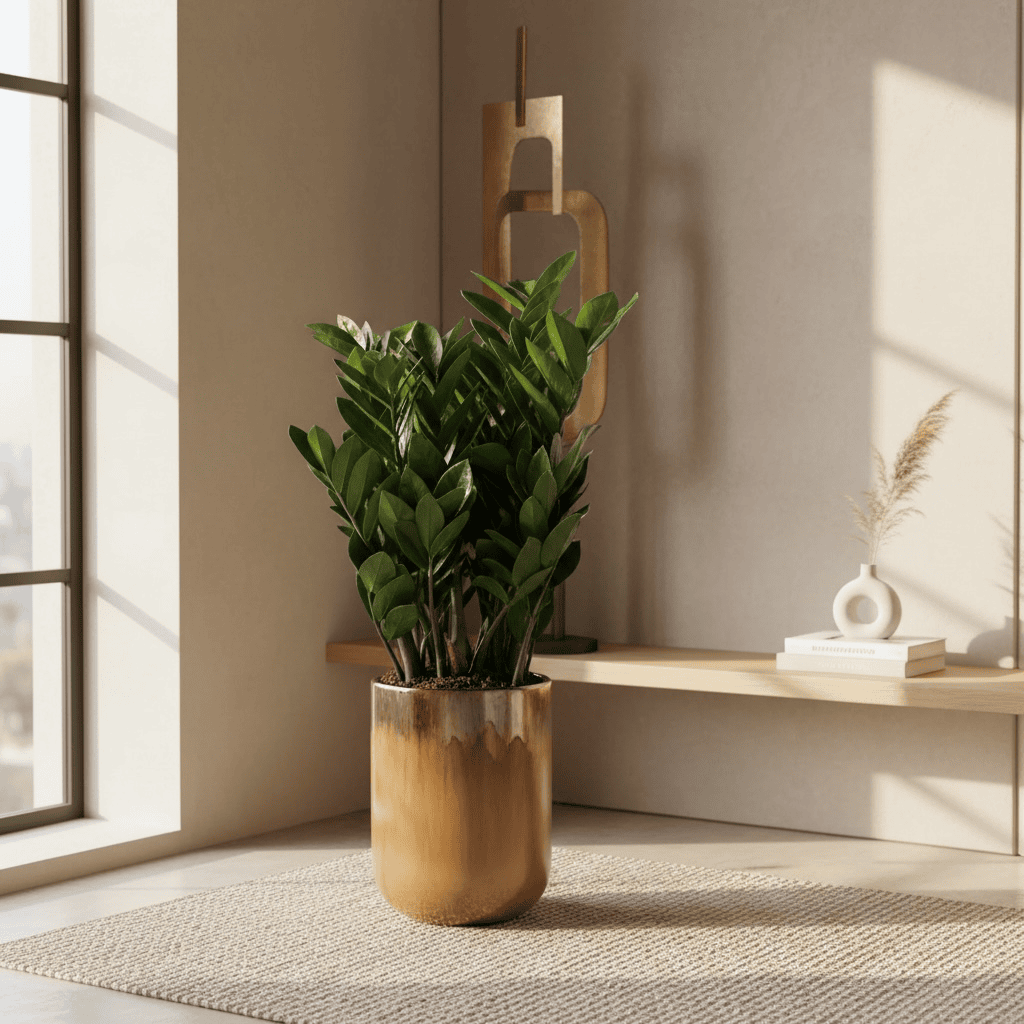
Shop this plant at PlantShop.hkThe perfect beginner plant for Hong Kong homes: it tolerates low light and forgets-to-water weeks with ease. The one rule that matters most: rather dry than wet, and let the soil dry out completely before watering.
LightLow light to bright indirect; best 2–4 m from east/south window
WateringWater only when dry 5 cm deep; every 10–14 days in spring/summer
Best spot in HKLiving room, office or any indoor spot; avoid west sun and air-con vents
PetsToxic to cats & dogs — keep out of reach; wear gloves
Care in a nutshell
To grow a ZZ plant in Hong Kong, remember one mantra: rather dry than wet, and you will basically never kill it. Its rhizomes are like little potatoes storing water, so forgetting to water for two or three weeks is absolutely fine; overwatering is what actually kills it. Put it anywhere with a little light. It does not need to be near a window and will survive in dark corners. It is happiest at 18–27°C, and growth stalls below 15°C. Keep the soil very free-draining, and when repotting go up only one size (3–5 cm wider). Wipe dust off the leaves occasionally and they will look much nicer; if you want it to grow faster, apply a balanced liquid fertiliser diluted to half strength every 4–6 weeks in spring and summer.
Origin & characteristics
The ZZ plant, Zamioculcas zamiifolia, belongs to the arum family (Araceae) and is the sole species in its genus — a "monotypic genus" in botanical classification. It is native to drought-prone regions of East Africa, specifically Tanzania, Kenya, and southeastern Madagascar, growing in dry scrub and rocky terrain at elevations of 0–600 metres. In its native habitat, the ZZ plant faces prolonged dry seasons with annual rainfall of only 600–1,000 mm distributed highly unevenly. These harsh conditions forged the ZZ plant's extraordinary drought resistance — its thick, fleshy rhizomes store substantial water and nutrients, while waxy leaves minimise water loss through transpiration, enabling survival through extreme drought.
The ZZ plant's morphology is highly distinctive. Leaves are pinnately compound, composed of multiple bright green, leathery, oval leaflets approximately 5–8 cm long and 2–3 cm wide, arranged in neat pairs like ancient Chinese cash coins strung together — hence the Chinese common name "money tree." Mature stems grow upright, reaching up to 1 metre tall with a diameter of 1–2 cm, smooth and deep green to light brown. Underground, the plant develops dense clusters of fleshy rhizomes — irregular in shape and several centimetres in diameter — serving as the plant's "life reserve tank."
The ZZ plant was introduced to large-scale commercial cultivation by Dutch horticultural companies in 1996, and rapidly became a global phenomenon alongside snake plant (Dracaena trifasciata) and pothos (Epipremnum aureum) as one of the "big three beginner plants." In Hong Kong, the ZZ plant is virtually ubiquitous — found in residential living rooms, offices, shopping malls, and hotel lobbies. Its popularity stems from a simple truth: it almost cannot be killed. Forget to water for weeks? It stays green. Dim light? No problem. Never fertilised? Still thriving. The ZZ plant simply persists — quietly adding life to any space.
Light
The ZZ plant tolerates an exceptionally broad light range, from low-light environments to bright diffused light. This wide adaptability reflects its native habitat — in East African dry scrub, the ZZ plant grows beneath taller shrubs, long adapted to low-light conditions. Its thick, waxy leaves efficiently utilise limited scattered light for photosynthesis.
Hong Kong indoor placement recommendations:
- Best positions: 2–4 metres from east- or south-facing windows in bright diffused light. This position promotes new leaf growth and deeper, glossier leaf colour.
- Acceptable positions: Further from windows in interior spaces, rooms relying primarily on indoor lighting, corridor corners. Growth will be slower in these positions, but the plant remains healthy.
- Avoid: Strong summer midday direct sun, especially west-facing windows. Intense light causes brown scorch spots on leaves or leaf edge curling and colour fading.
A practical light assessment: if you can comfortably read a newspaper at that position, the light is sufficient for a ZZ plant. If the room is too dark (such as a windowless storage room), move the ZZ plant to a brighter position for a "light holiday" of several days every one to two weeks, or supplement with a grow light.
Rotate the pot 90–180 degrees every two weeks for even light exposure, preventing the leaf crown from growing lopsided.
Watering
The ZZ plant's watering principle is "prefer dry over wet; only water when completely dried out." This is the single most critical yet most commonly overlooked aspect of ZZ plant care. The plant's thick rhizomes store abundant water, giving it formidable drought tolerance; but this same adaptation means overwatering causes rhizomes to rot in perpetually wet soil — the leading cause of ZZ plant death.
Correct watering procedure:
- Check soil moisture: Insert your finger approximately 5 cm deep; if any moisture is detected, do not water. Only water when the soil is completely dry throughout, then wait an additional 1–2 days.
- Water thoroughly: Water slowly until drainage flows from the bottom, ensuring the entire soil mass is moistened.
- Empty the saucer: After 15 minutes, completely empty any standing water. The ZZ plant must never sit in water.
Seasonal adjustments:
- Spring/Summer (growing season): Approximately every 10–14 days, adjusted for pot size, soil formula, and ventilation.
- Autumn/Winter (dormant period): Approximately every 21–30 days. Winter growth is extremely slow with weak transpiration; water needs are minimal.
- Humid spring fog / rainy season: Extremely high humidity slows soil drying dramatically; extend to 30+ days between waterings, or pause watering entirely.
Most common beginner mistakes:
- Watering on a fixed calendar schedule ("every Monday") — this ignores environmental variation and easily leads to overwatering or underwatering
- Seeing dry surface soil and assuming watering is needed — ZZ plant roots concentrate in the lower and middle soil; dry surface does not mean the bottom has dried
- Chronic saucer standing water — this is the "express lane" to root rot; develop the habit of emptying saucers every time
Advanced moisture assessment methods:
- Lift the pot to gauge weight — light and airy means thoroughly dry; heavy means still moist
- Use a soil moisture meter; water only when readings approach the "dry" end
- Observe stems: if stems begin slight wrinkling, the rhizome is drawing on reserves — water thoroughly at this point
Air-conditioned room note: Long-term air conditioning dries the air, but the ZZ plant's extreme drought tolerance usually means no watering adjustment is needed. The more likely concern is that soil dries more slowly in air-conditioned rooms, possibly requiring further reduced watering frequency.
Soil & pot
The ZZ plant needs extremely free-draining, aerated potting mix — this is the key to preventing root rot. Recommended formula: cactus and succulent specialist soil 5 parts + perlite 3 parts + coarse sand or fine gravel 2 parts. This blend drains rapidly; water flows through quickly without lingering around rhizomes. If using standard potting mix, you must add substantial perlite (at least 30–40% of total volume) to improve drainage.
Commercial formula options:
- Cactus/succulent specialist soil (use directly or with slight additional perlite)
- Araceae specialist soil (typically pre-mixed with perlite and bark chips)
- Orchid growing medium blended with small amount of potting mix
Pot selection:
- Material: Terracotta is ideal — excellent breathability that helps soil dry out; concrete or ceramic are acceptable alternatives; plastic is lightweight but has poor breathability, requiring stricter watering control
- Drainage: The pot must have drainage holes, with a 2–3 cm layer of clay pebbles or broken pottery shards as a drainage base. Never plant directly into a pot without drainage holes.
- Size: The ZZ plant prefers being slightly "crowded" — when repotting, upgrade only one size (3–5 cm larger diameter). Oversized pots hold excessive wet soil and readily cause root rot. Typically repot every 2–3 years in spring.
During repotting, inspect rhizome condition. If rhizomes have filled the entire pot base, consider division propagation. After repotting, pause watering for approximately one week to allow damaged roots time to heal, reducing infection risk.
Temperature & humidity
The ZZ plant grows best at 18–27°C, matching Hong Kong indoor conditions perfectly. Among tropical foliage plants, its cold tolerance is relatively strong — short periods above 10°C usually cause no serious problems, but prolonged temperatures below 15°C stall growth and leaves may yellow. Hong Kong winter indoor temperatures are generally not a concern, but during brief cold snaps (temperatures dropping below 10°C), move the plant away from cold window drafts.
The ZZ plant has very relaxed humidity requirements — typical household humidity of 30–60% is fully acceptable. Hong Kong summer humidity is usually adequate; winter air conditioning or heating also requires no special humidification — this is a major advantage over other tropical foliage plants. If you wish to raise ambient humidity (primarily for more lustrous leaf appearance), consider:
- Light leaf misting (mainly for cleaning dust from leaf surfaces)
- Grouping with other foliage plants
- Pebble tray beneath the pot (water level below pot base)
Note: Although the ZZ plant tolerates dry conditions, avoid positioning directly in front of air-con outlets. Continuous cold airflow causes leaf moisture loss that can eventually dry leaf edges.
Common problems
| Issue | Likely cause | What to do |
|---|---|---|
| Leaves yellowing, stem base softening and rotting | Overwatering causing rhizome rot | Stop watering immediately; unpot and inspect rhizomes; cut away rotted portions, treat wounds with cinnamon powder or fungicide, air-dry for 1–2 days, then replant in dry soil; severe cases may not be recoverable |
| New leaves persistently small, growth stalled | Too little light or insufficient nutrients | Move to brighter position; apply half-strength balanced liquid fertiliser every 4–6 weeks in spring and summer |
| Leaves developing yellow spots then browning | Strong light scorch | Move to diffused light position; scorched leaves cannot recover — wait for new growth |
| Stems leggy, leaves sparse, leaning outward | Chronic low light causing phototropic elongation | Gradually move to brighter position; prune leggy stems to encourage new basal bud development; temporary staking may help |
| Leaves covered with dust, lost sheen | Long-term leaf surface cleaning neglected | Wipe leaves gently with damp cloth, or rinse with a shower head (ensure potting soil is not excessively wetted); leaves regain lustre after cleaning |
| Small amount of winter leaf yellowing and drop | Normal physiological process or slightly low temperature | A few old leaves yellowing is normal metabolism, no cause for concern; if heavy leaf loss occurs, check whether temperature is too low or watering is excessive |
Not sure your spot gets enough light, or something looks off? Send us a photo on WhatsApp 4492 9648 and we’ll take a look.
Questions people ask
Can a ZZ plant grow in low light in Hong Kong?
Yes. It tolerates anything from low light to bright indirect light, though it grows more slowly in dim spots. For denser, darker green growth, place it 2–4 metres from an east- or south-facing window.
How often should I water a ZZ plant in Hong Kong?
About every 10–14 days in spring and summer and every 21–30 days in autumn and winter, but the soil is the real guide: if your finger finds any moisture 5 cm down, do not water.
Why is my ZZ plant turning yellow and soft at the base?
The usual cause is overwatering, which rots the rhizomes. Stop watering, unpot it, cut away the rotten parts, dust the cuts with cinnamon powder or fungicide, let it dry for 1–2 days and repot in dry soil. Severe cases may not be saved.
Is the ZZ plant safe for cats and dogs?
No. It contains insoluble calcium oxalate crystals that can cause oral irritation, drooling, vomiting and difficulty swallowing, so keep it out of reach of pets.
Fun facts
The ZZ plant's commercial history is a modern horticultural classic. In 1996, plant collectors from Dutch horticultural company Van Winden-Erica B.V. discovered this long-overlooked species in a South African botanical garden, captivated by its resilient vitality and distinctive leaf form. Through just a few years of tissue culture and commercial promotion, the ZZ plant transformed from a "forgotten African plant" into one of the world's best-selling indoor foliage plants. This success owed largely to the ZZ plant's "practically unkillable" character — in busy urban lives, people increasingly prefer low-maintenance plants.
The ZZ plant also appeared in NASA's Clean Air Study, confirmed to absorb xylene, toluene, and other volatile organic compounds (VOCs). As noted in other contexts, the actual indoor air purification effect of plants in real rooms is limited (room volume vastly exceeds experimental chamber volume), but as a large foliage plant, the ZZ plant's dense pinnate leaf surface does provide some air purification function while releasing oxygen and raising humidity.
ZZ plant flowers are extremely rare indoors, but in its native habitat or ideal greenhouse conditions, mature plants produce curious spathe-and-spadix inflorescences at the stem base — characteristic of the Araceae family. The inflorescence is pale green to cream-white, somewhat resembling a miniature peace lily. Interestingly, ZZ plant flowers emit an odour resembling rotting meat or mushrooms, designed to attract fly pollinators — flies serve as important pollination agents in tropical savanna ecosystems.
The ZZ plant can be propagated through three methods: rhizome division (fastest, new shoots emerging in 4–6 weeks), stem cutting (moderate speed, rooting in 3–4 weeks), and single leaf cutting (slowest but most fascinating — a single leaf developing into a complete new rhizome system takes 6–9 months). Single leaf cutting is the best way to observe the ZZ plant's remarkable biology — watching a tiny leaf progressively develop a complete rhizome system demonstrates the astonishing resilience of plant life.
In feng shui, the ZZ plant's neatly arranged pinnate leaflets resemble strings of ancient Chinese cash coins, symbolising "rolling wealth and abundant fortune;" its upward-growing stems represent "rising ever higher." Because it is so easy to keep alive, the ZZ plant is also a popular business-opening gift — auspicious symbolism without worrying whether the recipient can keep it alive.
References (expand to view sources)
References
- Missouri Botanical Garden. Zamioculcas zamiifolia – Plant Finder. https://www.missouribotanicalgarden.org/PlantFinder/PlantFinderDetails.aspx?taxonid=275702
- New York Botanical Garden. ZZ Plant (Zamioculcas zamiifolia) – Houseplant Care. https://libguides.nybg.org/ZZPlant
- Plant Care Hub. Zamioculcas Zamiifolia Care: Watering and Light Guide. https://www.plantcarehub.net/zamioculcas-zamiifolia-care/
- Bath Garden Center. ZZ Plant Care: How To Care for Zamioculcas Zamiifolia. https://www.bathgardencenter.com/post/zz-plant-care
- NASA Clean Air Study. Interior Landscape Plants for Indoor Air Pollution Abatement. https://ntrs.nasa.gov/citations/19930073077
- Hong Kong Agriculture, Fisheries and Conservation Department. Hong Kong Herbarium. https://www.herbarium.gov.hk/
- Hong Kong Leisure and Cultural Services Department. Greening Information – Indoor Foliage Plants. https://www.lcsd.gov.hk/green/
⚠️ Pet / toxicity: The ZZ plant is toxic to cats and dogs, containing insoluble calcium oxalate crystals that cause oral irritation, drooling, vomiting, and difficulty swallowing if ingested. Pet owners should place the plant in positions inaccessible to pets. Wear gloves when handling to avoid sap contact with skin or eyes.
Shop at Plantshop
View all Plants →

For Hong Kong homes and offices. Stock and pricing follow the product page.
FAQs
Origin & characteristics
The ZZ plant, Zamioculcas zamiifolia, belongs to the arum family (Araceae) and is the sole species in its genus — a "monotypic genus" in botanical classification. It is native to drought-prone regions of East Africa, specifically Tanzania, Kenya, and southeastern Madagascar, growing in dry scrub and rocky terrain at elevations of 0–600 metres. In its native habitat, the ZZ plant faces pr
Watering
The ZZ plant's watering principle is "prefer dry over wet; only water when completely dried out." This is the single most critical yet most commonly overlooked aspect of ZZ plant care. The plant's thick rhizomes store abundant water, giving it formidable drought tolerance; but this same adaptation means overwatering causes rhizomes to rot in perpetually wet soil — the leading c
Soil & pot
The ZZ plant needs extremely free-draining, aerated potting mix — this is the key to preventing root rot. Recommended formula: cactus and succulent specialist soil 5 parts + perlite 3 parts + coarse sand or fine gravel 2 parts. This blend drains rapidly; water flows through quickly without lingering around rhizomes. If using standard potting mix, you must add substantial perlite (at least 30–40% o
Temperature & humidity
The ZZ plant grows best at 18–27°C, matching Hong Kong indoor conditions perfectly. Among tropical foliage plants, its cold tolerance is relatively strong — short periods above 10°C usually cause no serious problems, but prolonged temperatures below 15°C stall growth and leaves may yellow. Hong Kong winter indoor temperatures are generally not a concern, but during brief cold snaps (temperatures d
