



Check the conversation as well as the view
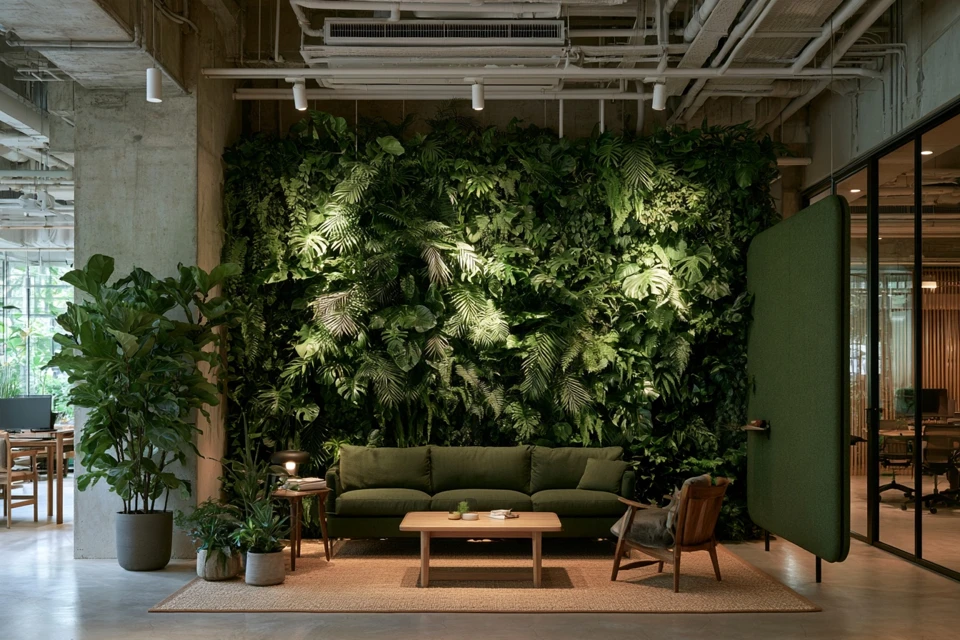
A row of foliage can make reception feel separate from the desks beyond it. Sit down and the next person may disappear from view, while their words remain perfectly clear. That distinction belongs in the brief before another row of pots is ordered.
In this article
- Check the conversation as well as the view
- Separate three different briefs
- Ask for evidence that matches the installation
- Use a seating trial to expose obvious gaps
- Keep the visual screen workable
- Keep the conversation plan distinct from the planting plan
- Quick questions
- Three forms for a visual brief
Use a plant screen to plan views and seating boundaries; do not infer acoustic performance or confidentiality from its height, density or quantity. Sensitive conversations need a space and arrangement approved by the company. First decide what should be hidden from sight and what must remain unheard.

Separate three different briefs
| What you want to improve | What to observe | Do not infer |
|---|---|---|
| Sightlines | Views from entrances and seats, standing and sitting | Hiding a face also hides a screen |
| Perceived comfort | Users’ views on enclosure, openness and layout | Feeling quieter proves acoustic compliance |
| Speech privacy | Whether others can understand speech, assessed against the requirement | A lower apparent volume makes sensitive details unintelligible |
Ask for evidence that matches the installation
Outdoor hedges, roadside vegetation and a handful of indoor pots differ in scale, setting and sound paths. Results for an outdoor planting cannot be transferred to an indoor product arrangement. Procurement needs evidence that corresponds to the actual proposal.
If noise reduction or speech privacy is part of procurement, define the requirement and obtain a suitable acoustic assessment of the premises. Any supplied test needs to match the materials, dimensions, installation and conditions of the proposed scheme. “Green screen” is a description, not a performance specification.
Use a seating trial to expose obvious gaps
Trial the seating plan with a floor layout or safely movable markers before filling it with heavy pots. Check seated and standing views from the entrance, neighbouring desks and circulation routes. Look at monitors, whiteboards and documents, not only people’s faces.
If trialling ordinary conversation, use non-sensitive sample sentences and observe intelligibility from places someone could actually stand. This is a way to reveal obvious problems, not a confidentiality certification. A phone’s decibel reading is not a speech-privacy assessment either. Keep participating colleagues informed about the exercise.
Keep the visual screen workable
A useful visual divider leaves room for the plants to live and for people to work. Provide light, access for care and growing space. Preserve circulation, exits, fire equipment and maintenance routes according to the premises’ requirements. If watering means dismantling the row, the layout needs more room.
Expect the view to change as foliage grows, turns or loses a leaf. Recheck sightlines after relocation, replacement or a marked change in the canopy. Where a monitor or document must stay out of view, make an appropriate screen and spatial arrangement part of the plan rather than relying entirely on leaf cover.
Keep the conversation plan distinct from the planting plan
Quick questions
Will a denser row make personnel discussions private?
Plant quantity is not a confidentiality test. Follow company requirements for the room and equipment.
Does that make a plant screen pointless?
It can establish a visual boundary and interrupt an open sightline, depending on the real canopy and position. A clear visual brief allows it to be judged on that purpose.
What if the plants are already purchased?
Keep positions that work for light and access, and move sensitive conversations to a suitable place. If the original brief included acoustic performance, obtain the missing assessment rather than substituting denser foliage for evidence.
Three forms for a visual brief
Compare these for their visual outlines, without a decibel claim or privacy rating. Trial the actual forms in the space; a product photograph does not guarantee complete screening.
- Areca Palm: Feathery foliage can form a softer, partial boundary, with gaps and care access allowed for.
- Fiddle-Leaf Fig: Large blades offer distinct visual planes, with openings between and beneath them that need a seated check.
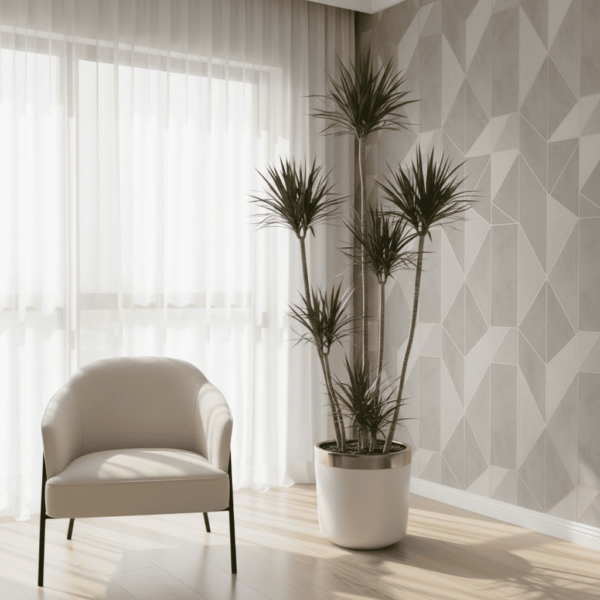
- Madagascar Dragon Tree: Slender stems and upper crowns mark a boundary but may leave seated views open; trial the height first.

Areca Palm
Areca Palm — Feathery, arching fronds that soften a living room, studio or office corner.
- Light: Bright light indoors, protected from sudden intense western sun.
- Watering: Water as the surface dries, maintaining even moisture with drainage.
Hong Kong care guide: Areca Palm (light, watering & common issues)
Before & after purchase · Plantshop Care Encyclopedia

Featured

Fiddle-Leaf Fig
Fiddle-Leaf Fig — Large, violin-shaped leaves on an upright stem; it grows best in a steady, bright position.
- Light: Bright indirect light to gentle sun; keep the position stable.
- Watering: Water after the top 3–5 cm dries; reduce in winter or low light.
Hong Kong care guide: Fiddle-Leaf Fig (light, watering & common issues)
Before & after purchase · Plantshop Care Encyclopedia

Madagascar Dragon Tree
Madagascar Dragon Tree — Slender canes topped with narrow, deep green leaves edged in red.
Hong Kong care guide: Madagascar Dragon Tree (light, watering & common issues)
Before & after purchase · Plantshop Care Encyclopedia
