


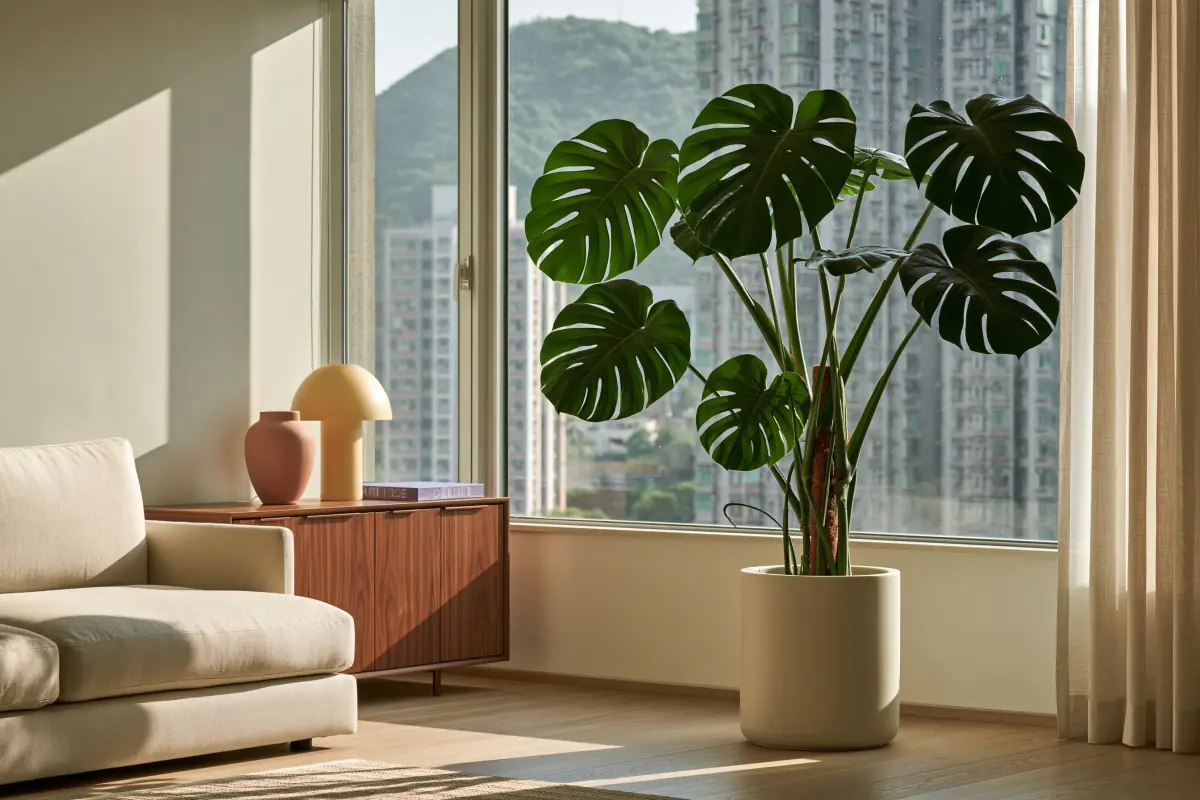

Assess the plant position, not just the room
Before buying, assess the intended position at the height of the plant’s leaves. Window direction is only a starting point. Neighbouring buildings, overhangs, glazing, curtains and distance from the window all affect what reaches the plant. A living room that looks bright with its lights on can still have unsuitable corners.
In this article
- Assess the plant position, not just the room
- Turn 'bright' into three useful questions
- Check the position at three points in the day
- Copy this indoor-light worksheet
- Use a phone light app as a comparison aid
- Use the observations to make a decision
- Common questions
- Compare three plants against your light assessment
This is a practical first assessment, not a diagnosis from a photograph or a promise that every species will thrive at a fixed distance from a window. Complete the worksheet before browsing large indoor plants, so you can choose a plant for the space you actually have.

Turn 'bright' into three useful questions
Does sunlight fall directly on the leaves? A distinct patch of sunlight indicates direct exposure at that moment; sunlight through glass can still be direct light. How long does it last? A brief morning sun patch is different from useful daylight through much of the day. Which parts of the plant receive it? The upper leaves of a tall plant may sit near the window while furniture shades the lower canopy.
Bright indirect light describes substantial daylight without sustained strong direct sun on the foliage. It is not a universal numerical specification. Nor does low-light tolerance mean no-light tolerance. The University of Minnesota’s lighting guide distinguishes tolerating lower light from receiving enough light for dense growth or flowering.
Check the position at three points in the day
- Mark two candidate positions. Call them A beside the window and B beside the sofa, for example. Record approximate distance from the glass and intended leaf height; a photograph taken at floor level is not enough.
- Observe in the morning, around midday and in the afternoon. Note direct sunlight, curtain position and shadows from neighbouring buildings. Use times that fit your routine, but compare both positions at the same times.
- Repeat in different weather. Include a brighter and a cloudier day. Extend the record across a week if conditions vary substantially. This is a data-gathering routine, not a claim that seven days predict the whole year.
- Keep the room in normal use. If you usually close the blinds, assess that arrangement. Photographs help document location, but automatic camera exposure makes them unreliable measurements of light intensity.
Copy this indoor-light worksheet
Use one sheet per location. Write ‘not confirmed’ where information is missing rather than presenting an estimate as a measurement.
| Record | Your observation | Why it matters |
|---|---|---|
| Position ID and expected leaf height | ____ | Keeps observations comparable |
| Window direction and approximate distance | ____ | Describes the position without deciding from direction alone |
| Blinds, glazing, overhangs and external obstructions | ____ | Identifies what reduces incoming light |
| Direct sun: morning / midday / afternoon | __ / __ / __ | Shows changes during the day |
| Difference between bright and cloudy days | ____ | Avoids judging from the best day only |
| Normal room-light operating hours | ____ | Separates daylight from artificial lighting |
| Unknowns and next action | ____ | Prompts another observation, relocation or supplier discussion |
Use a phone light app as a comparison aid
If you use a phone light app, keep the phone, app, sensor orientation and measurement height consistent. Use it to compare A with B. Readings from different devices or apps may not be directly comparable, and lux is not a measurement of the photosynthetically active photons received by a plant.
A single reading should not become a guaranteed pass mark for a species. For supplemental lighting, ask about output at the intended distance, canopy coverage and operating arrangements. Wattage, colour temperature and how dazzling a lamp looks do not by themselves establish suitability. Adding plant lighting is a design decision, not simply a matter of buying any spotlight.
Use the observations to make a decision
Conditions are reasonably clear: shortlist plants by light requirements, then consider canopy size, pet access and the care you can provide. The position looks promising but the record is incomplete: observe a cloudy day or the room with its usual blinds before buying. There is almost no daylight and artificial lighting has not been assessed: change the position or address the lighting first.
For example, position A may receive morning sun before a neighbouring building shades it, while B is further inside with blinds usually drawn. This is an illustrative scenario, not a customer measurement. It establishes that the two positions differ; it does not prove that A suits every large plant.
Common questions
Is a north-facing window always unsuitable?
No. External obstructions, window size, the exact position and the species all matter. Record the direction, but do not reject a location on that factor alone.
Can lights at night make up for poor daylight?
That depends on output, distance, spectrum and operating time. Ordinary room lighting may contribute, but should not be assumed sufficient without assessment. Keeping lights on continuously is not a substitute for a suitable lighting plan.
Do yellow leaves after relocation prove there is too much light?
No. Check moisture, previous conditions, sudden strong sun exposure and how symptoms develop. Changing lighting, fertiliser and the pot together makes the cause harder to identify.
Use the care encyclopedia to check the chosen plant’s needs. When asking us for advice, share a position photograph, normal curtain arrangement and this worksheet rather than only saying that the room is bright.
Compare three plants against your light assessment
Once you have completed the worksheet, compare the position with the plant’s requirements before choosing by leaf shape or scale. These three plants provide a useful starting point.
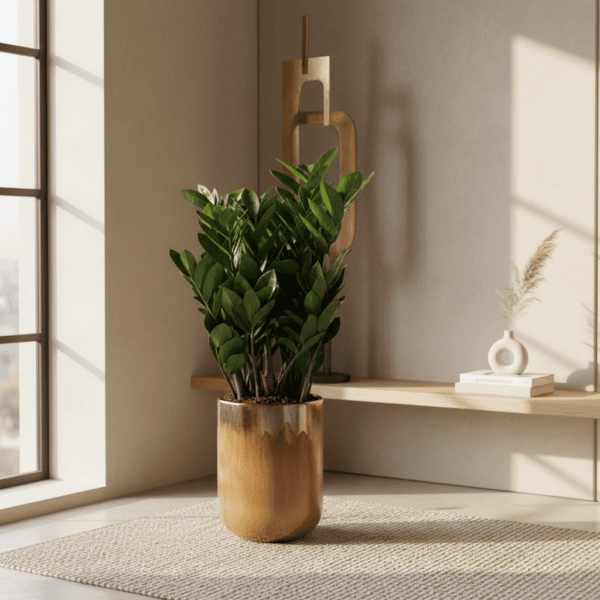
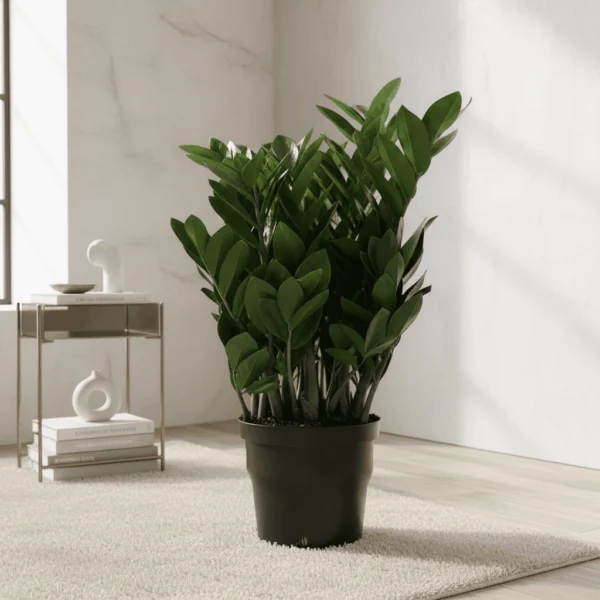
- ZZ Plant: A ZZ plant is a candidate for a lower-light position, but it still needs a useful light source; a permanently dark corner is unsuitable.
- Fiddle-Leaf Fig: For a fiddle-leaf fig, check the daylight beside the window and repeat the assessment with your usual blinds in place, rather than judging by room lighting alone.
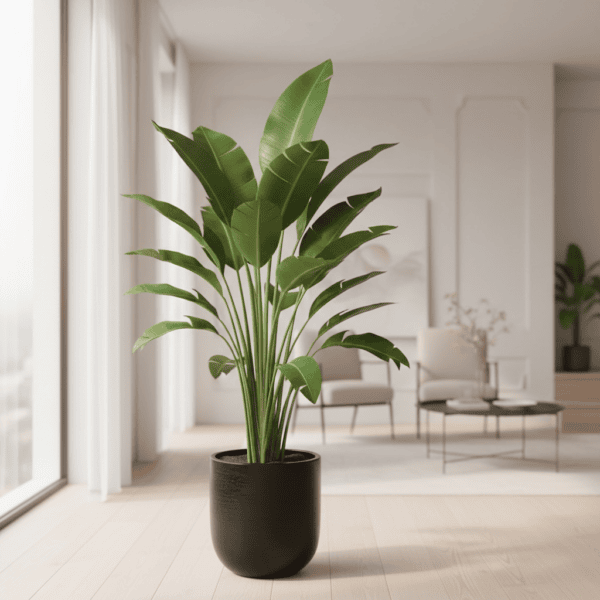
- Giant Bird of Paradise: The leaves of a giant bird of paradise extend higher into the room. Assess the whole canopy, including changes in sunlight and heat beside the glass.
Featured
ZZ Plant
ZZ Plant — Glossy, deep green leaflets on upright stems; it copes with lower light and infrequent watering.
- Light: Bright indirect light to sun, introduced gradually.
- Watering: Water thoroughly only after most of the mix dries; never leave standing in water.
Hong Kong care guide: ZZ Plant (light, watering & common issues)
Before & after purchase · Plantshop Care Encyclopedia

Featured

Fiddle-Leaf Fig
Fiddle-Leaf Fig — Large, violin-shaped leaves on an upright stem; it grows best in a steady, bright position.
- Light: Bright indirect light to gentle sun; keep the position stable.
- Watering: Water after the top 3–5 cm dries; reduce in winter or low light.
Hong Kong care guide: Fiddle-Leaf Fig (light, watering & common issues)
Before & after purchase · Plantshop Care Encyclopedia
Featured
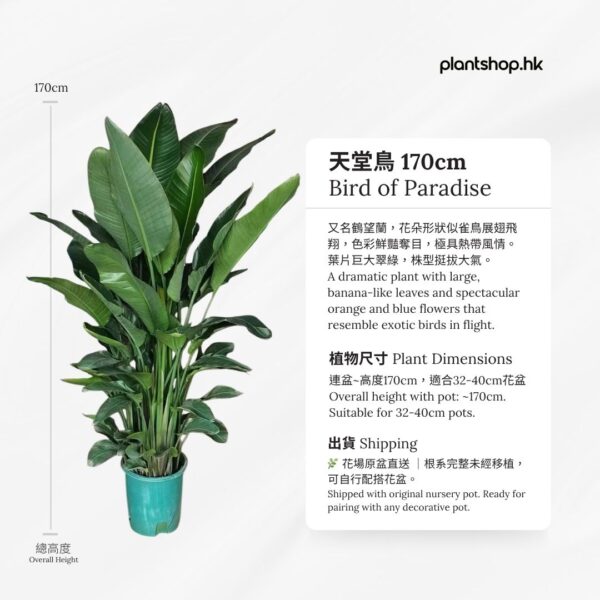
Giant Bird of Paradise
Giant Bird of Paradise — A large Strelitzia nicolai, approx. 170cm tall, with upright stems and broad tropical leaves for bright living rooms, offices and entrances.
- Strong vertical form for larger indoor spaces
- Best in bright light; acclimatise gradually before stronger direct sun
- Water when the top 2–3cm of soil feels dry, then drain thoroughly
Hong Kong care guide: Giant Bird of Paradise (light, watering & common issues)
Before & after purchase · Plantshop Care Encyclopedia
