


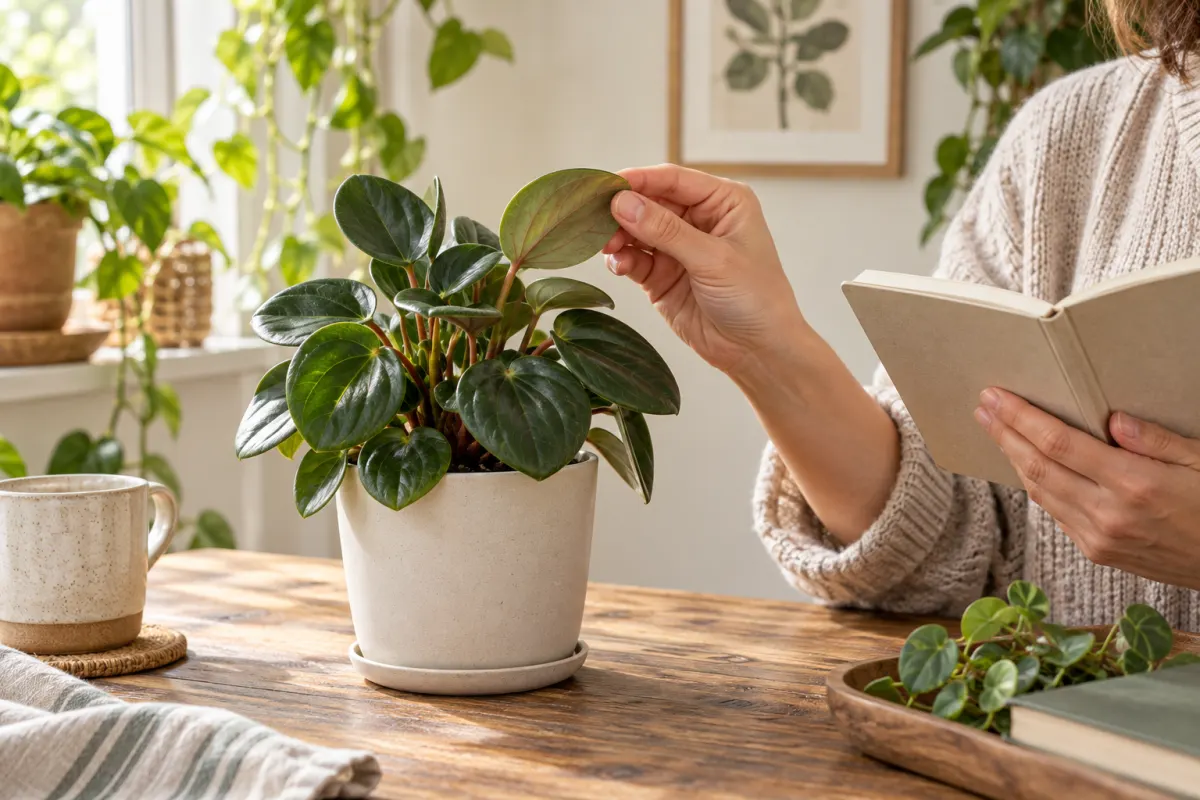

Small blisters or corky bumps on a houseplant leaf can be oedema, a physiological response to the plant’s water balance. Similar-looking marks can also have other causes. A photograph may show the shape, but it cannot confirm the diagnosis on its own.
What plant oedema means
Oedema (also spelled edema) is not a contagious infection. It can develop when roots absorb water faster than leaves lose it, so cells swell and form raised lesions. University of Maryland Extension describes houseplant oedema as wart-like or crusty bumps, often on lower leaf surfaces; lesions can later turn brown or necrotic and be mistaken for disease or insect feeding. Its indoor-plant guide names jade, English ivy, schefflera and snake plant among plants that can be prone.
The appearance can change over time. The University of Wisconsin–Madison Extension describes blisters that may enlarge, merge, burst and leave tan, corky scars. It links the imbalance to warm, moist growing medium combined with conditions that reduce water loss, such as high humidity, low light, cool air or poor air movement. These are clues to review, not a universal cause list for every plant or every bump.
Observe where and how the marks appear
Note whether the raised areas are on the underside or upper surface, between veins or directly over a main vein, and whether they are limited to older leaves. Photograph several leaves from both sides and include the whole plant. Keep a record of recent watering and changes in room position; a pattern over time is more useful than a close-up of one spot.
On small screens, scroll the table sideways to see all columns.
| What you notice | One possibility | What to check |
|---|---|---|
| Raised blisters on the lower surface, sometimes turning tan or corky | Oedema is possible. | Review root-zone moisture and whether the medium is staying wet while light or air movement is low. |
| Bumps appear on upper or lower surfaces, including over major veins | Intumescence is another physiological look-alike. | University of Massachusetts Extension distinguishes its usual distribution from oedema, but a single mark is not enough to tell them apart. |
| Fine stippling, webbing, insects or damage concentrated around new growth | A pest may be involved. | Inspect both leaf surfaces, the midrib, stem joints and growing points with a magnifier. |
| Dark or pale marks that are flat, spreading or damaging the leaf tissue | Another environmental or disease problem may be present. | Do not label it oedema from a photograph; track changes and seek an identification if it progresses. |
Oedema and intumescence can resemble galls or feeding damage. The University of Massachusetts Extension notes that oedema more typically appears on the lower leaf surface and between veins, while intumescence may be on either surface and can occur over major veins. Those patterns help guide inspection, but do not make a photo diagnostic. The University of Wisconsin cautions that very few plant diseases can be accurately diagnosed by eye.
Check the root zone before changing your routine
Feel the medium below the surface rather than relying on a dry-looking top. Check whether the pot drains and whether water is left in a saucer or cachepot. Compare how quickly the pot dries now with its usual pattern. A cool, dim position, restricted air movement or consistently wet mix may contribute to oedema in susceptible plants, but do not stop watering altogether: roots still need water, and the response must fit the plant’s needs.
Make one measured adjustment at a time. If the root zone stays wet, allow it to dry adequately before watering again and make sure excess water can drain away. If the plant is in very low light, improve it gradually within the species’ suitable range rather than putting it straight into harsh sun. Avoid a fixed watering calendar; the plant, medium, pot and room conditions determine how quickly it dries.
A worked example: corky marks on a jade plant
Imagine a jade plant with small raised patches on the underside of several older leaves. The pot feels damp, and it has been watered again because the surface looked dry. Oedema is one possibility, since jade is listed among susceptible houseplants and excess root uptake can exceed leaf water loss. But that does not confirm the cause: inspect for pests, check whether marks are raised or part of the leaf, and review the moisture below the surface. If new lesions keep appearing or the plant declines, collect clear photographs of both leaf surfaces and the whole plant for an expert assessment instead of treating the picture as a diagnosis.
When to ask for a closer assessment
Seek a plant-specific diagnosis if lesions continue to spread, new leaves become distorted, the plant weakens, or you find signs of insects or webbing. Include a photograph of the whole plant, close views of both sides of affected leaves, and notes on watering, light and recent changes. A diagnostic service may need a physical sample to separate physiological damage from pests or disease. Do not treat every corky patch as infectious or apply a fungicide without knowing what you are treating.
Where the plant otherwise looks healthy and the marks are old scars, watch the next leaves rather than repeatedly cutting damaged foliage. Oedema scars may remain visible after the conditions that caused them have changed; new growth is the more useful indicator of whether the problem is continuing.
Frequently asked questions
Is oedema contagious to other plants?
Oedema is a physiological disorder, not an infection that spreads from plant to plant. However, pest or disease look-alikes can have different causes, so inspect before deciding that similar marks have the same explanation.
Will corky marks disappear after I water less?
Existing scars may remain. Review how wet the root zone stays and whether the pot drains, then adjust watering to the plant and conditions. Watering less often is not automatically right for every species.
Can you confirm oedema from a leaf photo?
No single photo can reliably exclude look-alikes. Both leaf surfaces, the growth pattern, plant condition and growing conditions all help; a plant clinic may need a sample for confirmation.
Sources
- University of Maryland Extension, “Edema of Indoor Plants” — houseplant symptoms, water-uptake imbalance and commonly susceptible species.
- University of Wisconsin–Madison Extension, “Edema” — blister-to-corky-scar development, environmental conditions and caution about visual diagnosis.
- UMass Extension, “Edema and Intumescence” — physiological conditions, symptom distribution and look-alikes.
Related reading
- Why Are My Plant’s Leaves Turning Yellow? 9 Causes and Fixes
- Choosing Water for the Plants You Already Have
Sources checked on 26 September 2026.
