


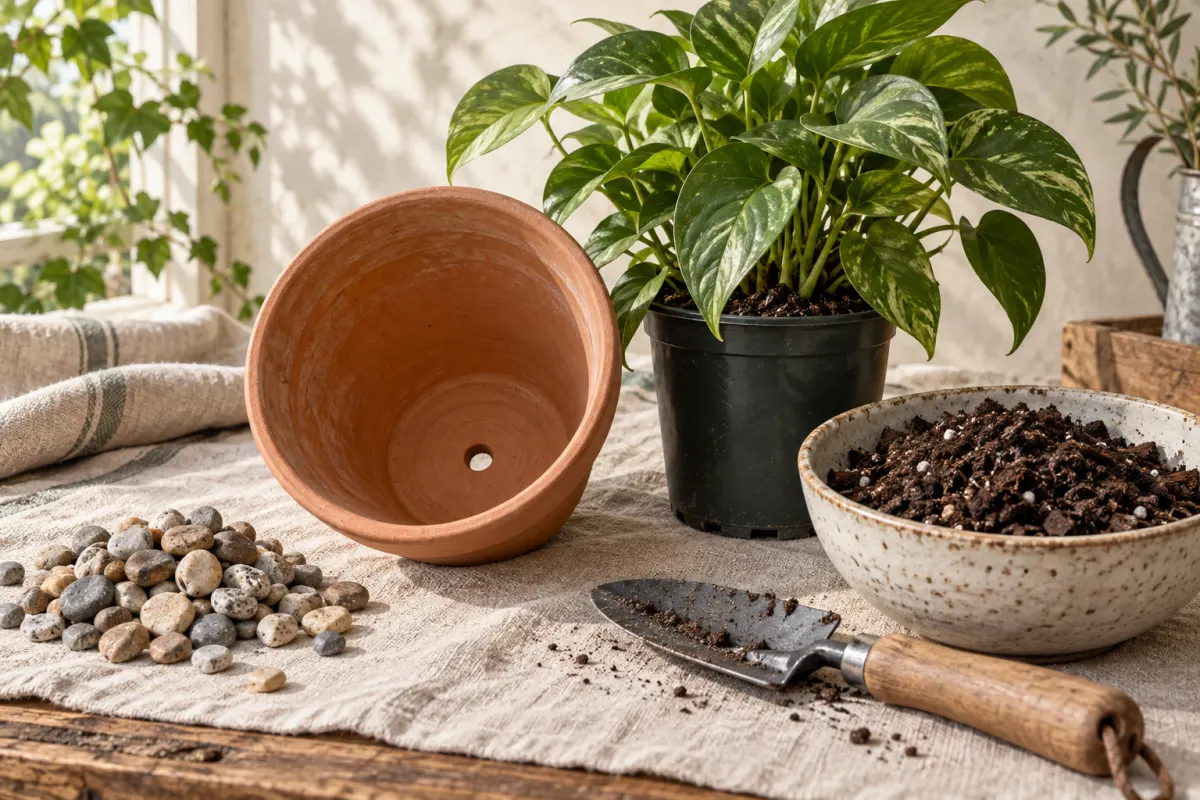

A gravel layer at the bottom of a pot is not a simple, universal drainage fix. It changes the boundary between the growing mix and the container outlet, and a 2025 experiment found that some layers reduced water retained in the tested pots. That is useful evidence—but not proof that every plant will grow better with gravel.
This article is about a coarse layer beneath the potting medium in a pot that already has drainage holes. It is separate from decorative stones on the surface and from a decorative outer pot with no holes.
Why water behaves differently in a pot
After watering, gravity pulls excess water down, while the pores between particles hold some moisture by capillary forces. The lower part of a container can remain wetter than the upper part. Iowa State University Extension calls this a saturation zone: with the same medium, it reaches roughly the same height in short and tall containers, so a tall pot has more medium above it. Fine pores can raise that wetter zone; container height and medium structure therefore matter. Iowa State’s container guide explains this pattern.
When fine potting mix meets a much coarser layer, the change in pore size can affect how water moves across the boundary. A common explanation has been that water may pause above that interface until the fine medium is very wet, leaving a raised saturated layer. But water movement depends on the materials and the outlet together; the boundary alone cannot tell you how much moisture remains after drainage.
What the 2025 pot experiment found
A peer-reviewed 2025 PLOS ONE study directly measured water retained after freely draining pots containing three different growing media. The researchers compared 30 mm and 60 mm layers of gravel, lightweight aggregate, grit or sand. The tested mixes included two coir-based media and one loam-based compost. Across these conditions, drainage layers almost always reduced or did not change total container water-holding capacity; the best-performing layer varied with the mix, although 60 mm coarse sand was the most consistent in those trials.
This challenges the blanket claim that every coarse layer necessarily raises water retention. It does not establish a universal houseplant recommendation. The researchers measured water, not plant growth or root health; they did not measure pore size or the precise physical mechanism, and their results came from particular pots, materials and layer depths. Their own paper calls for more work to explain the results. The accurate takeaway is that drainage layers can change post-drain water retention, and the direction and size of that change depend on the system.
A practical way to read the options
On small screens, scroll the table sideways to see all columns.
| Choice | What it can do | What it cannot promise |
|---|---|---|
| Pot with open drainage holes and one suitable mix | Lets excess water leave while retaining a continuous root zone. | It cannot make frequent watering harmless. |
| Coarse layer beneath the mix | In the 2025 tests, some layer-and-mix combinations retained less water after drainage. | It cannot guarantee healthier roots or a faster drying time for every plant. |
| More suitable mix or container depth | Changes pore structure or the proportion of medium above the wetter bottom zone. | It cannot correct a blocked hole or standing water in an outer pot. |
A gravel layer also takes up space that could otherwise contain the plant’s growing medium. That may matter in a small or shallow pot, where root volume is already limited. There is no benefit in adding it automatically; equally, the new experiment does not justify saying that an existing layer must always be removed.
What to do with a plant you already own
Do not unpot a healthy plant just to remove gravel. Check whether the inner pot has open holes, whether water can drain into and out of its saucer, and how long the root zone remains wet. If the plant is growing normally and the pot drains, leave it alone. If the medium stays wet for a long time or the plant declines, review the mix, pot size, light and watering interval when you next need to repot; do not assume the gravel is solely to blame.
If you are choosing a new pot, use a container with adequate drainage holes and select a medium that suits the plant’s moisture needs. The 2025 paper suggests a coarse layer could be one tool for changing water retention, but its results are not a prescription for a household recipe. A uniform mix is simpler to assess and avoids sacrificing root-zone depth; a layered set-up should be a deliberate choice with a reason.
A worked example: the plant is wet for too long
Suppose a plant in a short pot is still wet several days after watering. Adding stones beneath its mix might alter the amount of water held after drainage, but it would also reduce the depth available to roots. First check that the drainage holes are not blocked and that the pot is not sitting in collected water. Then review whether the mix is unusually fine or the pot much larger than the root ball. If you decide to repot, choose a suitable medium and a pot size that matches the roots. The aim is a predictable root zone, not simply a visible layer of gravel.
For an established plant that looks well, a few stones at the base are not an emergency. The research is useful for weighing future choices; it is not a reason to disturb roots on a healthy plant.
Frequently asked questions
Does gravel always create a perched water table above it?
That has been a common theoretical explanation based on a fine-to-coarse interface. The 2025 experiments found lower or unchanged water retention in their tested containers, so the blanket prediction did not describe those results. The study did not settle how every mix, layer and pot behaves.
Should I use a thick layer because the study found 60 mm of sand worked?
No universal depth follows from one experiment. The 60 mm coarse-sand layer was the most consistent among the specific materials and mixes tested. It was not tested as a plant-health treatment across different household species.
Can I put gravel in a pot without drainage holes?
This article does not cover that set-up. A coarse bottom layer is not a substitute for an open outlet; excess water still needs somewhere to go. Use an inner pot with drainage holes if you want water to leave the root zone.
Sources
- “Effect of drainage layers on water retention of potting media in containers,” PLOS ONE (2025) — direct tests of post-drain water retention; no live-plant growth or root-health trial.
- Iowa State University Extension, “Potting Media: Components and Handling” — saturation zones, particle pores and how pot height changes the share of medium above the wetter zone.
Related reading
- How to Use Decorative Planters Without Drainage Holes
- Choosing Planters for Large Plants | Materials, Sizing, and the Drainage Question
Sources checked on 26 September 2026.
