



The Hidden Problem After Renovation After renovation, even when the air smells neutral, formaldehyde may still be present. It outgasses from furniture, paint, flooring, and adhesives — and because it’s colourless, you often won’t know it’s there. Long-term exposure can cause headaches and eye irritation, and the World Health Organisation classifies it as a Group 1 carcinogen. Opening windows and ventilating thoroughly is the most critical first response. Plants can serve as a natural, considered supplementary measure — but the honest framing is that they’re supporting cast, not the lead.
Where Does Formaldehyde Come From? — formaldehyde removal plants
Wooden furniture (especially MDF and particle board), paint and varnish, flooring (laminate, carpet adhesive), curtains and upholstery, glues and adhesives.
NASA Research vs. Reality: The Honest Version
In 1989, NASA conducted an indoor air purification study, testing plants’ ability to remove formaldehyde, benzene, and other volatile organic compounds. Results showed certain plants do absorb these compounds — but the experiments were conducted in sealed small chambers of approximately 0.9 cubic metres, an entirely different environment from a ventilated living room.
Subsequent research (Irga 2018; Cummings & Waring 2019) found that in normally ventilated indoor environments, plants’ purification effects drop sharply. Some researchers estimate you’d need nearly 100 plants per square metre to match the output of a single air purifier.
The right priority order: open windows first. Run an air purifier with an activated carbon filter second. Add plants as the third layer — a considered supplement that locally improves the micro-environment, regulates humidity, and makes a space feel inhabited. All of the following participated in NASA research and are well-suited to Hong Kong indoor conditions.
8 Plants Worth Knowing
Peace Lily (Spathiphyllum)
Participated in NASA research; its broad leaves absorb multiple VOCs. One of the most communicative plants available — its leaves droop when thirsty, offering a clear reminder before the situation becomes critical. Beautiful when flowering. Height: 60cm–1m | Placement: Living room, near new furniture
Note: Toxic to cats and dogs
Snake Plant (Sansevieria)
Absorbs CO₂ and releases oxygen at night (CAM photosynthesis) — unusual among common houseplants. Grows upright without claiming significant floor space. Appeared in NASA research for formaldehyde absorption. Height: 60cm–1.5m | Placement: Bedroom, living room corner
Note: Toxic to cats and dogs
English Ivy (Hedera helix)
Trailing growth — hangs on walls, drapes from shelves, fills vertical space with minimal footprint. NASA research demonstrated absorption of formaldehyde, benzene, and airborne mould. Height: Trails to 2m | Placement: Wall-mounted, shelves, window area
Note: Toxic to cats, dogs, and children — position with care
Areca Palm (Dypsis lutescens)
Participated in NASA research and confirmed non-toxic to cats and dogs by the ASPCA — the strongest option for pet households. Its leaves release moisture, actively regulating indoor humidity. Needs bright indirect light.
Height: 1.5–2.5m | Placement: Living room, generous spaces
Burgundy Rubber Plant (Ficus elastica)
Large, thick, lacquered leaves that participated in NASA research. Deep green, visually substantial, and adaptable to varied light conditions. Height: 1–2.5m | Placement: Living room, study
Note: Sap can irritate skin; toxic if ingested
Monstera (Monstera deliciosa)
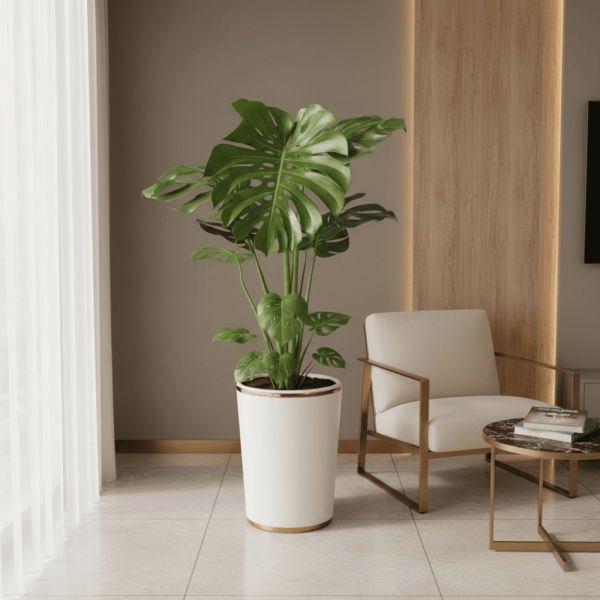
Large, split leaves with demonstrated formaldehyde absorption in NASA research. Among the most recognisable indoor plants of the past decade — fast-growing, and satisfying to observe weekly. Height: 1–2.5m | Placement: Living room, beside new furniture
Note: Toxic to cats and dogs
Golden Pothos (Epipremnum aureum)
Among the most forgiving plants available — it trails beautifully from cabinet tops and tolerates near-neglect. NASA research noted its formaldehyde and benzene absorption. Height: Trails several metres | Placement: Cabinet tops, shelves
Note: Toxic to cats and dogs
Aloe Vera
A useful plant on multiple registers — the gel soothes burns and minor skin irritation. Releases oxygen at night. Compact, considered, and low-maintenance. Height: 30–60cm | Placement: Kitchen windowsill, bedroom
Note: Toxic to cats and dogs; consuming large quantities is inadvisable for humans
The Right Approach to New Home Air Quality
In priority order: open windows and ventilate — nothing replaces this. Air purifier with activated carbon filter. Plants as supplementary presence that also happens to improve local air quality.
The value of plants extends well beyond VOC absorption — they bring life to a new space, regulate humidity, and shift how the room feels to inhabit. One well-placed large plant contributes to all three.
PlantShop offers a considered selection of large plants to match your new home’s style and light conditions. Browse to find your favourites.
Related Products
Below are the plants mentioned in this article, available for direct purchase. Each comes with a care card and WhatsApp support:



7-day health guaranteeFree delivery over HK$1,500WhatsApp help from a real person
FAQs
Where Does Formaldehyde Come From?
Wooden furniture (especially MDF and particle board), paint and varnish, flooring (laminate, carpet adhesive), curtains and upholstery, glues and adhesives.
NASA Research vs. Reality: The Honest Version
In 1989, NASA conducted an indoor air purification study, testing plants' ability to remove formaldehyde, benzene, and other volatile organic compounds. Results showed certain plants do absorb these compounds — but the experiments were conducted in sealed small chambers of approximately 0.9 cubic metres, an entirely different environment from a ventilated living room.
8 Plants Worth Knowing Peace Lily (Spathiphyllum)
Participated in NASA research; its broad leaves absorb multiple VOCs. One of the most communicative plants available — its leaves droop when thirsty, offering a clear reminder before the situation becomes critical. Beautiful when flowering. Height: 60cm–1m | Placement: Living room, near new furniture
Snake Plant (Sansevieria)
Absorbs CO₂ and releases oxygen at night (CAM photosynthesis) — unusual among common houseplants. Grows upright without claiming significant floor space. Appeared in NASA research for formaldehyde absorption. Height: 60cm–1.5m | Placement: Bedroom, living room corner


