



A New Home. One Right Plant. The Room Changes Entirely.
The boxes are unpacked, but the white walls still read as provisional — as though the space is waiting for a decision to be made about it. A full renovation is not the answer to that particular quality of emptiness. One 130–180cm plant, placed in the right position, is often sufficient to shift the entire register of a room. PlantShop specialises in this scale, each specimen hand-selected by our horticulturists. We have watched new residents reach that particular feeling of “this is finally home” in the moment a plant is carried through the door and set in the corner we suggested. Here are five large plants that are suited, specifically, to a new Hong Kong home.
Why Scale Matters — large plants new home hong kong
A 130–180cm plant transforms idle corners — those awkward vertical spaces where nothing at human height quite fits — into composed spatial moments. It introduces vertical layering that furniture alone cannot produce, and the effect on perceived ceiling height is immediate and consistent. One plant of this scale placed in a corner animates an entire wall, softens the architectural lines that new construction always produces in abundance.
On air purification: the claim warrants correction. NASA’s 1989 Clean Air Study was conducted in sealed laboratory chambers, and the purification capacity observed there does not translate into a residential interior with normal air circulation. For post-renovation air quality, ventilation is the most effective and direct intervention. Plants are supplementary — and their primary contribution is presence, not purification.
Humidity regulation, however, is real and measurable. Plants at this scale carry substantial leaf surface area, and their transpiration releases moisture into air that Hong Kong’s year-round air conditioning perpetually desiccates. A room with large plants is noticeably more comfortable to inhabit — not theoretically, but in the moment.
Five Large Plants for New Homes
Fiddle-Leaf Fig (Ficus lyrata) The Fiddle-Leaf Fig has dominated the aspirational interior for more than a decade, and the compulsion is earned. Those broad, violin-shaped leaves carry visual weight commensurate with a considered art purchase; the silhouette — spare, vertical, resolved — occupies a living room corner with the authority of a designed object. Indoors it reaches 1.5–2.5 metres. Positioned near a window with generous indirect light, it achieves what the design press has consistently attributed to it.
A candid qualification: it has a disposition. Leaf drop in the first month or two after a move is normal acclimatisation behaviour — it is not cause for alarm. Patience, consistent care, and a position it is then left to occupy without repeated relocation will produce the result.
Best location: Living room corner, near windows with bright indirect light Care: Water weekly; rotate the pot at intervals for even growth Care difficulty: ★★★☆☆
Pet note: Toxic to cats and dogs (contains insoluble calcium oxalate)
Monstera (Monstera deliciosa) The Monstera‘s split, fenestrated leaves carry a tropical energy that resists both trend and season — they have been a dominant indoor plant form for a reason that has nothing to do with current fashion. Indoors it reaches 1.5–2 metres. It is among the most accommodating plants of this scale: it processes strong light, average light, and partial shade with equal equanimity, which makes it the most forgiving of the five for anyone at the beginning of their relationship with large plants. Growth is at a satisfying pace — the unfurling of a new leaf is a small, specific, recurring pleasure.
Many articles cite the Monstera as a “super air purifier.” The actual purification effect is modest. Grow it for what it delivers.
Best location: Living room, entryway Care: Water every 10–14 days; appreciates ambient humidity Care difficulty: ★★☆☆☆ Pet note: Toxic to cats and dogs (calcium oxalate crystals cause oral irritation if ingested)
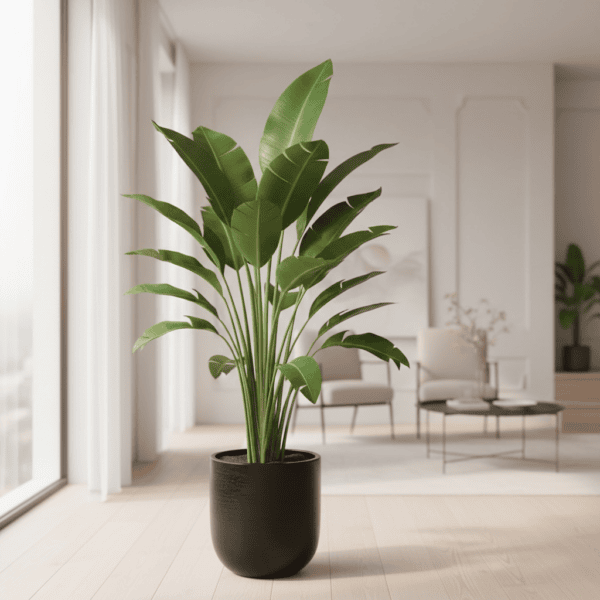
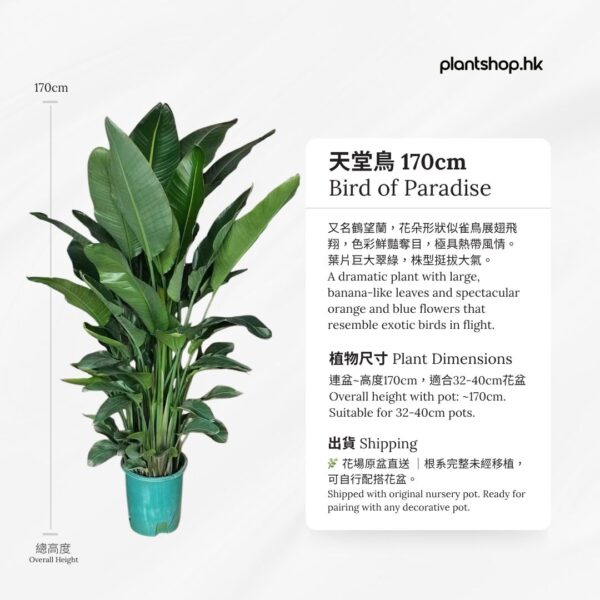
Giant Bird of Paradise (Strelitzia nicolai) Tall, broad-leaved, and immediately commanding — the Giant Bird of Paradise at 130–180cm reorganises whatever room it enters. Its banana-like leaves at this scale carry the particular authority of tropical abundance, and the visual statement is neither tentative nor ambiguous. It rarely flowers indoors; the draw is entirely the leaf architecture. It requires a position with genuine sunlight — a window-adjacent location for best results.
Best location: Living room near windows, apartments with balconies Care: Water weekly; fertilise on a regular schedule
Care difficulty: ★★★☆☆
Areca Palm (Dypsis lutescens) The Areca Palm‘s arching fronds extend with a generosity that reads, unmistakably, as resort — the kind of quiet tropical abundance that makes a room feel like somewhere else on a weekday evening. It is one of very few large plants certified non-toxic to pets by the ASPCA, making it the default choice for homes with cats or dogs. Its transpiration is among the highest of any indoor plant, which translates directly into measurable humidity benefits in an air-conditioned interior.
A clarification worth stating: the claim that the Areca Palm “releases oxygen at night” is inaccurate. It is not a CAM plant; at night it respires identically to all other non-CAM plants — absorbing oxygen and releasing CO₂.
Best location: Living room corner, near windows Care: Keep soil evenly moist; mist the fronds regularly Care difficulty: ★★☆☆☆
Pet safety: Non-toxic ✅ (ASPCA certified)
Burgundy Rubber Plant (Ficus elastica) The Rubber Plant’s deep green, lacquered, waxy leaves have a composed authority that is in no way dependent on scale — at 1.3–2 metres, it suits living rooms and studies equally. It is the most forgiving of the five: it tolerates both low and bright indirect light, requires watering only every 2–3 weeks, and produces the most consistent results with the least dedicated attention. The one qualification: it is toxic to cats and dogs, so households with pets should consider the Areca Palm instead.
Best location: Living room, study Care: Highly drought-tolerant; water every 2–3 weeks Care difficulty: ★☆☆☆☆
Pet note: Toxic to cats and dogs
Placement at a Glance
Living Room: Adjacent to the television cabinet: Fiddle-Leaf Fig or Monstera as the compositional focal point Sofa corner: Areca Palm or Giant Bird of Paradise to address vertical volume
By windows: Any light-demanding variety
Entryway: Entrance area: Monstera or Rubber Plant — the first impression is the entry, not the living room
On the shoe cabinet: A considered small plant grouping
Bedroom: Beside the nightstand:
Snake Plant (shade-tolerant, compact, suited to a position that receives little direct light)
By windows: Areca Palm (non-toxic; safe where a pet might investigate)
Your Action Plan for Moving In Assess the light conditions across every room — window count, orientation, depth of natural light penetration Set a budget that accounts for both plants and planters Choose one or two statement large plants — Monstera or Rubber Plant are the most accommodating starting points Pair each with a planter that is in genuine visual dialogue with the space Arrange delivery and placement — and confirm the position before the plant arrives
PlantShop specialises in 130–180cm large indoor plants. Every plant ships with a care card and direct WhatsApp access to our horticulture team for any question that arises after delivery. If you are moving into a new home and want the right plant — placed correctly, cared for properly from day one — we are available from selection through to final placement. A person replies. — PlantShop Horticulture Team
Related Products
Below are the plants mentioned in this article, available for direct purchase. Each comes with a real-person care card:


FAQs
Why Scale Matters
A 130–180cm plant transforms idle corners — those awkward vertical spaces where nothing at human height quite fits — into composed spatial moments. It introduces vertical layering that furniture alone cannot produce, and the effect on perceived ceiling height is immediate and consistent. One plant of this scale placed in a corner animates an entire wall, softens the architectural lines that new co
Five Large Plants for New Homes
Fiddle-Leaf Fig (Ficus lyrata) The Fiddle-Leaf Fig has dominated the aspirational interior for more than a decade, and the compulsion is earned. Those broad, violin-shaped leaves carry visual weight commensurate with a considered art purchase; the silhouette — spare, vertical, resolved — occupies a living room corner with the authority of a designed object. Indoors it reaches 1.5–2.5 metres. Posit
Placement at a Glance
Living Room: Adjacent to the television cabinet: Fiddle-Leaf Fig or Monstera as the compositional focal point Sofa corner: Areca Palm or Giant Bird of Paradise to address vertical volume
Bedroom: Beside the nightstand:
Snake Plant (shade-tolerant, compact, suited to a position that receives little direct light)

