



The door opens. Before anyone has spoken, before a card has been exchanged, before you have fully registered the ceiling height or the quality of the furniture, your nervous system has already absorbed the air humidity, the temperature of the light, the particular density of the space — and your eyes have come to rest on a tree in the corner. Done. First impression formed.
In psychology, this is the Primacy Effect: the first piece of information we encounter is the most durable, and the most resistant to subsequent revision. Harvard psychologist Amy Cuddy’s research adds a layer — first impressions between people organise themselves primarily around two judgments: *trustworthiness* and *competence*. Extend that logic to spaces, and the moment a client crosses your threshold, the same unconscious assessment is already running: does this company attend to its environment? Does it care about the details? Can I trust it?
The reception area is not “somewhere to place a few plants.” It is the brand’s opening sentence.
How Plants Participate in Brand Storytelling Consider two scenarios.
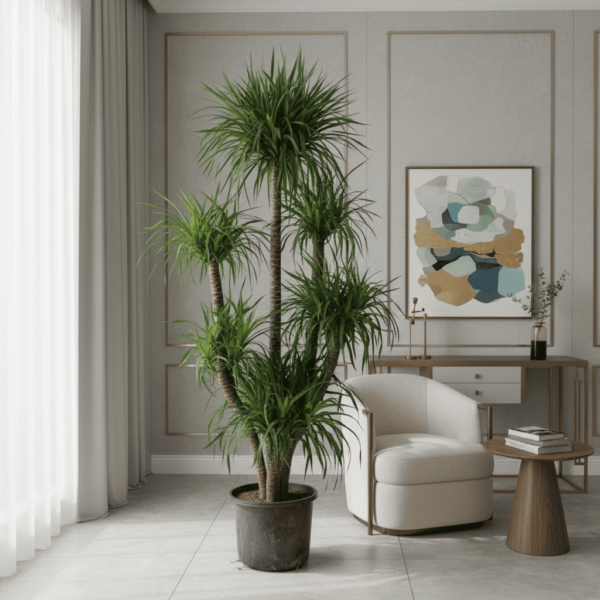
A law firm: two Madagascar Dragon Trees flanking the reception desk, their leaves lacquered and unblemished, the pots matte black ceramic. What registers is stability, professional authority, a space that has been thought about.
A technology start-up: a single Fiddle-Leaf Fig in a cement planter, its leaves broad and energetic, positioned in the corner as though it arrived before the furniture did. What registers is forward momentum, youth, a company that colours deliberately outside the conventional lines.
Same floor area. Different plants. Entirely different story told.
After years of corporate greening work, the most consistent failure we encounter in reception areas is not the absence of plants but their abandonment — a yellowing Money Tree wilting without water, a row of artificial flowers carrying a season’s worth of dust on every petal. These do not add to the impression. They subtract from it. If a company cannot sustain the environment at its own front door, every client who notices will form a view about what that implies for the standards operating behind it. Plants speak on your behalf whether you direct them to or not.
Three Principles of Reception Greening — reception plant design hong kong
Impressive but unobtrusive
Reception is a circulation hub. A plant can be tall — it should be — but it must never obstruct movement, must never produce a sense of enclosure, must never make the space feel smaller than it is. Two to two-and-a-half metres is typically the calibrated range — presence without oppression. Maintain at least 1.2 metres of clearance on principal pathways; visitors with luggage or in groups must move through without negotiation.
Evergreen consistency over seasonal bloom
Flowering plants have their moment, and it is a good moment — but wilted petals on a Monday before an important meeting are a poor introduction. Reception requires unwavering consistency. Madagascar Dragon Trees and Burgundy Rubber Plants are perennially “on” — they do not fade after their bloom period, do not leave you replacing them urgently, do not look out of season in February or August.
The planter is part of the message
An ordinary plastic pot can compromise a fine specimen. Financial institutions: marble-patterned ceramic communicates refined gravitas that the stone reference earns. Design firms: cement or oxidised metal signals the willingness to experiment and a comfort with harder materials. Social enterprises: raw, unfinished timber speaks to a care for people and the planet that no written statement can carry as efficiently. The material is a visual language, as integral to the brand system as the typeface or the logo colour.
Layout Considerations
Symmetrical composition — one plant on each side of the reception desk: the classical balance suited to traditional industries, where predictability is a form of authority. Focal-point composition — one large Fiddle-Leaf Fig or Giant Bird of Paradise anchors a corner; everything else plays a supporting role: suited to contemporary businesses where a single strong gesture communicates confidence. Living wall — highest cost, most indelible effect: a full green wall on the back surface ensures that no one leaves the reception without carrying it with them.
Practical Caution
Layout must follow the actual conditions of the space: available natural light, ventilation quality, proximity to air conditioning vents. Plants are living organisms; an inappropriate position produces decline, and decline in a reception area is worse than having placed nothing at all. We observed an Areca Palm positioned directly beneath an air conditioning unit: within three months, every leaf tip was brown and brittle. A reception that signals inattention is more damaging than a bare one.
Viewpoint: Greening Belongs in the Design Brief
Our Position
Reception greening should not be decided after the furniture is in place. It belongs in the design brief from the outset — because it implicates lighting, floor load-bearing, drainage, and electrical points for supplemental grow lights. If you are planning a new space, add greening to the initial brief: not “where do we put a few pots?” but “how do our plants participate in our brand’s first sentence?”
Those seven seconds when the door opens — what impression are you prepared to make? PlantShop specialises in 130–180cm large potted plants, each hand-selected to arrive in prime condition. Not satisfied? WhatsApp us — a person picks up.
— PlantShop Horticulture Team
Related Products
Below are the plants mentioned in this article, available for direct purchase. Each comes with a personal care card and WhatsApp support from our team:




FAQs
Three Principles of Reception Greening Impressive but unobtrusive
Reception is a circulation hub. A plant can be tall — it should be — but it must never obstruct movement, must never produce a sense of enclosure, must never make the space feel smaller than it is. Two to two-and-a-half metres is typically the calibrated range — presence without oppression. Maintain at least 1.2 metres of clearance on principal pathways; visitors with luggage or in groups must mov
Evergreen consistency over seasonal bloom
Flowering plants have their moment, and it is a good moment — but wilted petals on a Monday before an important meeting are a poor introduction. Reception requires unwavering consistency. Madagascar Dragon Trees and Burgundy Rubber Plants are perennially "on" — they do not fade after their bloom period, do not leave you replacing them urgently, do not look out of season in February or August.
The planter is part of the message
An ordinary plastic pot can compromise a fine specimen. Financial institutions: marble-patterned ceramic communicates refined gravitas that the stone reference earns. Design firms: cement or oxidised metal signals the willingness to experiment and a comfort with harder materials. Social enterprises: raw, unfinished timber speaks to a care for people and the planet that no written statement can car
Layout Considerations
Symmetrical composition — one plant on each side of the reception desk: the classical balance suited to traditional industries, where predictability is a form of authority. Focal-point composition — one large Fiddle-Leaf Fig or Giant Bird of Paradise anchors a corner; everything else plays a supporting role: suited to contemporary businesses where a single strong gesture communicates confidence. L

