



The Brain Is Not a Machine — staff pantry plants
Hong Kong lunch breaks are contracting. According to UBS’s *Prices and Earnings* report, Hong Kong’s workforce averages 2,600 working hours per year — the highest figure recorded globally. The lunch break, for many, has become a desk interval: a lunchbox held in one hand while the inbox stays open on the screen in front of them. The rest area, where it exists at all, is a cluster of folding chairs in the pantry or a row of window seats that no one has sat in since the renovation.
But directed attention — the cognitive resource that processes documents, executes decisions, and sustains concentration through meetings — is finite. When it depletes, it requires genuine restoration. Staring at a screen between tasks does not restore it. What does is a fundamentally different category of experience.
Attention Restoration Theory: Why Green Works Differently
In 1984, environmental psychologists Rachel and Stephen Kaplan articulated Attention Restoration Theory, which distinguishes between two modes of mental engagement. Directed attention is the effortful mode: it is what the brain deploys to read a contract, compose a response, or track a meeting’s argument. It burns quickly and cannot be sustained indefinitely. Soft fascination is the effortless mode: the brain engages lightly with something naturally compelling — swaying leaves, the pattern of light through glass, the sound of water — and in doing so, directed attention replenishes without the exhausting quality of forced concentration.
Simply put: allowing the mind to drift toward a plant for fifteen minutes is one of the more efficient forms of mental recovery available. The Kaplans’ research demonstrates that even fifteen minutes of exposure to natural elements produces a significant restoration of fatigued attention. For someone working ten or more hours in a building, a break corner with greenery may represent the only contact with the natural world that day. To eliminate it — to treat the rest area as leftover space after the meeting rooms are accounted for — is to ask people to run at full cognitive output with no mechanism for recovery.
The Break Room Is Not Remainder Space
The treatment of a break room as whatever is left after the serious areas of the office are allocated communicates, with precision, the company’s position on whether the people who work there deserve to rest. Employees read this accurately, even when they cannot articulate it.
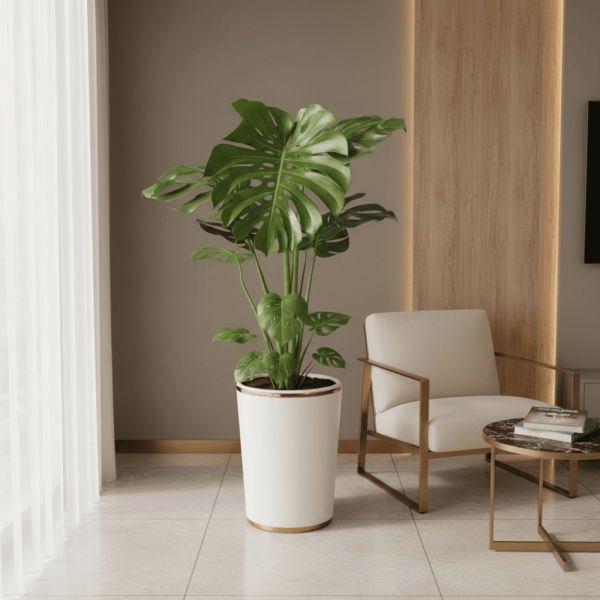
A considered break room carries a different quality: visually distinct from the work area, with plants creating the kind of green enclosure that allows people to step out of the office atmosphere even when they cannot step out of the building. A Fiddle-Leaf Fig or Monstera in the corner shifts the register of the entire space. A row of herb pots on the windowsill — mint, rosemary, lavender — introduces an aromatic dimension that the rest of the office does not have. Soft lighting. Natural materials: timber surfaces, rattan chairs, a linen cushion. The components are not expensive; the intention is what distinguishes them.
An HR manager at a financial firm in Central offered this observation: “Since we introduced plants to the pantry, informal conversations between colleagues have increased noticeably — and a number of cross-departmental collaborations have come directly out of those conversations.” Greening generates aesthetic value and, it turns out, functions as a catalyst for the casual exchanges that formal meetings do not produce and cannot be scheduled.
Two colleagues from different departments, both waiting for mint tea to steep, beginning a conversation — that is how project obstructions get resolved and how ideas that would not survive a meeting room find the environment they need.
Three Spatial Directions for the Break Room
Urban Oasis — For Medium-Scale Spaces
A large Fiddle-Leaf Fig as the compositional anchor, herb pots arrayed on the windowsill, trailing Pothos or Ivy descending along one wall. Layered without density. The effect is a room that breathes — people register it immediately on entering.
Japanese Zen — For Environments That Need Quiet
Small bonsai, bamboo specimens, smooth stones. A restrained tonal palette that slows the breath involuntarily. In a city of this volume and pace, genuine quiet is not an absence — it is a provision.
Tropical Garden — For Open-Plan Spaces and High-Intensity Teams
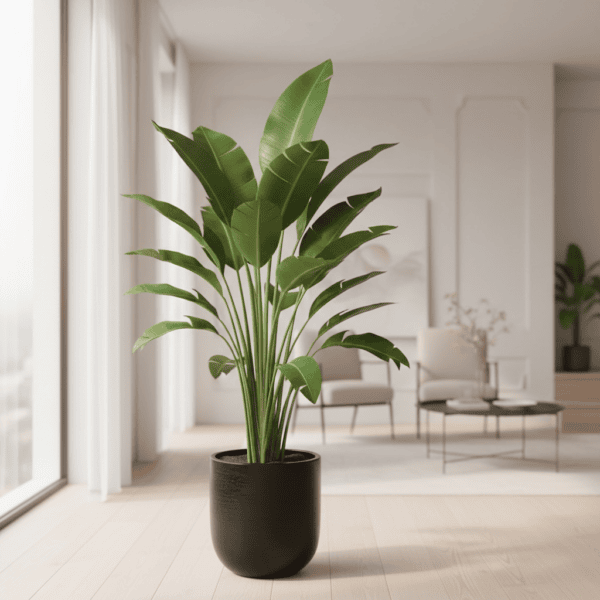
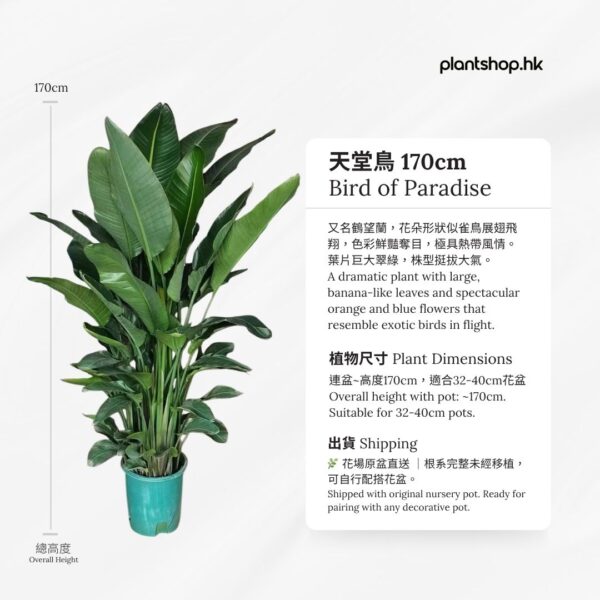
Giant Bird of Paradise and Areca Palm alongside hanging chairs or low seating. Hong Kong has no beaches within reach, but it can have a corner that reads — unambiguously, on a Tuesday afternoon — as somewhere else entirely.
Herbs: The Break Room’s Most Functional Contribution
When floor space is constrained, at minimum grow a few herbs. Mint infused in hot water is a thirty-second act of care directed at oneself. Rosemary’s scent has a documented grounding effect. Lavender carries a measurable tension-reducing quality. The particular value of herbs is the physical act of harvesting: employees who cut their own mint sprig from a pot their team waters together have a relationship with that plant that is categorically different from the relationship with a floor specimen maintained by someone else. Some companies run “adopt-a-plant” programmes in which individual teams tend a herb pot across the season — low-stakes engagement that produces the particular camaraderie of shared, minor responsibility.
Our Position
Hong Kong’s working hours are a structural condition that no single company can resolve. But creating a corner where people can, briefly, completely disengage — that is within reach of any company, at a cost far below what the gesture returns. A few plants, two comfortable chairs, one warm light. That is the most basic expression of regard for the people who appear every day.
Break room greening is not a perk. It is an investment in the mental recovery and creative capacity of the workforce — and when people return from a break that restored something, the quality of what follows is different. That is cause and effect, plainly stated.
PlantShop has completed break room greening projects across Central and Admiralty. We understand the particular constraint of Hong Kong’s commercial floor plans — we specialise in 130–180cm large plants, and one well-chosen specimen can transform a corner completely. Every plant ships with a care card accessible to any colleague, without prior plant knowledge required. — PlantShop Horticulture Team
Related Products
Below are the plants mentioned in this article, available for direct purchase. Each comes with a personal care card and WhatsApp support from our team:



FAQs
The Brain Is Not a Machine
Hong Kong lunch breaks are contracting. According to UBS's *Prices and Earnings* report, Hong Kong's workforce averages 2,600 working hours per year — the highest figure recorded globally. The lunch break, for many, has become a desk interval: a lunchbox held in one hand while the inbox stays open on the screen in front of them. The rest area, where it exists at all, is a cluster of folding chairs
Attention Restoration Theory: Why Green Works Differently
In 1984, environmental psychologists Rachel and Stephen Kaplan articulated Attention Restoration Theory, which distinguishes between two modes of mental engagement. Directed attention is the effortful mode: it is what the brain deploys to read a contract, compose a response, or track a meeting's argument. It burns quickly and cannot be sustained indefinitely. Soft fascination is the effortless mod
Japanese Zen — For Environments That Need Quiet
Small bonsai, bamboo specimens, smooth stones. A restrained tonal palette that slows the breath involuntarily. In a city of this volume and pace, genuine quiet is not an absence — it is a provision.
Tropical Garden — For Open-Plan Spaces and High-Intensity Teams
Giant Bird of Paradise and Areca Palm alongside hanging chairs or low seating. Hong Kong has no beaches within reach, but it can have a corner that reads — unambiguously, on a Tuesday afternoon — as somewhere else entirely.

