



Make room for the roots before they get in the way
A Monstera root can begin as an intriguing detail beside the stem and end up in the robot vacuum’s path. Where the sofa, window and plant share a corner, it pays to notice that route before the root finds a gap behind the furniture.
In this article
Healthy aerial roots do not need cutting for tidiness, and their appearance alone is not a reason to repot. First distinguish roots growing from the stem from those emerging through drainage holes. Then check for contact with furniture, vulnerable surfaces and everyday routes. An accessible path is easier to arrange before a root becomes caught.
Understand the climbing habit
RHS explains that Monstera climbs trees in its native habitat, using roots from the stem to attach and support that growth. An appropriate indoor support provides somewhere to climb. This does not mean every aerial root needs its own glass of water, or that aerial roots replace ordinary care of the potted root system.
Follow the root back to its origin and check that the support is stable and the main stem is adequately held. Do not tie a movable petiole down or pull a fine root taut like a cable tie. Supporting the plant and guiding a root are separate jobs; instability comes first.
Mark three boundaries around the pot
- Daily movement: where do chairs, the vacuum, feet and cleaning tools travel? Keep roots out of those routes.
- Surfaces: locate timber, wallpaper, curtains and cables. Leave access to inspect them rather than allowing roots to become wedged in gaps.
- Care access: identify the support, pot surface and place you reach to check the mix. Preserve the watering and inspection opening.
A still-flexible root may be gently directed towards a suitable support, or towards the pot surface where this does not require a sharp bend. Do not drive it into hard mix or coil it tightly. If a route only works with force, change the route rather than adding another tie.
A route check before you move anything
| Observation | First action | Avoid |
|---|---|---|
| Flexible root towards a walkway | Plan a gentle alternative route early | Waiting until it catches the vacuum |
| Rigid root crossing the rim | Check whether the whole pot can be repositioned safely | Folding it back into the pot |
| Root attached to a surface | Stop pulling and ask how to release it | Assuming only the root will be damaged |
| Root entering the base of a cover pot | Check standing water and whether the inner pot can be removed | Forcing the inner pot upwards |
| Soft decay or odour on root or stem | Record separately and arrange assessment | Hiding it with decorative material |
Respect an established root
Once a root has become rigid, bending it may snap it or pull at its attachment. Look for a small, safe change to the whole pot’s orientation or to nearby furnishings first. A large container needs suitable help; neither the stem nor the root is a handle.
Where removal appears necessary, discuss the reason and the plant’s condition with someone familiar with it. A root attached to a surface, entwined with a support or helping to hold the plant in place needs particular care. Decide how much, if anything, to remove from that assessment rather than a percentage borrowed from another specimen.
A tidy room can still allow growth
Quick questions
Do many aerial roots mean the plant is thirsty?
Their number alone cannot tell you. Check the mix, moisture and overall condition.
Can I bury the main stem to hide them?
Do not raise the compost level just to conceal roots. Changing planting depth is a separate horticultural decision, not a styling shortcut.
What if there is no room for a climber?
Accept some visible roots, find a more suitable position or choose a different form next time. A workable room should not require repeatedly removing the plant’s natural features.
A climber or a different silhouette?
If climbing roots are part of the appeal, give Monstera room for them. For a different structure, compare the other two forms below.
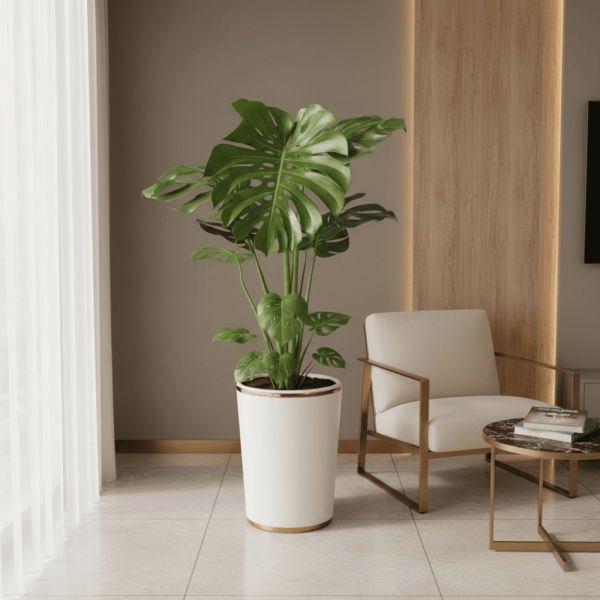
- Monstera Deliciosa: The climber discussed here: allow for support, canopy and root routes rather than measuring only the pot base.
- Burgundy Rubber Plant: Its distinct stems and broad leaves offer a different, non-vining silhouette; the leaves still need clearance.
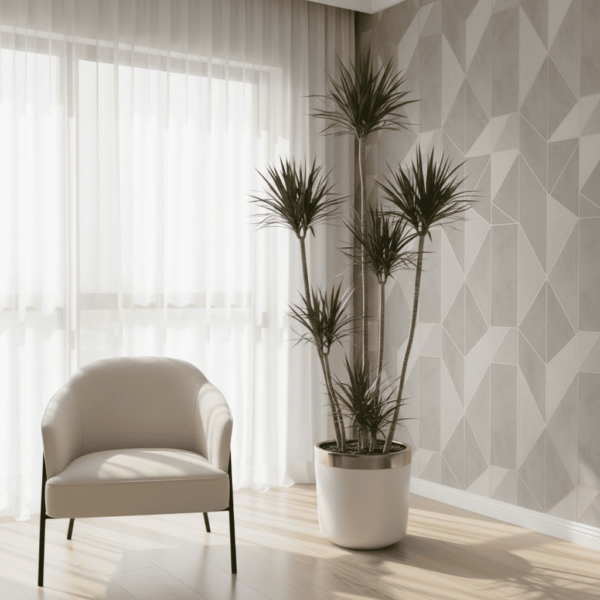
- Madagascar Dragon Tree: Slender stems and narrow-leaved crowns provide a vertical alternative. Check the actual spread and stability against the selected option.
Featured

Monstera Deliciosa
Monstera Deliciosa — A large, 130–150cm indoor plant with sculptural split leaves that brings confident tropical form to living rooms, offices and entrances.
- Best in bright, indirect light; avoid harsh afternoon sun
- Let the compost become almost dry, then water thoroughly and allow it to drain
Hong Kong care guide: Monstera Deliciosa (light, watering & common issues)
Before & after purchase · Plantshop Care Encyclopedia

Featured

Burgundy Rubber Plant
Burgundy Rubber Plant — glossy dark foliage and a distinct branching form for your living room or workspace. Choose a position with bright, indirect light.
Hong Kong care guide: Burgundy Rubber Plant (light, watering & common issues)
Before & after purchase · Plantshop Care Encyclopedia

Madagascar Dragon Tree
Madagascar Dragon Tree — Slender canes topped with narrow, deep green leaves edged in red.
Hong Kong care guide: Madagascar Dragon Tree (light, watering & common issues)
Before & after purchase · Plantshop Care Encyclopedia
