



Agree the definitions before comparing numbers
Read overall height, canopy spread and the outside dimensions of the container separately. Height alone cannot tell you whether foliage will block a window, extend into a route or fit the decorative planter you already own.
In this article
- Agree the definitions before comparing numbers
- Six dimensions that are easy to confuse
- Worked example: two plants labelled 150 cm
- Measure the room beyond the pot footprint
- Complete this specification check before enquiring
- Separate present dimensions from future growth
- Common questions
- Compare measurements across different plant shapes
The definitions below provide a shared language for enquiries; they are not a claim that every supplier measures in the same way. When browsing large floor plants, follow the specification on the individual product page. If the starting point of a height measurement is unclear, confirm it rather than assuming plant height includes the pot.

Six dimensions that are easy to confuse
| Dimension | Measurement to clarify | Main use |
|---|---|---|
| Overall height | Base of the specified pot to the highest natural leaf tip; list any stand separately | Ceiling, window and visual proportions |
| Plant height | Surface of the growing medium to the highest natural leaf tip | Size of the plant itself |
| Canopy spread | Widest natural foliage span; add a second perpendicular measurement if useful | Space occupied and route clearance |
| Inner pot outside diameter | Maximum diameter including the rim, plus height and base diameter | Fit inside a decorative planter |
| Outer planter usable interior | Opening, narrower internal sections and usable depth | Fit and access for removal |
| Outer planter external size | Maximum outside diameter and height, including feet or base | Floor footprint and handling |
Do not straighten curved foliage to obtain a taller measurement. A single-stem tree and a multi-stem plant can have the same height and spread but a different visual density. Clear information about the actual plant is still needed.
Worked example: two plants labelled 150 cm
These figures explain the terminology. They are not Plantshop stock specifications or quotations.
| Illustrative label | Known information | Valid conclusion |
|---|---|---|
| A: overall height 150 cm | Includes the specified inner pot, excludes a separate stand | That arrangement measures about 150 cm from pot base to leaf tip |
| B: plant height 150 cm | Measured from the medium surface; pot height is 30 cm | It is not 150 cm overall. Simply adding 30 cm is also unreliable because the medium surface is below the rim |
| C: planter diameter 35 cm | Only the external diameter is given | This does not establish that a 34 cm inner pot will fit |
Support inside a decorative planter and the natural position of foliage affect the finished height. Ask for the approximate floor-to-leaf-tip measurement of the complete arrangement you will receive.
Measure the room beyond the pot footprint
- Measure usable floor space. Include the planter, base and the access you need for cleaning. Mark it with a removable method that will not damage the finish.
- Check space at foliage height. Account for chair backs, curtains, door swings and wall-mounted objects. A pot may fit while its canopy collides with furniture.
- Try normal movements. Sit down, pull out chairs, open cupboards and draw curtains. Relying on everyone to be careful is not a substitute for suitable space.
- Measure the delivery route. Entrances, door frames, corridor corners, lift doors and the lift car can all impose limits. Record usable clear dimensions rather than nominal dimensions on a drawing.
For heavy plants or awkward routes, give measurements and photographs to the handling team. Do not assume foliage can be folded, the plant tilted or the pot removed safely.
Complete this specification check before enquiring
| Item | Product or supplier information | Site requirement |
|---|---|---|
| Plant and specified arrangement | ____ | Position ID: __ |
| Overall height and starting point | ____ | Available height: __ |
| Natural canopy spread | ____ | Available width and depth: __ |
| Inner pot and usable planter interior | ____ | Fit and removal access: __ |
| Base, stand and finished height | ____ | Included or excluded: __ |
| Transport arrangement and narrowest route | ____ | Handling-team confirmation: __ |
| Specification range and open questions | ____ | Confirmation date: __ |
Plants change as they grow. A sensible specification range and an explanation of what photographs represent are more useful than millimetre precision for every leaf. An illustrative image is not a scaled measurement record.
Separate present dimensions from future growth
A product measurement describes the arrangement at purchase. A mature height in a plant reference may describe very different growing conditions and many years of growth; it is not a forecast of short-term indoor growth. Think about future access for moving, pruning and maintaining suitable light.
The RHS houseplant reference is a starting point for growth habits, alongside Plantshop’s care encyclopedia. If a space requires a tightly controlled shape, explain that before ordering rather than expecting a living plant to retain its delivery-day outline indefinitely.
Common questions
Does a bigger pot always mean a bigger plant?
No. Container design, root-ball size and plant form all affect the arrangement. Pot diameter does not replace a height or canopy measurement.
Can I calculate height from a product photograph?
Perspective, camera lenses and furniture dimensions can distort proportions. Use confirmed specifications rather than scaling from a sofa or person in an image.
Does the stated height include a stand?
Check the individual description and ask if it is unclear. A stand also needs suitable load capacity and a compatible base.
Review the current delivery information and confirm any route or handling requirements before delivery. Complete dimensions make a suitable choice much easier.
Compare measurements across different plant shapes
Plants of a similar height can occupy very different amounts of space. When comparing these products, record overall height, maximum canopy spread, the outside pot-rim diameter and access dimensions separately.
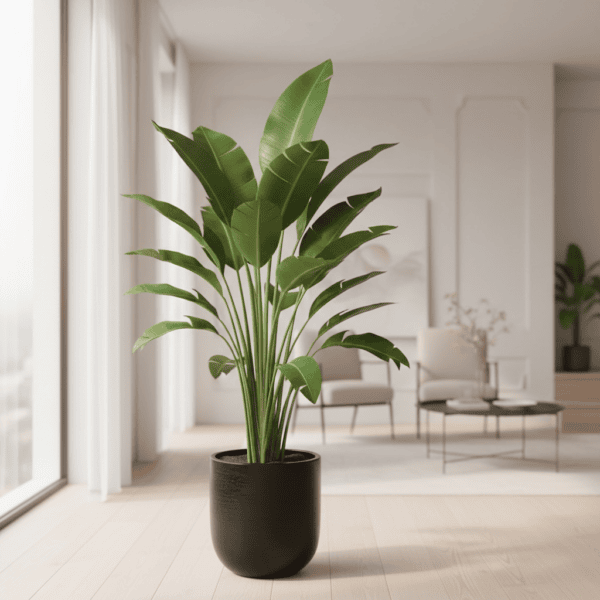
- Giant Bird of Paradise: For a giant bird of paradise, allow for the tallest leaf, sideways spread and clearance from the ceiling and curtains.
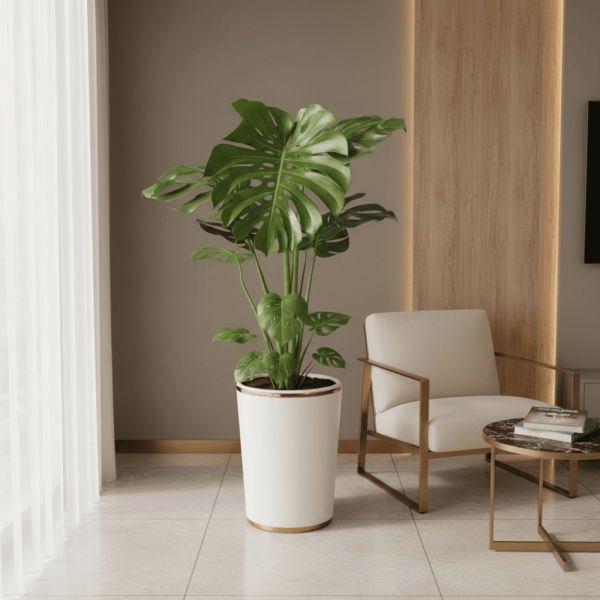
- Monstera: For a monstera, measure to the outermost leaves; pot diameter is not the width of the whole plant.
- Madagascar Dragon Tree: For a dragon tree, note the direction of each leafy crown as well as overall height when assessing corners or positions beside furniture.
Featured
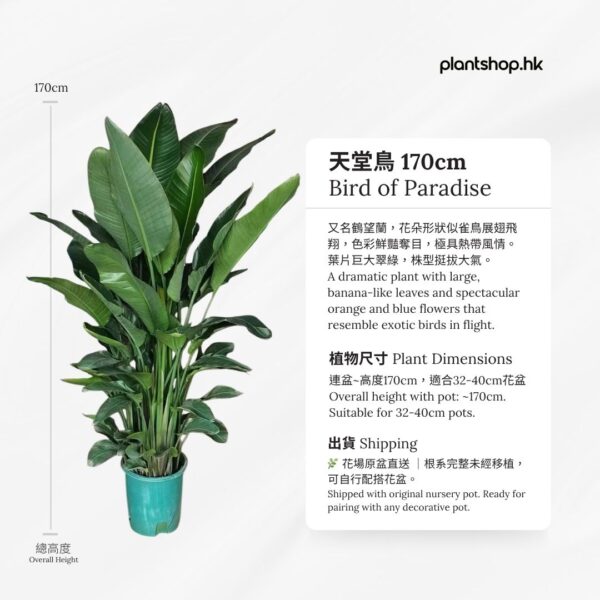
Giant Bird of Paradise
Giant Bird of Paradise — A large Strelitzia nicolai, approx. 170cm tall, with upright stems and broad tropical leaves for bright living rooms, offices and entrances.
- Strong vertical form for larger indoor spaces
- Best in bright light; acclimatise gradually before stronger direct sun
- Water when the top 2–3cm of soil feels dry, then drain thoroughly
Hong Kong care guide: Giant Bird of Paradise (light, watering & common issues)
Before & after purchase · Plantshop Care Encyclopedia
Featured

Monstera Deliciosa
Monstera Deliciosa — A large, 130–150cm indoor plant with sculptural split leaves that brings confident tropical form to living rooms, offices and entrances.
- Best in bright, indirect light; avoid harsh afternoon sun
- Let the compost become almost dry, then water thoroughly and allow it to drain
Hong Kong care guide: Monstera Deliciosa (light, watering & common issues)
Before & after purchase · Plantshop Care Encyclopedia
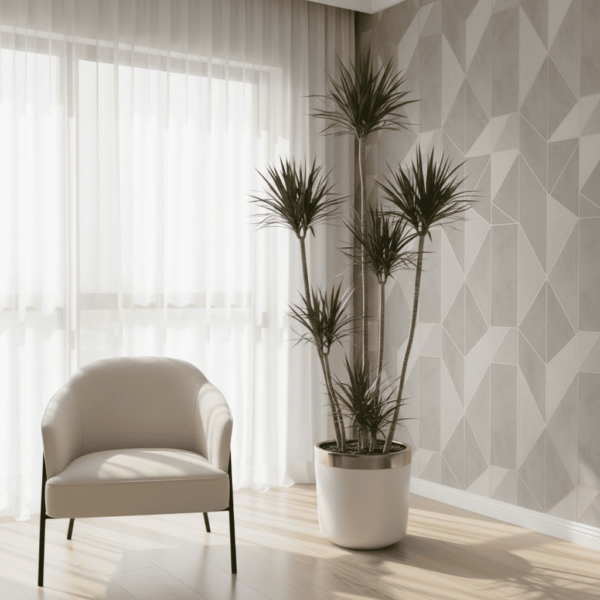

Madagascar Dragon Tree
Madagascar Dragon Tree — Slender canes topped with narrow, deep green leaves edged in red.
Hong Kong care guide: Madagascar Dragon Tree (light, watering & common issues)
Before & after purchase · Plantshop Care Encyclopedia
