


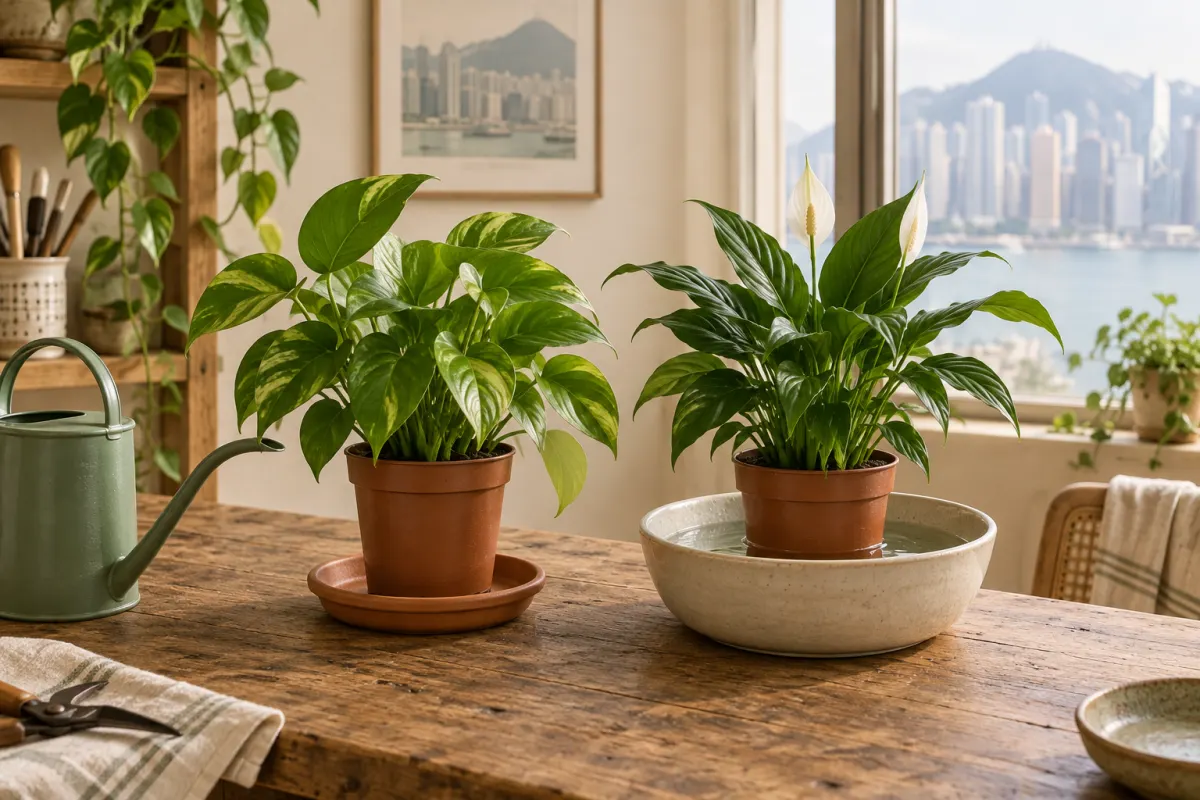

Top watering is the straightforward default for most houseplants; bottom watering can be useful when you want water to wick up from below or need to keep leaves dry. Neither method fixes an unsuitable pot or a mix that stays wet for too long. Choose the method for the plant and the job, then let excess water drain away.
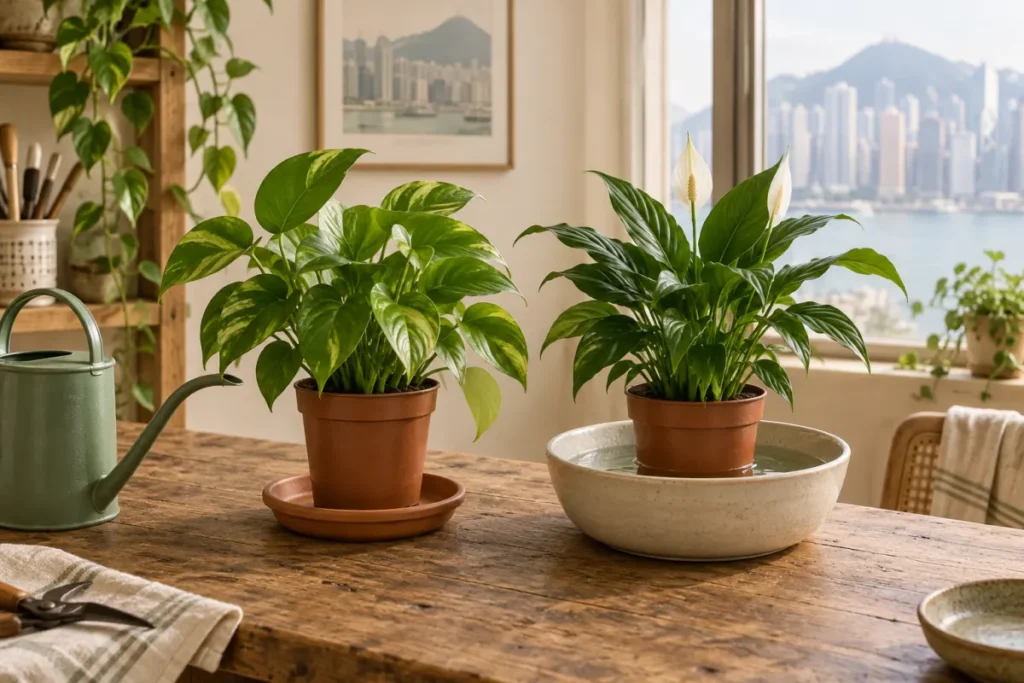
What the two methods actually do
With top watering, pour water onto the compost surface, directing it below the leaves, and let it move down through the root zone. Water should be able to leave through the drainage holes. With bottom watering, sit a pot that has drainage holes in a shallow container of water. The compost absorbs moisture upwards by capillary action. When the mix has taken up enough, lift the pot out and empty the tray.
These are ways to deliver water, not separate plant-care systems. The University of Maryland Extension describes both methods and stresses emptying excess water. Virginia Cooperative Extension also notes that the method does not change the plant’s underlying moisture needs: the aim is to wet the useful root-zone volume without leaving the pot waterlogged.
When top watering is the better fit
Watering from above makes it easy to see when water runs freely through the pot, and it is useful when you want to flush accumulated soluble salts from the compost. University of Maryland Extension explains that dissolved fertiliser salts can remain behind as water evaporates; a thorough top watering that drains away can carry some of them out. Do not leave the pot standing in that drainage water.
Keep the stream on the compost rather than pouring over leaves. Some plants are more vulnerable to problems when their foliage stays wet, and mineral residue from water can mark leaves. Virginia Cooperative Extension names African violets, begonias, cyclamens and some cacti as examples where wet foliage may be undesirable. This is a reason to direct water carefully or consider bottom watering; it is not a rule that every leaf must remain dry in every circumstance.
Top watering is also a useful way to check the pot’s drainage. If water immediately rushes out, that does not prove the whole rootball has become evenly moist: compacted or water-repellent compost can let water travel down a gap. Check the mix rather than assuming either that it is dry or that it has soaked through.
When bottom watering can help
Bottom watering can be convenient for a plant with dense leaves, for a species that dislikes wet foliage, or when dry compost is slow to absorb water from above. Virginia Cooperative Extension notes that a water-repellent mix may take up water from below, although it can require more time. This method only works when water can enter through holes in the base of the growing pot.
Watch the surface of the mix rather than relying on a fixed timer. Virginia Tech’s guidance uses a moist surface as one sign that water has wicked through the pot. Once it has, lift the pot and let it drain completely. A tall pot, very dry mix or an unusually dense rootball may take up water unevenly, so check moisture within the mix if the plant remains limp or the upper compost is still dry.
Bottom watering is not the same as leaving a plant in a full saucer, using a reservoir pot, or keeping the compost permanently damp. Remove the pot from the water after it has absorbed what it needs. Long periods sitting in water reduce the air available to roots and can contribute to root problems.
The trade-offs to keep in mind
Bottom watering may be less effective at rinsing salts from the top of the compost because water is moving upwards rather than flushing down through the pot. If you see a salt crust, top watering can carry some soluble salts out, as University of Maryland Extension explains. First make sure the drainage holes are clear and the compost is not staying wet for prolonged periods. If drainage is blocked or the mix remains saturated, correct that before flushing; always empty the runoff.
Neither method can compensate for a pot without drainage, a blocked hole or a decorative outer pot holding standing water. If your plant lives in a cachepot, remove the inner growing pot for watering where practical, allow it to drain, then return it. For a self-watering container with a reservoir, follow the reservoir system’s instructions; that is different from briefly placing a nursery pot in a basin. Our guides explain why water can run straight through a pot and how self-watering pots work.
Choose by the issue, not by a universal rule
Start with the plant, pot and compost, then choose the method that addresses the practical constraint.
On small screens, scroll the table sideways to see all columns.
| Your situation | Try first | Check afterwards |
|---|---|---|
| Ordinary foliage plant in a drained pot | Water onto the compost, below the leaves | Allow free drainage; empty the saucer |
| Dense leaves or foliage that should stay dry | Bottom water if the pot has holes | Confirm moisture has reached the surface; drain fully |
| Compost repels water or dries unevenly | Bottom watering may help, or apply water slowly from above | Check more than one depth for dry pockets |
| Salt crust or need to rinse the mix | Top water through the compost | Discard runoff; do not leave the pot in it |
| No drainage hole or water trapped in an outer pot | Fix the container setup first | Do not leave roots sitting in collected water |
Common questions
Is bottom watering safer against overwatering?
No method makes excess water harmless. Either way, the mix must be suited to the plant, the pot needs drainage, and water left in a tray should be removed.
Does bottom watering clean the compost?
It can hydrate the root zone, but it does not flush salts down and out as top watering does. Use top watering when a rinse is needed and the plant can tolerate it.
Should I alternate between the two?
You can use either method when it suits the task. A useful approach is to bottom water when you need to keep foliage dry or the compost is slow to absorb water, then top water when you need to rinse the mix. Do not alternate on a rigid schedule.
Related reading
Sources checked on 26 September 2026.
References
- Virginia Cooperative Extension — Properly Watering Container Houseplants (SPES-804) — Top and bottom watering, drainage, foliage and moisture checks.
- University of Maryland Extension — Watering Indoor Plants — Watering methods, draining excess and soluble salt management.
