



The evening curtain test
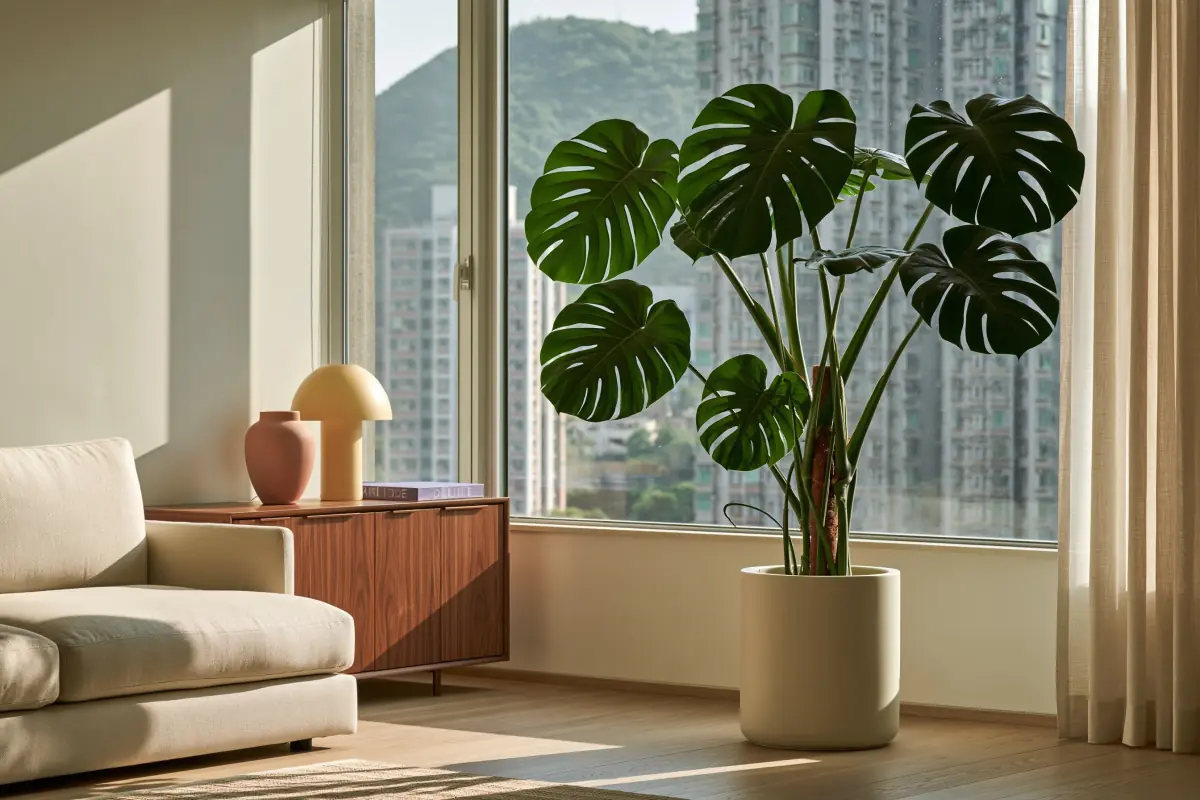
A leaf shadow on the wall is the easy part of placing a plant beside a full-height window. The better test comes in the evening, when you draw the curtains. If that means pushing leaves aside or moving the pot, the position needs another look. Make room for three things: the canopy, the moving curtains and your access to the window.
Start with those daily movements, then choose a plant whose shape fits. This guide works through the space around the glass; the large indoor plant selection can help you compare candidates once the position is clear. The arrangement should feel as comfortable to use as it is to look at.

Measure beyond the pot
Start with the plant. Check the outermost leaves as well as the base of the pot. A broad canopy can project beyond a relatively small container, while an upright plant may spread near the top. Leave room for adjustment and review it as the plant grows; a stated sale height is not a permanent dimension.
Next, check the curtains. Drawn-back fabric has depth, and a sheer curtain can move in a breeze. Blinds have their own controls and operating space. Open and close them fully instead of relying only on a floor plan.
Finally, consider access. You need somewhere to stand, reach the handle and clean the lower glass. Follow the path of any opening panel. It should not strike leaves, the planter or a support.
Watch the light you actually live with
A position close to the glass, one behind a sheer curtain and one tucked into the adjoining corner are different growing environments. Observe the arrangement you actually live with. Do you reopen the curtains in the morning, then close them against afternoon sun? When does the neighbouring building cast a shadow?
The University of Minnesota’s indoor-light guide recommends matching plants to the available light. Full-height glazing does not automatically turn direct sun into indirect light. When relocating a plant, consider its previous conditions and avoid a sudden move from shade into strong sun.
A reading lamp may make the corner attractive at night. Its presence alone does not establish that the plant receives sufficient growing light.
Three positions to try
- Use the fixed-glass side. Keep frequently opened panels accessible and try the plant beside glazing that does not need daily operation. Check both the light and the reach of the leaves.
- Stay outside the curtain’s path. Keep the container and foliage clear of the fabric when it is open or closed. Avoid squeezing a plant between glass and curtains simply to make the room look tidy.
- Use the adjoining wall. Moving the plant back can free up working space, but the light must be reassessed. Choose a species for the light available there.
Before buying, mark the approximate pot footprint with a box and use a tape measure to check the proposed canopy spread. Use the box to test clearance and assess the light separately.
A window-position checklist
Test the position on an ordinary working day, using the room as usual. Mark anything you have not checked as unconfirmed.
| Action | What to look for | Observation or adjustment |
|---|---|---|
| Open and close the curtains fully | Fabric catching leaves, stems or the container | ____ |
| Open the usual window panels | Reachable handles and a clear opening path | ____ |
| Stand at the glass to clean it | Space for feet, hands and cleaning tools | ____ |
| Walk from the sofa to the window | Repeated contact between foliage and clothing | ____ |
| Observe morning and afternoon | Direct sun, obstructions and normal curtain use | ____ |
| Inspect beneath the pot | Access to check water and clean the floor | ____ |
Leave the room easy to use
A large plant with wet potting mix can be considerably heavier than its empty container. Do not move it by pulling the stem. A wheeled drip tray is not automatically suitable for crossing thresholds or slopes: check load limits, the contact area beneath the pot and the route, and arrange sufficient help.
Where children or pets can reach the arrangement, consider stability, pulling and contact with the plant as well. If access, curtain movement and adequate light cannot all be accommodated, a different shape or position may be more workable than repeatedly cutting foliage to fit.
Sit back in your usual chair for the final check. Leave enough open space to enjoy both the leaves and the view, with the curtain still within easy reach.
Choose a silhouette for the window
Once the curtains and window work freely, compare the space with these three silhouettes. Confirm the chosen specimen’s height and canopy spread before ordering.
- Fiddle-Leaf Fig: Broad foliage creates a substantial outline. Test whether the canopy will overlap the curtains.
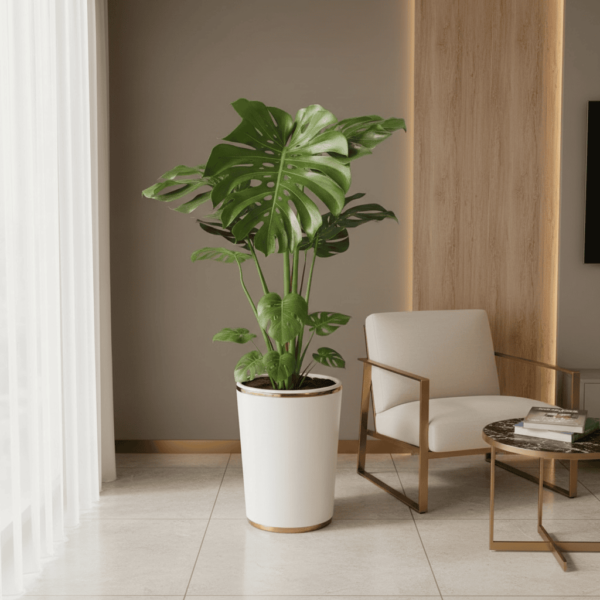
- Monstera: Outward-reaching leaf stalks need lateral space; pot diameter alone is not a useful footprint.
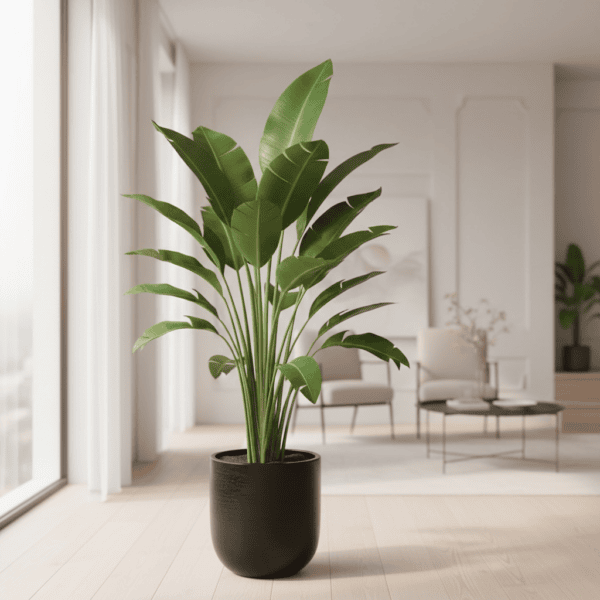
- Giant Bird of Paradise: Check the upper leaves against opening panels and confirm that the position provides suitable light.

Hot

Fiddle-Leaf Fig
Fiddle-Leaf Fig — Large, violin-shaped leaves on an upright stem; it grows best in a steady, bright position.
- Light: Bright indirect light to gentle sun; keep the position stable.
- Watering: Water after the top 3–5 cm dries; reduce in winter or low light.
- Ships in its original nursery pot; decorative planters are available as an upgrade.
Keep away from pets and children that chew leaves, and wash your hands after contact with the sap.
Hong Kong care guide: Fiddle-Leaf Fig (light, watering & common issues)
Before & after purchase · Plantshop Care Encyclopedia
Hot

Monstera Deliciosa
Monstera Deliciosa — A large, approx. 130cm indoor plant with sculptural split leaves that brings confident tropical form to living rooms, offices and entrances.
- Best in bright, indirect light; avoid harsh afternoon sun
- Water when the top 2–3cm of soil feels dry, then drain thoroughly
- Original nursery pot included; decorative planter upgrade available
Hong Kong care guide: Monstera Deliciosa (light, watering & common issues)
Before & after purchase · Plantshop Care Encyclopedia
Hot

Giant Bird of Paradise
Giant Bird of Paradise — A large Strelitzia nicolai, approx. 170cm tall, with upright stems and broad tropical leaves for bright living rooms, offices and entrances.
- Strong vertical form for larger indoor spaces
- Best in bright light; acclimatise gradually before stronger direct sun
- Water when the top 2–3cm of soil feels dry, then drain thoroughly
Hong Kong care guide: Giant Bird of Paradise (light, watering & common issues)
Before & after purchase · Plantshop Care Encyclopedia