



If a houseplant looks planted too deep after repotting, compare the new compost line with the old one before changing anything. For most established foliage plants, keep the plant at its previous depth. Do not add compost to cover lower stems or leaf stalks; a rootball that sits low in its pot is not by itself a reason to bury more stem.
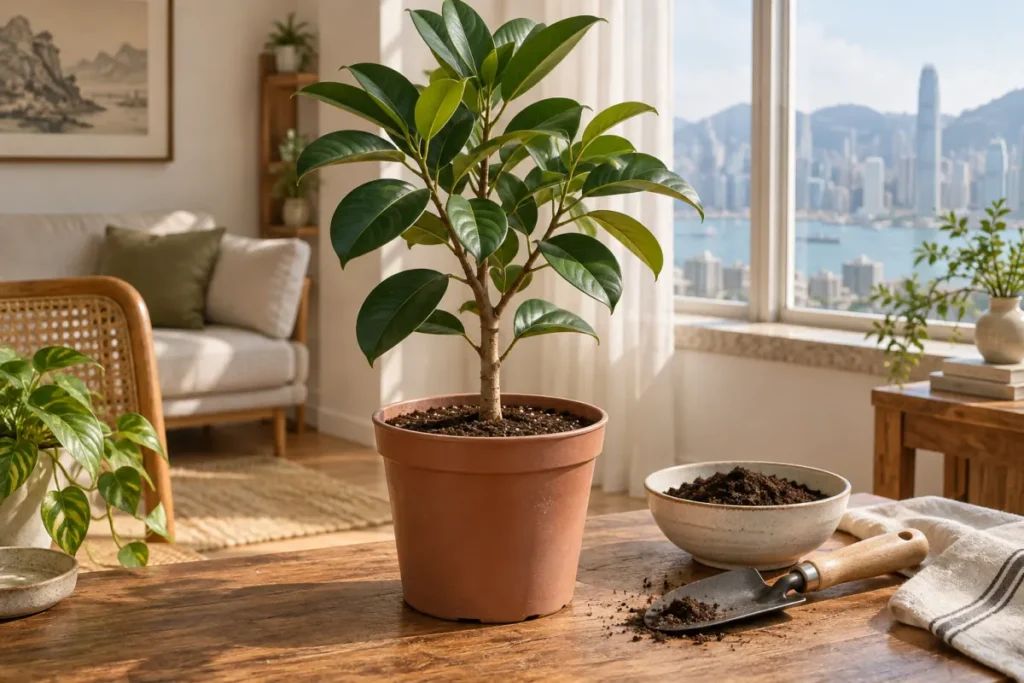
First check: where was the old soil line?
Look for a colour or texture change on the lower stem, a faint ring of old compost, or a change in the way the lowest leaves emerge. These clues can help you locate the original surface, but they are not always clear after a nursery plant has been cleaned or handled. If you took a photograph before repotting, compare it with the current pot.
The University of Illinois Extension advises replanting a houseplant at the same depth it occupied in its old pot. The Royal Horticultural Society likewise says to cover exposed surface roots only lightly and not to pile compost around a stem or trunk. In practice, keep the rootball at its previous level and leave a little space below the pot rim for watering. The aim is a stable plant with its roots covered, not a stem buried to make the surface look neat.
What counts as “too deep”?
Extra compost over the original soil line can leave a longer section of stem or the plant’s centre sitting in damp media. That is different from simply covering fine roots that were exposed during repotting. A few surface roots can be covered lightly; a thick collar of compost pressed against the stem is not the same thing.
Check the structure of your particular plant. Some foliage plants have a distinct stem; others grow from a central crown at the base. The crown is not a general name for every active growing point: its position and the appropriate planting depth depend on the plant’s structure. Use the previous compost line as your reference rather than assuming that a growing point should sit at the soil surface. Do not treat every brown section near the base as stem that needs burying: it may be old leaf tissue, a woody trunk or part of the plant’s normal structure. If it is firm and the plant is stable, appearance alone does not show that the root system is damaged.
Keep the crown distinct from roots and aerial growth
A crown, fine surface roots and aerial roots are different structures. Fine roots at the surface may need a light cover of mix; do not pile compost around lower stems just to hide the crown. Aerial roots grow above the compost and are not a cue to raise the soil line. Avoid trimming, forcing or tucking them under the compost just to make the pot look uniform.
There are exceptions to any general rule. Plants grown from a bulb, corm, rhizome or other specialised storage structure, and some plants with pseudobulbs, have species-specific planting guidance. Do not apply the ordinary foliage-plant rule to those structures. Identify the plant and follow a reliable guide for that species or ask a qualified horticultural professional before changing its depth.
If it is too deep, correct it with minimal disturbance
If you have just repotted and the rootball is still loose, support it from below and raise it only enough to restore the former soil line. Add or remove mix beneath the rootball so it sits level; do not pull the plant up by its leaves or use the stem as a handle. Backfill around the roots gently and keep the growing point visible.
If loose compost has been added against the stem, remove only the excess around it. Work slowly with clean fingers or a small spoon, stopping when you reach the previous surface. Do not excavate into the rootball or strip soil away from fine roots. If correcting the height would require pulling the entire plant out again, weigh the benefit against the extra disturbance. A slight difference is not, by itself, a reason to intervene when the stem is firm and the plant is growing normally.
Pause and assess: a soft or darkening stem base, a sour smell, persistently wet mix or ongoing decline deserves attention on its own. Those signs do not prove that planting depth caused the problem. Check drainage and root condition before deciding whether another repot is justified.
A quick depth check
Use the plant’s previous soil line as your reference, then choose the least disruptive action.
On small screens, scroll the table sideways to see all columns.
| What you see | What it may mean | Next step |
|---|---|---|
| The lower stem and plant base look as they did before | Depth is probably unchanged | Leave it; check ordinary moisture and drainage |
| Loose compost is mounded against a foliage stem | The new surface may be higher than the old line | Brush away only the surplus around the stem |
| Fine roots are exposed at the surface | Some roots may need a light covering | Cover exposed fine roots lightly, away from stems and growing points |
| Bulb, corm, rhizome or pseudobulb is involved | Depth depends on the plant’s structure and species | Find species-specific planting instructions first |
Common questions
Can I add compost around the stem to make the plant more stable?
Do not use a deep mound as a substitute for a stable rootball. Check whether the roots are seated and the pot is appropriately sized. If the plant rocks, firm the mix gently around the rootball while keeping the former soil line visible.
Should I repot again straight away?
Only if the plant is materially too deep or another root-zone problem needs correction. Repeatedly lifting a healthy plant over a small surface difference can add avoidable disturbance.
Does a visible aerial root mean the soil is too low?
No. Aerial roots grow above the mix by design in some plants. They do not establish where the original soil line was or mean that the stem should be buried.
Related reading
- Spring Repotting and Pruning | How to Give Large Plants a Proper Fresh Start
- When a Houseplant Leans: Working with Light and Shape
Sources checked on 26 September 2026.
References
- University of Illinois Extension — Repotting — Same planting depth and practical repotting checks.
- Royal Horticultural Society — How to repot a plant — Lightly cover surface roots and avoid compost piled around stems or trunks.
