



Level: Beginner
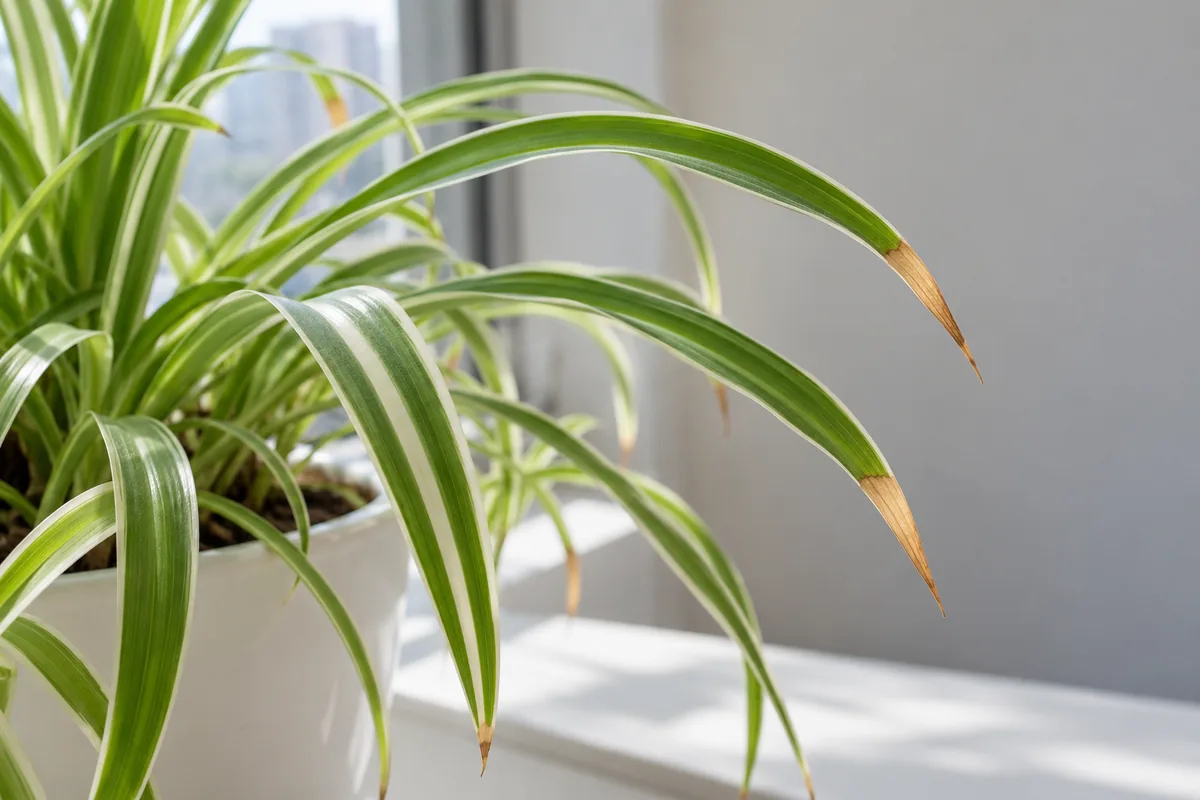
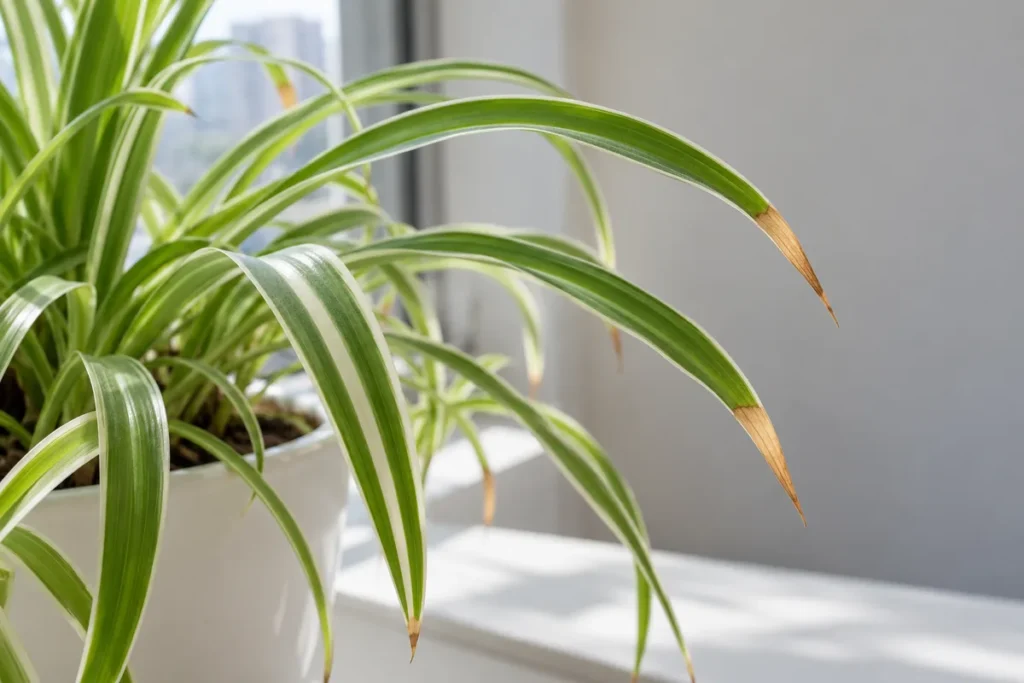
Brown, crisp leaf tips and edges most often trace back to dry air, salts in the potting mix, fluoride or chlorine in water, or uneven watering, and these can overlap. Check for white crust, the species and the plant’s position, change one thing at a time, and judge by new growth.
Key points
- Common causes are low humidity, fertiliser or water salts, fluoride or chlorine in tap water and uneven watering, but sources do not rank them, so your own conditions decide [1][3].
- Misting has weak support as a way to raise humidity because leaves dry quickly; humidifiers are the better-supported option [2][6].
- Trimming brown tips only improves appearance, and new browning will return if the cause stays [1].
- Hong Kong tap water has fluoride added, and some species may be sensitive, but none of the sources gives a plant-damage threshold, so work by species and elimination [5][10][11].
How do I confirm it is tip burn and not something else?
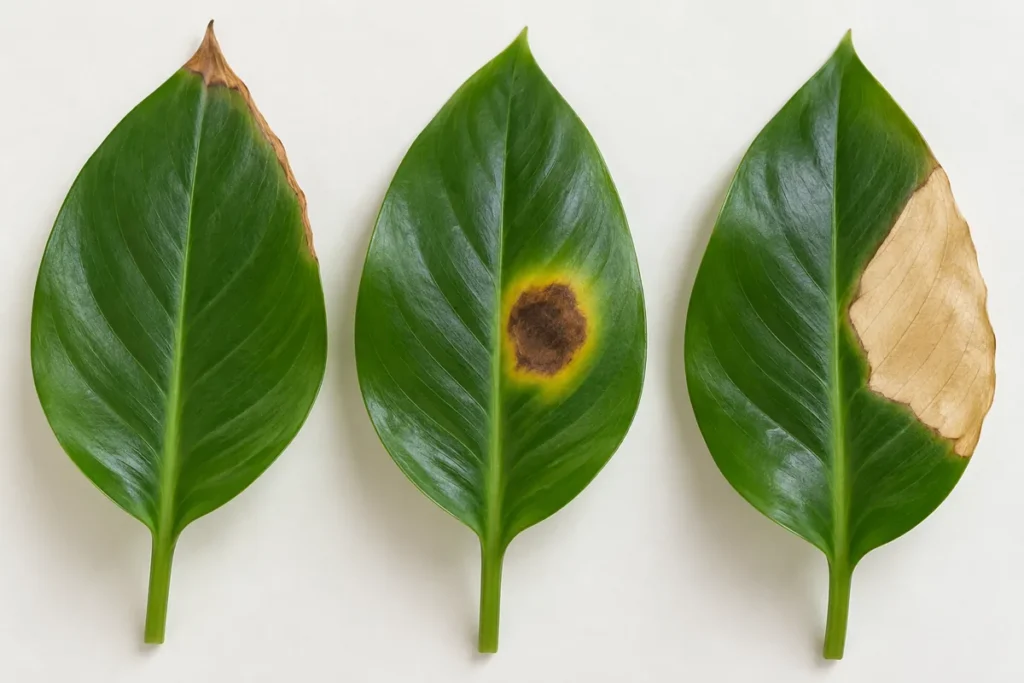
Check where the damage sits. Tip burn is dry, crisp, brown tissue at the tip or edge while the rest stays green. The University of Missouri calls it marginal or tip necrosis and lists fertiliser salts, softened water, low temperature and prolonged dry soil as causes [3]. A mid-leaf spot, yellow halo or soft dark patch points elsewhere.
On a phone, swipe sideways to see every column.
| Clue | Possible cause | Next step |
|---|---|---|
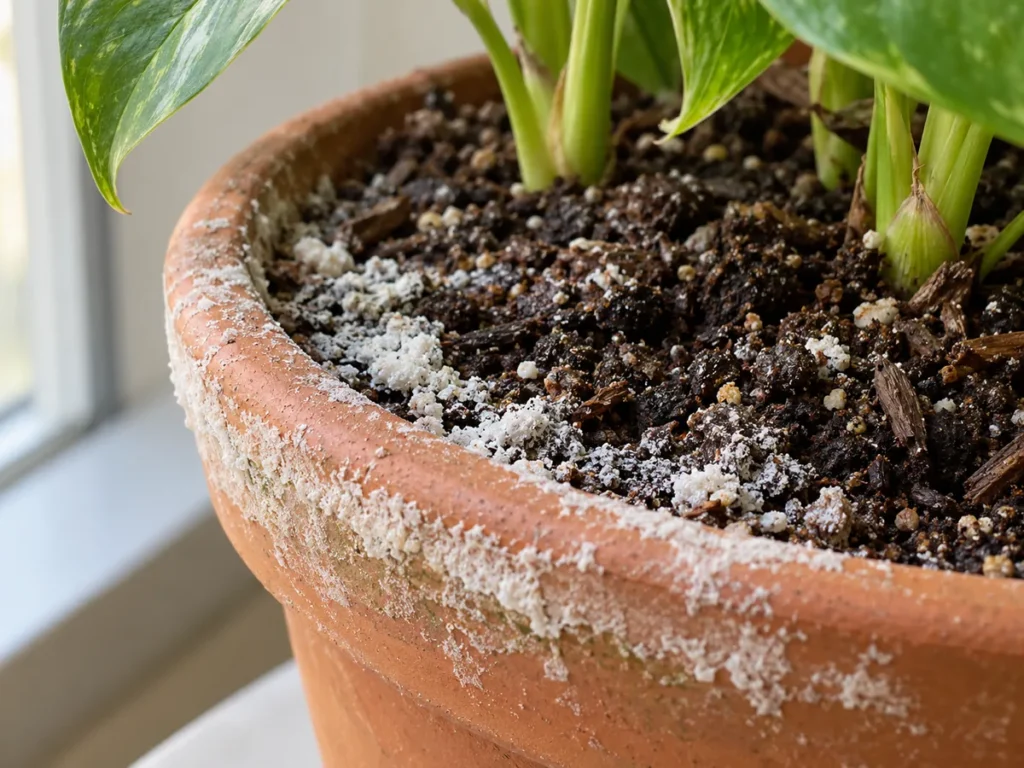
| White crust on the soil or pot rim, some yellowing, recent heavy feeding | Fertiliser or water salts building up are worth suspecting first [3][7] | Stop feeding, then flush the mix as described below |
| Dracaena, spider plant, prayer plant or calathea, light feeding, clean soil surface | Fluoride or chlorine in tap water may play a part [1][4][5][6] | Try another water source and track new leaves |
| Plant sits in an air-con draught or a dry corner, soil looks normal | Dry air is a commonly cited cause [1][5] | Place a hygrometer nearby and move the plant out of the draught |
| Soil dries out completely, then gets a large drink | Uneven watering [1][3] | Water on a steadier rhythm once the top has dried |
| Brown patch mid-leaf, yellow halo, soft or water-soaked look | Not typical tip burn; leaf spot or sunburn is more likely | See leaf spots |
| Whole plant limp, soil wet for days, sour smell, soft stem base | Possible root problem, with brown tips as one symptom | See root rot |
What are the usual causes, and which one is most likely?
The sources emphasise different things. Iowa State says low humidity is the most likely cause, then lists uneven watering, fertiliser salts and tap-water chemicals [1]. Missouri starts with fertiliser salts, then softened water, cold and dry soil, and treats fluoride as a separate cause in sensitive plants [3]. NC State points to chlorine, fluoride or built-up salts for spider plant and corn plant [4][5]. None gives percentages, so ‘most likely’ reflects emphasis, not a measured ranking.
- Dry air: Iowa State and UNH both give about 40 to 50 per cent relative humidity as a common target [2][6], and NC State notes dry indoor air can brown tips [5].
- Salts from feed or water: Fertiliser salts collect at leaf margins and tips and cause burn-like damage; softeners swap in highly soluble sodium or potassium salts, which mimics over-feeding [3]. White crust and brown tips are signs of salt build-up [7].
- Fluoride and chlorine: Iowa State names spider plant, ti plant, dracaena, prayer plant and calathea as sensitive over time [1]; Missouri says fluoride moves to leaf edges and tips [3].
- Uneven watering: Leaving soil dry too long can brown tips [1][3].
For the curious: chlorine and fluoride are different substances. NC State names both for spider plant but fluoride and salts for corn plant [4][5]. This guide therefore says ‘fluoride or chlorine may be involved’ rather than blaming one.
In Hong Kong, how do I tell humidity, salts, fluoride and watering apart?
Work through four checks, changing one thing at a time. This order is our own arrangement of the sources above, not a protocol from any single paper.
- Look at the soil surface and pot rim. White crust points to salts; no crust makes salts less likely but does not rule them out [7].
- Check the species. Spider plant, ti plant, dracaena, prayer plant and calathea are the ones named as sensitive to tap-water chemicals [1][4][5][6]. For other species the fluoride and chlorine evidence is thinner.
- Measure humidity. Put a hygrometer by the plant for several days and compare it with the usual 40 to 50 per cent figure [2][6].
- Keep a watering log. Note each date and how dry the mix was, to see whether it keeps drying out completely [1][3].
Separate outdoor and indoor air. The Hong Kong Observatory’s 1991–2020 monthly mean relative humidity is about 82 to 83 per cent from March to May, about 70 per cent in December and 78 per cent over the year [8]. Those are outdoor readings at its headquarters, not your flat; a room with air-con on and windows shut can differ widely, so use a hygrometer. A humid city does not make dry-air damage impossible, and it does not mean watering less.
High floors. Wind or an air-con draught may scorch edges, but no source I checked links high-rise wind to tip burn, so this is weak-evidence guesswork.
High floors and small flats. Strong wind or an air-con draught may scorch edges faster, but none of the sources I checked links high-rise wind to tip burn, so treat this as a reasonable guess with weak evidence. Note whether the damage faces the wind.
What numbers does Hong Kong tap water have, and could it burn leaf tips?
Fluoride is added on purpose. The Water Supplies Department says fluoride is added during treatment for dental protection [11]. The Department of Health recommends 0.5 mg per litre, against a WHO guideline value of 1.5 mg per litre, according to a 2016 government reply [10].
Mineral figures are modest, but they settle nothing. The Water Supplies Department report for April 2024 to March 2025 gives average total hardness of 36 mg/L as calcium carbonate (maximum 62), average chloride 20 mg/L (maximum 60), average conductivity 141 µS/cm (maximum 290) and average pH 8.3 [9]. These are network monitoring results, not your tap, and say nothing about plants.
Gaps and disagreement. NC State and UNH suggest changing or standing tap water for sensitive plants [5][6], yet no source states what fluoride level harms a plant. So the idea that Hong Kong’s 0.5 mg/L must burn a spider plant is unsupported; sensitive species might react, and new growth is the test.
Water softener at home? Softeners add sodium or potassium salts and can mimic over-feeding [3], so suspect salts before fluoride. These sources do not say whether ordinary filters remove fluoride; check the maker. See Hong Kong tap water and plants.
Does misting help?
Weak evidence; the sources do not recommend it as the main fix. Iowa State says misting is not an effective way to raise relative humidity because foliage dries quickly [2]. UNH says it lifts humidity only briefly and wet foliage can invite fungal disease [6].
What has better support. Iowa State calls a humidifier an excellent way to raise indoor humidity [2]. Grouping plants and pebble trays appear in Iowa State and NC State advice [2][4] without measurements, so treat them as minor helpers. See mist and pebble trays.
What should I do once I see brown tips?
Beginner: three steps first. Trim the brown parts if you wish, but only for looks, because new browning returns if the cause stays [1]. Pause feeding, as Missouri calls winter feeding counterproductive when growth is slow [3]. Then use the humidity reading and watering log to find the likeliest cause.
- Flush only if there is crust. Colorado State suggests lifting off the crust and roughly half an inch to an inch of surface mix, taking care not to damage roots [7].
- Flush in a sink. Remove the saucer, make sure the drainage holes are clear, and fill the pot to the top with tepid water a couple of times, letting it drain well between rinses [7].
- Clean up, top up with fresh mix and water lightly. Scrape salts from the pot exterior, holes and saucer, then water again only when the original root ball feels dry [7].
Intermediate: change the water. If you suspect fluoride or chlorine, Iowa State says to use a different source [1], and NC State suggests non-fluoridated water for corn plant [5]. UNH suggests letting tap water stand at least 24 hours [6], but that is weak evidence: no source measured whether standing lowers fluoride. Judge by new leaves, not old ones.
Change one thing, then wait for new leaves. Moving the plant, switching water, repotting and feeding all at once leaves you unable to tell what worked.
What should I avoid doing?
- Do not mist daily as a humidity fix. The evidence is weak and wet leaves can invite disease [2][6].
- Do not add fertiliser because the tips are brown. Fertiliser salts may be the cause [3][7].
- Do not change everything together. You will not know what helped.
How do I prevent it, and when should I get help or let go?
Prevention is consistency. Water thoroughly, empty the saucer and feed at the recommended rate [7]. In an air-conditioned room, move the plant out of the draught and watch a hygrometer; a humidifier is the better-supported tool if it stays under 40 to 50 per cent [2][6]. In the humid season, still water by how dry the mix is.
When to get help. If damage spreads fast, turns soft or black, smells, or comes with insects or powder, it is probably not simple tip burn. Start with root rot and send photos to a nursery or horticulturist if needed. For over-feeding, see fertiliser burn.
When to relax. If new leaves come in clean and only a few older tips are brown, it is mainly cosmetic [1]. If several new leaves still brown, go back to the table.
Check it step by step with Plant Doctor →
Frequently asked questions
Should I trim brown tips?
Iowa State says trimming improves looks but new browning returns if the cause stays [1]. It gives no cutting method, so follow the leaf shape.
Is distilled or filtered water enough?
Iowa State only advises another water source [1], and NC State suggests non-fluoridated water for corn plant [5]. Neither tested particular filters or distilled water on your plant, so try it on one sensitive plant and track new leaves.
Do I have to buy a humidifier for an air-conditioned room?
Not necessarily. Read a hygrometer first. If it stays below the usual 40 to 50 per cent figure and the plant has brown tips, a humidifier is the better-supported option [2][6]. If the reading looks fine, check salts and watering first.
Is edge browning after a typhoon the same problem?
The sources I checked do not link strong wind to leaf-edge browning, so the evidence is thin. Look at whether the damage faces the wind and compare it with the table above.
Why do some plants by one window brown and others do not?
Species differ. Sources name spider plant, ti plant and dracaena as more sensitive to tap-water chemicals [1][6], and corn plant to fluoride and salts [5].
Sources
- Iowa State University Extension and Outreach: “Why does my houseplant have brown leaf tips and edges?” — Lists common causes of brown tips and edges (low humidity, salt build-up, tap-water chemicals, uneven watering) and says trimming only fixes appearance
- Iowa State University Extension and Outreach: “The air in our home is extremely dry in winter. Should I mist the houseplants?” — Says misting is not an effective way to raise humidity and suggests humidifiers, grouping and pebble trays
- University of Missouri Integrated Pest Management: “Houseplant Problems (Missouri Environment and Garden News)” — Explains how fertiliser salts, water softeners, low temperature, prolonged dry soil and fluoride cause tip and margin necrosis
- North Carolina State Extension: “Ribbon Plant – Chlorophytum comosum (NC Extension Gardener Plant Toolbox)” — Spider plant: advises avoiding tap water because chlorine and fluorides can cause leaf tip burn; also suggests a humidifier or pebble tray
- North Carolina State Extension: “Dracaena fragrans (NC Extension Gardener Plant Toolbox)” — Corn plant is sensitive to fluoride and built-up salts; suggests non-fluoridated water, monthly flushing, and notes dry air browns tips
- University of New Hampshire Extension: “Houseplant Winter Care Q&A” — Humidity range for tropicals, misting raises humidity only briefly, and the advice to let chlorinated or fluoridated tap water stand 24 hours
- Colorado State University Extension (PlantTalk Colorado): “1339 – Leaching Salts From Potting Mixes” — Signs of salt build-up (white crust, brown tips) and the step-by-step method for leaching potting mix
- Hong Kong Observatory: “Monthly Meteorological Normals for Hong Kong (1991-2020)” — Monthly mean relative humidity for Hong Kong (Observatory headquarters, 1991-2020)
- Water Supplies Department, Hong Kong: “Drinking Water Quality for the Period of April 2024 – March 2025” — General properties of Hong Kong drinking water: conductivity, total hardness, calcium, chloride and pH (minimum, maximum, average)
- Government of the Hong Kong SAR (Legislative Council question reply): “LCQ18: Water resources management and drinking water safety” — Department of Health recommends 0.5 mg per litre fluoride in drinking water; WHO guideline value is 1.5 mg per litre (2016 reply)
- Water Supplies Department, Hong Kong: “Water Treatment” — WSD describes fluoride being added for dental protection and a small residual chlorine being maintained
Further reading
- Back to Plant Doctor
- Hong Kong tap water for plants: chlorine, hardness and salts
- Do misting and pebble trays raise humidity?
- Plants in air-conditioned rooms
- Fertiliser burn: what to do after overfeeding
- Brown or black spots on leaves
Sources checked: 31 October 2026. This is general guidance, not an on-site diagnosis. Always follow the product label.
