


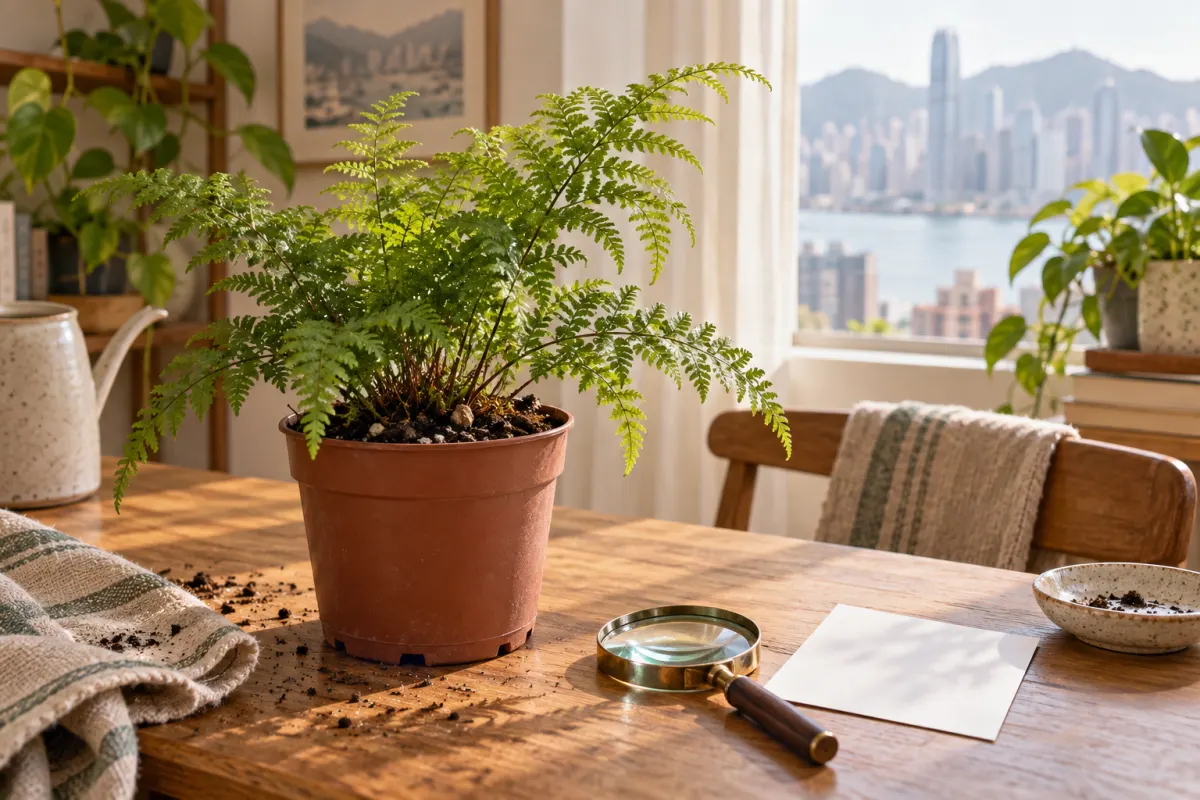

Watch whether it jumps or flies, then look more closely. Springtails are tiny, wingless soil arthropods that often spring away when disturbed, particularly after watering. Fungus gnats are small, dark flies whose larvae live in damp growing media. Both can turn up around moist pots, but they are not the same visitor and one movement alone is not a reliable identification.
Start with appearance and movement
Springtails are usually minute and often grey or cream-coloured. They have no wings, and many species make a short jump when the soil is disturbed or freshly watered. Colorado State University Extension describes them as feeding mainly on decaying organic material and soil microorganisms. In houseplant pots they usually cause little damage, although very large numbers are a reason to look more closely at the growing conditions and roots.
Fungus gnats are small, dark, delicate flies. You may see adults hovering above the compost, moving around the plant or collecting near a window. Their larvae live in moist growing media; they are pale or translucent and have a darker head. Colorado State University Extension’s guide to houseplant pests explains that adult fungus gnats are mainly a nuisance, while larvae feed on fungi and decaying material and can also feed on root hairs.
The smallest animals can be hard to see clearly. Put several clues together: size, colour, wings, flight, location and compost moisture. One fly does not prove that every plant in the room is infested; a pale speck on the surface is not automatically a fungus gnat larva.
A useful first distinction: springtails are most often noticed hopping on damp compost; fungus gnats are more often recognised by flying adults and soil-dwelling larvae. Treat that as a starting point, not a definitive test.
Look separately for adults and soil-dwellers
Watch just above the compost for a minute. Do small, dark flies rise from the pot or hover around the foliage? Then check the surface and saucer with a torch. If you see only tiny pale specks that jump away, with no persistent flight, springtails become more likely — but keep the conclusion provisional.
If small flies keep appearing, use a hand lens to inspect the top layer of compost for pale, worm-like larvae with darker heads. Do not dismantle the root ball just to search for them. Adults may move away from the source, so check every pot in the room and note which ones stay damp longest, have water trapped in a cachepot or contain fallen leaves. Iowa State University Extension notes that different kinds of small animals can share a houseplant pot because it provides moisture, food and shelter; finding them in the same pot does not mean they are the same kind of organism or the same life stage.
Check the conditions you can verify
Both springtails and fungus gnats are easier to notice where compost stays moist. Feel the mix rather than judging by the colour of its surface, and check the inner pot’s drainage holes, outer pot, saucer and position. Empty standing water and remove dead leaves from the surface. If the potting mix is hydrophobic or water runs around the root ball, treat that as a separate watering problem rather than assuming the insects caused it.
Do not dry every plant until it wilts in an attempt to starve the visitors. Let the surface dry between waterings only as far as the plant can tolerate. Succulents, ferns and tropical foliage plants have different needs, so check the species and the moisture in its pot before changing the routine. If one plant is wet while another is ready for water, do not force them onto the same schedule. Our guide to checking a moisture meter against the compost explains why measurement position matters.
Decide whether treatment is needed
An occasional springtail on a healthy plant is usually a nuisance to observe, not a reason to use pesticide. Correct standing water or persistently damp compost, clear away decaying material, then watch whether the numbers change. With fungus gnats, first work out which pot is producing repeated adults. A few flies do not justify replacing the compost in every container.
If the population keeps rising, the same pot repeatedly produces adults, or the plant shows a separate decline, get advice that suits the plant and the identified problem. Do not mix homemade pesticide recipes or use a product outside its label. If you have confirmed fungus gnats, see our fungus gnat guide. This guide focuses on telling the two apart before you act.
A quick comparison
These are observation clues, not a diagnostic key.
On small screens, scroll the table sideways to see all columns.
| Clue | More typical of springtails | More typical of fungus gnats |
|---|---|---|
| Visible adult | Tiny, often pale or grey, wingless and able to spring away | Small, dark, winged fly that hovers or flies around the pot |
| In the compost | Often seen on damp surfaces with decaying material | Pale larvae with a darker head may be present in moist media |
| Usual concern | Usually a nuisance; very high numbers merit a root-zone check | Adults are a nuisance; large larval populations may affect young roots |
| First check | Moisture and standing water | Which pot repeatedly produces adult flies |
Common questions
Do springtails damage houseplants?
Most springtails found in pots feed on decomposing material and soil microorganisms and do little harm. If numbers are very high or a plant is declining, inspect the root zone rather than assuming that every springtail is feeding on the plant.
Should I repot every plant after seeing one fungus gnat?
No. Find the pot that repeatedly produces adults, check its drainage and moisture, then focus on that container. Replacing compost across a whole collection can disturb healthy roots without addressing the actual source.
Can I let the compost dry completely?
That is not suitable for every plant. Allow the surface to dry between waterings only within the plant’s needs, while correcting poor drainage and removing decaying material.
Related reading
- Fungus Gnats in Your Soil? A Complete, Lasting Control Guide
- Large Plant Pest and Disease Control | Identification, Treatment, and Prevention
Sources checked on 26 September 2026.
References
- Colorado State University Extension — Managing Houseplant Pests — Appearance, life stages, plant risk and moisture-related management for fungus gnats and springtails.
- Iowa State University Extension and Outreach — The Harmless Houseplant Hitchhikers — Why different small organisms may share damp houseplant pots, and how springtails differ from fungus gnats.
