


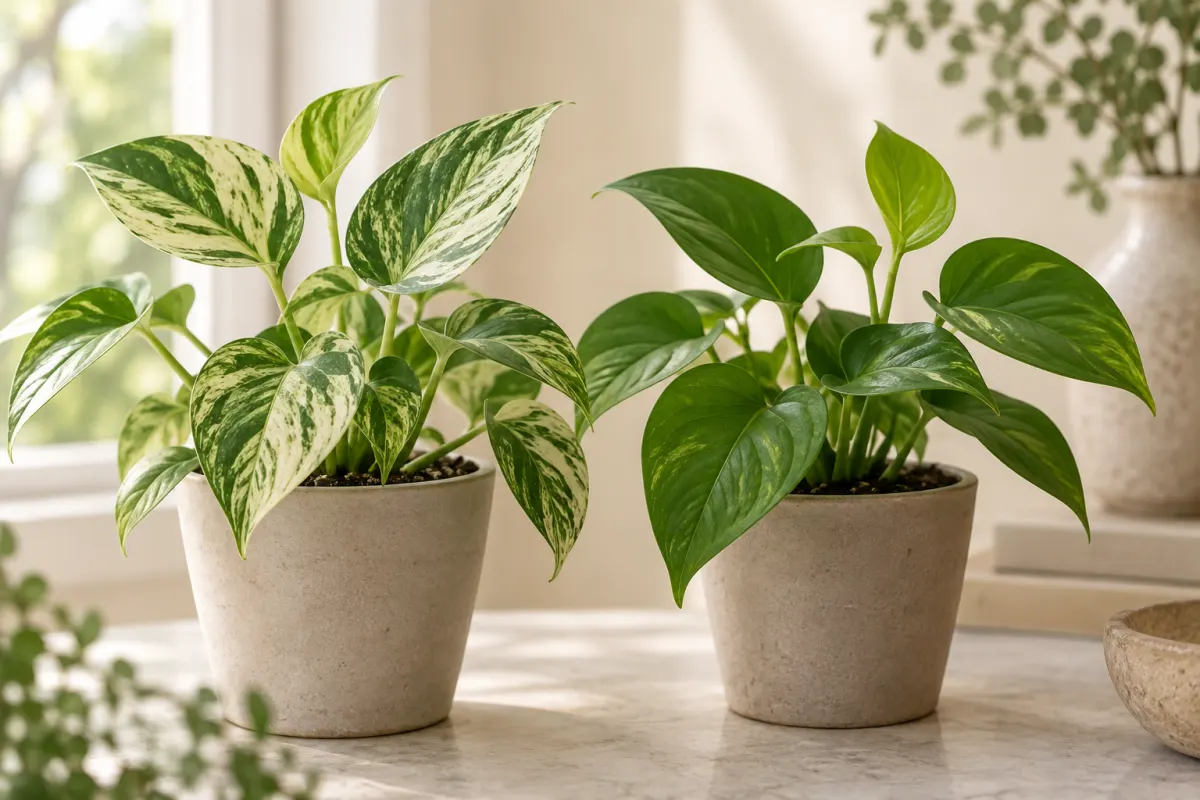

One greener leaf does not prove that a variegated plant has reverted. A whole, consistently green shoot can be a true reversion in some chimeral cultivars; a change across the plant may also reflect light, new-leaf maturity, a different kind of variegation or another stress. Identify the pattern before pruning or moving the plant into stronger sun.
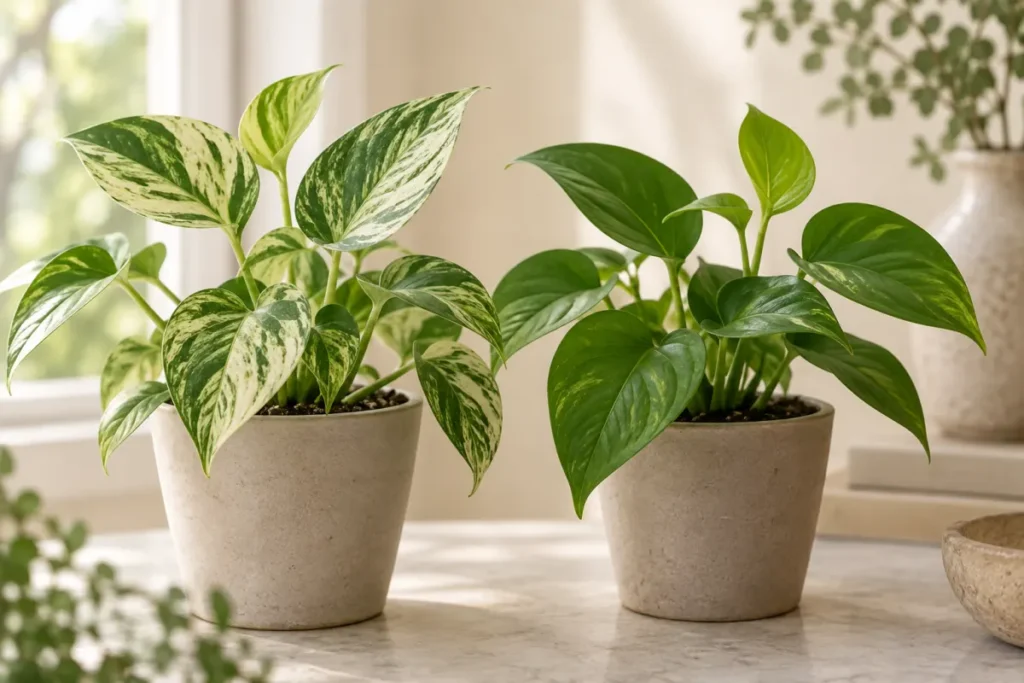
Variegation can have different causes
“Variegated” describes colour pattern, not one single biological mechanism. In a chimera, the growing tip contains cells from different genetic lineages; some tissues may lack chlorophyll, which creates pale or white areas. The University of Florida, University of Kentucky and Texas A&M’s plant propagation resource explains that chimeras differ in stability. Its companion page notes that variegation can also come from inherited patterning, transposons or pathogen infection—not only chimeras. Those other forms should not be treated as if they will all respond to pruning in the same way.
This is why the phrase “it is turning green” needs a closer look. A stable patterned cultivar, an unstable chimeral shoot and a temporary colour shift are not interchangeable problems.
Read where the green growth appears
On small screens, scroll the table sideways to see all columns.
| Pattern you see | A useful possibility | What to check next |
|---|---|---|
| One branch or stem now makes only green leaves | A non-variegated shoot may be growing from a chimeral plant. | Trace the stem to its point of origin and compare several leaves on that same shoot. |
| Several new leaves look greener after a move | Light conditions may be affecting colour expression in that plant, but the response is species-specific. | Compare the same plant’s older and newer leaves; check whether the pattern changes gradually or along a single shoot. |
| Colour breaks appear irregularly across the plant | Variegation types, environmental injury, nutrient disorders or infection can look different. | Look for other symptoms and avoid diagnosing a pathogen from colour alone. |
The Royal Horticultural Society guide, which focuses mainly on shrubs and trees, describes a pure-green shoot among variegated branches as reversion and notes that such shoots may be more vigorous. Treat this as a pattern clue, not a rule for every indoor cultivar. University of California Cooperative Extension also notes that a sudden, distinctively patterned shoot can be a chimera, while virus symptoms may instead be irregular or mosaic-like and some nutrient disorders do not begin on one specific shoot. RHS reversion guidance and UC Cooperative Extension’s symptom guide both caution that pattern matters.
Light can change colour expression, but there is no single rule
Light is relevant, but “low light makes every variegated plant turn green” is too broad. In a controlled study of the spider plant Chlorophytum comosum ‘Vittatum’, researchers changed the light levels of attached mother plants and plantlets and recorded shifts in the proportions of green, light-green and pale tissue. The direction and size of the shift differed between the mother plant and its plantlets. The paper therefore supports a species- and set-up-specific effect, not a universal houseplant rule. The Acta Horticulturae study also explains that relatively little was known about environmental effects on variegation.
Use the plant’s recommended light range, then observe successive leaves. If the plant was recently moved, give it time to produce new growth before deciding that a stable branch has reverted. Do not put it into harsh direct sun to “bring the white back”: stronger light can cause leaf damage in some plants, and the study does not prescribe a light level for other species.
A calm check before you cut
- Photograph the whole plant and the stem producing greener leaves.
- Trace that stem back to where it joins the main plant. Compare multiple new leaves on that branch with leaves on other branches.
- Note any recent change in light position, watering, temperature or fertiliser; do not assume one change explains every colour pattern.
- Check whether the leaf is simply new and still expanding. Reassess after it has matured and after the next leaf opens.
- If the same branch continues to produce only green leaves, decide whether keeping the cultivar’s pattern is important before pruning.
For a confirmed non-chimeral shoot on a plant whose variegation you want to retain, the UF/IFAS propagation resource recommends periodic removal of non-chimeral stems; the RHS gives similar advice for its shrub examples. Make a selective cut back to variegated growth only if the plant’s branching habit and health make that appropriate. One greener leaf is not enough reason to remove a healthy stem.
A worked example: one green branch on a patterned plant
Imagine a variegated indoor plant beside a window. One new branch makes three leaves with no pale pattern, while the rest of the plant still produces its usual markings. Photograph the branch, follow it to its origin and check another leaf as it opens. If the green pattern remains confined to that shoot, a chimeral reversion is one possibility; if all new growth has changed since the plant was moved, review the lighting and give the plant time. Neither pattern confirms a cause by itself. If the cultivar’s pattern matters, wait until the branch is clearly distinct before considering a targeted prune.
Frequently asked questions
Can brighter light restore a reverted branch?
Do not assume so. A genuine change in the cells making up a chimeral shoot is different from a temporary, light-related change in colour expression. Light response varies by plant and cultivar; the study cited here examined one spider-plant cultivar.
Should I remove every leaf that turns green?
No. First determine whether the change is one persistent shoot or a broader change across the plant. Pruning a single leaf will not correct a plant-wide response, and unnecessary cutting removes healthy tissue.
Is all variegation chimeral?
No. University plant-propagation material describes inherited pattern variegation, transposons and pathogen-related variegation as other possibilities. If colours change irregularly with other signs of decline, seek a plant-specific assessment rather than assuming reversion.
Sources
- UF/IFAS, University of Kentucky and Texas A&M, “Chimeras” — chimera structure and different stability types.
- UF/IFAS, University of Kentucky and Texas A&M, “Chimeral Reversion” — chimeral shoots may revert green or pale; removal of non-chimeral stems to retain a pattern.
- UF/IFAS, University of Kentucky and Texas A&M, “Variegation” — pattern variegation, transposons and pathogen-associated forms.
- Royal Horticultural Society, “Reversion in Plants” — definition, typical shrub/tree scope and advice to prune reverted shoots back to variegated growth.
- Chen, McConnell & Henny, Acta Horticulturae 659 (2004) — light-associated colour changes in one spider-plant cultivar; plantlet and mother-plant responses differed.
- UC Cooperative Extension, “Distinguishing Abiotic and Biotic Symptoms in Plants” — patterned chimeras, virus-like mosaics and other symptom distinctions.
Related reading
Sources checked on 26 September 2026.
