


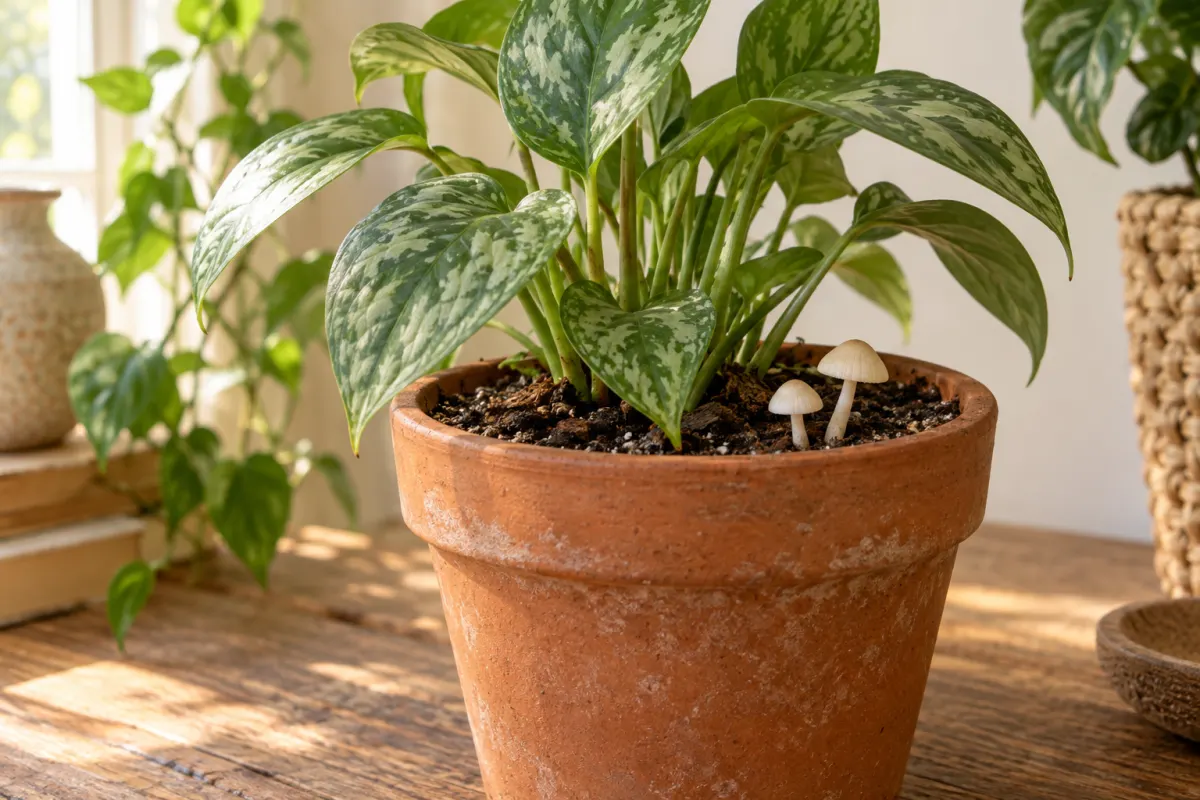

A mushroom in the compost does not automatically mean your plant has root rot, and its appearance cannot tell you whether it is safe. Many fungi in potting media feed on decomposing organic matter rather than living plant tissue. Some mushrooms, however, can be poisonous if eaten. Keep the pot out of reach of children and pets while you inspect the compost and drainage; do not identify an unknown mushroom from colour or a photograph.
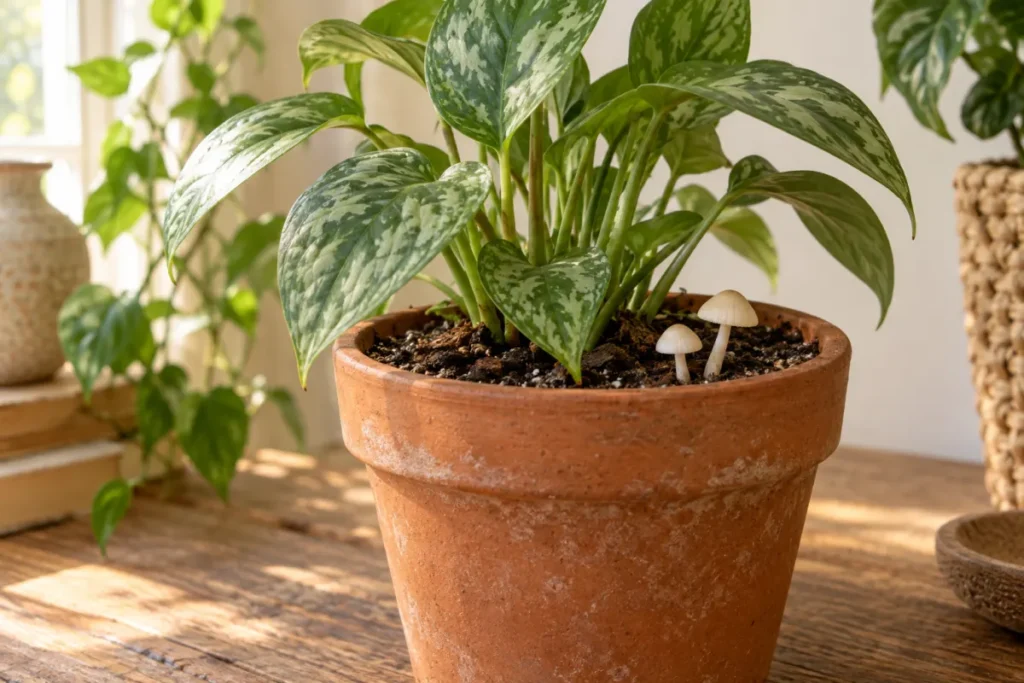
What the mushroom can tell you — and what it cannot
The visible mushroom is the fruiting body of a fungus; much of the organism may be present as fine threads in the compost or decaying plant material. Iowa State University Extension explains that a common fungus found in houseplant pots breaks down organic matter and does not harm living plants. UF/IFAS’s guide to mushrooms in potting soils notes that many fungi in containers are saprotrophic, although other kinds can occur.
That makes a mushroom a reason to check the pot, not a diagnosis. It does not prove root rot, a nutrient deficiency, contaminated compost or that the plant is entirely healthy. Soft tissue at the stem base, persistent wilting or compost that stays wet are separate clues worth assessing. Never eat a mushroom that has appeared in an indoor plant pot.
Safety first: if a person or pet has eaten an unknown mushroom, contact a local medical or veterinary service promptly. Keep the pot out of reach while you seek professional advice.
Three useful first steps
- Prevent accidental contact. Move the pot where children and pets cannot reach it. If you cannot keep it out of reach, remove the visible mushrooms and seal them for disposal. Do not leave specimens on a table or let an animal sniff or lick the compost.
- Record the whole situation. Take a photograph of the whole pot, the compost surface, the drainage area and the plant’s stems and leaves. Note when it was last watered and whether water is standing in a saucer or outer pot. If you ask a horticultural professional for help, those details are more useful than a close-up alone; an online image match is not a reliable identification.
- Check the compost before repotting. Look for blocked drainage holes and water trapped in an outer pot, then check the moisture in more than one place. If the plant is firm and stable, do not dismantle the root ball just because one mushroom has appeared.
Remove the fruiting body, then look at the conditions
If a mushroom could be picked up, licked or dropped into food, wear gloves if you prefer and remove the visible part carefully. Seal it in household waste, wash your hands and wipe the nearby surface. Removing the mushroom reduces contact with the visible part; it may not remove the fungal threads already in the compost, so another one may appear.
Check how wet the compost is and whether excess water can leave the pot. If it is still moist, do not water again simply because you have noticed a mushroom. When to water depends on the plant, the container, the compost and the room; a succulent and a moisture-loving fern do not share one drying threshold. Better drainage and avoiding persistently saturated compost are more useful steps than applying an unidentified product. Iowa State says fungicide treatments are generally ineffective against the common yellow houseplant mushroom it discusses. UF/IFAS also points to changes in growing conditions rather than guessed chemical treatments.
When is repotting worth considering?
Consider the root zone if the compost smells sour, the drainage remains poor, the stem base is soft or the plant continues to decline. Those signs matter independently of the mushroom. Start by checking the drainage hole and the moisture pattern; do not pull a large or tightly packed plant out of its pot by force. If you need to assess a white or crusty surface at the same time, see our guide to white marks on houseplant compost.
Moisture, humidity and organic material can favour mushroom fruiting, but one condition alone does not identify the fungus or diagnose plant damage. Change one relevant part of the care routine — for example, clear water trapped in an outer pot or correct a watering method that has left the mix wet for too long — and watch how the compost dries. Repotting, feeding, changing the position and applying fungicide all at once makes it difficult to tell what helped.
A simple decision table
Use this to separate household safety from plant care. It is not a mushroom identification chart.
On small screens, scroll the table sideways to see all columns.
| What you notice | A sensible next step | Avoid |
|---|---|---|
| A mushroom is within reach of a child or pet | Move the pot; remove the visible mushroom if needed | Assuming colour proves it is harmless |
| A mushroom appears, but the plant looks stable | Record it and check compost moisture and drainage | Repotting immediately because of one mushroom |
| Wet compost plus continued wilting or a soft stem base | Assess drainage and the root zone for that plant | Removing the mushroom and treating the problem as solved |
| A person or pet has eaten an unknown mushroom or feels unwell | Contact a local medical or veterinary service promptly | Waiting for an online identification before seeking help |
Common questions
Does a mushroom mean I have overwatered?
Not necessarily. Fungi may already be present in the compost or arrive as airborne spores. Check the actual moisture, drainage and plant condition before changing the watering routine.
Will removing the mushroom make the plant safe?
It reduces access to the visible fruiting body, but fungal threads may remain in the compost. Keep children and pets away from the pot.
Should I use fungicide?
Do not apply a fungicide just because you see a mushroom. The sources describe a common pot mushroom as unlikely to harm the plant and note that fungicides may not stop it fruiting; first address a verified drainage or moisture issue.
Related reading
Sources checked on 26 September 2026.
References
- Iowa State University Extension and Outreach — Will yellow mushrooms harm my houseplant? — Organic matter in potting media, possible effect on plants and safety limits.
- UF/IFAS Extension — A Basic Guide to Mushrooms Commonly Encountered in Potting Soils — Container fungi, conditions that favour fruiting and why appearance is not a safe identification method.
