



Level: Beginner
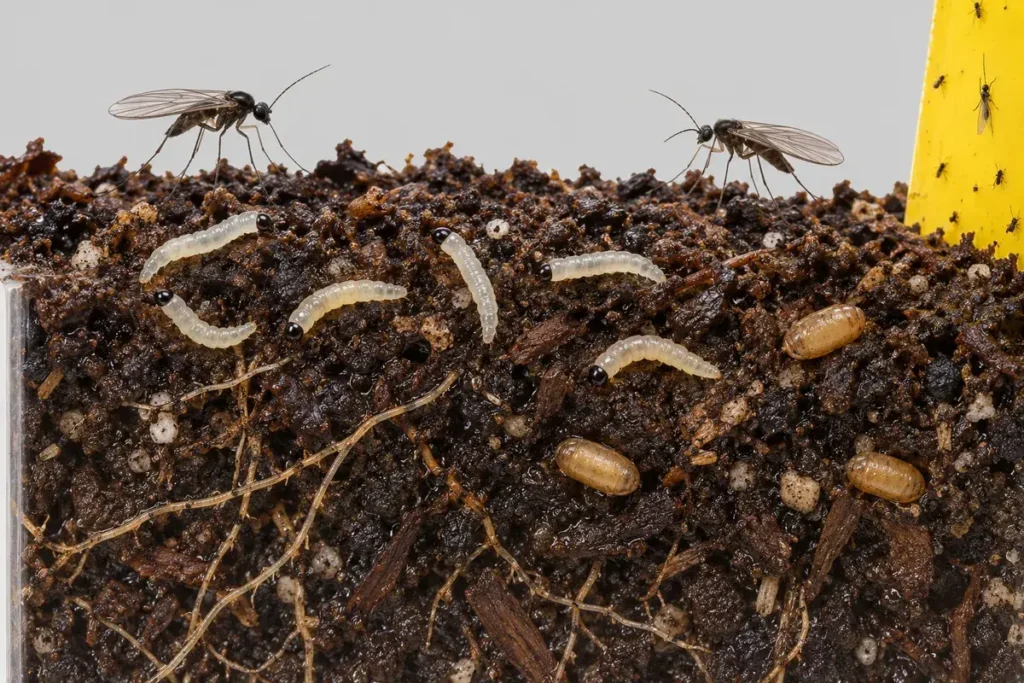
Tiny dark flies around a houseplant are usually fungus gnats. The adults are mostly a nuisance; the target is the larvae living in the top layer of damp mix. The most effective step is a drier surface, backed by yellow traps and a treatment aimed at larvae [1][2].
Key points
- Adults generally do not feed on plants; larvae live in the damp top layer, and real damage in homes is uncommon [2].
- Egg to adult takes roughly three to four weeks, so treatment has to be sustained [1][2].
- A drier mix surface matters most; yellow traps monitor and cut adult numbers [1][2].
- Insecticides are not generally recommended at home; follow any label, and Hong Kong regulates pesticides under Cap. 133 [1][5].
How can I tell fungus gnats from other tiny insects?
Look at behaviour and shape. The University of Wisconsin says adults are dark, delicate flies about 1/8 inch long, with a rounded Y-shaped wing vein near the tip that needs a magnifying glass to see [2]. NDSU uses the same feature to confirm them [4]. Adults fly weakly, rest on pots and soil, and are drawn to light [1].
On a phone, swipe sideways to see every column.
| Clue | Possible cause | Next step |
|---|---|---|
| Small, dark, mosquito-like, weak flight, resting on soil or windows | Fungus gnats [1][2] | Try the potato test for larvae, below |
| Hovering around fruit or kitchen waste | More likely fruit flies, a distinct insect [2] | Clear ripe fruit and waste; not a pot problem |
| Short bristle-like antennae, tied to algae and wet spots | Shore flies, which differ from fungus gnats in antenna length [1] | Cut standing water and algae |
| Wingless specks jumping on the soil | Possibly springtails, which are a different animal | See Springtails or Fungus Gnats? |
To check for larvae, place a potato slice cut-side down on the mix and look after three to four days for maggots feeding on it [2]. NDSU notes the larvae have black heads and that large numbers mean treatment is worthwhile [4]. UC IPM also mentions raw potato chunks for monitoring [1]. Wisconsin adds that vinegar traps do not work for monitoring fungus gnats [2].
To compare with other soil-dwelling pests, see Bugs in the soil: a quick ID table.
Why do they keep coming back? How long is the life cycle?
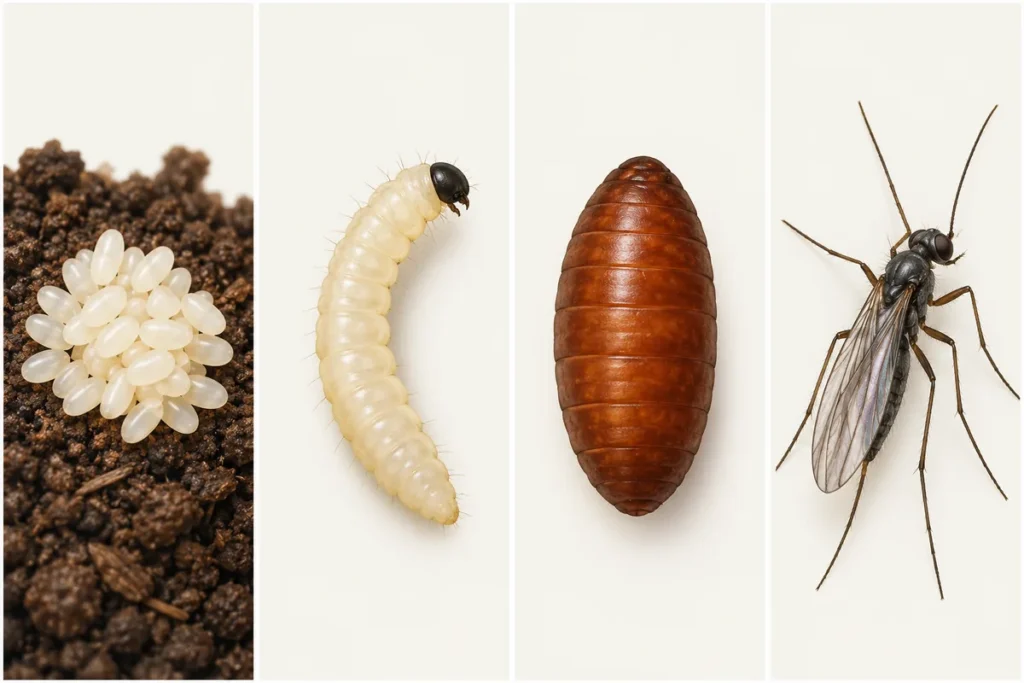
Because eggs, larvae, pupae and adults can all be present at once. Wisconsin says a female lays up to 200 eggs, eggs hatch in about three to six days, larvae pupate within one to two weeks, adults emerge four to five days later and live about a week, and a generation can take as little as three to four weeks [2]. UC IPM gives about 17 days per generation at 75°F (roughly 24°C), and says warmer conditions speed development [1].
Our inference: the Observatory’s 1991–2020 mean temperature is about 16.5°C in January and about 28.9°C in July [6], so much of the year is close to or above the UC IPM example, and generations indoors in Hong Kong may overlap closely. The sources do not cover Hong Kong, so this is only an inference.
Adults are a small part of the story. UC IPM says most of a fungus gnat’s life is spent as larva and pupa in soil or organic matter, so the best control targets immature stages rather than chasing adults [1]. On damage, Wisconsin says larvae can injure roots when numbers are high, but this is rare in homes [2]; Oregon State says larvae can damage seedlings directly [3], so watch seedlings and cuttings closely.
What are the steps to break the life cycle?
- Dry the surface. Wisconsin and Oregon State advise letting the top inch dry before watering [2][3]; NDSU says the top two inches [4]. They differ, so judge by plant type and by hand: moisture-loving plants should not be dried that far. Bottom watering helps, and do not leave water in the saucer [3].
- Add yellow sticky traps. Place small cards at the pot edge or near foliage and replace them every few days [3]. Traps help monitoring but do not reach larvae in the mix [1][2]. Take care near pets and children [3].
- Find the source pot. Use the potato test on each pot and isolate those with larvae [4]. UC IPM advises against moving infested plants to new areas, so adults do not spread [1].
- Target larvae with Bti. Wisconsin says products containing Bacillus thuringiensis subsp. israelensis (Bti) work on larvae but not on eggs, pupae or adults, and need repeat applications about five to seven days apart [2]. UC IPM gives about every five days because Bti does not persist indoors [1]. Oregon State describes mixing the product with water, letting it stand for 30 minutes, then pouring it onto the mix [3].
- Top the surface with coarse sand or fine gravel. Wisconsin suggests half to one inch, to keep the surface drier and less attractive for egg-laying; it may take three to four weeks of changed watering and topping to bring them under control [2].
- In severe cases, repot or discard. UC IPM advises using only pasteurised potting mix [1]; Oregon State says heavily infested plants can be thrown away so you can start over [3].
Pesticides in Hong Kong are regulated by the Pesticides Ordinance (Cap. 133); only registered pesticides may be distributed under a licence and used [5]. The Bti product names in the sources above come from overseas markets, and this guide has not checked whether they are sold in Hong Kong. Read the label and ask a licensed retailer before buying.
Which approaches should I avoid, or treat as weakly supported?
Insecticides: UC IPM says insecticides are generally not recommended for fungus gnats at home [1]. Wisconsin says chemical control is not warranted unless an infestation is severe; if you use one, choose a product labelled for houseplants indoors, follow the label, treat the soil surface and resting places, and do not spray the air because that is ineffective [2]. This guide gives no home-made mixes or concentrations.
Folk remedies: in the university material we read, we found no support yet for hydrogen peroxide drenches or washing-up liquid water. We therefore give no recipes or strengths. That means the evidence is missing, not that they are proven harmful.
Traps alone: useful, but they do not touch larvae, so cut moisture as well [1][2]. Spraying or fogging the air: Wisconsin says spraying the air is ineffective [2], and UC IPM advises against fogging indoors or spraying adults in flight [1].
Sand topping trade-off: sand suits plants whose surface should dry; it may not suit moisture-loving plants, as it changes evaporation. This is our inference, not from the sources.
How do I stop them returning, and what is different in Hong Kong?
- Quarantine new plants for a few weeks with a sticky trap and check daily before mixing them with others [3].
- Check plants that spent summer outdoors before bringing them in: Wisconsin and NDSU both link outdoor stays to infestations indoors [2][4].
- Remove dead leaves and flowers [3], and empty saucers [3].
- Use pasteurised mix and keep opened bags closed [1][3].
Hong Kong context: Observatory data show mean relative humidity of about 82–83 per cent from March to May [6]. Our inference is that the mix surface may dry slowly around the humid season, helping gnats persist. Do not read ‘Hong Kong is humid’ as meaning every plant needs less water. See Hong Kong’s humid season, and decide watering by hand-check: How to water houseplants.
When should I get help or let the plant go?
If numbers keep rising after you have cut moisture and used traps and Bti for a while, or seedlings and cuttings are being eaten, look for other sources such as a wet saucer, old unpasteurised mix or another infested pot. Check the roots too. If the stem base is soft or the mix smells, see root rot.
For a large, long-running problem, or if you cannot confirm the insect, ask a plant doctor or a licensed pest controller. Discarding a badly infested seedling or an inexpensive plant and starting afresh is a reasonable choice [3]. If a pet or child has touched a trap or product, contact a vet or doctor and bring the label.
Frequently asked questions
Do fungus gnats bite people or harm plants?
Wisconsin says adults do not feed on plants and are mainly a nuisance; larvae feed on decaying matter and fungi, and can damage roots in large numbers, though that is rare at home [2]. Seedlings are more vulnerable [3].
How often should I change yellow traps?
Oregon State advises replacing small cards every few days [3]. They monitor and catch adults but cannot solve the problem alone [1][2].
How long until I see results?
Wisconsin says changed watering and sand topping may take three to four weeks to bring gnats under control [2]; NDSU notes Bti may need several applications [4]. Falling adult numbers on your trap suggest you are on track.
Can I get fungus gnats in a Hong Kong winter?
UC IPM says fungus gnats can occur indoors at any time of year [1]. The Observatory’s January mean temperature is about 16.5°C [6], so winter does not mean you are safe.
If I use traps, do I still need to water less?
Yes. Wisconsin calls changing the environment the single most important step, with traps as support [2].
Sources
- University of California IPM (UC IPM): “Fungus Gnats (Pest Notes)” — Identification, life cycle, moisture management, traps, Bti, insecticides not generally recommended at home
- University of Wisconsin Extension: “Fungus Gnats on Houseplants” — Wing-vein ID, life cycle, potato test, dry surface, sand topping, Bti intervals
- Oregon State University Extension: “I have fungus gnats everywhere. Can you help?” — Less watering, yellow traps, Bti drench method, quarantining new plants
- North Dakota State University Extension: “Dakota Gardener: Houseplant Fungus Gnat Woes” — Dry-down depth, sticky-card monitoring, potato test, Bti needing repeat doses
- Agriculture, Fisheries and Conservation Department (AFCD), Hong Kong: “Pesticide Control and Related Information” — Pesticides Ordinance (Cap. 133) rules on registration and distribution
- Hong Kong Observatory: “Monthly Meteorological Normals for Hong Kong (1991-2020)” — Monthly mean temperature and relative humidity, 1991-2020
Further reading
- Back to Plant Doctor
- Bugs in the soil: a quick ID table
- Overwatered or underwatered? A side-by-side check
- Quarantine and hygiene for new plants and tools
- Home pest control: soap, neem and alcohol, how to choose and use
- Springtails or Fungus Gnats? Identify the Soil Visitors
- Plant Saucers and Mosquitoes: A Hong Kong Home Check
Sources checked: 31 October 2026. This is general guidance, not an on-site diagnosis. Always follow the product label.
