



Level: Beginner
If a cat touches lilies or a dog or cat eats sago palm, treat it as an emergency and call a vet straight away [1][2][3]. If a child or adult swallows a plant, clear the mouth and seek medical help; call 999 for breathing trouble or collapse [13][14]. Do not induce vomiting.
Key points
- Cats and lilies or daylilies, and dogs or cats with sago palm, are the first combinations to deal with [1][3].
- Lists are never complete. If a plant is not listed, that does not make it safe [5].
- Do not induce vomiting at home; there is no safe home method for cats [6].
- Toddlers are the most likely to eat plants, so placement and fast medical help matter more than memorising every toxin [14].
Which plants should you deal with first?
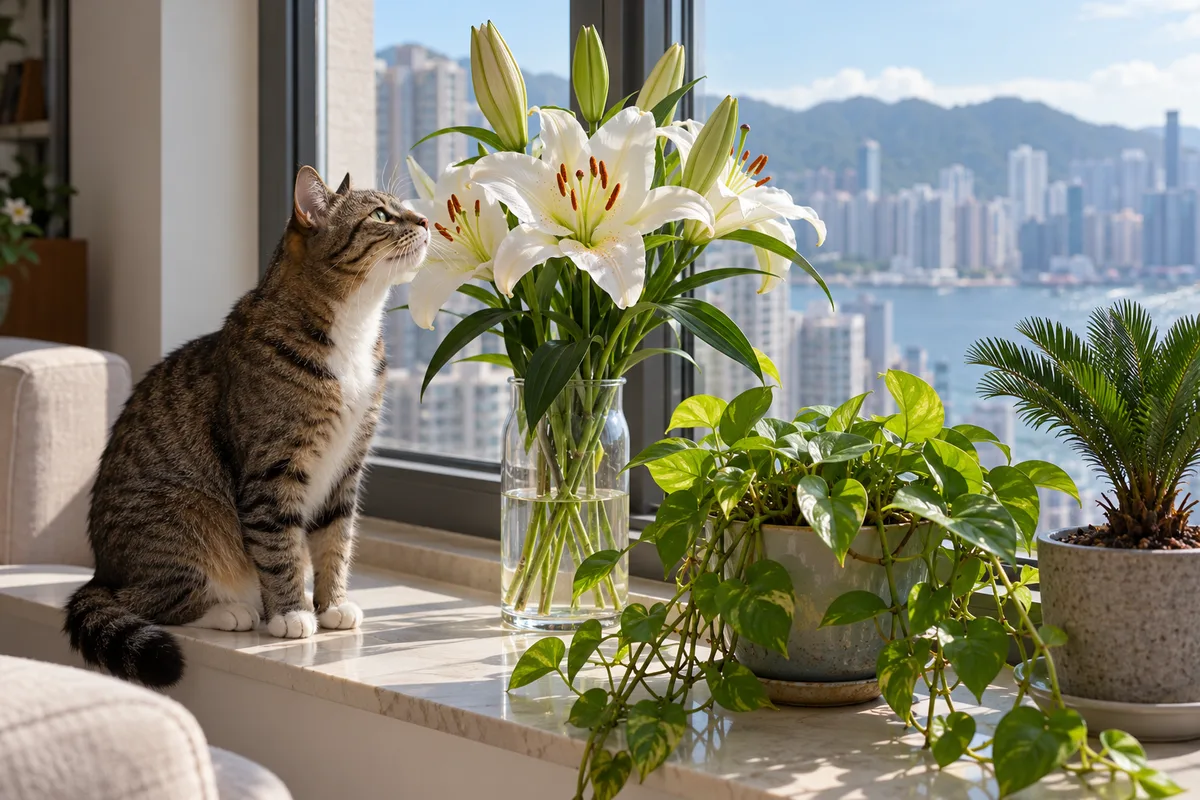
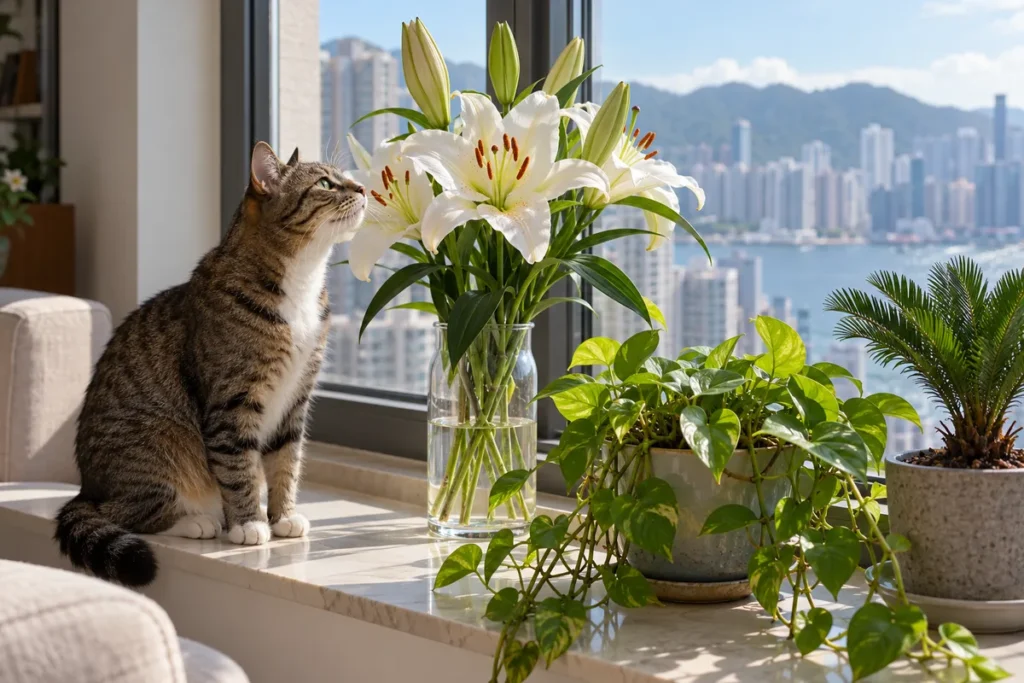
Start with cats and lilies. The ASPCA says even a small exposure can cause acute kidney injury in cats, including licking pollen or drinking vase water, and it includes daylilies (Hemerocallis) in the warning [1]. Its Easter lily page says cats are the only species known to be affected and lists the plant as non-toxic to dogs [2]. If you have a cat, the safest rule is to keep lilies and daylilies out of the home, including in mixed bouquets.
Next is sago palm. The ASPCA lists it as toxic to dogs and cats, with signs that include vomiting, bleeding problems and liver failure [3]. The Hospital Authority’s Hong Kong poisonous plant atlas names the seeds as the poisonous part and reports vomiting, diarrhoea and dizziness in people [11].
Then come plants common in Hong Kong that many people overlook. The atlas says all parts of oleander are poisonous and gives a reported lethal dose of five leaves [8]. Chinese narcissus bulbs have been mistaken for onions, and two clusters of poisoning were reported in Hong Kong in 2014, all recovering with supportive care [12]. Take extra care around Lunar New Year displays.
The aroid family causes painful mouth injury. Pothos is toxic to dogs and cats, mainly causing mouth irritation, drooling and vomiting [4]. For dieffenbachia, the atlas says a small piece can be toxic, especially the stem, and severe cases can swell the throat and block the airway [7].
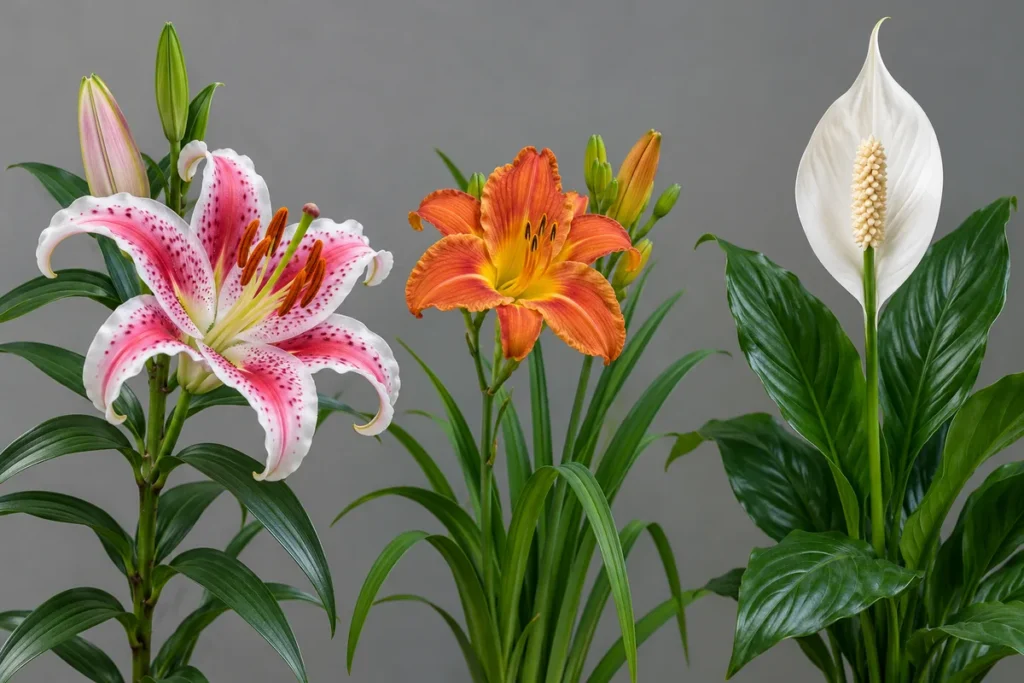
Our own reasoning: a plant with lily in its name is not necessarily related to true lilies. Peace lily and true lily act differently, so check the botanical name on the label rather than the common name.
Not listed does not mean safe. The ASPCA itself says its list is not all-inclusive [5]. If your plant is not named here, look up its botanical name and ask a vet or doctor.
How do you confirm the plant and what was eaten?
First, identify the plant. Appearance, smell or taste cannot reliably separate poisonous from harmless plants, as the NSW guidance puts it [14]. Use the purchase label or botanical name. If unsure, take a photo and keep a small cutting for the vet or doctor. That last step is our practical suggestion, not a source requirement.
Second, note the time, the amount you think was eaten, and the pet’s weight and age. For cats and lilies, speed matters: the ASPCA says it is often fatal if treatment is delayed beyond 18 hours [1].
On a phone, swipe sideways to see every column.
| Clue | Possible cause | Next step |
|---|---|---|
| Cat licked lily pollen, drank vase water or chewed a leaf | Lily or daylily, kidney risk [1] | Call a vet at once; do not wait for vomiting [1] |
| Dog or cat chewed sago palm seed or leaf | Sago palm, liver risk [3] | Call a vet at once [3] |
| Pet drooling, pawing at mouth, vomiting near a pothos | Calcium oxalate irritation [4] | Call a vet with plant name and time |
| Child has mouth pain, drooling or hoarse voice after chewing a stem | Aroid calcium oxalate [7] | Clear mouth, go to A&E; call 999 for breathing trouble [13][14] |
| Sap in eye or red, sore skin (crown-of-thorns, poinsettia) | Latex irritant [9][10] | Rinse with water, then ask a doctor [10][14] |
| Narcissus bulb or oleander eaten, or bulb cooked by mistake | Narcissus or oleander [8][12] | Go to A&E and bring the plant |
What should you do first if a pet eats a plant?
- Contact your own vet clinic and give the plant name, time and amount [5]. The ASPCA hotline is a US service, so Hong Kong owners should start with a local vet.
- Remove any plant still in the pet’s mouth and put the remaining plant out of reach.
- Bring a cutting or photo of the plant to the clinic (our practical suggestion).
- Do what the vet says. If they have not asked for it, do not add extra steps.
At night or on public holidays, you need to know which clinic opens 24 hours. Ask your vet beforehand rather than searching in a panic.
What if a child or adult touches or swallows a plant?
The NSW guidance says to wash skin with clean running water, flush eyes for 20 minutes, and remove any plant pieces from the mouth and rinse it out [14]. That is Australian guidance. Do not call the Australian number; in Hong Kong go to A&E, and call 999 if needed [13].
Call 999 first for breathing trouble or unconsciousness [13][14]. The atlas describes an adult who bit a dieffenbachia stem, developed breathing difficulty, needed an emergency tracheostomy and then recovered [7]. Severe mouth pain, a hoarse voice or trouble swallowing should never be left to see what happens.
Toddlers carry the highest risk. NSW notes that children under two are most at risk of eating poisonous plants [14]. If a child has eaten any unknown plant, seek medical advice even if they seem well.
What should you not do?
- Do not induce vomiting. The ASPCA says nothing can be given at home to safely make a cat vomit, and for dogs it must be under professional guidance [6].
- Do not give water, milk, salt water or folk remedies. The sources we read do not support them.
- Do not wait because a plant has a reputation for being only mildly toxic. Poinsettia is a good example: the atlas cites a large case review where most patients showed no toxicity [9]. But that does not make other plants equally mild, so check each one.
- Do not treat a non-toxic list as permission to let pets chew plants. The ASPCA warns its list is not complete [5].
How do you prevent problems in a Hong Kong home?
For homes with cats, dogs or toddlers, the safest approach is not to buy lilies, sago palm, oleander or narcissus bulbs at all. Moving plants up high only lowers the risk; cats climb well, and small flats leave few truly safe places.
- Bouquets: tell the florist you have a cat and avoid lilies and daylilies [1].
- Dispose of trimmings and fallen leaves straight away, especially sap-producing plants such as crown-of-thorns [10].
- Teach children not to eat anything straight from a plant [14].
- Label pots with the botanical name, including gifts.
- Check the ASPCA or the Hong Kong atlas first. If a plant is not listed, treat it as unconfirmed [5].
For related safety topics, see how to choose pest control products and integrated pest management basics, because pesticide residue can also affect pets and children.
When is it an emergency?
A cat that has had any contact with lilies needs a vet whether or not it shows signs, because kidney failure can follow later [1]. Bleeding or yellowing after sago palm is an emergency [3]. For people, breathing trouble, collapse or severe continuing pain means 999 [13][14].
If someone handles crown-of-thorns or oleander often, wear gloves and eye protection, and get medical help if sap reaches the eye [10]. If worry persists, removing the plant is a reasonable choice and nothing to feel bad about.
For other plant trouble, see rescuing a struggling plant.
Frequently asked questions
Which flowers should I avoid with a cat?
Avoid lilies and daylilies first. The ASPCA says even small exposure can injure a cat’s kidneys, and pollen and vase water count [1]. If unsure about another flower, ask a vet.
Are lilies a problem for dogs?
The ASPCA lists Easter lily as non-toxic to dogs and says cats are the only known affected species [2]. Dogs can still get an upset stomach from any plant [5], so ask a vet if they vomit or seem unwell.
Are poinsettias really deadly?
The atlas says the latex irritates skin and ingestion can cause nausea or vomiting. A large case review found most patients had no toxicity and a minority had mild stomach signs [9]. Still keep them away from children and pets.
Why not make a pet vomit at home?
The ASPCA says there is no safe home method for cats, and dogs only under professional guidance [6]. Contact a vet or A&E and let them decide.
Where can I get poison advice in Hong Kong?
In an emergency, call 999 or go to A&E [13]. For pets, call your vet clinic. We did not find a clear public poison hotline on the official pages we opened, so we do not give a number.
Sources
- ASPCA: “Getting to the Bottom of the Dangers of Easter Lilies” — Lily and daylily kidney risk in cats, pollen and vase water, the 18-hour delay
- ASPCA: “Toxic and Non-toxic Plants: Easter Lily” — Easter lily: toxic to cats, listed as non-toxic to dogs
- ASPCA: “Toxic and Non-toxic Plants: Sago Palm” — Sago palm is toxic to dogs and cats and can cause liver failure
- ASPCA: “Toxic and Non-toxic Plants: Golden Pothos” — Pothos: insoluble calcium oxalates, mouth irritation, drooling, vomiting
- ASPCA: “Toxic and Non-Toxic Plants” — The list is not complete; contact a vet if poisoning is suspected
- ASPCA: “Is It Ever Safe to Induce Vomiting?” — No safe home method to make a cat vomit; dogs only under professional guidance
- Hospital Authority Toxicology Reference Laboratory: “Atlas of Poisonous Plants in Hong Kong: Dieffenbachia seguine” — Dieffenbachia: calcium oxalate raphides, mouth and throat injury, airway compromise in severe cases
- Hospital Authority Toxicology Reference Laboratory: “Atlas of Poisonous Plants in Hong Kong: Nerium oleander” — Oleander: whole plant poisonous, cardiac glycosides affect heart rhythm
- Hospital Authority Toxicology Reference Laboratory: “Atlas of Poisonous Plants in Hong Kong: Euphorbia pulcherrima” — Poinsettia: latex irritates skin; a large case review found no toxicity in most patients
- Hospital Authority Toxicology Reference Laboratory: “Atlas of Poisonous Plants in Hong Kong: Euphorbia milii” — Crown-of-thorns: sap irritates skin and eyes; irrigation with water
- Hospital Authority Toxicology Reference Laboratory: “Atlas of Poisonous Plants in Hong Kong: Cycas revoluta” — Sago palm: seeds poisonous; vomiting, diarrhoea and dizziness in people
- Hospital Authority Toxicology Reference Laboratory: “Atlas of Poisonous Plants in Hong Kong: Narcissus tazetta var. chinensis” — Chinese narcissus: bulbs mistaken for onion; two Hong Kong clusters in 2014
- Hong Kong SAR Government (HKEngage): “Emergency & Ambulance Services” — Hong Kong emergency number 999
- Sydney Children’s Hospitals Network (NSW Poisons Information Centre): “Poisonous plants” — Toddler risk, first-aid steps (clear mouth, rinse), no look-based rule for poisonous plants (Australian guidance)
Further reading
- Back to Plant Doctor
- How to choose pest control products
- Integrated pest management basics
- Rescuing a struggling plant
- Quarantine and hygiene for new plants
Sources checked: 31 October 2026. This is general guidance, not an on-site diagnosis. Always follow the product label.
