



Level: Beginner
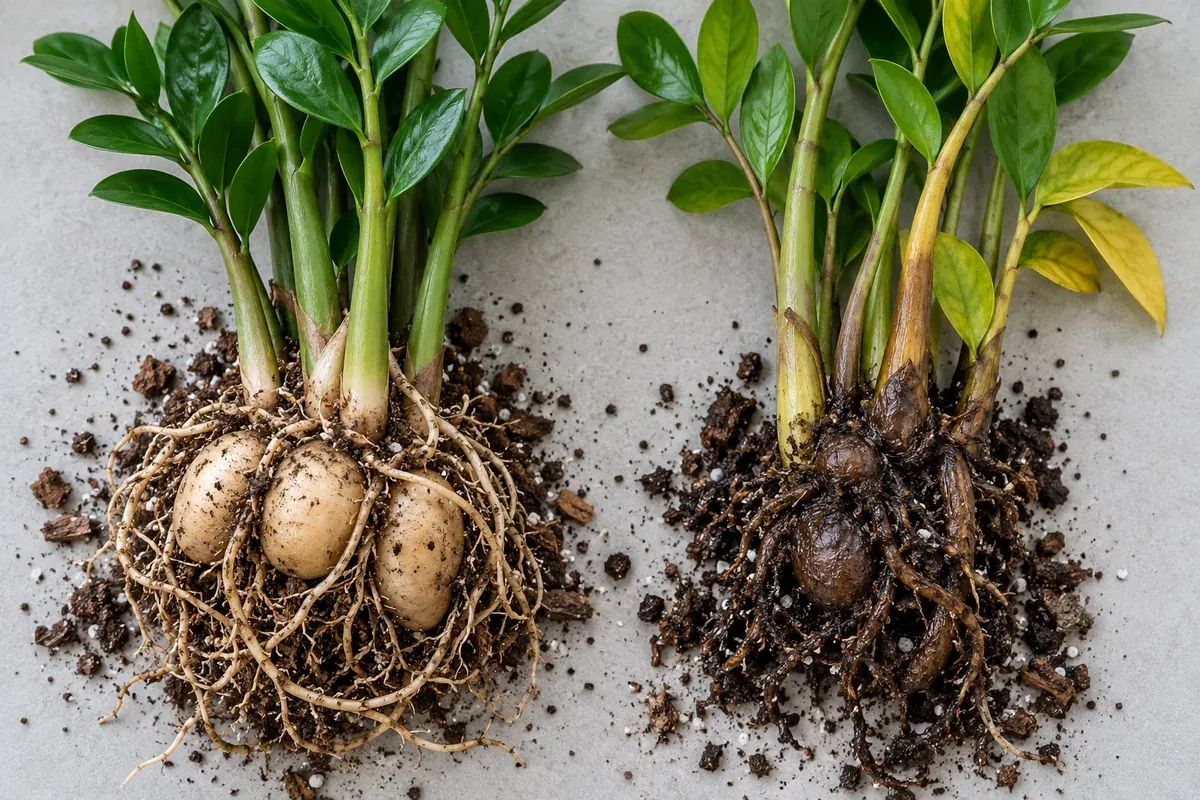
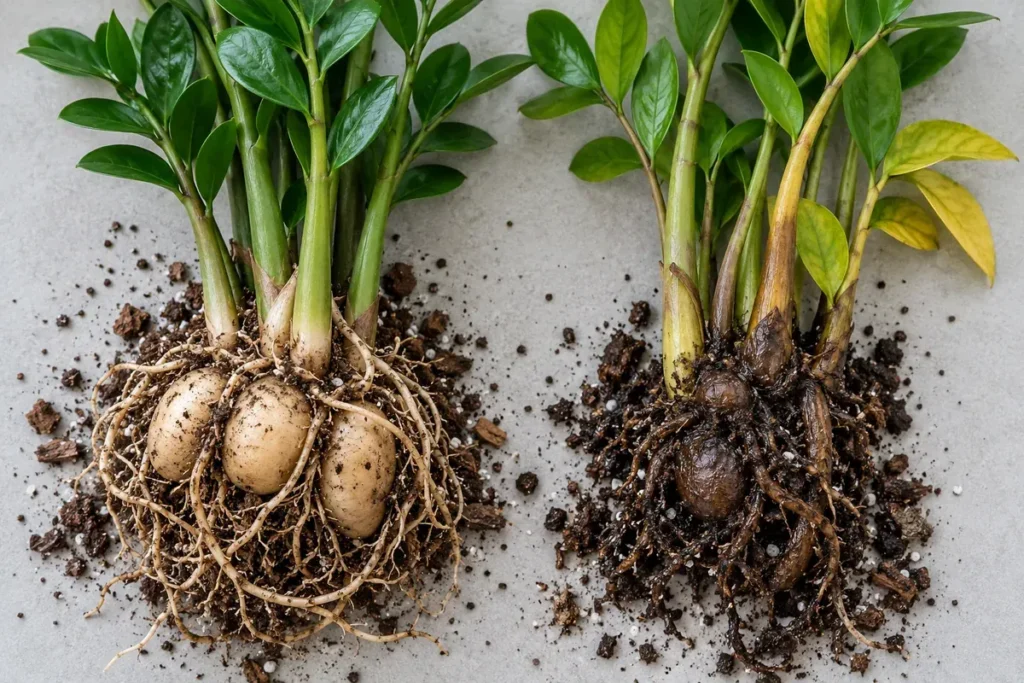
A ZZ plant (Zamioculcas zamiifolia) tolerates drought, but yellow leaves and soft stems most often follow rhizomes that stay wet [2][4]. Stop watering, unpot and inspect the rhizomes. Only trim and repot once you see rot, rather than adding more water or feed.
Key points
- The University of Connecticut says yellow leaves and rotting rhizomes are signs of overwatering [2].
- ZZ stores water in its rhizomes, so if in doubt, wait to water [2][4].
- A few dark spots on the stems are normal [3].
- ZZ grows slowly, so no new growth is not always a problem. It can irritate pets that chew it [1][6].
What do the clues on a ZZ plant mean?
Use the clues to narrow it down. UF/IFAS gives the scientific name as Zamioculcas zamiifolia and lists ZZ plant and aroid palm among its common names [1]. In Hong Kong it is often sold as the money plant (金錢樹), which is a different plant from the braided money tree; see money tree problems. The table below is a first pass, since one symptom can have several causes.
On a phone, swipe sideways to see every column.
| Clue | Possible cause | Next step |
|---|---|---|
| Several stems yellow together, soil still wet | Overwatering, rhizome rot [2][4] | Stop watering, unpot and inspect rhizomes |
| Soft, darkening stem base | Rhizome may be rotting [2][4] | Unpot, cut away rotted parts |
| A few small dark flecks, stem still firm | Clemson says this is normal [3] | No action, just watch |
| Bleached or curling leaves, later yellow then brown | Light may be too strong [2] | Move to indirect light |
| Stems bend away from the light | UConn says stems may lean away when light is too strong [2] | Same fix; check for improvement |
| No new growth at all | Slow growth is normal, and weak light slows it more [1][3] | Check light first, do not rush to feed |
One or two older leaves yellowing now and then may just be ageing. If the other stems are firm, watch before you unpot.
Are yellow leaves from overwatering or low light?
Overwatering is the most common suspect. The University of Connecticut lists yellow leaves and rotting rhizomes as signs of it [2]. The fleshy rhizome stores water, which is why ZZ copes with dry spells [2][4].
Sources disagree on how often to water. Iowa State says a thorough watering every 7 to 14 days is usually fine [5]. Clemson advises once or twice a month, only when the mix has dried completely [3]. NYBG suggests about once a month in winter [4]. The gap shows that frequency depends on light, pot size and mix, not a fixed schedule. They agree on one rule: if in doubt, wait [4].
Light matters too. UConn says direct sun can bleach and curl leaves, and too much light can turn them yellow then brown [2]. NYBG notes that in very poor light the plant slowly declines and may suddenly collapse after years of endurance [4]. Low-light tolerant does not mean a dark corner is ideal.
High humidity in Hong Kong does not mean ZZ needs extreme dryness. The Observatory’s 1991-2020 mean relative humidity is about 78% a year, and 82-83% from March to June [8]. Pots still dry at different speeds, so check the soil or lift the pot to judge its weight.
How can you confirm rhizome rot?
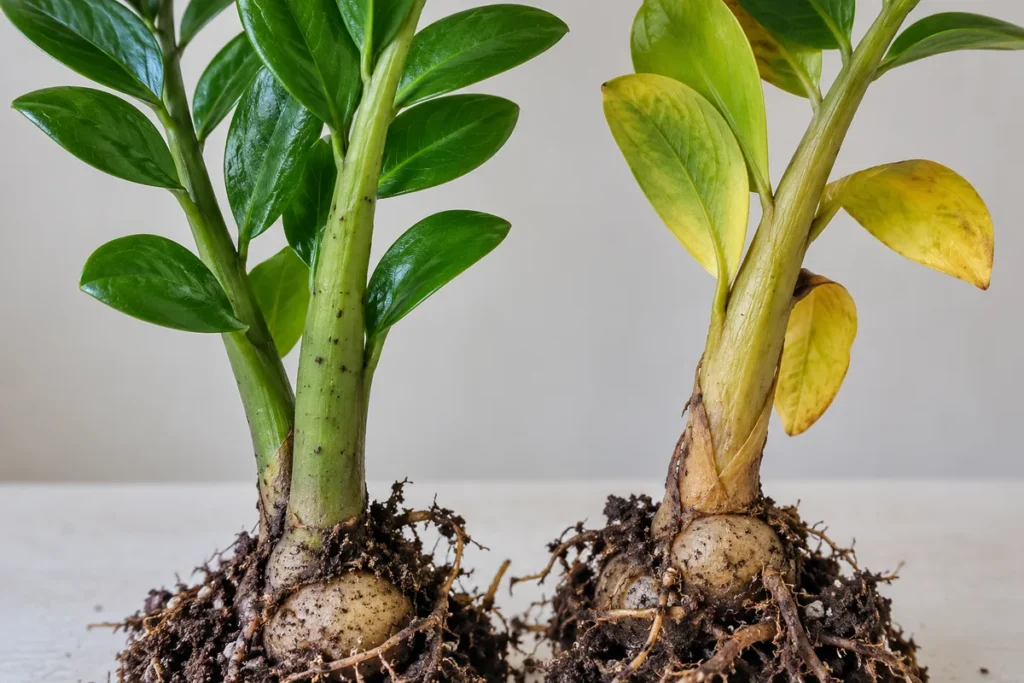
Unpot and look. Chicago Botanic Garden, writing about houseplants in general, says healthy roots are firm and pale while rotten roots are soft [7]. ZZ rhizomes look like tubers, so we would expect healthy ones to feel plump and firm. That expectation is our inference, since the sources do not describe rhizome texture.
- Hold the stem base and slide the root ball out gently.
- Shake off some old mix and look for soft, blackened roots or rhizomes [7].
- NYBG says a saucer holding water or a pot with no drainage hole can lead to rhizome rot [4], so check the pot base too.
- If the rhizomes are firm and only one stem is yellow, cut that stem near its base and watch.
Appearance alone may not show whether low oxygen or a pathogen is behind the rot. Naming a pathogen needs a lab.
What should you do once you find rot?
Stop watering, cut away the soft parts, then replant in clean, free-draining mix. This matches Chicago Botanic Garden’s general houseplant advice [7].
- Stop watering and keep the plant in bright, indirect light.
- Unpot and cut away soft, blackened rhizomes and roots with clean shears [7].
- Keep the firm rhizomes. If most are rotten, recovery is less likely (our inference; no source gives a figure).
- Use a free-draining mix. Clemson suggests a coarse blend of peat or coir with perlite and sand [3].
- Use a pot with drainage holes and pour off water that collects in the saucer [4][5].
- After repotting, hold off watering until the mix has dried [3].
UF/IFAS and UConn both say ZZ has few pest or disease problems [1][2]. If pests do appear, follow the product label.
What should you avoid doing to a struggling ZZ plant?
- Do not water because leaves are yellow. Yellow leaves are a sign of overwatering [2].
- Do not stand the pot in a saucer of water or a solid outer pot. NYBG links this to rhizome rot [4].
- Do not move it suddenly into harsh direct sun. Direct sun can bleach and curl leaves [2].
- Do not feed straight after repotting. This is our inference. ZZ grows slowly, and UF/IFAS suggests low-dose feeding about twice a year [1].
- Do not use home remedies on the roots. We have not seen university or botanic garden support for them. Follow the product label for any treatment.
Do not panic about dark specks on the stems either. Clemson says black spots on the stems are normal [3].
Is no new growth a problem?
Not necessarily. UF/IFAS says ZZ grows slowly even in favourable conditions [1], and Iowa State says it grows in spurts [5]. Clemson notes growth is slower in low light [3].
If leaves are firm, stems are hard and nothing is yellowing, a pause may be normal. Light is the easiest factor to change. On feeding, UF/IFAS suggests a low dose about twice a year [1], while UConn says half-strength once or twice in the growing season, or full strength every six months [2]. The advice differs slightly, but none of it calls for frequent feeding.
If you want to propagate, UConn says leaf cuttings can take up to nine months to form rhizomes indoors [2], so do not dig them up early. See no new growth.
How do you prevent problems in Hong Kong, and what about pets?
Prevention is about drainage, light and avoiding vents. NYBG advises keeping the plant away from air conditioning and heat vents [4].
- Air-conditioned rooms: keep clear of the vent. See air conditioning and plants.
- Winter: sources set different lower limits. UF/IFAS says growth slows and injury may occur below 50°F (about 10°C) [1], while Clemson advises keeping it above 60°F (about 16°C) [3]. The Observatory’s January mean daily minimum is about 14.6°C [8], so cold nights deserve attention. See cold snaps.
- Humid season: the pot dries slowly, so decide by soil check, not the calendar. See the humid season.
- Balcony: avoid strong direct sun [2] and introduce it gradually.
For pets, ASPCA lists ZZ plant among insoluble calcium oxalate plants. Chewing can cause mouth irritation, drooling and vomiting, but severity is low and long-term effects are not expected [6]. Clemson marks it as not pet safe [3], Iowa State calls it poisonous to people and pets if eaten [5], and UConn advises keeping it away from children and pets [2]. If an animal or child chews it, contact a vet or doctor.
If most rhizomes are rotten, stems keep softening or several plants show the same pattern, send clear photos of the rhizomes to a plant clinic or reliable expert. When damage is severe, letting go can be the realistic choice. See rescuing a dying plant.
For any symptoms in people or pets, ask a doctor or vet rather than relying on web guidance.
Frequently asked questions
Is a ZZ plant the same as a money tree?
No. In Hong Kong the ZZ plant is often sold as 金錢樹 (Zamioculcas zamiifolia) [1], while the braided money tree is Pachira aquatica. Their care differs, so read the matching guide.
How often should I water a ZZ plant?
Sources differ. Iowa State says every 7 to 14 days [5], Clemson says once or twice a month [3]. If in doubt, wait [4], and let the mix dry first.
Are dark spots on the stem a disease?
Clemson says black spots on the stems are normal [3]. If a stem turns soft and the darkness spreads, unpot and inspect the rhizomes [2].
Is a ZZ plant safe for cats and dogs?
ASPCA lists it with calcium oxalate plants that can irritate the mouth and cause vomiting, with low severity [6]. Clemson marks it as not pet safe [3]. Call a vet if a pet chews it.
Does a ZZ plant need regular fertiliser?
No. UF/IFAS says it grows slowly and suggests a low dose about twice a year [1]. UConn says full strength every six months is an option [2].
Sources
- University of Florida IFAS Extension: “Florida Foliage House Plant Care: ZZ Plant (ENH1219/EP480)” — Scientific and common names, watering, temperature, slow growth, fertiliser, root rot, drought leaf drop (outdoor context)
- University of Connecticut Home and Garden Education Center: “Zamioculcas zamifolia (ZZ plant factsheet)” — Rhizome water storage, signs of overwatering, light scorch, stems bending away from light, leaf-cutting timing, toxicity precaution
- Clemson University Home & Garden Information Center: “ZZ Plant (Zamioculcas zamiifolia): Indoor Care, Growing Tips & Plant Guide (HGIC 1570)” — Watering frequency advice, cold limit, normal black stem spots, pet-safety warning
- New York Botanical Garden, LuEsther T. Mertz Library: “Houseplant Care – ZZ Plant (Zamioculcas zamiifolia)” — When in doubt wait, reduced winter watering, avoid AC vents, saucers and undrained pots causing rhizome rot
- Iowa State University Extension and Outreach: “The ZZ Plant (Yard and Garden)” — Tolerance of low light and drought, watering interval, growth in spurts, poisonous-if-ingested statement
- ASPCA: “These Houseplants Can Cause Trouble for Your Pets” — ZZ plant listed among insoluble calcium oxalate plants, with signs and severity
- Chicago Botanic Garden: “Overwatered Houseplants” — Unpotting to inspect roots, healthy versus rotten roots (general houseplants)
- Hong Kong Observatory: “Monthly Meteorological Normals for Hong Kong (1991-2020)” — 1991-2020 monthly mean temperature and relative humidity
Further reading
- Back to Plant Doctor
- Root rot: what to do
- Overwatering versus underwatering
- How to water properly
- Toxic plants, pets and children
- How to care for a ZZ plant in Hong Kong
Sources checked: 31 October 2026. This is general guidance, not an on-site diagnosis. Always follow the product label.
