



Level: Intermediate
Wash pests off first, then consider insecticidal soap, alcohol or neem for the pest in question, patch test, and follow the product label. UC IPM says pesticides indoors are for when other methods fail [1], and Colorado State Extension says it found no evidence that homemade soap sprays work [4].
Key points
- Confirm there are pests, then wash and isolate the plant. Treat sprays as a back-up, not step one [1][2].
- Soap works on contact only, is weaker on eggs, and can scorch some plants [4][6].
- Alcohol and neem both have limits: sources disagree on alcohol strength, and evidence for neem on houseplants is thin [3][5][7].
- In Hong Kong only registered pesticides may be distributed and used; dish soap and home mixes are poor choices [4][6][8].
How can you confirm pests before reaching for a spray?
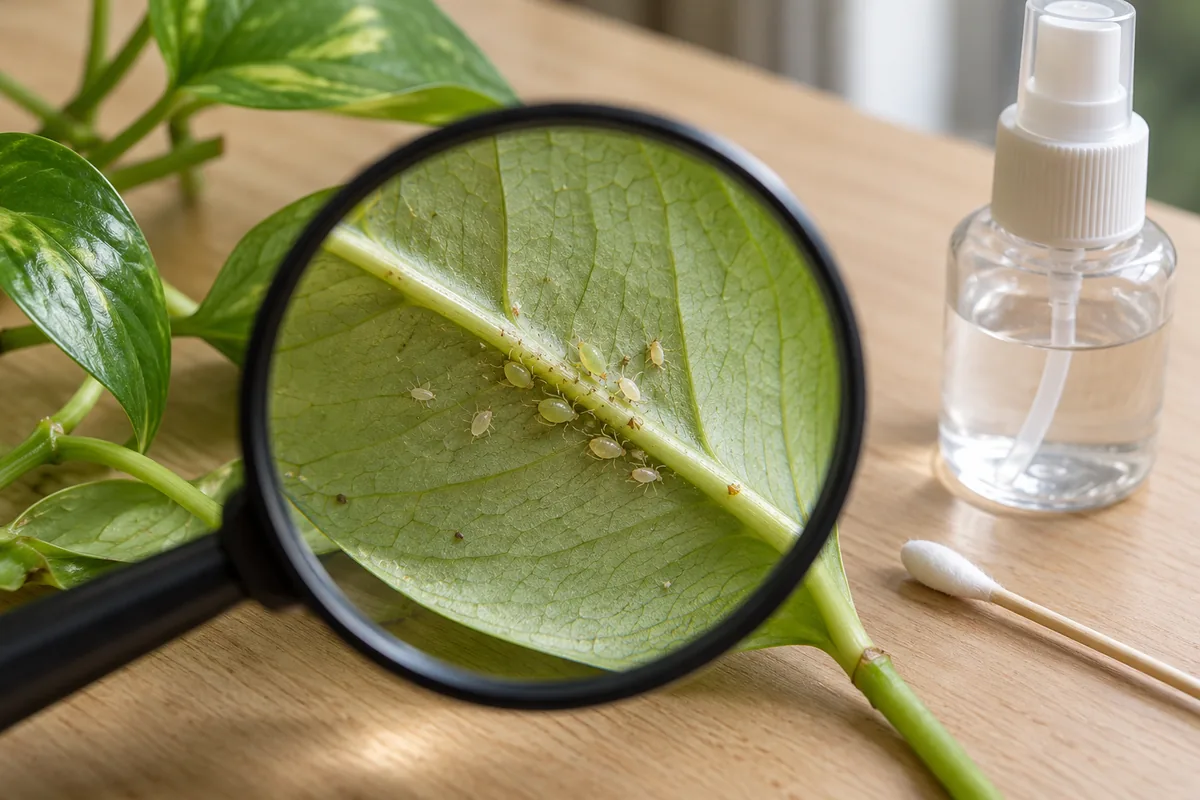
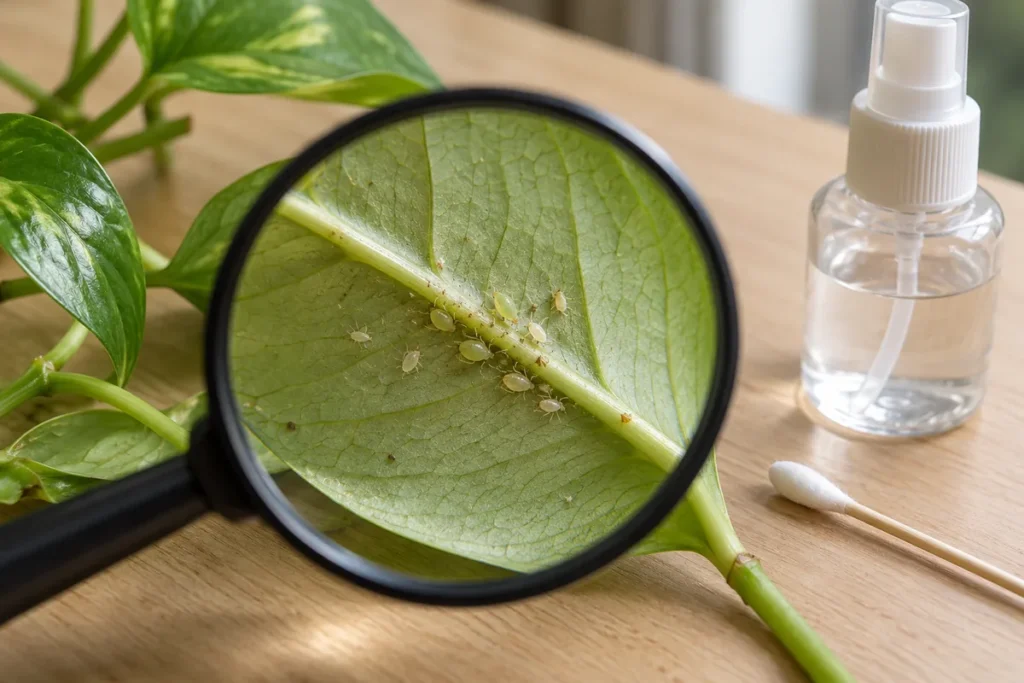
Check first, then decide. UC IPM says most houseplant problems come from care and the home environment, such as poor light or watering, and pests are only one cause [1]. If leaves are yellow or sticky, look under leaves, at leaf joints and at new growth before spraying anything.
UC IPM advises washing soft-bodied insects and mites off with water first, and only then considering insecticidal soap or horticultural oil [1]. It also advises isolating a plant with a problem straight away and washing your hands after handling it [1].
On a phone, swipe sideways to see every column.
| Clue | Possible cause | Next step |
|---|---|---|
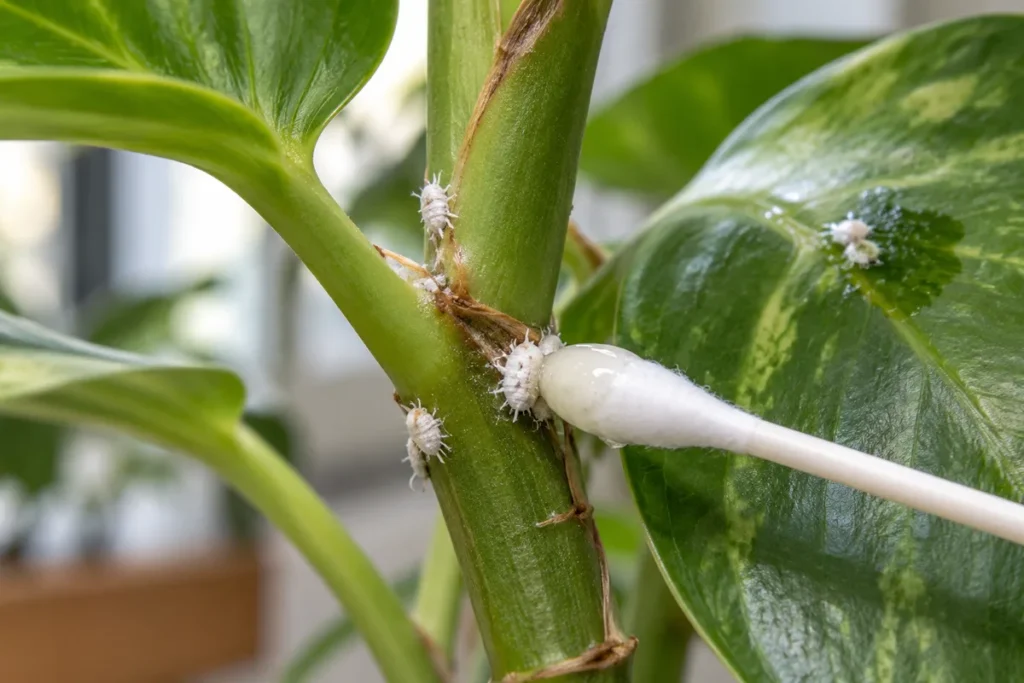
| White cottony clusters at leaf joints, sticky leaves | Mealybugs are likely; adults have a waxy coat [3] | Spot treat or wash; see mealybugs |
| Fine pale specks, webbing under leaves | Possibly spider mites | Wash leaf undersides; see spider mites |
| Sticky leaves, ants present | Honeydew from aphids, scale or mealybugs [1] | Trace the source; see sticky leaves |
| A few pests, leaves undamaged | Early catch; monitoring may be enough | Wash, remove affected parts, recheck weekly [1] |
| Yellow or brown patches after spraying | Possible spray injury [6] | Stop spraying, rinse with clean water, test small areas only |
Hong Kong note: in humid spells, sticky or dark leaf surfaces are not always pests and may be water marks or mould. Look carefully before deciding to treat.
Which suits which pest: soap, alcohol or neem?
All three are back-up options with clear limits. Soap is the most common but only hits what it touches; alcohol suits small spot treatment; neem has the patchiest evidence. This section gives only what the sources state, not recipes.
Insecticidal soap. The University of Connecticut says soap works best on soft-bodied pests such as aphids, mealybugs, thrips, spider mites and whiteflies, is weaker on eggs, and is poor against hard-bodied beetles [6]. Colorado State Extension stresses that dried soap leaves no residue and that you must wet the pest, so undersides matter [4]. Because of that, it notes repeat treatments every four to seven days may be needed for pests such as spider mites and scale crawlers [4].
Alcohol. UC IPM suggests, for serious mealybug problems, dabbing with 70% isopropyl alcohol or weaker mixed with water, after testing a small area for leaf burn [3]. Colorado State PlantTalk suggests a cotton swab dipped in rubbing alcohol for small infestations, or a spray of 10 percent alcohol and 90 percent water for heavy ones, repeated weekly [5]. The two strengths differ, which shows there is no agreed standard, so patch test first.
Neem. NPIC says neem oil contains azadirachtin, which reduces insect feeding and interferes with insect hormones, making growth and egg-laying harder [7]. UC IPM says soap, oil and neem applied to immature mealybugs can reduce numbers, while the adult wax coat and hiding habit make contact products less effective [3]. None of the sources we read gave controlled trials of neem on potted houseplants, so treat the evidence as limited.
- Mealybugs (waxy adults): alcohol dabbing [3][5]; soap, oil or neem are better aimed at young stages [3].
- Spider mites, aphids, whiteflies: UC IPM suggests washing first, then soap or horticultural oil [1].
- Eggs: soap is weaker on them, so repeat on a schedule [4][6].
What is a careful treatment routine, step by step?
Isolate, patch test, then treat only the affected parts. These steps combine advice from UC IPM, Colorado State and Connecticut. Product quantities always come from the label.
- Isolate the plant and wash your hands after handling it [1].
- Wash pests off leaves and stems with water, at a time when foliage dries quickly [1].
- Patch test one leaf and wait at least 24 hours for yellow spots, burnt tips or scorch [6]. Colorado State suggests testing a day or two ahead [4].
- Choose a product labelled for indoor use on your plant species and follow the label [1]. Do not mix your own strengths.
- Cover the pest, including undersides, until wet but not dripping [4][6]. Early morning or evening suits better than hot, sunny hours [6].
- Repeat by pest: alcohol weekly until pests are gone [5]; four to seven days for spider mites and scale crawlers [4].
- Check before every repeat, because leaf damage can build up with repeated exposure [4].
UC IPM also suggests spraying outdoors where practical, so residue disperses and furniture stays clean [1]. See also mealybugs, scale insects and thrips.
Wear gloves and follow the label’s protective advice [1]. If skin or eyes are irritated, rinse with water and seek medical advice.
Which home remedies should you avoid?
- Dish soap or household cleaner mixes. Colorado State says homemade mixes are not consistently formulated or tested, and household soaps should not be used as pesticides [4]. Connecticut adds that dish soap can dissolve the waxy leaf surface and raise injury risk [6].
- Spraying the whole plant untested. Injury is hard to undo [4][6].
- Spraying stressed plants. Connecticut says hot, dry, newly transplanted or soft-growth plants are more likely to be damaged [6].
- Spraying sensitive plants. Connecticut lists possible sensitivity in schefflera, dieffenbachia, jade plant, ivy, palms, some succulents and delicate ferns [6]. Check the label if you grow these.
- Mixing soap in hard water. The same source says it may work less well and be harsher on plants [6].
- Assuming stronger alcohol works better. UC IPM gives 70% as an upper level [3], while PlantTalk’s spray example is only 10% [5].
What should you know about pesticides in Hong Kong?
Pesticides in Hong Kong fall under the Pesticides Ordinance (Cap. 133). The Agriculture, Fisheries and Conservation Department says the term covers any substance used to control insects, fungi and other pests, and that only registered pesticides may be distributed and used [8]. Choose clearly labelled, locally registered products rather than unlabelled liquids bought online.
Whether a home-made soap mix counts as a pesticide is not spelled out on the AFCD page we read. That point is our inference, not legal advice. The safest route is a registered product labelled for indoor plants, used as directed.
For pets and children, we only report what sources say. NPIC says neem oil can be slightly irritating to eyes and skin, and reports adverse reactions, including drooling and trembling, when it was used on cats for flea control in other countries [7]. If you have cats or dogs, ask your vet before use and follow the label on keeping pets away.
Small flats need ventilation after spraying. UC IPM notes indoor pesticide use is legally and practically limited [1], so a clear label matters more than an online recipe.
How do you avoid needing sprays again?
Prevention is more practical than cure. UC IPM advises examining leaves, leaf bases, flower stalks and roots before buying, then checking new plants weekly at first and monthly once they stay clean [1]. It also notes that washing leaves with water regularly prevents many insect problems [1].
Check plants that have spent time on a balcony before they come back inside. UC IPM advises inspecting them closely and continuing to monitor for a few weeks [1]. Ants protect aphids, mealybugs and scale, so deal with ants in the pot [1].
The full routine is in integrated pest management for houseplants, and for new arrivals see quarantine and hygiene.
When should you stop spraying or give up the plant?
Consider stopping when sensible methods fail and pests keep returning. UC IPM says control can be impractical once a pest is established, and discarding the plant may be the better course [1]. It gives similar advice for spider mites that persist or worsen [1].
If the plant matters to you, or several plants are affected, photograph leaf undersides and the pests and ask a local plant professional, rather than increasing strength or mixing products. UC IPM advises avoiding broad-spectrum, long-residue materials [1][3].
Giving up is not failure. If new plants are not isolated, the next plant may meet the same problem.
Frequently asked questions
Can I spray a dish soap mix on my plant?
It is not advised. Colorado State says homemade mixes are not consistently formulated and there is no evidence they work [4], and Connecticut says dish soap can dissolve the leaf’s waxy layer [6].
Is neem safe because it is natural?
Natural does not mean risk-free. NPIC says neem oil can be slightly irritating to eyes and skin, and reports adverse reactions in cats [7]. Ask your vet if you have pets, and follow the label.
How long should I wait before spraying again?
It depends on the pest and the label. Soap leaves no residue, so spider mites and scale crawlers may need repeats every four to seven days [4]. Alcohol dabbing is repeated weekly until pests are gone [5].
Leaves have yellow spots after spraying. What now?
It may be spray injury. Connecticut describes yellow or brown spots, burnt tips and scorch [6]. Stop further spraying, rinse with clean water, and check whether the plant is on the label’s sensitive list.
Should I wear gloves to treat plants indoors?
Yes. UC IPM advises protective gloves and any equipment the label requires, and spraying outdoors when possible [1].
Sources
- University of California IPM (UC IPM): “Houseplant Problems” — Washing off pests first, pesticides only if labelled for indoor use on the plant, soap or oil before other products
- University of California IPM (UC IPM): “What Is Integrated Pest Management (IPM)?” — Under IPM, pesticides are used only after monitoring shows a need
- University of California IPM (UC IPM): “Mealybugs” — Alcohol strength ceiling, patch testing, wax reduces contact products, soap/oil/neem help on immature stages
- Colorado State University Extension: “Insect Control: Insecticidal Soap” — Soap is contact-only with no residue; homemade mixes lack evidence; dish soap can injure plants; patch test first
- Colorado State University Extension (PlantTalk Colorado): “1466 – Mealy Bugs on Houseplants” — Cotton swab with alcohol, 10% alcohol spray, weekly repeats, patch testing
- University of Connecticut Home Garden Education Office: “Insecticidal Soaps” — Works on soft-bodied pests, weaker on eggs, injury symptoms, sensitive plants, hard water, dish soap risk
- National Pesticide Information Center (NPIC, Oregon State University): “Neem Oil Fact Sheet” — What neem oil is, how it works, mild skin and eye irritation, adverse reactions reported in cats
- Agriculture, Fisheries and Conservation Department (Hong Kong): “Pesticides Registration (Pesticides Ordinance, Cap. 133)” — Definition of pesticide and registration: only registered pesticides may be distributed and used
Further reading
- Back to Plant Doctor
- Integrated pest management for houseplants
- Mealybugs: how to tell and what to do
- Quarantine and hygiene for new plants
- A Calm Plan for an Office Plant with Pests
- The Photographs That Make a Plant Question Clearer
Sources checked: 31 October 2026. This is general guidance, not an on-site diagnosis. Always follow the product label.
