



Level: Advanced
Integrated pest management (IPM) means identifying and monitoring pests first, then combining prevention, physical, biological and chemical methods only as needed, rather than spraying at the first sign of a bug. UC IPM says pesticides are used only after monitoring shows a need [2], and advises checking new houseplants weekly at first [1].
Key points
- IPM rests on identification, monitoring, acting only when needed, and then checking the result [2].
- Check new plants weekly; after several clean weeks, you can move to monthly [1].
- Isolate a problem plant at once, wash pests off first, then consider soap or oil; other pesticides come last [1].
- The sources give no pest-count thresholds or fixed quarantine days for houseplants, so your own notes matter [1][2].
How is IPM different from spraying at the first bug?
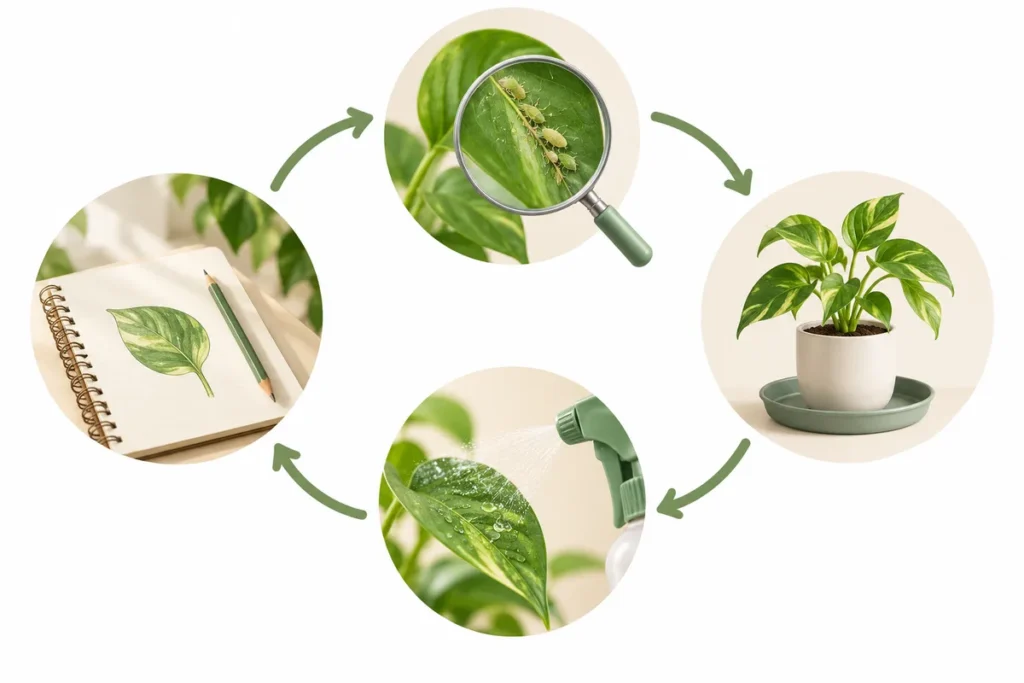
IPM is a process, not a product. UC IPM describes it as a prevention-led strategy that combines methods, with pesticides used only after monitoring shows they are needed and aimed at the target organism [2]. It lists six common components: identifying the pest, monitoring numbers and damage, guidelines for when to act, prevention, combining tools, and assessing the result [2].
At home, that means working out the problem first and choosing the lightest method. UC IPM says most houseplant problems come from care and conditions such as light or watering, and pests are only one cause [1]. Rule out care problems before assuming a pest.
On a phone, swipe sideways to see every column.
| Step | At home | Source |
|---|---|---|
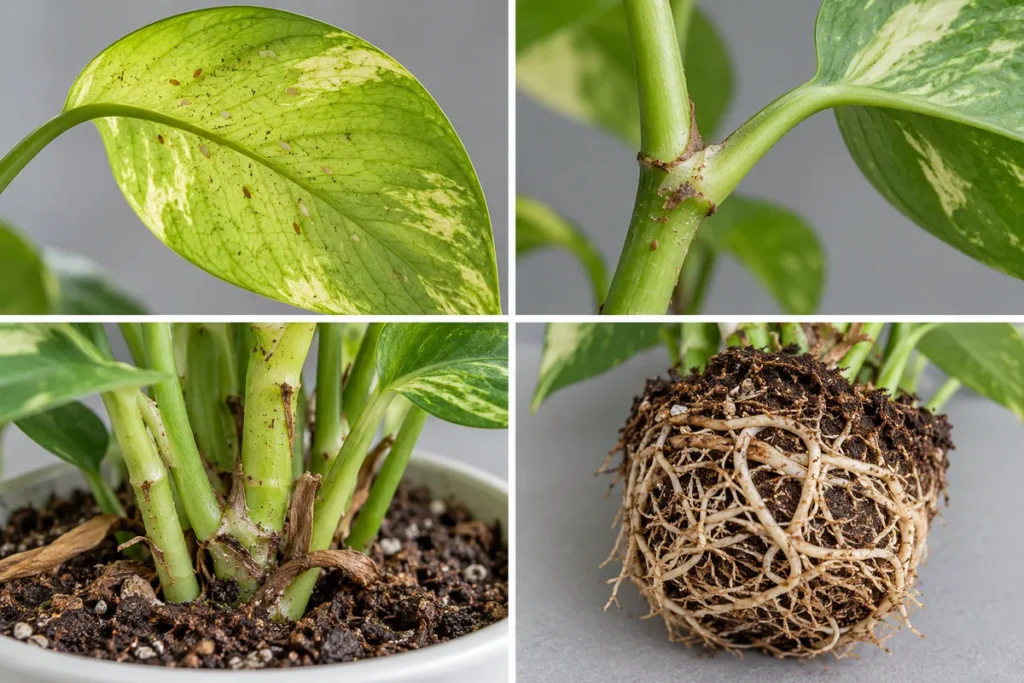
| Identify | Pest, mite or care problem? See white spots on leaves | UC IPM [1][2] |
| Monitor | Weekly for new plants at first, then monthly [1] | UC IPM [1] |
| Action threshold | No houseplant count thresholds in the sources; judge by damage and change in numbers | UC IPM [2] |
| Prevent | Inspect before buying, isolate, manage water, keep tidy | UC IPM [1] |
| Combine methods | Wash, remove parts, sticky cards; soap or oil last [1] | UC IPM [1] |
| Assess | Recheck and decide on repeats [5] | UConn [5] |
How do you inspect new and existing plants?
Inspect the same places on a regular schedule. UC IPM advises examining leaf surfaces, leaf bases, flower stalks and roots before buying, unpotting where possible, and rejecting plants with signs of pests or disease [1]. At home, check new plants weekly for the first weeks, and if nothing shows up after several weeks, move to monthly checks [1].
UC IPM notes mealybugs hide behind or inside leaf bases, in leaflet folds and flower clusters [1], and the adult wax coat and hiding habit make contact products less effective, so early detection counts [3]. For spider mites, UC IPM says a 10X hand lens helps identification [1].
- Look at leaf undersides and leaf joints, where pests gather [1].
- Look for honeydew and ants. Ants protect aphids, mealybugs and scale [1][3].
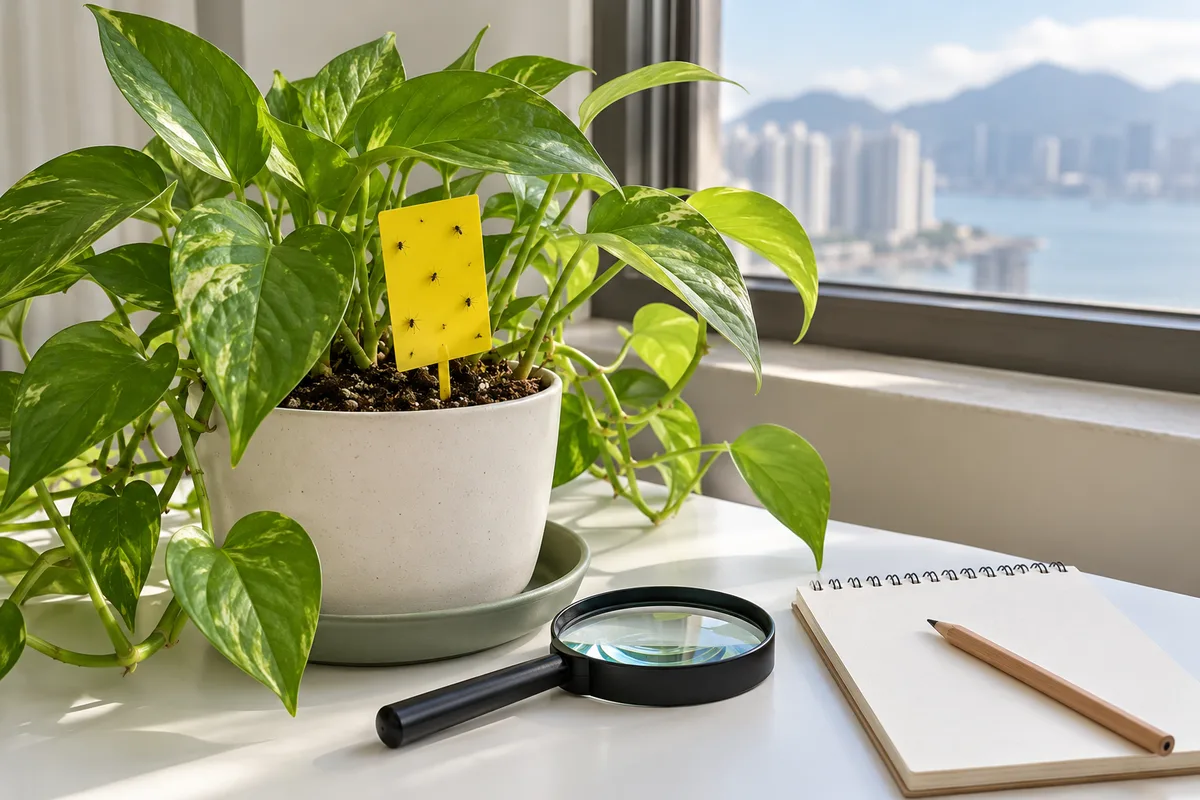
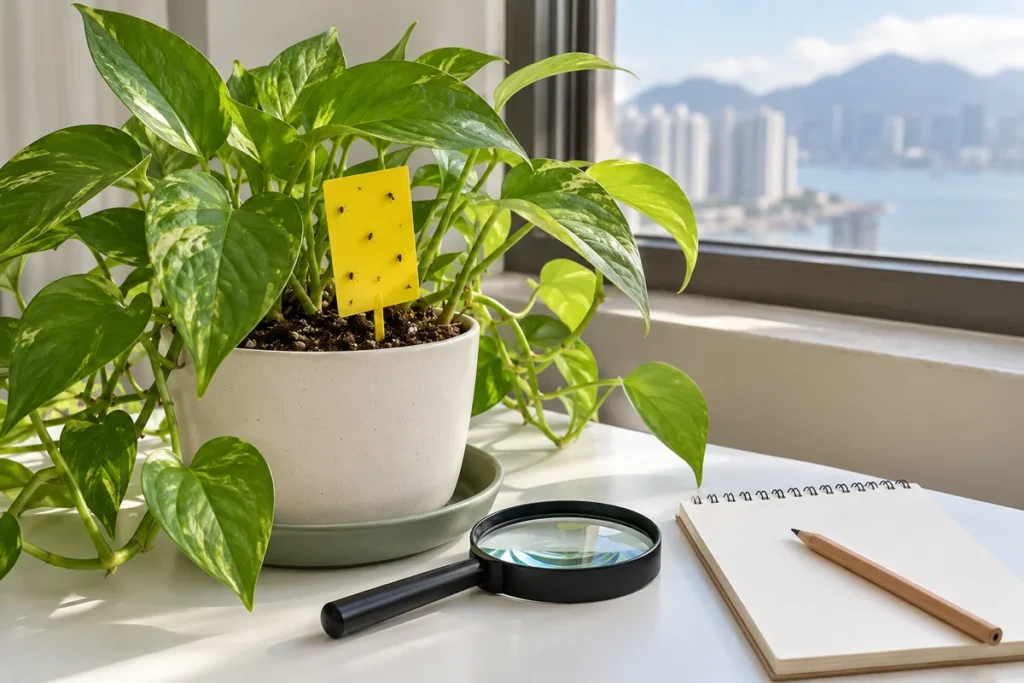
- Yellow sticky cards. UC IPM says they can sometimes reduce adult whiteflies and fungus gnats, so treat them as a monitoring aid, not a full solution [1].
- After time outdoors. Plants returning from a balcony need close inspection and several weeks of monitoring [1].
Hong Kong note: treat a balcony plant moved indoors before a typhoon like a new arrival and check it first. This is our inference from UC IPM’s advice on outdoor rotation [1].
What order should you treat a problem in?
Isolate, identify, then use the lightest method first. UC IPM says to isolate a plant with insects, mites or disease immediately and wash your hands afterwards [1], and to identify the problem correctly before choosing a method [1][2].
- Isolate the affected plant [1].
- Identify it using our pages on mealybugs, spider mites, scale insects, aphids, thrips, whiteflies and fungus gnats.
- Wash and remove. UC IPM says soft-bodied insects and mites can be washed off, and affected parts discarded [1].
- If still needed, try soap or horticultural oil first, as UC IPM advises before other pesticides, checking the label allows your plant species [1].
- Consider other pesticides last, only if labelled for indoor use, your plant and the pest [1]. In Hong Kong only registered pesticides may be distributed and used [6].
- Repeat and assess. Soap leaves no residue [4], and repeats should follow your follow-up checks [5].
For details on soap, alcohol and neem, see home pest control.
UC IPM advises avoiding broad-spectrum products because they reduce natural enemies [3].
What should you record, and what is the principle behind it?
Records show whether a treatment worked, instead of relying on memory. One IPM component is assessing the result after acting [2]. The fields below are our suggested format; the sources do not set a template.
- Date, plant and location (for example window or air-conditioner outlet).
- Observation: pest level (none, few, many), damage, honeydew or ants.
- Action: washing, removal, isolation, product and label directions used.
- Next check date and result (less, same, more).
As a hypothetical, suppose you find a few mealybugs on one plant. You note the date, spot and count, then recheck a week later. If fewer, you keep washing; if more, you isolate and escalate. The example shows the method only and is not real data.
Two numbers from the sources help you set check intervals. UC IPM says the fungus gnat life cycle takes about a month and adults live about 7 to 10 days [1], so our inference is that a single check cannot confirm control; watch for longer than one life cycle. Colorado State says soap has no residue, and spider mites and scale crawlers may need repeat treatment every four to seven days [4].
What should you avoid in an IPM routine?
- Buying without inspecting. UC IPM says problems on a plant are unlikely to disappear, so reject plants showing them [1].
- Not isolating. The problem can spread to other plants [1].
- Routine preventive spraying. IPM uses pesticides only once monitoring shows a need [2].
- Broad-spectrum, long-residue products. They reduce natural enemies [3], and UC IPM advises avoiding them [1].
- Dish soap mixes. Colorado State says household soaps should not be used as pesticides [4].
- Repeat spraying without rechecking. Leaf damage can accumulate [4].
How do you prevent pests in a Hong Kong home?
Prevention rests on checks at the door, water management and tidiness. UC IPM advises choosing plants whose light and temperature needs suit your home, since healthy plants resist pests and recover faster [1], and removing old plant material and washing leaves regularly [1]. For fungus gnats, it says overwatering and poor drainage can raise numbers, so avoid standing water [1].
Wash plants when foliage will dry quickly, since prolonged leaf wetness can favour disease [1]. This matters in humid spells, though that link to Hong Kong weather is our inference and the sources give no Hong Kong figures.
On regulation, the AFCD says only registered pesticides may be distributed and used in Hong Kong [6], so choose clearly labelled, locally registered products.
When should you give up or ask a specialist?
Consider stopping when pests keep returning, spread, or the plant keeps declining. UC IPM says control can be impractical once a pest is established, and discarding the plant and starting afresh may be best [1]. It gives the same advice for spider mites that persist or worsen [1].
If several plants show the same problem or the plant matters to you, photograph leaf undersides and the pests and ask a local plant professional, instead of raising strengths or mixing products [3].
Giving up is not failure. If checks and isolation do not improve, the next plant may meet the same problem.
Frequently asked questions
How long should a new plant be isolated?
UC IPM gives no fixed number of days; it advises weekly monitoring for the first weeks, then monthly if all is clear [1]. Staying longer is a personal judgement for caution.
Do yellow sticky cards work?
UC IPM says they can sometimes reduce adult whiteflies and fungus gnats [1]. They suit monitoring better than replacing inspection or other methods.
Why avoid routine preventive sprays?
IPM uses pesticides only once monitoring shows a need [2], and UC IPM notes indoor pesticide use is legally and practically limited [1].
How soon should I recheck after treating?
It depends on the pest and the product. Soap leaves no residue, so spider mites and scale crawlers may need repeats every four to seven days [4], and repeats should follow follow-up checks [5].
Can I use natural enemy insects at home?
UC IPM says beneficial insects and nematodes have worked in large indoor plantings, but are not usually practical for a few plants at home [1].
Sources
- University of California IPM (UC IPM): “Houseplant Problems” — Pre-purchase checks, weekly monitoring of new plants, isolation, washing, post-outdoor checks, ants, yellow sticky traps, when to discard
- University of California IPM (UC IPM): “What Is Integrated Pest Management (IPM)?” — IPM definition, monitoring and identification, six components, pesticides only when needed
- University of California IPM (UC IPM): “Mealybugs” — Where mealybugs hide, honeydew and ants, wax limits contact products, avoiding broad-spectrum insecticides
- Colorado State University Extension: “Insect Control: Insecticidal Soap” — Soap has no residue, repeat intervals, patch testing, cumulative leaf damage
- University of Connecticut Home Garden Education Office: “Insecticidal Soaps” — Repeat treatment decided by follow-up scouting; weaker on eggs
- Agriculture, Fisheries and Conservation Department (Hong Kong): “Pesticides Registration (Pesticides Ordinance, Cap. 133)” — Pesticides Ordinance: only registered pesticides may be distributed and used
Further reading
- Back to Plant Doctor
- Home pest control: soap, neem and alcohol, used safely
- Quarantine and hygiene for new plants
- Mealybugs: how to tell and what to do
- A Calm Plan for an Office Plant with Pests
- The Photographs That Make a Plant Question Clearer
Sources checked: 31 October 2026. This is general guidance, not an on-site diagnosis. Always follow the product label.
