



Level: Beginner
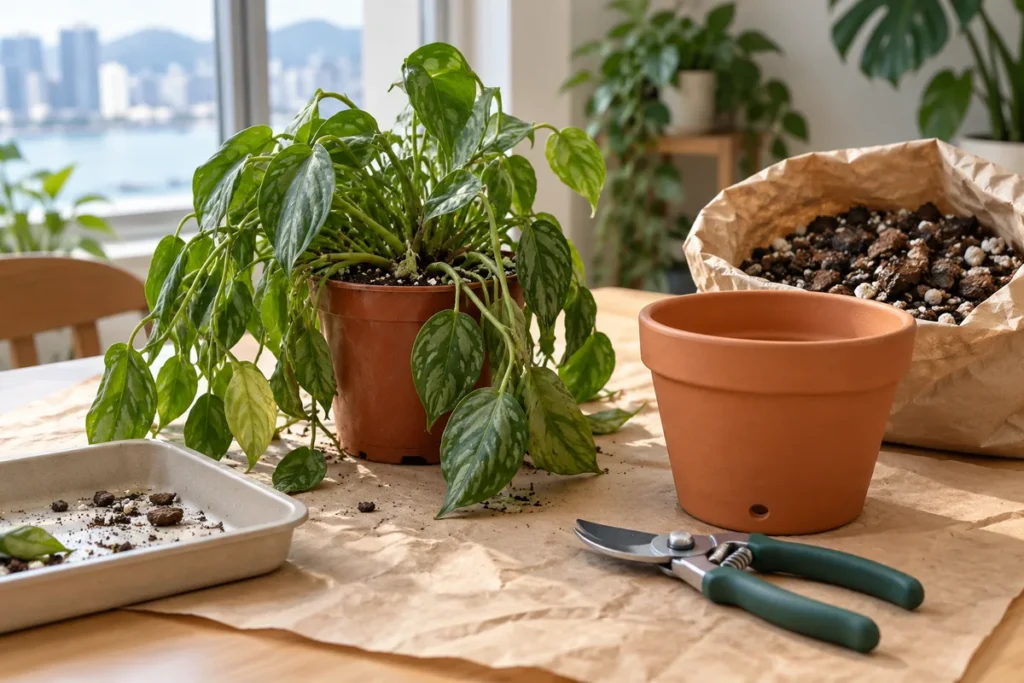
Stop and check the soil and roots before you do anything. If the pot is bone dry, rewet it slowly; if it is too wet, stop watering, unpot and trim rotten roots. If most roots or the stem base have collapsed, recovery is unlikely, so consider cuttings or replacing the plant.
Key points
- Drooping can mean too dry or root rot, and the signs overlap, so check roots and soil before adding water [2][6].
- Firm white roots mean there is still something to save; if over half the roots are damaged, consider letting go [1].
- Change one thing at a time. Do not repot, feed, prune hard and spray all at once (our own advice; the sources do not test it).
- Home fungicides are not advised for houseplant root rot; discarding badly infected plants and old mix is often more practical [3][4].
What is the first thing to check on a dying plant?
Check first, then water. Iowa State Extension says root-rot wilting is easily mistaken for thirst, so look at the roots and the moisture of the mix before adding more water [2]. University of Maryland Extension adds that overwatering is usually the number one reason for dying plants [4].
A three-part quick check works: push a finger or chopstick into the mix, lift the pot to feel its weight, and look and smell at the base of the pot. Virginia Cooperative Extension notes that overwatered and underwatered plants can look alike, with wilting often the first sign of both [6].
On a phone, swipe sideways to see every column.
| Clue | Likely cause | Next step |
|---|---|---|
| Mix dry, pot light, soil pulled from the rim | Too dry [6][4] | Rewet slowly by bottom watering (see below) |
| Water runs straight out of the pot, root ball still dry | Dried mix repelling water [5] | Submerge or bottom water; see water runs straight through |
| Soil stays wet, leaves yellow, musty smell at the base | Overwatering or root rot [6][2] | Stop watering, unpot and check; see root rot |
| Soil wet but plant still wilting | Damaged roots cannot take up water [2][4] | Unpot and inspect the roots |
| Stem base soft and blackening | Stem rot or severe root rot [4] | See stem rot; consider letting go if severe |
How can you tell whether it is still worth saving?
Unpotting gives the clearest answer. Chicago Botanic Garden says healthy roots are firm and white, while infected or rotten roots are soft and darkened, often with an unpleasant smell [1]. Iowa State adds that healthy roots show many feeder roots, while rotted ones are mushy and brown or reddish [2].
How much of the root system is damaged matters. Chicago Botanic Garden says that if most roots look healthy you can trim the damaged ones, remove dead foliage and repot in fresh mix, but if over half are damaged you might consider discarding the plant [1]. The Wisconsin clinic goes further and says that throwing out a root-rotted plant is often the best and cheapest option [3].
Some websites suggest scratching the stem to see green tissue. We found no university or botanical garden source that sets out this test, so treat it as a rough hint only and do not give up a plant on that alone.
The sources give no recovery times, so do not expect results in days. Look for new leaves or better colour over time.
What is the triage order, from mild to severe?
Work from the mild end and reassess after each step.
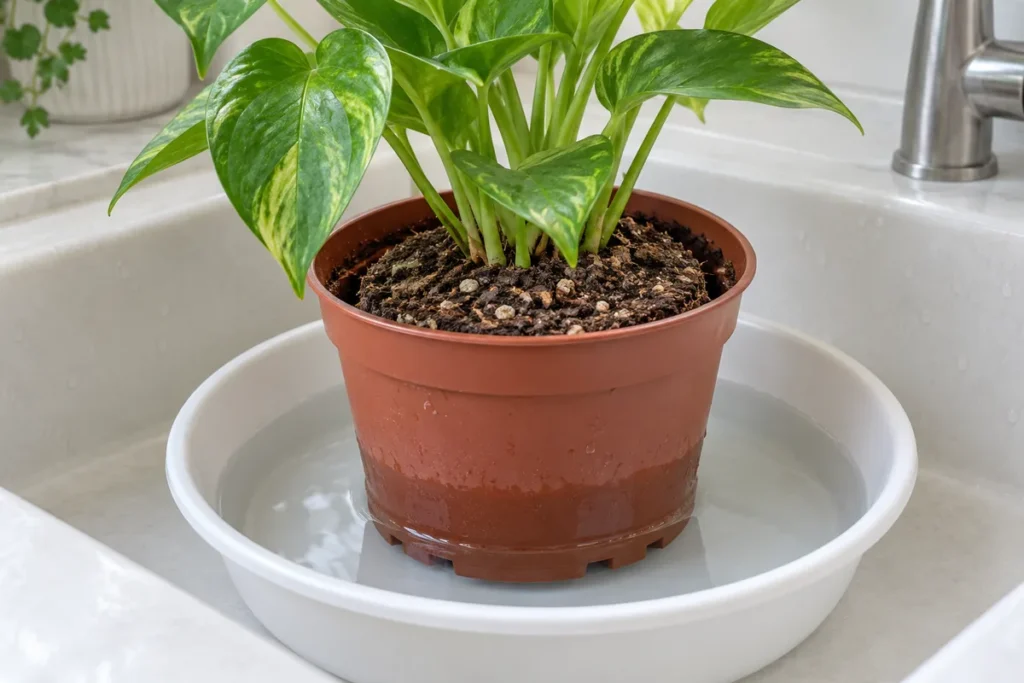
- Level 1, too dry: University of Maryland Extension suggests standing the pot in warm water, about half-submerged, for an hour or two so the mix reabsorbs water slowly [4]. UC Master Gardeners say bottom watering may take an hour or more, and the pot should not be left soaking: check after an hour or two [5].
- Level 2, too wet: Virginia Cooperative Extension advises clearing blocked drainage holes, letting the mix dry, pruning dead stems, leaves or roots, and repotting in new mix if needed [6]. Do not leave a pot in drainage water for more than 60 minutes [6].
- Level 3, root rot: unpot, trim soft brown roots, remove yellow or dead leaves and repot in fresh, fast-draining mix [1][7]. Phipps suggests removing no more than 10% of the leaves at once and waiting for the roots to dry before watering again [7].
- Level 4, severe: if most roots are rotten or the stem base has collapsed, discard the plant and old mix, and clean tools and pots [3][4]. Take cuttings only from healthy tissue [4].
The sources disagree on one point. Phipps suggests a little gravel at the bottom for ballast and drainage [7], whereas the University of Wisconsin clinic says not to put rocks in the pot [3]. We lean towards Wisconsin because it fits the other sources; see gravel at the bottom of a pot.
What should you avoid when rescuing a plant?
- Watering at the first sign of drooping: check soil and roots first, because rotten roots also cause wilting [2].
- Feeding to give it strength: Nebraska Extension says wilted and newly repotted plants should not be fertilised [8].
- Using a home fungicide: the Wisconsin clinic does not recommend them, citing limited and costly products [3].
- Reusing old mix or plastic pots: Wisconsin says old mix can carry root-rot fungi and plastic pots are hard to disinfect [3].
- Cutting off too many leaves at once: Phipps suggests no more than 10% at a time [7].
For disinfecting tools or clay pots, the Wisconsin clinic mentions a 10% bleach or detergent solution, or alcohol. Follow the product label and keep the area ventilated.
How do you stop it happening again in Hong Kong?
In Hong Kong the key is to judge by the soil, not by the weather. Hong Kong Observatory 1991–2020 normals show mean relative humidity of about 82% to 83% from March to May and a July mean temperature of about 28.9°C [9]. That does not mean all plants need less water: an air-conditioned room or a sunny window can dry a pot quickly.
- Beginner: check with a finger or chopstick before each watering, use pots with drainage holes and empty the saucer.
- Intermediate: use a fast-draining mix and build a habit from how to water.
- Advanced: photograph the plant from the same angle and compare trends with overwatered or underwatered.
When should you give up or ask for help?
Recovery is less likely if over half the roots are rotten, the stem base is soft all the way through, or the plant keeps declining weeks after you have repotted and corrected the care [1][3]. The Wisconsin clinic says discarding is often the most practical choice [3].
Before you discard it, take cuttings if any stem looks healthy; Maryland advises taking cuttings only from healthy tissue [4]. If you want a second opinion, see photographing a plant for advice.
Frequently asked questions
My plant is drooping. Should I water it straight away?
No. Check the soil and roots first. Iowa State notes that root-rot wilting looks like thirst, and more water could make it worse [2]. If the mix is dry and the pot is light, rewet it by bottom watering [4][5].
All the leaves have dropped. Is it too late?
It depends on the roots and the stem base. Firm white roots mean there is still a chance, while mostly rotten roots mean recovery is less likely [1]. The sources do not give recovery times, so watch over time.
Should I spray fungicide?
The Wisconsin clinic does not recommend chemical fungicides for houseplant root rot [3]. If you suspect insects, identify them first; see IPM for houseplants.
How do I avoid it happening again?
Water by soil dryness rather than the calendar, use pots with drainage holes and a fast-draining mix, and empty the saucer. Both Wisconsin and Iowa State stress watering by need [2][3].
Sources
- Chicago Botanic Garden: “Overwatered Houseplants” — Unpotting to check roots, trimming damage, fresh mix, considering discarding when over half the roots are damaged
- Iowa State University Extension: “Root Rots of Houseplants” — Root-rot wilting is easily mistaken for thirst; check roots and mix moisture before adding water
- University of Wisconsin Plant Disease Diagnostics Clinic: “Root Rots on Houseplants” — Discarding is often best for root rot, fungicides not advised, no gravel in the pot, do not reuse mix or plastic pots
- University of Maryland Extension: “Winter Indoor Plant Problems” — Overwatering as a leading cause of death, half-submerging a dried-out pot, separating and discarding badly infected plants
- UC Master Gardeners of Santa Clara County: “Watering Hydrophobic Soil” — Dried-out mix repels water, water runs down the pot edge, submerging and bottom watering
- Virginia Cooperative Extension (Virginia Tech): “Properly Watering Container Houseplants” — Overwatered and underwatered symptoms overlap; remedies for each; bottom watering
- Phipps Conservatory and Botanical Gardens: “Ask Dr. Phipps: Root Rot” — Do not remove more than 10% of leaves at once, trim brown mushy roots, fast-draining mix, wait for roots to dry before watering
- Nebraska Extension in Lancaster County: “Success With Houseplants – Fertilization” — Wilted, newly repotted or dormant plants should not be fertilised
- Hong Kong Observatory: “Monthly Meteorological Normals for Hong Kong (1991-2020)” — 1991-2020 monthly mean temperature and relative humidity
Further reading
- Back to Plant Doctor
- Root rot: how to confirm it, treat it and when to stop
- Overwatered or underwatered? A side-by-side check
- Transplant shock: helping a plant settle after a move
- Dormancy: adjusting water and feeding in winter
Sources checked: 31 October 2026. This is general guidance, not an on-site diagnosis. Always follow the product label.
