



Level: Beginner
Yellow monstera leaves are more often linked to overwatering or weak light, and solid leaves usually mean the leaf is still young or the light is weak [5][4]. Check where the yellowing starts and whether the pot is still wet before you change anything.
Key points
- Yellow lower leaves with a pot that stays wet point first to overwatering or low light; then check the roots [5][3].
- No splits is usually about leaf age or weak light, and the sources give no timeline in months [3][4][5].
- Aerial roots are for climbing. Guiding them onto a support is safer than cutting them, and no university source we found backs routine removal [3][4].
- Monstera is toxic to cats and dogs, so call a vet if a pet chews it [2][1].
How do I tell yellowing, solid leaves and aerial root problems apart?
First confirm the plant. This guide is about Monstera deliciosa, the Swiss cheese plant. NC State Extension says it is not a true philodendron, comes from Mexico to Panama, and is often confused with Monstera adansonii and Rhaphidophora tetrasperma [1]. Care is similar, but leaf size differs.
On a phone, swipe sideways to see every column.
| Clue | Likely cause | Next step |
|---|---|---|
| Older lower leaves yellow, pot stays wet | Overwatering or low light [5][3] | Pause watering and check the roots; see root rot |
| Droplets on leaves, soil always wet | Medium too wet [4] | Water less and improve drainage |
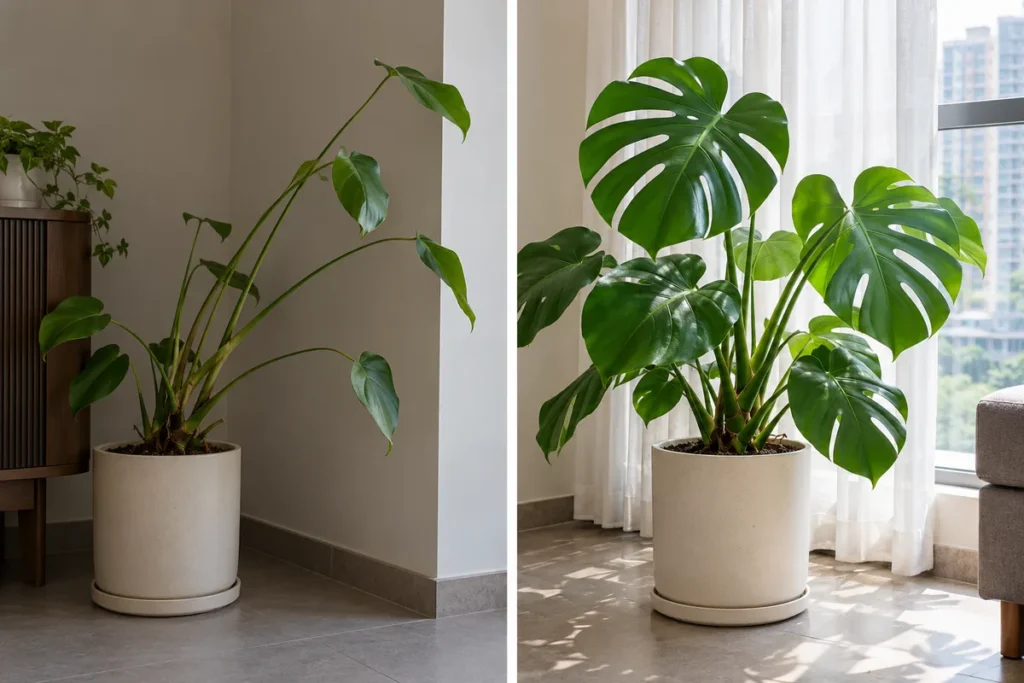
| Small solid new leaves, long stretched stem | Weak light [3][4][5] | Move gradually towards brighter light |
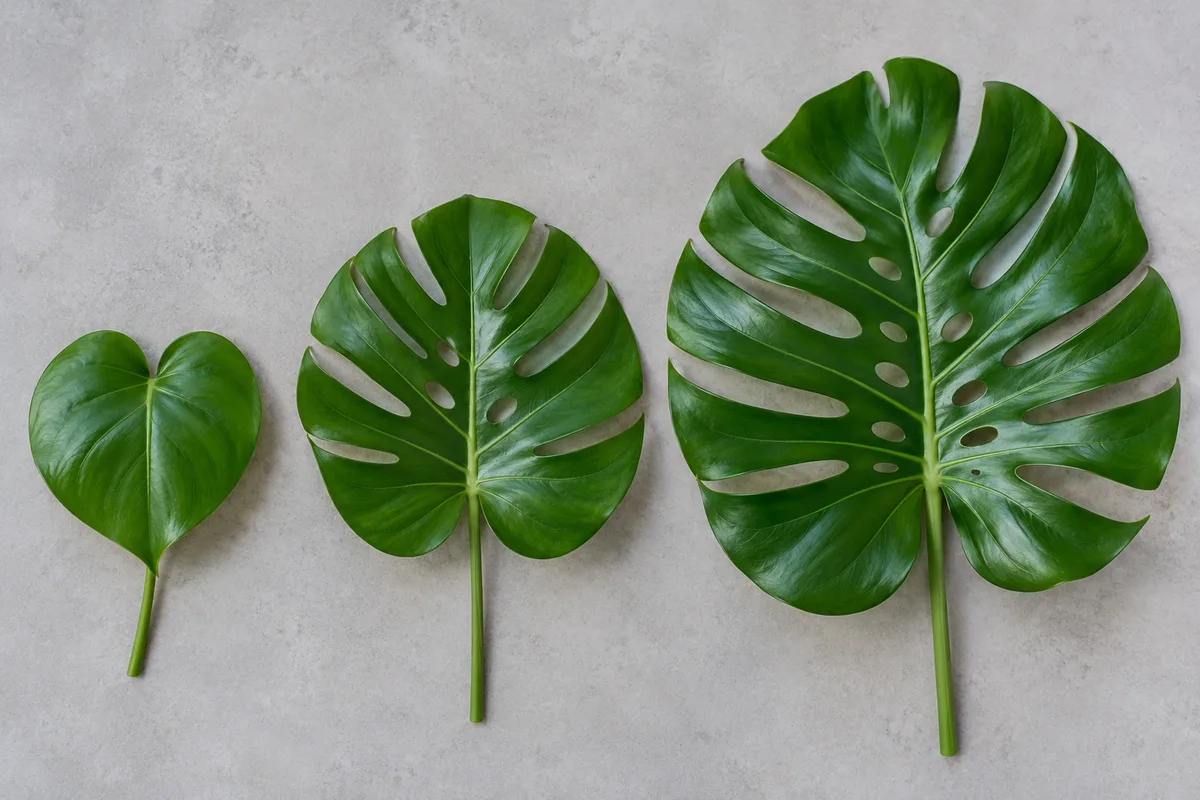
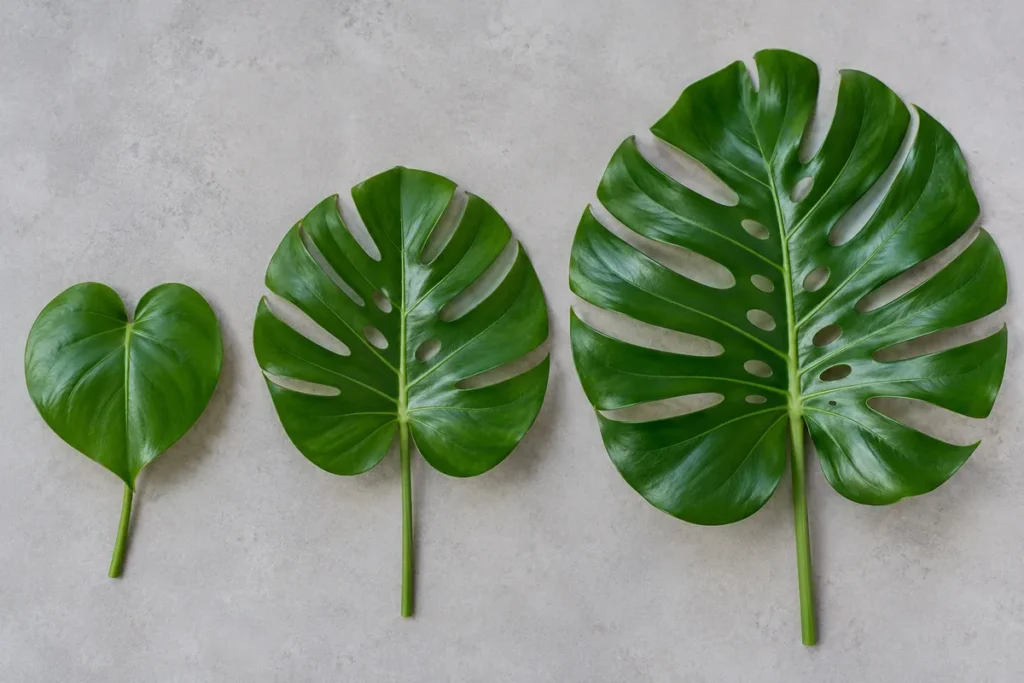
| Small solid leaves on a young plant | Juvenile leaves are naturally uncut [3][4] | Give support and wait for bigger leaves |
| Brown leaf edges | Air too dry [4] | Keep away from air-con vents; see brown leaf tips |
| Bleached or scorched patches after a move | Light changed too fast [4][6] | Return to gentler light |
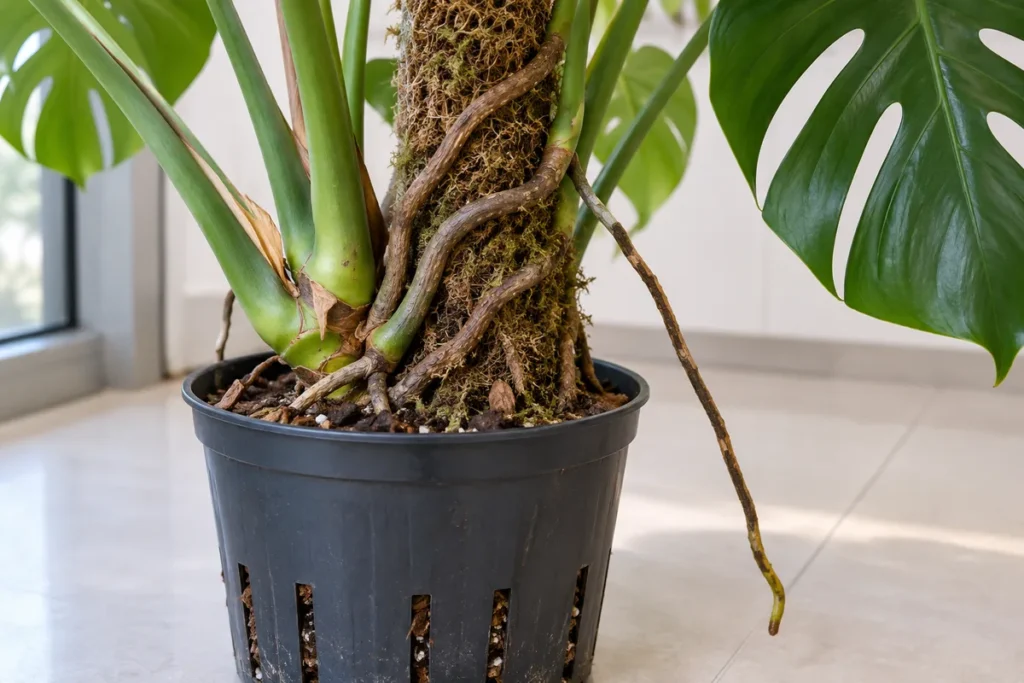
| Roots growing out of the pot | Normal climbing structure [3][4] | Add a support |
Photos and descriptions give clues only, not a diagnosis. For more on telling causes apart, see yellow leaves.
Are yellow monstera leaves always overwatering?
No. Overwatering is a common cause, but not the only one. Penn State says too much water can lead to root rot [3]. Clemson, in its philodendron section, says yellow lower leaves and dying growing tips can come from too little light or overwatering [5]. Read the yellowing together with soil moisture and light.
The sources disagree on how dry the pot should get, so do not treat any one as final. NC State says let the top quarter to third dry [1]. Penn State says the top 1 to 2 inches (about 2.5 to 5 cm) [3]. UConn says 2 to 3 inches (about 5 to 7.5 cm) [6]. Wisconsin says only that the medium should dry slightly [4]. These are US conditions, not Hong Kong figures. Pick a finger-depth and stick to it; see how to water.
Wisconsin notes that leaves may sweat when the medium is too moist, and advises less water to prevent rot [4]. If a sour smell or soft stem comes with yellowing, unpot it and read root rot and smelly soil.
Why is my monstera not splitting?
Most often the leaf is still young or the light is weak. Penn State says juvenile leaves are small and mostly uncut, and become large and perforated as they mature [3]. Wisconsin describes seedlings with small leaves without lobes or holes [4]. Wisconsin and Clemson both say weak light prevents perforations [4][5], and Penn State says plants get leggy in lower light [3].
How long it takes is not stated in these sources, so we give no month count. UConn says holes form outward from the midrib and increase with leaf size, and that leaf size typically jumps once vines attach [6]. Our inference: better support plus better light is more sensible than extra fertiliser alone.
What are the holes for? Penn State and Wisconsin only say they are thought, in theory, to let wind pass through [3][4]. That is unsettled, so do not treat the holes as essential.
Light advice also differs. Wisconsin suggests bright light in summer and direct sun in winter [4]. Penn State says bright but not direct [3]. UConn says 3 to 6 hours of direct sun but warns large leaves burn easily [6]. Variegated forms need more light [1]. Window direction and shading vary a lot in Hong Kong flats, so start from our indoor light guide; for stretched stems see leggy plants.
Should I cut or guide aerial roots?
Aerial roots are for climbing. Penn State says wild plants use roots from the leaf base to attach to trees [3]. Wisconsin suggests a moss-covered support pushed into the pot, watered so roots can take up water and nutrients [4]. UConn says leaf size usually rises once vines attach [6].
Is cutting harmful? No source we found says either way, and none supports routine removal, so we do not recommend it. Our inference: guide roots onto a support first if they are in the way. Wisconsin does cut stems just below an aerial root, but that is for propagation [4]. See also making room for aerial roots.
NC State says sap can cause contact dermatitis, and Penn State suggests gloves [1][3].
How do Hong Kong air-con, humid spells and wind affect a monstera?
Penn State prefers humidity above 50% [3]. Hong Kong Observatory 1991-2020 normals give a monthly mean relative humidity from about 70% in December to about 83% in April and May [7]. That is an outdoor station reading, and air-conditioned rooms or vent spots may differ (inference). Wisconsin says leaf edges turn brown when humidity is too low [4].
On temperature, Penn State gives about 60 to 85°F (roughly 16 to 29°C) and says the plant dislikes cold drafts [3]. Wisconsin says no growth below 50°F (10°C) and frost kills it [4]. The Observatory’s January mean daily minimum is about 14.6°C [7], so a cold night near a window deserves care (inference).
For long wet spells see humid season. On windy balconies, NC State says sturdy support prevents stem breakage [1]; see typhoon preparation.
What should I do, step by step?
- Note soil wetness, light position and any cold air before changing anything (inference).
- Probe the soil with a finger. If it is still wet, hold off watering until it reaches the dryness you chose [1][3][6].
- Check that the pot drains and no water sits in the saucer.
- If soil stays wet and smells sour, or the stem base is soft, unpot and check roots; see root rot.
- Move towards brighter light gradually. Wisconsin warns that plants moved outdoors need gradual acclimation or leaves can scorch [4].
- Add a moss-covered support for aerial roots and keep the moss damp [4].
- Check leaf undersides. Penn State and Wisconsin list aphids, mealybugs, scale and spider mites [3][4]; see mealybugs and spider mites. Follow product labels for any treatment.
What should I avoid doing?
- Adding water or fertiliser the moment a leaf yellows. UConn says monstera is easily burned by high soil salts [6].
- Moving it straight into strong direct sun. Wisconsin and UConn both warn about scorch on large leaves [4][6].
- Watering on a fixed schedule without probing the soil (inference).
- Relying on misting. No university or botanic garden source we found supports it for monstera; Penn State mentions a humidifier [3] and NC State a pebble tray [1].
How do I prevent problems, and when should I get help or give up?
Prevention: bright but gradually changed light, probe before watering, give a support, and avoid cold drafts [3][4][6].
If the stem base is mushy, the whole plant collapses, or most roots are rotted, recovery is unlikely; see can it be saved. If a pet chews it, ASPCA lists mouth irritation, drooling and vomiting [2]. Call a vet at once (the ASPCA hotline is a US number, so contact a Hong Kong vet). For a person with mouth burning after eating it, NC State and Penn State describe calcium oxalate irritation, so seek medical advice [1][3].
Frequently asked questions
How long until a monstera starts splitting?
The sources give no timeline. Penn State says juvenile leaves are small and mostly uncut and become perforated as they mature [3]; Wisconsin and Clemson say weak light prevents holes [4][5]. Judge by leaf size and light rather than months.
Is monstera safe for cats and dogs?
No. ASPCA lists Monstera deliciosa as toxic to dogs and cats because of insoluble calcium oxalates, with mouth irritation, drooling and vomiting [2]. NC State also notes sap can irritate skin [1]. Call a vet if you suspect chewing.
Can aerial roots go into the soil?
Wisconsin says aerial roots grow downward and root if they reach the ground [4]. UConn says vines with established aerial roots can be buried 2 to 3 inches below the first node, but growing tips should stay clear [6]. That is for potting cuttings, not routine care.
Will a monstera split under office fluorescent light?
Wisconsin says it can grow under fluorescent light but will not develop perforations if the light is inadequate [4]. Brightness and hours matter more than the lamp type; see grow lights for windowless offices.
Are droplets on the leaves a good sign?
Not necessarily. Wisconsin says leaves sweat when the medium is too moist, and advises less water to prevent rot [4]. Probe the soil first.
Sources
- NC State Extension: “Monstera deliciosa (Ceriman, Cutleaf Philodendron, Hurricane Plant, Mexican Breadfruit, Split-leaf Philodendron, Swiss Cheese Plant)” — Scientific and common names, origin, watering depth, variegated cultivars needing more light, support, toxicity and contact dermatitis
- ASPCA: “Toxic and Non-toxic Plants: Swiss Cheese Plant” — Monstera deliciosa is toxic to dogs and cats; toxic principle and clinical signs
- Penn State Extension: “Monstera as a Houseplant” — Juvenile versus mature leaves, aerial root function, light and humidity, watering, cold drafts, pests, gloves
- University of Wisconsin-Madison Division of Extension: “Swiss-Cheese Plant, Monstera deliciosa” — No perforations in weak light, leaves sweating, brown edges in dry air, moss support and aerial roots, gradual acclimation outdoors, low temperature
- Clemson Home & Garden Information Center: “Philodendron, Pothos & Monstera” — Low light prevents perforations; yellow lower leaves can come from too little light or overwatering (stated in the philodendron section)
- University of Connecticut Home & Garden Education Center: “Monstera deliciosa” — How holes form, watering depth, light acclimation, fertiliser salts, larger leaves after attaching, burying aerial roots
- Hong Kong Observatory: “Monthly Meteorological Normals for Hong Kong (1991-2020)” — 1991-2020 monthly mean relative humidity and mean daily minimum temperature
Further reading
- Back to Plant Doctor
- Yellow leaves: causes, how to tell them apart and what to do
- Root rot: how to tell, what to do and when to give up
- Leggy plants: stretched stems and long gaps
- Making Room for Monstera Aerial Roots
- How to Care for Monstera Deliciosa in Hong Kong
Sources checked: 31 October 2026. This is general guidance, not an on-site diagnosis. Always follow the product label.
