



Level: Intermediate
Keep new plants, and any plant that has been outdoors, apart from your other plants until you are sure they carry no pests [1]. A plant can carry pathogens with no visible symptoms [4], so looking healthy is not proof. Clean tools and pots first, then disinfect them [2].
Key points
- Put new and outdoor-returned plants in a separate spot until you are sure they have no pests [1].
- Plants can carry pathogens without any visible symptoms, so a healthy look is good news, not a completed check [4].
- Clean tools before disinfecting, or the disinfectant works less well [2]. Alcohol and bleach advice differs slightly between universities, as set out below [2][3][4].
- None of the sources we read gives a fixed quarantine length, so go by what each check finds, not the calendar [1][5].
Why quarantine a new plant at all?
Pests and pathogens can arrive on a new plant without you seeing them. Penn State Extension advises quarantining every newcomer until you are sure it has no infestation [1], and suggests treating any plant that has been outdoors as infested, isolating it when it comes in [1].
Disease is harder still to spot. Oregon State Extension notes that plants can carry viruses, bacteria or fungi with no visible symptoms [4]. That comes from a guide on propagation and plant sales rather than houseplants alone, but the principle carries over: a normal look does not mean nothing is hiding.
The aim is simple. If something turns up, it affects one pot, not the whole shelf. See also a calm plan for an office plant with pests and integrated pest management.
How do you quarantine a plant, and for how long?
Pick a spot away from other plants where you will see it daily. Penn State describes a routine of putting new plants in quarantine and examining them daily [1]. The source names no particular room, so keep to the principle: no leaf contact with other plants and no shared saucers. (The saucer point is our inference, since water and pests can move through them.)
On length, none of the sources we read gives a number. Penn State says only to isolate until you are sure there are no pests [1]. Our own inference is to restart the clock from the last time you saw a pest, and to keep checking at every watering even if you find nothing [5].
- Isolate it. Keep it apart from other plants in decent light, not harsh direct sun [1].
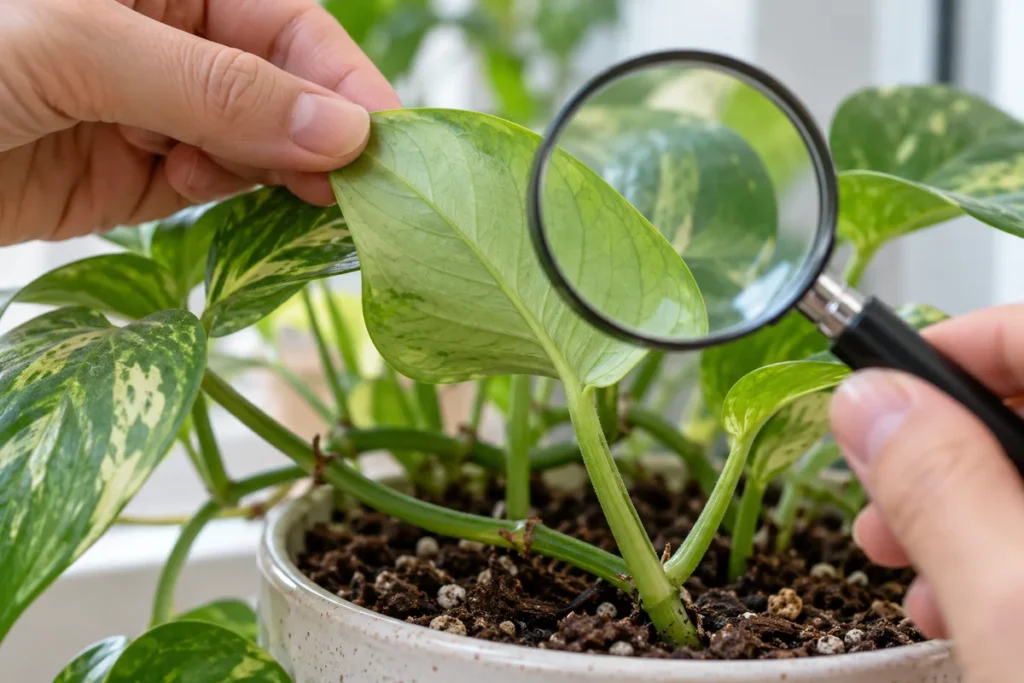
- Do a careful first check. Look at leaf tops, undersides, leaf joints and the soil surface.
- If it has been outdoors, wash it. University of Minnesota Extension says some experts bathe plants in mild soapy water, or wash leaf tops and undersides and let the soapy water reach the soil; very large plants can be sprayed with water [5]. That advice is for plants returning indoors after summer outside, so it may not suit every new purchase, and some leaves dislike water.
- Wash the outside of the pot. The same source suggests cleaning pot exteriors to remove dirt and any pests [5].
- Check at every watering. Minnesota recommends checking for signs of infestation at each watering once plants are inside [5].
On a phone, swipe sideways to see every column.
| Clue | Possible cause | Next step |
|---|---|---|
| Small, often green insects under leaves | Possibly aphids [5] | Keep isolated and wash leaves; see aphids [5] |
| White cottony tufts in leaf joints or undersides | Mealybugs are more likely | Keep isolated; see mealybugs |
| Fine speckles and webbing on leaves | Possibly spider mites | Keep isolated; see spider mites |
| Tiny flies or jumping specks on the mix | Possibly fungus gnats or springtails | See bugs in soil |
| Leaf spots but no insects | Disease, or an environmental problem | Isolate; see leaf spots |
| Looks perfectly healthy | Does not rule out hidden pathogens [4] | Isolate anyway and check at each watering [1][5] |
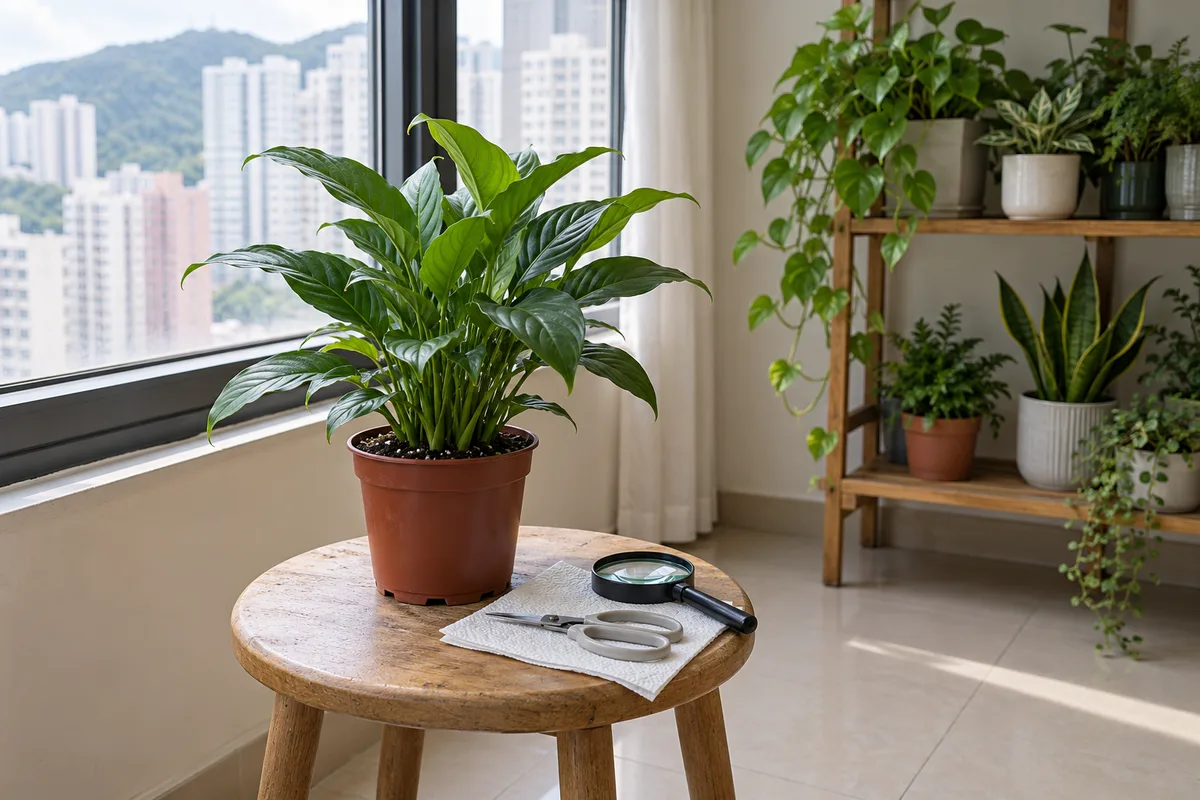
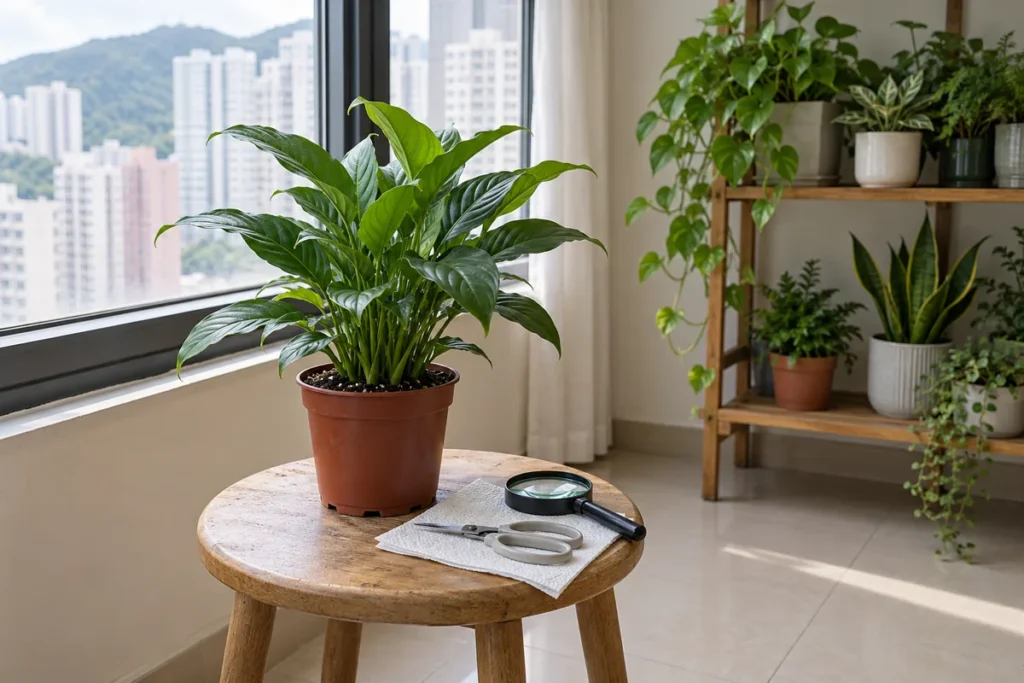
Hong Kong note: in a small flat the quarantine spot can be a stool or a corner of a windowsill. What matters is distance from other plants, not the size of the room.
What should you look at during quarantine?
Fix the places and the habit. Minnesota Extension advises checking at each watering [5], and Penn State describes daily checks [1]. They fit together: a quick daily glance, then a proper look under the leaves when you water.
- Leaf undersides: aphids are small, often green, and can be found there [5].
- Leaf joints and new growth: small or hidden pests tend to settle there (a general observation, not a sourced figure).
- Soil surface: flies, powder or mould; for mould see mould on soil.
- Photos: take one from the same angle each time so changes show. This is our suggestion, not from the sources.
If you find pests, identify them before treating. Do not spray at the first sighting. For pesticide products, see the section on when to ask for help below.
Clean first or disinfect first?
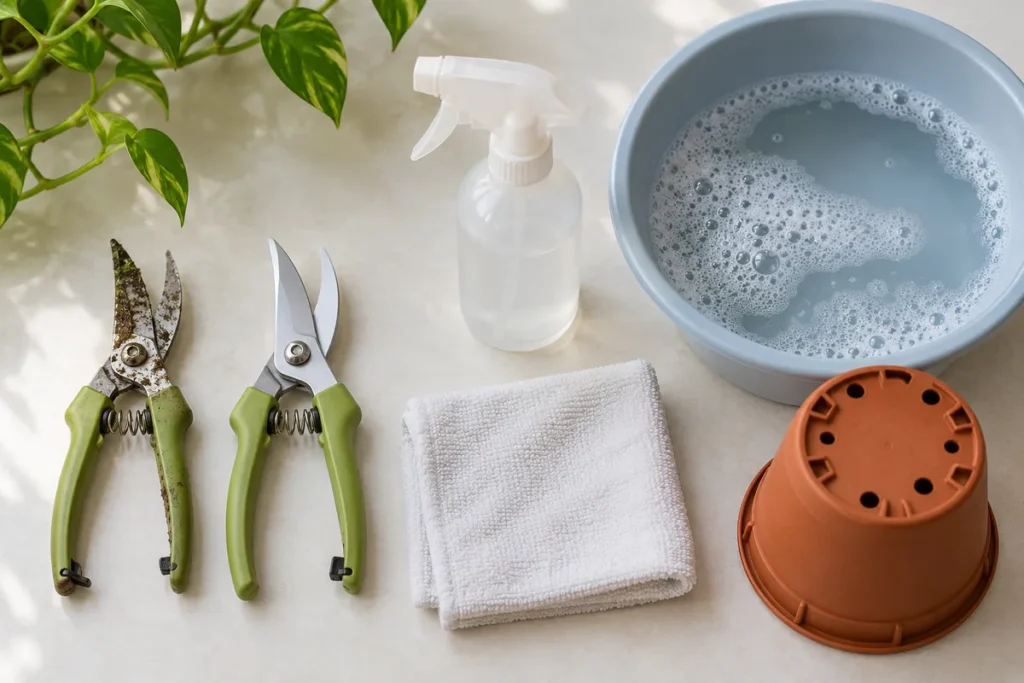
Clean first, then disinfect. University of Minnesota Extension says dirt and debris left on tools interfere with disinfection [2], and Missouri Extension warns that soil and organic matter may neutralise the chlorine in bleach [3]. So wash off the soil, disinfect, then let the tool dry.
On disinfectants, the sources differ, so do not treat one as the final word.
- Alcohol: Minnesota says isopropyl alcohol at 70% or more disinfects surfaces for bacteria, fungi and viruses [2]. Oregon State gives 70% alcohol with 30% water, saturating the surface and letting it air dry [4].
- Bleach: Minnesota and Missouri both give one part bleach to nine parts water [2][3]. Contact time differs: Minnesota says it acts within seconds [2], Missouri says a couple of minutes [3], and Oregon State says ten minutes then rinse [4]. We would follow the longer figure or the product label.
- Bleach goes off: Oregon State says the diluted solution loses effectiveness after about two hours, so mix it fresh [4].
- Metal blades: Minnesota says bleach corrodes metal and is not recommended for cutting tools that need a sharp edge, as it can pit and nick the metal [2].
Pots can carry disease too. Minnesota says containers can carry disease in soil and debris, and to clean the whole pot inside and out [2]. Oregon State says containers that held diseased plants should be discarded or disinfected [4]. For the reuse checklist, see before an old plant pot comes back into use.
These sources mostly describe gardens and nurseries rather than a few pots on a flat. For small home use, wiping with alcohol is simpler, and corrosion is less of a concern (the last point is our inference).
What should you avoid?
- Moving a plant in with the others because it looks fine: pathogens can be symptomless [4].
- Using the same shears on the next plant without disinfecting: Missouri advises sanitising tools between uses to lower the risk of spreading disease [3].
- Spraying alcohol on caked-on soil: debris interferes with disinfection [2].
- Reusing yesterday’s bleach mix: it weakens after about two hours [4].
- Mixing your own pest sprays: follow the product label and never invent a recipe.
- Assuming quarantine is a one-off: keep checking at each watering afterwards [5].
How do you make this a habit at home in Hong Kong?
Treat prevention as a routine, not a one-off. For every new plant, gift or balcony plant coming back in, follow the same steps: separate spot, separate watering, regular checks [1][5].
- Keep one fixed quarantine spot, such as a window stool or a kitchen corner.
- Keep a dedicated pair of small shears and a cloth, cleaned and disinfected after use [2][3].
- Check balcony plants before bringing them in: treat them as having been outdoors and isolate first [1].
- Wash old pots before reuse, inside and out [2].
- Do not put a freshly repotted plant beside a new arrival: both may be stressed and symptoms get confusing (our inference).
If pests or disease still appear, read integrated pest management and choosing pest-control products.
When should you ask a specialist or give up on a plant?
If a quarantined plant shows heavy or recurring infestation, or several plants show the same pattern, ask a plant professional to identify it rather than escalating treatments yourself. Pesticides in Hong Kong are regulated under the Pesticides Ordinance (Cap. 133), and only registered products are distributed under licence [6]. Use locally legal products and follow the label exactly. Do not mix your own strengths.
If one plant is badly affected and you need to protect the rest, discarding it may be more practical than waiting. Do not reuse the pot or mix without cleaning or disinfecting [4].
With pets or young children at home, read the product label and ask a vet or doctor before using any pesticide. Do not assume ‘natural’ means safe.
Frequently asked questions
How long should new plants be quarantined?
None of the sources we read gives a fixed length. Penn State Extension says only to isolate until you are sure there are no pests [1]. In practice, keep checking during quarantine and at each watering [5].
Why quarantine a plant that looks healthy?
Because plants can carry pathogens with no visible symptoms [4]. Quarantine trades time and observation for safety.
Can I wipe shears with alcohol, or must I use bleach?
Both have university support. Alcohol at 70% or more disinfects surfaces [2]. Bleach at one part to nine of water corrodes metal and is not recommended for tools that need a sharp edge [2]. Wash off soil first [2].
Can I reuse an old pot if I wash it?
If it held a diseased plant, sources advise discarding or disinfecting it [4], and cleaning it inside and out [2]. See before an old plant pot comes back into use.
Can I mix my own spray if I find pests?
We advise against it. Follow the product label, and note that pesticides in Hong Kong are regulated under the Pesticides Ordinance (Cap. 133) [6].
Sources
- Penn State Extension: “Tips for a Bug-Free Houseplant Haven” — Quarantine newcomers and plants that have been outdoors until sure they have no infestation
- University of Minnesota Extension: “How to clean and disinfect gardening tools and containers” — Clean before disinfecting, alcohol and bleach use, bleach corrodes metal, pots can carry disease
- University of Missouri Extension: “Sanitize tools for good garden hygiene” — Sanitise tools between uses; bleach ratio and soak time; organic matter neutralises bleach
- Oregon State University Extension: “Safe plant propagation and plant sales” — Plants can carry pathogens with no symptoms; disinfectant strengths and contact times; alcohol use; containers from diseased plants
- University of Minnesota Extension: “Bringing houseplants back inside” — Check at each watering; wash leaf tops and undersides with soapy water; wash pot exteriors (source context: plants returning indoors after summer outside)
- Agriculture, Fisheries and Conservation Department (Hong Kong): “Pesticides Registration and Control” — Pesticides in Hong Kong are regulated under the Pesticides Ordinance (Cap. 133); only registered products are distributed under licence
Further reading
- Back to Plant Doctor
- Integrated pest management for houseplants
- Choosing and using pest-control products
- Bugs in soil: how to tell them apart
- A Calm Plan for an Office Plant with Pests
- Before an Old Plant Pot Comes Back into Use
Sources checked: 31 October 2026. This is general guidance, not an on-site diagnosis. Always follow the product label.
