



Level: Beginner
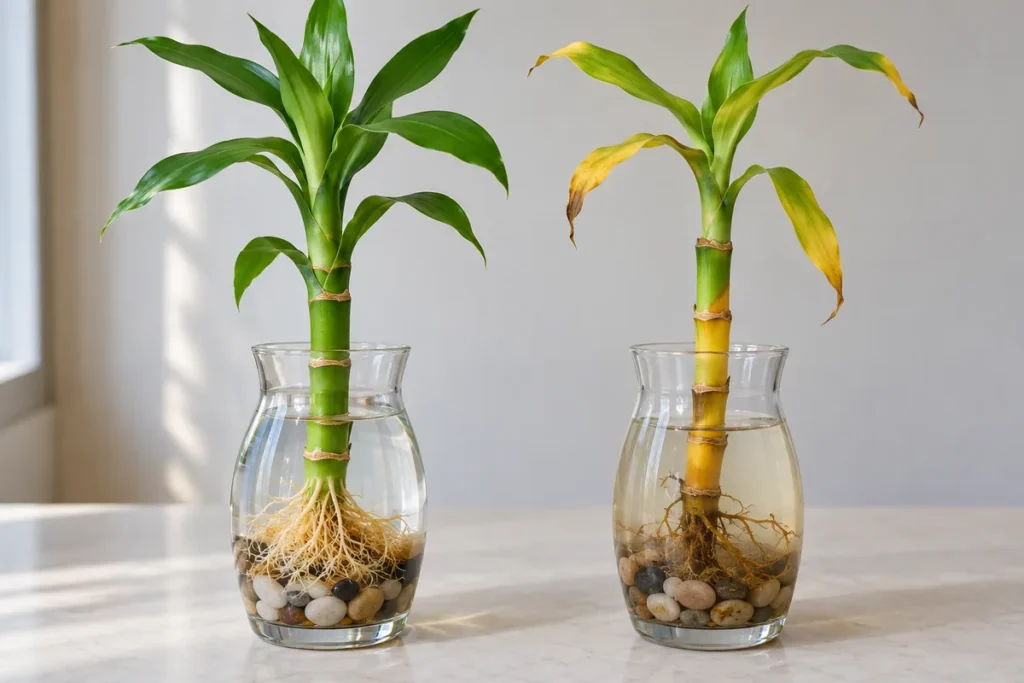
Lucky bamboo can turn yellow from overwatering, water quality, strong light or too much fertiliser [1][3][4]. Check where the yellow starts, then review your water changes and placement before cutting everything off or feeding more.
Key points
- Lucky bamboo is Dracaena sanderiana and is not a true bamboo [1].
- Yellowing has several causes: overwatering can cause yellow leaves and stem rot [1], and strong light, water quality or over-fertilising may also be involved [3][4].
- Advice on water changes differs: weekly [1][2] or every week to two weeks [4]. Hong Kong tap water has fluoride added [6] and a related dracaena is sensitive to it [5], but we found no source on lucky bamboo’s own tolerance.
- The plant is toxic to pets and can irritate skin [1][2].
How do I work out why my lucky bamboo is yellow?
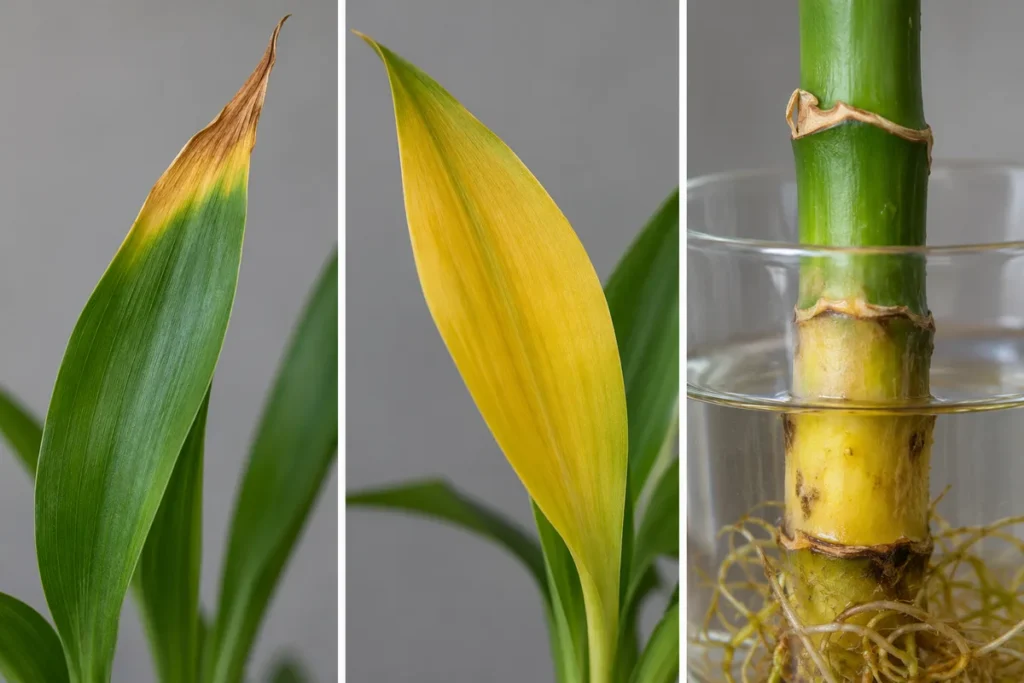
Start with where the yellow appears. NC State Extension says overwatering can cause yellow leaves and rotting stems [1]. NYBG says over-fertilising can turn the plant yellow from the bottom up, and that some plants simply become exhausted and do not recover [4]. UF/IFAS Extension lists too much light, chlorine or fluorine in city water, and pH as possibilities [3]. The table gives clues only, not a diagnosis.
On a phone, swipe sideways to see every column.
| Clue | Possible cause | Next step |
|---|---|---|
| Yellowing from the bottom up after feeding | Possibly too much fertiliser | Change to clean water and feed less [4] |
| Yellow leaves and a soft stalk near the water line | Possibly overwatering or stem rot (source describes potted plants) | Check the stalk base; see stem rot [1] |
| Brown-yellow leaves worse towards the window | Possibly too much light | Move to bright, non-direct light [2][3] |
| Still yellow after water changes, always on tap water | Possibly water quality (chlorine, fluoride, pH) | Try filtered or settled water; see Hong Kong tap water [3] |
| A few old leaves yellow, new growth fine | Possibly normal ageing or exhaustion | Trim the yellow leaves and keep watching [4] |
Hong Kong note: window ledges and balconies get hot. The Observatory’s 1991-2020 mean daily maximum for July is 31.6°C [7], and it may be hotter behind glass (author’s reasoning).
How do I change the water so it does not turn smelly?
Clemson Extension advises changing the water weekly [2]. NC State Extension also says weekly, partly to prevent mosquitoes [1]. NYBG says every week to two weeks [4]. The sources differ, so adjust by water colour and smell. Shortening the gap in Hong Kong’s warm weather is the author’s reasoning.
The sources we read do not explain smell directly, so this is the author’s reasoning: stagnant water clouds and smells, and frequent changes and washing the container help. If roots darken and the stalk turns soft, check the stalk base as well [1].
- Lift out the stalk and rinse roots and container with clean water.
- Keep enough water to cover the roots and at least one inch of stem [2].
- Change weekly, sooner if the water clouds [2][4].
- New roots usually form in two to three weeks [2].
Is tap water really bad for lucky bamboo?
The evidence is thin. UF/IFAS Extension says city water may contain too much chlorine or fluorine, and suggests filtered water, or letting tap water stand uncovered for one to two days so they disperse [3]. NYBG recommends distilled or rainwater because dracaenas dislike salts and chemicals [4]. NC State says a related species, corn plant, is sensitive to fluorides and salts and suggests non-fluoridated water [5], but that page is not about lucky bamboo.
Hong Kong’s Water Supplies Department says fluoride is added and a small residual chlorine is kept [6], with no concentration given on that page. We found no source stating how long standing is needed for fluoride to disperse, so the claim that a day or two fixes fluoride is weakly supported. A sensible route is to rule out light, feeding and overwatering first, then compare filtered or distilled water if you still suspect the tap (author’s reasoning). See tap water for plants.
What should I avoid doing?
- Putting the plant in a sunny window. UF/IFAS advises bright but not direct light and never in a window [3], and Clemson says direct sun browns the leaves [2].
- Feeding often. Clemson suggests feeding every other month at a quarter of the usual rate [2], and NYBG warns against over-fertilising [4].
- Adding more fertiliser because it is yellow. Rule out overwatering and water quality first [1][3].
- Trying unsourced home additives. We have found no university or botanic garden support, so the evidence is weak and we do not recommend them.
- Letting the water drop below the roots. Cover the roots and at least one inch of stem [2].
How do air conditioning, balconies and summer heat matter in Hong Kong?
NC State says low humidity can brown leaf tips [1]. Air-conditioned rooms are dry, so brown tips with healthy new leaves may not be a water problem; see air conditioning. Clemson advises bringing outdoor plants in before night temperatures fall below 65°F, about 18°C [2]. Hong Kong’s January mean daily minimum is 14.6°C [7], so take care with balconies in winter.
In hot spells the vase water warms quickly. Changing it earlier and avoiding window heat is the author’s reasoning.
When should I get help or give up?
If most of the stalk is yellow and soft, NC State says overwatering can rot stems [1], and NYBG says exhausted plants may not recover [4]. You can try re-rooting firm green sections (author’s reasoning; the sources give no success rate). If pests show up, Clemson names spider mites, mealybugs and aphids [2], and NC State lists thrips and scale among others [1]; see mealybugs.
Safety: Clemson says lucky bamboo is toxic to pets and can irritate human skin [2], and NC State also says it is toxic if eaten [1]. The ASPCA lists dracaena species as toxic to dogs and cats, with vomiting, depression and loss of appetite [8], although that page does not name lucky bamboo. Wear gloves, and contact a vet or doctor if anyone has eaten it.
How do I prevent problems?
- Keep it in bright, indirect light, such as an east- or north-facing room [2].
- Change the water and wash the container regularly [1][2].
- Feed lightly and rarely [2][4].
- Watch the leaf tips; if dry air is the cause, see brown leaf tips.
- For meaning and display ideas, see lucky bamboo stalks meaning.
Frequently asked questions
Is lucky bamboo a real bamboo?
No. NC State Extension says it is not a bamboo, and its scientific name is Dracaena sanderiana [1].
Can I grow lucky bamboo in soil?
Yes. NC State says it needs a moist mix or can grow in chlorine-free water [1], and Clemson describes both soil and water culture [2].
Do brown tips mean it needs more water?
Not necessarily. NC State says low humidity can brown the tips [1], and NYBG says salts or chemicals in water can brown the plant [4].
Do I need distilled water?
NYBG recommends distilled or rainwater [4], while UF/IFAS suggests filtered or settled tap water [3]. The evidence is limited, so compare rather than switching everything at once.
Is lucky bamboo safe for pets?
Clemson says it is toxic to pets [2]. Keep it out of reach and call a vet if a pet has chewed it.
Sources
- North Carolina State Extension: “Dracaena sanderiana (NC Extension Gardener Plant Toolbox)” — Scientific name, water and soil culture, weekly water change, overwatering, low humidity, pests, toxicity
- Clemson Cooperative Extension (HGIC): “How To Grow and Care for Lucky Bamboo (Dracaena Sanderiana)” — Light, weekly water change, water depth, rooting time, fertiliser, pests, pet toxicity
- UF/IFAS Extension Nassau County: “Q: The leaves on my lucky bamboo are turning yellow. What could be wrong?” — Yellowing from too much light, chlorine or fluorine in city water, or pH; filtered or settled water
- New York Botanical Garden (NYBG): “How can I save my lucky bamboo plant that is yellowing?” — Causes of yellowing: over-fertilising, light, water quality; water change frequency, distilled or rainwater
- North Carolina State Extension: “Dracaena fragrans (NC Extension Gardener Plant Toolbox)” — A related dracaena (corn plant) is sensitive to fluorides and salts; non-fluoridated water suggested (not lucky bamboo itself)
- Water Supplies Department, Hong Kong: “Water Treatment” — Hong Kong tap water has fluoride added and a small residual chlorine kept
- Hong Kong Observatory: “Monthly Meteorological Normals for Hong Kong (1991-2020)” — 1991-2020 mean daily maximum for July and August and minimum for January
- ASPCA: “Dracaena” — Dracaena species toxic to dogs and cats, with signs (the page does not list lucky bamboo by name; genus-level reference)
Further reading
- Back to Plant Doctor
- Stem rot: soft, black stem bases
- Hong Kong tap water for plants
- Lucky bamboo stalks meaning
Sources checked: 31 October 2026. This is general guidance, not an on-site diagnosis. Always follow the product label.
