



Level: Beginner
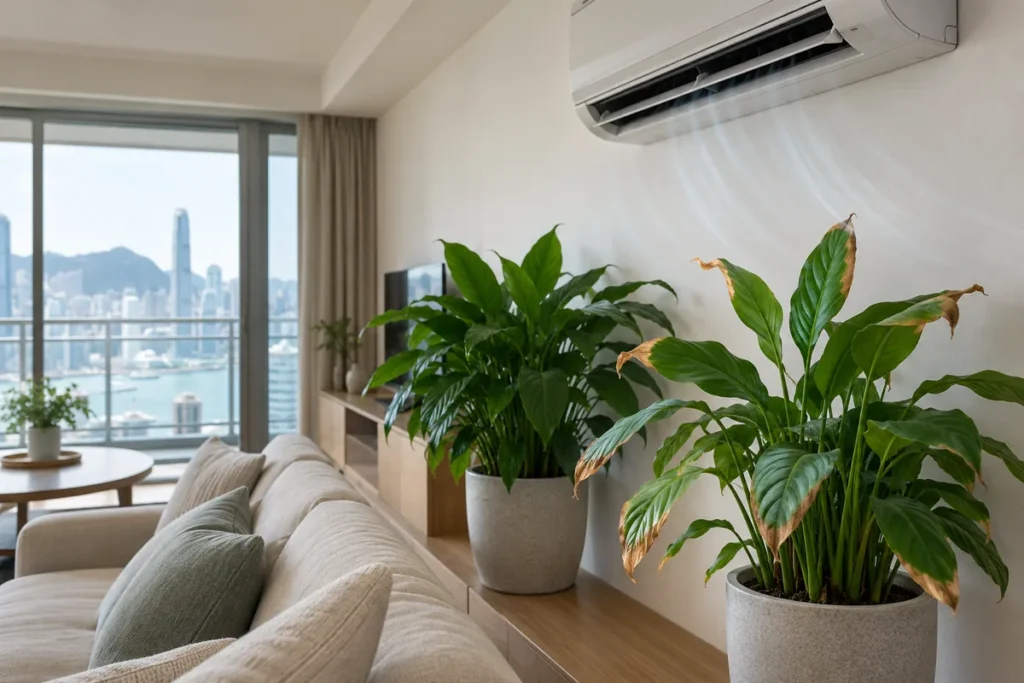
In an air-conditioned room, plants most often suffer from vent airflow, drier air and temperature swings rather than the set temperature itself. Move the plant out of direct airflow first, then water by soil dryness. Colorado State University says air movement near vents increases water loss from plants [1].
Key points
- Airflow near vents raises water loss, so brown tips and one-sided drying are more likely [1].
- The Hong Kong government advises 24-26°C for air-conditioned rooms in summer [5]. That setting alone is not shown to chill plants, but a direct draught is a separate matter (our inference).
- Misting and pebble trays add little humidity; grouping plants and using a humidifier have more support [1][3].
- Moving plants out of draughts, checking soil and changing conditions slowly is safer than adding water in a hurry [1][2].
How does air conditioning affect houseplants?
Three things change: airflow, humidity and temperature. Colorado State University says plants near heating or cooling vents face more air movement, which raises transpiration, and that some plants develop leaf spots or brown tips from low humidity [1]. Iowa State Extension advises keeping plants away from cold drafts and hot air vents and keeping leaves off cold windows [2]. Both describe winter heating, so applying them to cooling vents is our inference.
Hong Kong summers are humid outdoors. The Observatory’s 1991-2020 normals give a July mean relative humidity of about 81%, a mean daily maximum of 31.6°C and a mean daily minimum of 26.9°C [6]. The government suggests 24-26°C indoors in summer [5]. So there is a real step in temperature and air when you walk indoors. We found no source measuring actual humidity in Hong Kong air-conditioned rooms, so we give no figure.
How do I tell if the air conditioner is the cause?
Look at where the damage is and where the vent points. Damage concentrated on the windward side, easing with distance, is more typical of airflow. UC IPM notes that heat from equipment or vents injures foliage most strongly closest to the source [7]. That is a landscape setting, and the equivalent for cold vents is our inference.
On a phone, swipe sideways to see every column.
| Clue | Possible cause | Next step |
|---|---|---|
| Windward leaves crisp at tips and edges; soil dries fast | Vent airflow speeding water loss, plus drier air [1] | Move out of the airflow; check soil before watering |
| Leaves limp or reddish-purple after a move, no new growth | Cold or sudden change; tropical plants are more prone to chilling above freezing [4] | Check the temperature where it stands; avoid vents and cold glass [2] |
| Yellowing and soil stays wet | Slow drying plus frequent watering can both play a part; roots need checking | Stop watering; see overwatered or underwatered |
| Crisp tips but far from any vent | May be water quality, salts or something else | See brown leaf tips |
What steps should I take to adjust placement and care?
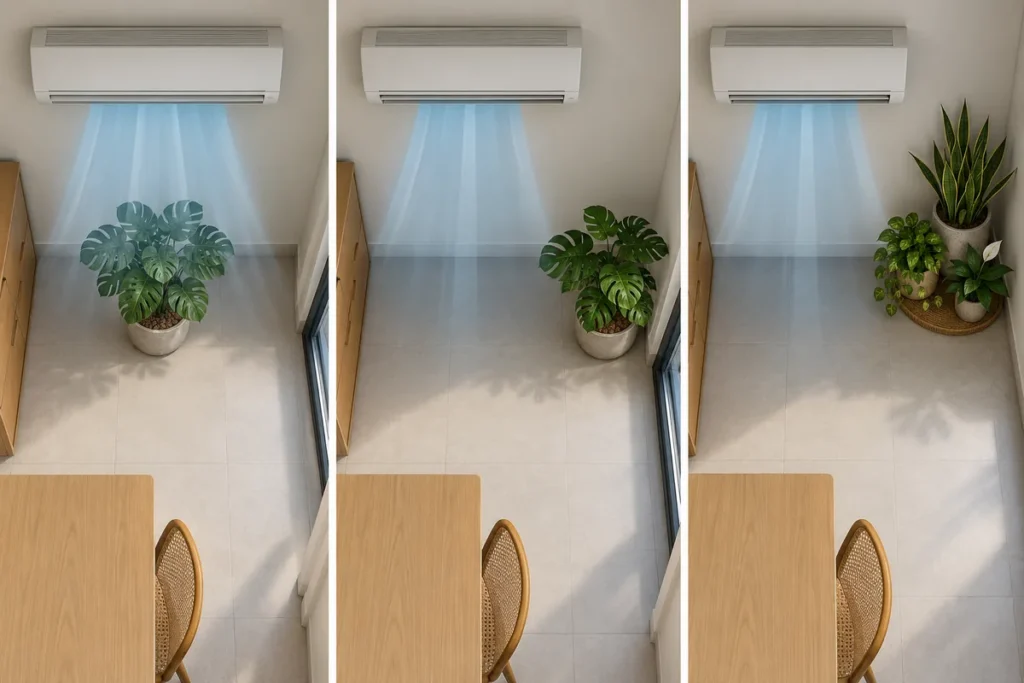
- Move the plant out of the direct airflow; if you can, angle the louvres away from the foliage [1][2].
- Keep leaves off cold windows and glass, as Iowa State advises [2].
- Test the soil with a finger before watering. Pots near a vent may dry faster, so check more often than usual [1].
- Group several plants together. Penn State says most sources still rate this helpful, depending on plant numbers and room size [3].
- If you want more humidity, consider a humidifier. Penn State says a whole-house unit may not reach ideal levels for plants but still helps [3].
Reassess after one to two weeks. Damaged leaves will not recover, so judge by new growth before trimming. Keep notes on where the plant stood and what changed, so you can tell which adjustment helped.
Hong Kong note: indoor air can be very damp in the wet season. Measure with a hygrometer before adding a humidifier, and see houseplants and dehumidifiers for placement.
Do misting and pebble trays help?
The evidence is weak, so do not rely on either. Penn State says misting raises humidity only until the water evaporates, perhaps minutes, and that evaporated water from a pebble tray spreads through the whole room with almost no overall effect [3]. Colorado State says misting must be frequent to work and may promote leaf diseases, yet it still recommends grouping plants on a tray of gravel and water [1]. The two universities differ: one still recommends trays, the other finds the effect small.
Both mention humidification devices as helpful [1][3]. We lean towards grouping plants and using a humidifier, with misting only as an occasional leaf wipe-down.
What should I avoid in an air-conditioned room?
- Do not place plants directly in front of or under a vent [1][2].
- Do not add lots of water the moment tips brown. Check the soil first; brown tips do not always mean thirst.
- Do not let leaves rest on cold windows [2].
- Do not assume a milder setting is automatically safe. The sources do not state a plant tolerance for 24-26°C, so any view is inference.
How do I prevent air-conditioning problems?
- Before placing a plant, feel the direction and strength of airflow and avoid direct draughts [1].
- For offices, see plants in an air-conditioned office.
- Light still matters; see assessing indoor light in Hong Kong homes.
- After moving a plant into a cooled room, watch new growth, and avoid repotting, moving again and feeding all at once.
For outdoor summer heat and light, see Hong Kong summer plant care.
When should I get help, or let a plant go?
If most leaves turn black and mushy, the stem base is soft, or leaves keep dropping two to three weeks after moving it from the vent, ask a plant doctor or an experienced gardener. A firm stem and new buds usually leave room for recovery; see save a dying plant. This is general guidance, not a diagnosis of your plant.
Check it step by step with Plant Doctor →
Frequently asked questions
How often should I water a plant in an air-conditioned room?
There is no fixed schedule. Pots near a vent may dry faster [1], so push a finger into the mix and water through only when it is dry. See how to water houseplants.
Can a 24-26°C setting chill my plants?
We found no source saying 24-26°C [5] chills common houseplants. UC IPM says tropical plants are more prone to chilling above freezing, with severity depending on duration, minimum temperature and how fast it drops [4]. Local cold air straight from a vent is different, so measure it.
Do I need a humidifier?
That depends on the plant. Penn State says humidifiers help, though a large unit may not reach ideal levels for plants [3]. Measure with a hygrometer first, then decide.
Is a spot by the window or by the vent better?
Avoid both direct draughts and cold glass. Iowa State advises keeping plants away from cold drafts and hot air vents and keeping leaves off cold windows [2].
Will the plant recover once the air conditioner is off?
We found no direct source. If airflow was the problem, new growth after moving away from the vent is the most reliable sign, while damaged leaves will not recover.
Sources
- Colorado State University PlantTalk: “Houseplants: Temperature and Humidity” — Air movement near vents raises transpiration, low humidity and brown tips, limits of misting and gravel trays
- Iowa State University Extension: “What is the proper temperature for houseplants during the winter months?” — Usual temperature range, avoiding cold drafts and hot air vents, leaves away from cold windows (winter heating setting)
- Penn State Extension: “Humidity and Houseplants” — Effect of misting, pebble trays, grouping and humidifiers; recommended indoor humidity range (winter heating setting)
- University of California IPM (UC IPM): “Chilling Injury” — Tropical and subtropical plants are more prone to chilling above freezing; duration and rate of drop matter (landscape plants)
- Electrical and Mechanical Services Department, Hong Kong: “Energy Saving Tips For Office: Air Conditioning (AC) and Ventilation” — Government advice to keep air-conditioned room temperature at 24-26°C in summer
- Hong Kong Observatory: “Monthly Meteorological Normals for Hong Kong (1991-2020)” — Monthly mean temperature and relative humidity (Observatory HQ, 1991-2020)
- University of California IPM (UC IPM): “Thermal Injury, or High Temperatures” — Heat from equipment and vents can injure foliage, worst closest to the source (landscape plants)
Further reading
- Back to Plant Doctor
- Hong Kong summer plant care: heat, sun and watering
- Brown crispy leaf tips and edges: dry air, salts or water quality?
- Misting and pebble trays: what the evidence says
- How to Keep Plants Alive in an Air-Conditioned Office (Hong Kong Guide)
- Houseplants and Dehumidifiers: Making Space for Both
Sources checked: 31 October 2026. This is general guidance, not an on-site diagnosis. Always follow the product label.
