



Level: Beginner
For a few days away, most houseplants cope after a thorough watering and a move away from strong light [1]. Beyond a week, they need a slow water supply such as a wick or a bathtub with towels [1][2]. Beyond four weeks, UF/IFAS advises sending plants to a sitter’s home [2].
Key points
- Test your chosen method before you leave, not on the day you travel [4].
- Water thoroughly before leaving and move plants out of strong light to slow drying [1][2].
- One to two weeks: pebble tray or bathtub and towels. Three to four weeks: a wick. Over four weeks: find a sitter [2].
- Bottles, spikes and water-retaining crystals each have limits, and Missouri Extension calls the crystals unreliable [3].
How long will you be away, and which plan fits?
Decide the length of absence first. The RHS says most houseplants tolerate a few days away, but more than a week calls for a way to supply water [1]. UF/IFAS Extension splits its advice into one to two weeks, three to four weeks and more than four weeks [2].
On a phone, swipe sideways to see every column.
| Time away | Options to consider | Source |
|---|---|---|
| A few days | Water thoroughly, move to a cooler spot or away from a bright window | [1][2] |
| One to two weeks | Self-watering pot, pebble tray, or bathtub with towels; move off warm windowsills | [2] |
| Three to four weeks | Wick from a raised reservoir; still water before leaving | [2] |
| Over four weeks | Send plants to a sitter’s home; if too big, arrange a visit at least weekly | [2] |
| Any length | Test the method first; a plant sitter is the first option suggested | [3][4] |
Hong Kong note: the July mean daily maximum is 31.6°C and the January mean daily minimum is 14.6°C [5]. A flat shut up in summer may run hotter than usual (our inference; the Observatory does not measure your home). In winter check each plant’s lowest tolerated temperature [1].
What should I do in the three days before leaving?
- Test the method. USask advises trying a watering method before you leave to see what suits your plants [4].
- Group plants together. Missouri Extension suggests grouping them for easier access to water [3].
- Move them out of strong light. UF/IFAS advises indirect light, where plants use less water, and says plants can survive a couple of weeks on lower light [2].
- Water deeply just before leaving. Several sources say so [1][3][4].
- Mulch the surface. USask and Missouri Extension both mention mulch to slow water loss [3][4].
- Know your pots. Clay pots dry faster than plastic or glazed ones, and small pots faster than large ones [4].
Missouri Extension also says not to turn the indoor thermostat up, since that adds to moisture loss [3]. Our inference: in a Hong Kong summer, think about plant heat tolerance against running costs; a steady, moderate air-conditioning setting may suit better than switching it off entirely. The source says nothing about air conditioning.
Which methods are backed by evidence: wicks, towels, bottles?
University and RHS pages describe capillary mat, wick, pebble tray and bathtub methods. The RHS says capillary matting suits groups of small pots and may not work with pots that have broken crocks in the base, while a wick suits a large single plant [1]. Clay pots need a thorough watering first so they begin drawing from the mat [1].
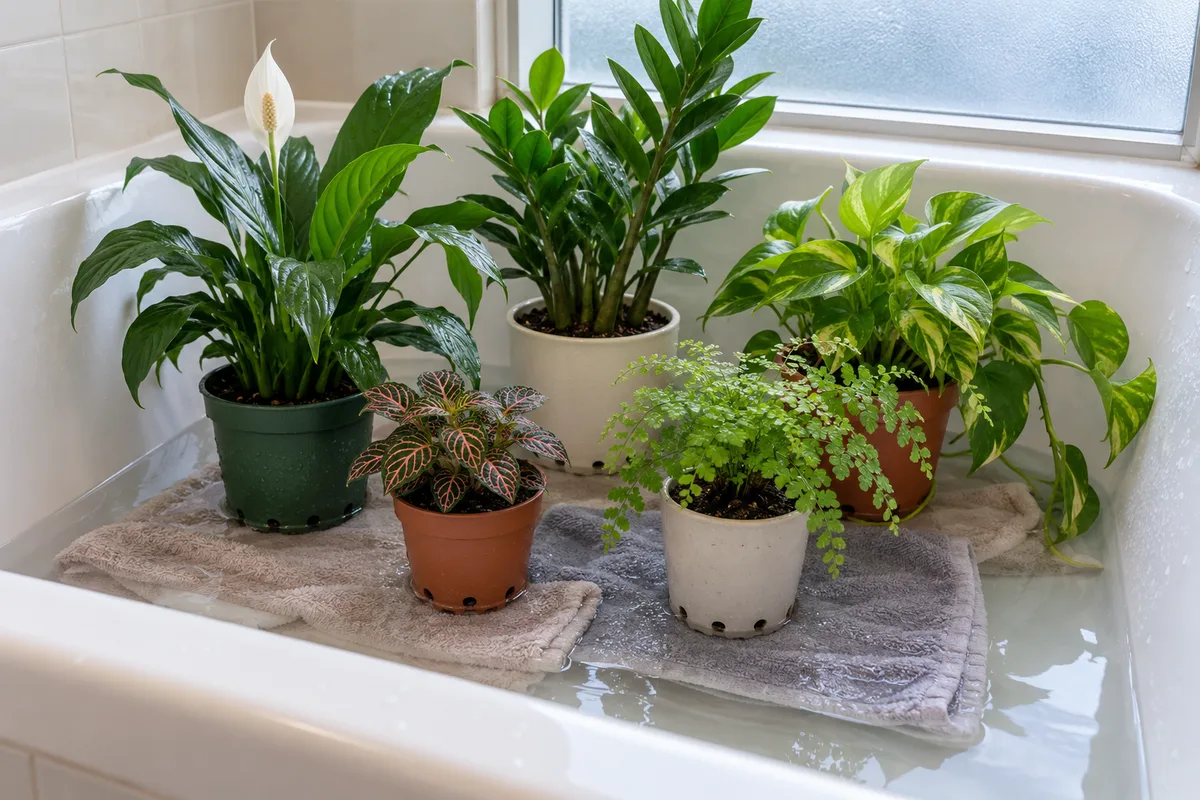
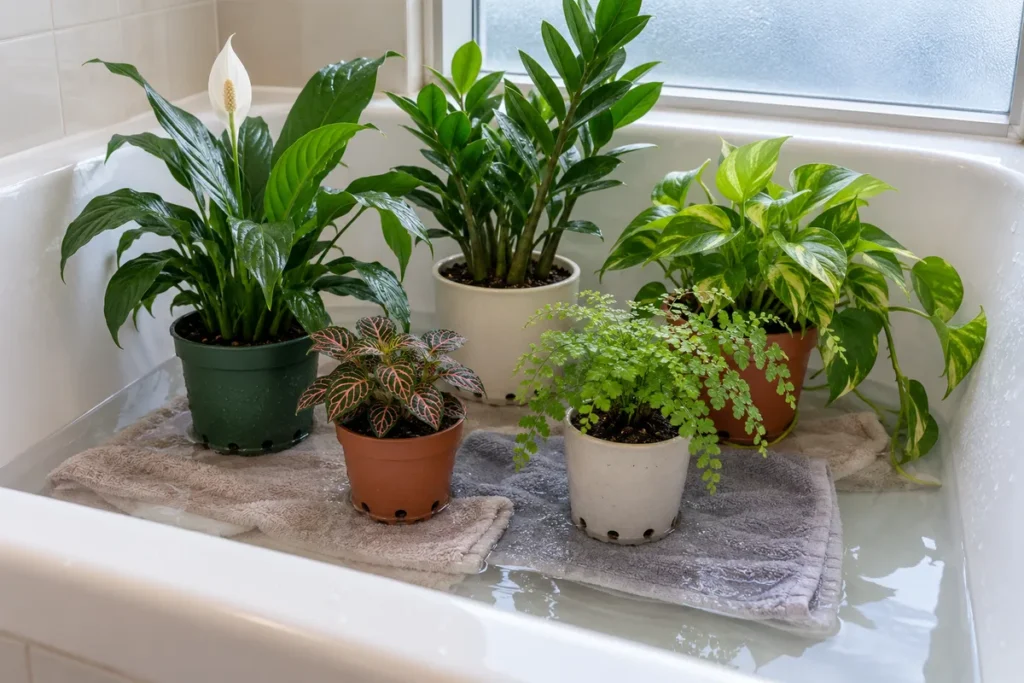
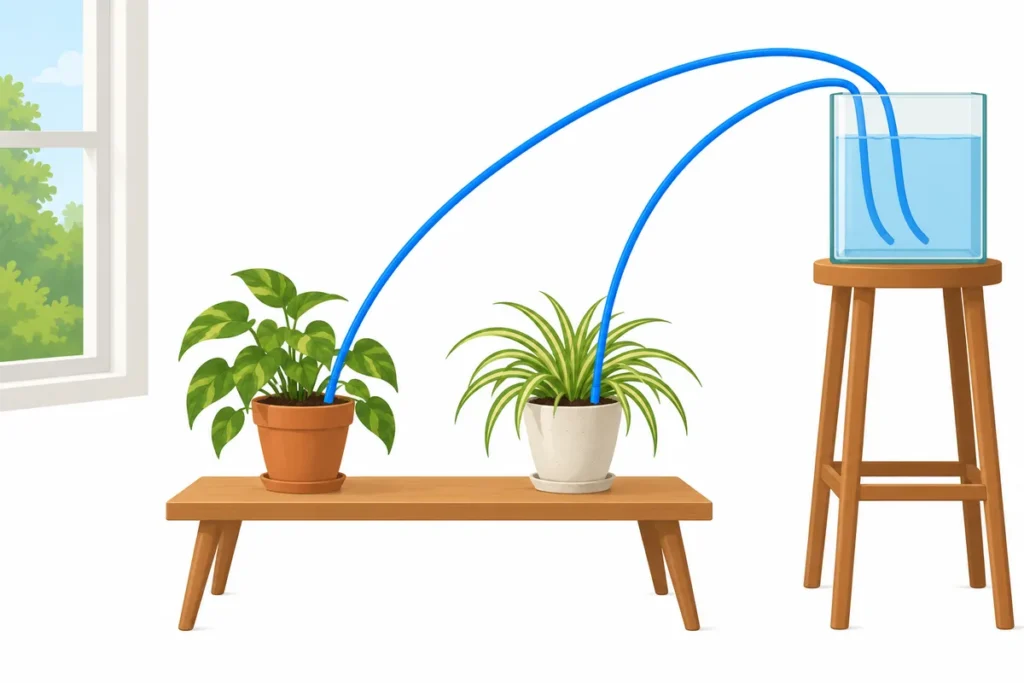
UF/IFAS says a pebble tray can buy about an extra week. For a bathtub, put about 5 cm (2 inches) of water in, add old towels and stand the pots on them with the bathroom light on, which can add about a week [2]. For three to four weeks it describes a wick from a raised reservoir, placed so it does not sit between plants and their light [2]. USask describes a wick of about 6 mm (1/4 inch) absorbent cotton string tucked into the soil [4].
For bottles and spikes, Missouri Extension describes poking small holes in the lid and one in the base so no vacuum forms, or buying watering spikes [3]. USask says spikes let water seep slowly into soil [4]. None of the pages gives a delivery rate or number of days, so treat them as short-term helpers and test first.
Weaker or limited options: Missouri Extension says water-retaining crystals are not always reliable and do not conserve water [3]. The RHS says covering plants suits short absences only [1], and that self-watering containers suit long-term growing rather than a holiday fix [1]. If you already use one, see is a self-watering pot right for your plant.
Do different plants need different plans?
Yes. The RHS says cacti and succulents tolerate longer without water [1], while USask says other plants like constantly moist soil [4]. A succulent and a monstera on the same windowsill should not get the same plan.
- Succulents and cacti: can go longer without water [1][4]. Water thoroughly and skip complex systems (our inference).
- Moisture-loving foliage plants: prioritise them for the wick or towel setup (our inference from the differing water needs in [2][4]).
- Small and clay pots: dry fastest, so deal with them first [4].
If you are unsure how a plant uses water, start with how to water.
What should I avoid doing before a trip?
- Trying a new method for the first time on departure day. Sources advise testing it [4].
- Putting the reservoir between plants and the window. UF/IFAS warns against blocking light [2].
- Sealing plants under plastic for weeks. The RHS limits covers to short absences [1].
- Relying on crystals. Missouri Extension calls them not always reliable [3].
- Leaving pots standing in water without testing drainage. For winter trips the RHS says compost should be moist but not waterlogged [1]; the waterlogging risk of towel and tray set-ups is our inference. See root rot.
What should I check when I get home?
Look at soil and leaves, then look for pests. UF/IFAS warns that stressed plants can quickly develop problems such as fungus gnats, aphids and mites [2]. See fungus gnats, aphids and spider mites.
If the soil is bone dry or leaves are limp, restore watering gradually. If the soil is still wet, do not water again straight away; see overwatered or underwatered. The sources we read give no recovery timetable, so judge by how the plant responds.
When should I find a plant sitter or accept losses?
Beyond four weeks, UF/IFAS recommends sending plants to a sitter’s home [2]. If plants are too big to move, have someone check at least weekly [2].
- Rare or valued plants: consider a plant sitter first [3] (the ranking is our inference).
- Return date uncertain: plan for the longer period and arrange cover.
- Plants already struggling with root rot or pests: deal with that first. The RHS advises against repotting purely for a short absence unless you already use reservoir systems [1]; see the repotting guide for timing.
If some plants come back badly wilted, accept that some loss is a known risk and does not mean your method was wrong. See saving a dying plant.
Frequently asked questions
What do plants need for a three-day trip?
Usually a thorough watering and a move away from strong light. The RHS says most houseplants tolerate a few days away [1], and cacti and succulents cope with even longer [1].
Can a bathtub with towels really cover a week?
UF/IFAS suggests about 5 cm (2 inches) of water, old towels and the bathroom light left on, which can add about a week [2]. Results depend on the plant, pot and room temperature, so test it first [4].
Will a bottle drip too much water?
The sources we read give no delivery rate or duration for bottles or spikes [3][4], so we cannot say. Test it before you leave and check the soil moisture.
Can I just ask a friend?
Yes. Missouri Extension suggests a reliable neighbour or sitter, and recommends showing them each plant’s water needs [3].
Is a self-watering pot a good holiday fix?
The RHS says self-watering containers suit long-term growing rather than a short holiday measure [1]. If you already use them, carry on; avoid repotting only for one trip [1].
Sources
- Royal Horticultural Society (RHS): “Houseplants: holiday care” — Short and longer absences, wick and capillary matting, covering plants short-term only, self-watering pots as a long-term not holiday measure, winter absences
- University of Florida IFAS Extension: “Vacation Plant Care” — Tiered by one to two weeks, three to four weeks and over four weeks; pebble tray, bathtub and towels, wicking; pests on stressed plants
- University of Missouri Extension: “Vacation planning includes plant care” — Plant sitter, grouping plants, deep watering before leaving, bottle irrigation, mulch, water-retaining crystals unreliable
- University of Saskatchewan Gardenline: “Watering houseplants & containers while on vacation” — Test the method first, clay and small pots dry faster, capillary mat, cotton wick, watering spikes, mini greenhouse
- Hong Kong Observatory: “Monthly Meteorological Normals for Hong Kong (1991-2020)” — July and January mean temperatures as background for a closed-up flat
Further reading
- Back to Plant Doctor
- How to water houseplants: how often and how much
- Overwatered or underwatered? A side-by-side check
- Is a Self-Watering Pot Right for Your Plant?
- Office Plant Care During Holiday Closures
- Why Water Runs Straight Through a Plant Pot
Sources checked: 31 October 2026. This is general guidance, not an on-site diagnosis. Always follow the product label.
