



Level: Intermediate
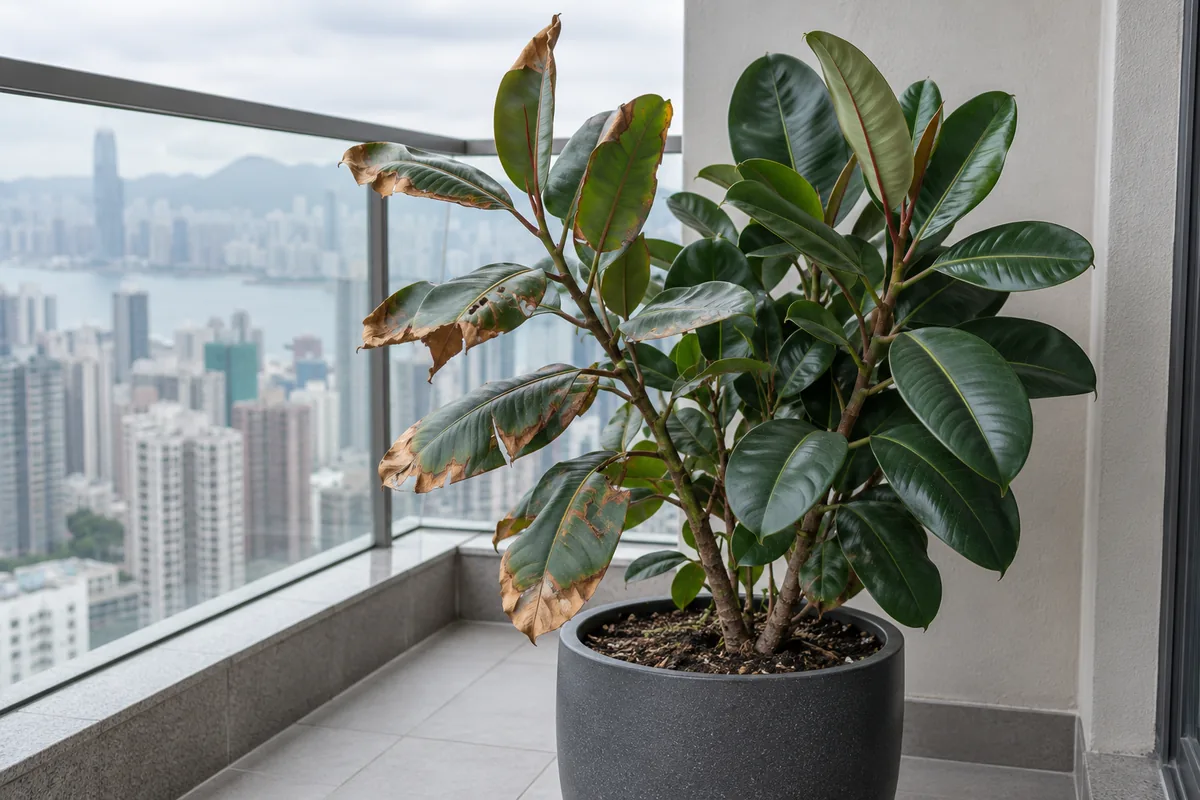
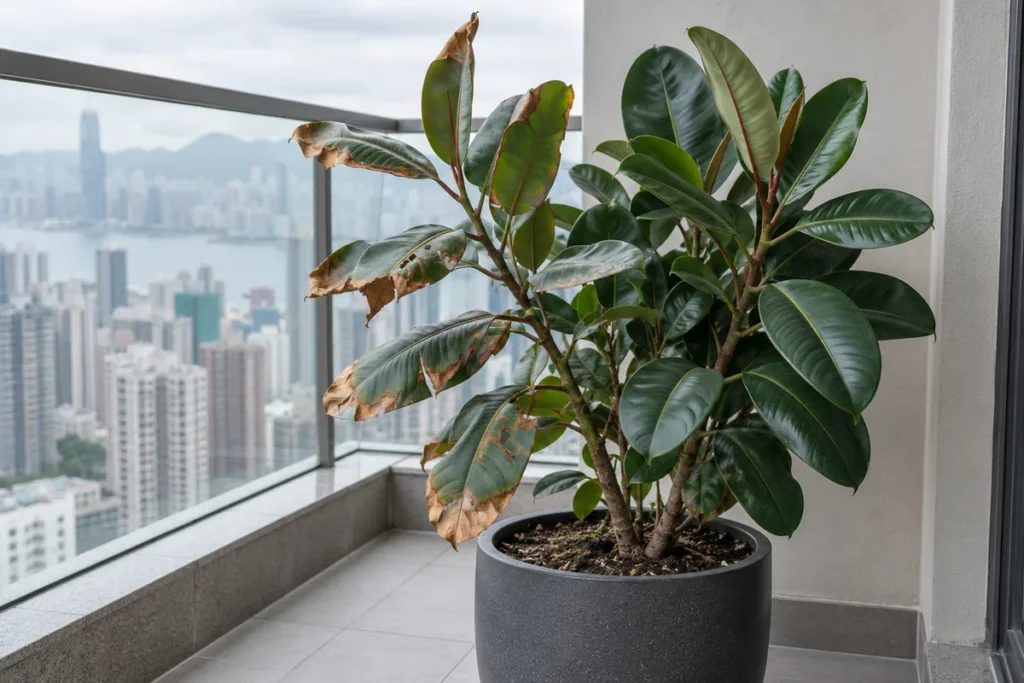
On a high-rise balcony, brown leaf edges and fast-drying pots may come from wind pulling water from leaves and soil [1], salt spray on exposed or seaward sides [3], or sun and reflected heat warming the root zone [4]. Check first whether damage sits on the windward side [2].
Key points
- Damage on one side points to wind or salt spray. Even damage across the whole pot needs checks of roots, watering and pot heat [2][3].
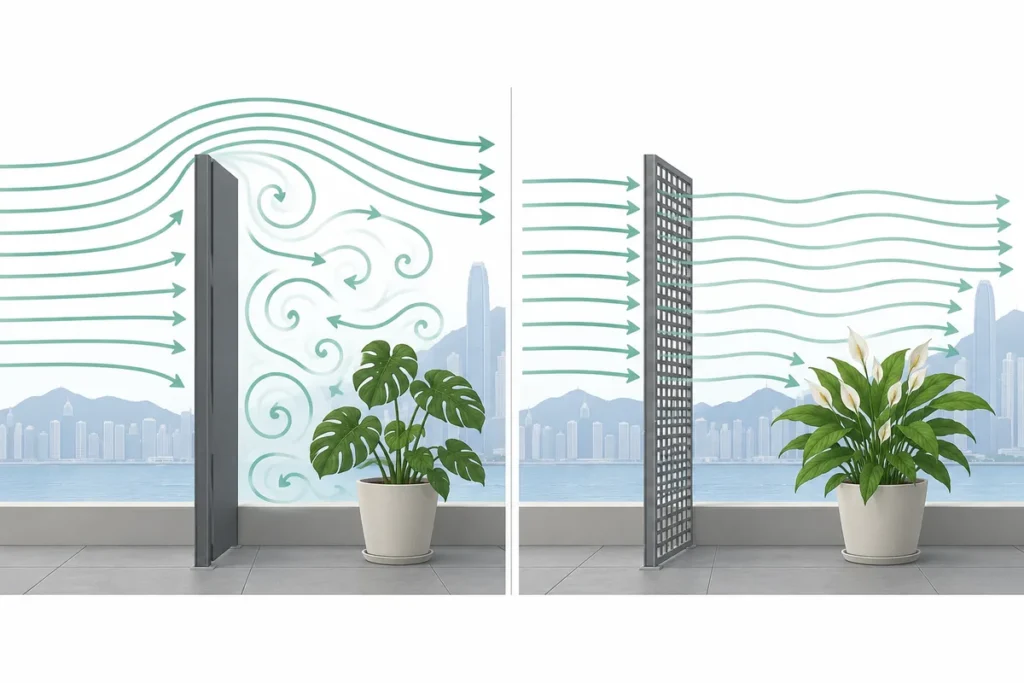
- A windbreak should be porous. The RHS considers a screen that filters 50 to 60 percent of the wind ideal, and solid walls can create turbulence behind them [1].
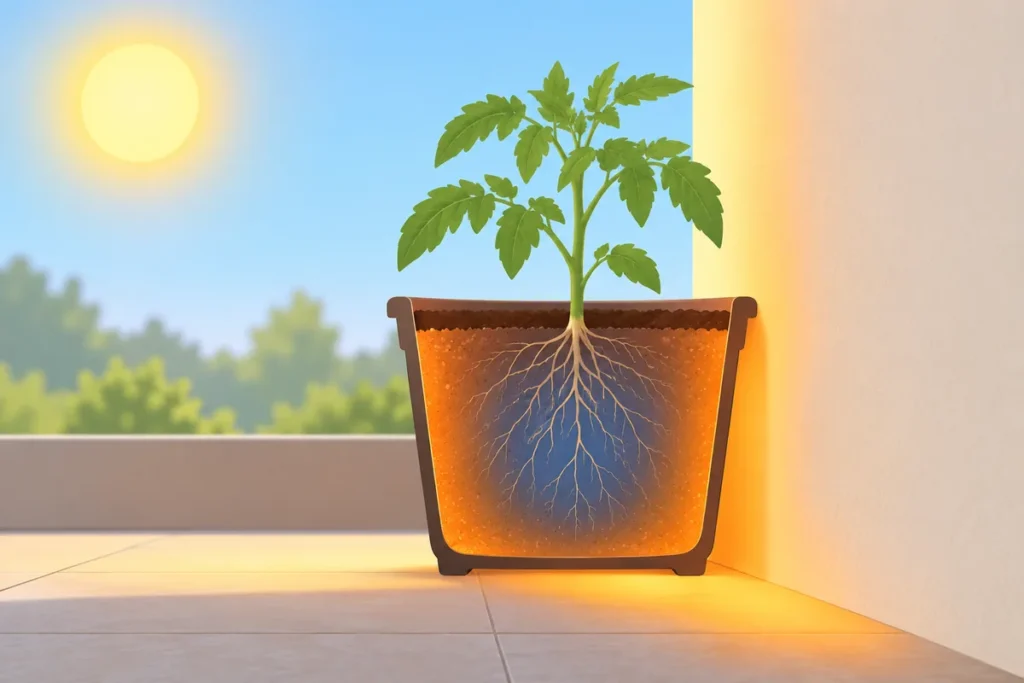
- A sunlit pot wall can run far hotter than the pot centre. A Kentucky review of nursery containers recorded west walls above 49°C, and lighter pots ran cooler [4].
- At Hong Kong Observatory Signal No. 3, secure loose objects or bring them indoors, which includes plant pots [5].
How can I tell wind, salt spray and reflected heat apart?
Start with where the damage sits. Washington State University says desiccating wind usually damages only one side of a plant [2]. The RHS also notes that scorch can be worst on the windward side and that potted plants are at particular risk [1]. Virginia Tech describes salt-spray burn on the windward side too [3]. The three look alike, so use several clues together.
On a phone, swipe sideways to see every column.
| Clue | Possible cause | Next step |
|---|---|---|
| Brown edges on the windward side, healthy leaves on the sheltered side | Wind drying leaves, or salt spray [1][2][3] | Add shelter first, then look for white residue on leaves [1][3] |
| Thin white crust on leaves, balcony near the sea or facing sea winds | Salt spray [3] | Rinse leaves with fresh water (our inference) and check pot drainage |
| Pot edge is very hot, plant wilts after watering or new leaves stay small | Overheated outer roots (our inference from nursery data) [4] | Shade the pot wall, use a lighter pot, move off the wall |
| Whole pot turns yellow and stays wet | Usually not wind; more likely watering or drainage | See overwatered or underwatered |
| White or brown patches two or three days after moving outdoors | Possible sunburn | See leaf sunburn |
Hong Kong note: do not blame wind for every brown tip. Dry indoor air from air conditioning, water quality and fertiliser can look similar. See brown leaf tips.
How does wind on a high balcony dry out plants?
Moving air carries water away from leaves and soil. The RHS explains that wind removes moisture from foliage and from the soil, and if the soil is dry the plant cannot replace what the leaves lose [1]. Its example is evergreens in UK gardens, which is a different setting from a Hong Kong balcony, but the drying mechanism applies to pots.
Wind varies a lot by site. The Observatory’s 1991 to 2020 normals give a mean wind speed of 9.9 km/h at its headquarters and 22.9 km/h at offshore Waglan Island [6]. It also says buildings and terrain can make local wind substantially different from the general picture, and that wind is often stronger on high ground [5]. Our inference is that a high, open balcony can be windier than street level. The sources did not measure balconies, so trust your own observation.
For a more advanced point, the RHS warns that solid walls and fences deflect wind over the top and can cause damaging turbulence a short distance behind, and that buildings can also create a wind tunnel [1].
Does sea wind bring salt spray to a high balcony?
It can if the balcony faces the sea or sits close to it, but we found no Hong Kong balcony measurements, so do not assume it. Virginia Tech explains that salt spray is wind-carried salty droplets. After they evaporate, sodium and chlorine can enter stems, buds and leaves [3]. That guide covers trees and shrubs. Applying it to houseplants is our reasonable inference, not direct evidence.
Salt-spray damage appears faster than soil-salt damage [3]. The same guide notes that where irrigation water is salty, repeated light watering without flushing water through, or poor drainage, can build up salt in soil [3]. Our inference: water pots until it drains out of the bottom rather than wetting the surface only.
How does reflected heat overheat roots in a pot?
Roots tolerate temperature extremes less well than shoots, according to University of Kentucky Extension [4]. Its review of nursery plants in full sun reports parts of the container root zone above about 40°C (104°F) for 5 to 10 hours a day, and west container walls above about 49°C (120°F) in summer [4].
The review found no known temperature that causes direct injury below about 42°C (108°F), yet around 40°C for 5 to 6 hours a day can impair physiology in most plants studied [4]. These are American nursery figures for black plastic pots, so do not treat them as your balcony pot’s temperature. The principle holds: the sunlit pot wall heats first, and the roots touching it suffer most.
The review lists direct and reflected sunlight as heat sources [4]. Our inference is that pots against walls, glass balustrades or dark tiles may gain extra reflected heat. Light-coloured containers held growing medium about 5 to 10°C (9 to 18°F) cooler than black ones [4]. Hong Kong’s July mean daily maximum is 31.6°C, which is air temperature rather than pot-wall temperature [6].
What should I do, step by step?
- Confirm the pattern. Watch for a week and see whether damage sits on the windward side [2].
- Shelter, but keep it porous. The RHS considers a screen filtering 50 to 60 percent of wind ideal [1].
- Avoid a solid wall. It can create turbulence behind it [1].
- Reposition. The RHS suggests pots can sit against a sheltered wall, but not where buildings form a wind tunnel [1].
- Shade the pot, not only the leaves. Use lighter pots or let pot walls shade each other to cut direct sun on the wall [4].
- Rinse leaves if you suspect salt and water until it drains (our inference; Virginia Tech suggests flushing salt from landscape soil with plenty of water [3]).
- Mulch the surface with bulky organic material to reduce water loss, as the RHS suggests [1].
For root problems see the repotting guide. For wider summer care see summer heat.
What should I avoid doing?
- Building a solid windproof wall. Solid barriers cause turbulence [1].
- Watering a little every day. With salty water, light watering without flushing can let salt build up [3].
- Moving everything to full sun at once. Sudden light changes can sunburn leaves. See moving plants onto the balcony gradually.
- Leaving pots on the rail when a typhoon signal is up. At Signal No. 3, secure loose objects or take them indoors [5].
- Naming one cause from one symptom. Wind, salt, heat, thirst and pests can all brown leaf edges.
How should I prepare for the next typhoon?
For daily prevention, choose tougher or smaller-leaved plants (our inference; the sources name no species), keep large-leaved or prized plants on the sheltered side, and rotate pots now and then so you can compare both sides.
Before a typhoon, the Observatory defines Signal No. 3 as sustained wind of 41 to 62 km/h with gusts that may exceed 110 km/h, and advises securing or bringing in loose objects [5]. Signal No. 8 means sustained 63 to 117 km/h and gusts that may exceed 180 km/h, and precautions should be complete before gales arrive [5]. See the full checklist in typhoon preparation.
Safety first: never lean over a balcony rail or climb in strong wind to rescue a pot. A falling pot can injure people below, so keep balcony pots stable.
When should I bring plants in or give up on the spot?
If only windward leaf edges are brown, shelter, shaded pots and steady watering usually come first. Scorched tissue does not turn green again, so wait for new growth. Consider moving a plant indoors or giving up the position in these cases:
- A typhoon signal is up. Bring pots in or secure them [5].
- The same spot keeps scorching plants even with shelter. That may mean the spot suits that species poorly (our inference).
- Roots look black, the pot edge is dried out, or the stem base is soft. See root rot.
- The plant is tall and top-heavy. A balcony may be riskier for it than indoors.
If several plants decline together within days, photograph the spot with the date and ask a professional horticulturist to check.
Frequently asked questions
Do I have to bring every plant indoors when the balcony is windy?
Not necessarily. Wind is one stress among several. Use a porous screen, keep pots stable and secure them for typhoon signals. The RHS suggests a screen filtering 50 to 60 percent of wind [1], and the Observatory advises securing loose objects at Signal No. 3 [5].
How do I know if my balcony gets salt spray?
Look at the damage pattern and for white residue. Virginia Tech links salt spray to burn on the windward side and to salt residue on foliage [3]. We found no Hong Kong balcony measurements, so we cannot say whether your spot gets it.
Do light-coloured pots really run cooler?
In nursery tests, growing medium in white, yellow, silver or light blue containers ran about 5 to 10°C cooler than in black ones [4]. Those were outdoor nursery pots, so a balcony difference will depend on walls, floor and shade.
Will a windbreak block too much light?
It may, depending on mesh and position. The sources we read give no light figures, so this is our inference: test a small area and watch whether new growth becomes long and pale before extending it.
Should I cut off scorched leaf edges?
Trimming tidies the look but does not repair the damage. Finding the cause matters more. If the browning keeps spreading, recheck wind, salt, roots and watering.
Sources
- Royal Horticultural Society (RHS): “Wind scorch” — Wind dries foliage and soil, pot plants at risk, 50-60 percent filtering screens, solid walls cause turbulence (UK garden evergreens)
- Washington State University HortSense: “Common Cultural: Desiccating wind” — Desiccating wind scorches leaves, damage often on one side (outdoor evergreens, winter setting)
- Virginia Tech / Virginia Cooperative Extension: “Trees and Shrubs that Tolerate Saline Soils and Salt Spray Drift (publication 430-031)” — Salt spray mechanism, windward-side burn, soil salt build-up (trees and shrubs)
- University of Kentucky Cooperative Extension: “Reducing Heat Stress to Container-grown Plants (HO-119)” — Root-zone temperature in sunlit containers, wall heating, lighter containers run cooler (nursery black plastic pots)
- Hong Kong Observatory: “Tropical Cyclone Warning Signals Leaflet” — Signal No. 3 and No. 8 wind speeds; buildings change local wind; secure loose objects at No. 3
- Hong Kong Observatory: “Monthly Meteorological Normals for Hong Kong (1991-2020)” — Mean wind speed at the Observatory and Waglan Island, July mean maximum temperature, humidity
Further reading
- Back to Plant Doctor
- Typhoon preparation for plants
- Summer heat and plants in Hong Kong
- Leaf sunburn: pale or brown patches after moving to brighter light
- Brown crispy leaf tips and edges
- Helping a Houseplant Settle onto the Balcony
Sources checked: 31 October 2026. This is general guidance, not an on-site diagnosis. Always follow the product label.
