



Level: Beginner
Before a typhoon, move balcony pots indoors or down to floor level before the wind builds, because the Observatory and the Fire Services Department both warn that loose objects can be blown off and fall from height onto people [1][2]. Your safety comes before the plants, and all preparations should be finished before Signal No. 8 [1].
Key points
- From Signal No. 3, secure or bring in anything the wind could carry off. Balcony pots fit that description [1][2].
- Once Signal No. 8 is up, preparations should already be done, and you should keep away from exposed windows [1]. Do not go out or approach the balcony door for the sake of a plant.
- After the storm, wait until winds ease before checking. Water stressed plants, but do not rush to prune or feed [1][4][5].
- Wind burn and salt spray can look alike. Most plant advice here comes from landscape plants, so treat it as a guide for pots rather than a test result [4][5].
When should you deal with balcony plants before a typhoon?
Do it when Signal No. 3 goes up at the latest. At that signal the Observatory asks people to make sure objects likely to be blown away are securely fastened or taken indoors, and to fasten overhanging facilities and temporary outdoor structures or place them on the ground [1]. Balcony pots, window-ledge pots and railing planters fit that description (our own reading, as the Observatory does not list flower pots by name).
The Fire Services Department notes that a tropical cyclone can blow loose objects away, causing them to fall from height [2]. On a high floor, a pot lost over the edge is a far worse outcome than a dead plant. That is why safety leads this guide.
The Observatory also says that once a signal is issued you should finish all precautions even if local winds have not yet picked up, because weather can deteriorate quickly [1]. Tropical cyclones mostly occur between May and November, with September the busiest [1]. Observatory 1991-2020 normals show about 7.4 days a year at Signal No. 3 or higher and about 2.4 days at Signal No. 8 or higher [3]. It does not happen every week, but it happens every year.
On a phone, swipe sideways to see every column.
| Signal | Observatory advice | What it means for pots |
|---|---|---|
| No. 1 Standby | Precautions should be taken [1] | Start counting pots on the balcony, ledges and railings (our suggestion) |
| No. 3 Strong Wind | Secure objects likely to be blown away or take them indoors [1] | Bring pots inside or down to the floor, starting with hanging and high ones |
| No. 8 Gale or Storm | Complete all precautions before gales commence; do not stand near windows on the exposed side [1] | Stop moving pots. Keep away from the balcony door and windows |
| No. 9 and No. 10 | Stay indoors, away from exposed windows and doors, as glass under wind strain shatters easily if hit [1] | Even if a pot moves or falls, do not approach the balcony |
Do not wrestle a heavy pot on your own. If it is too heavy, set it low and well away from glass doors and windows. This is our safety advice, not a sourced figure.
How should you handle ledge, railing and hanging pots?
Clear anything that sits high or near an edge first. The Fire Services Department says loose objects blown away from height can hit people below [2], so window-ledge pots, railing planters, wall racks and hanging baskets carry more risk than pots on the floor. The ranking is our inference from that risk.
- Take down high pots first: ledges, railings, racks and baskets go inside or to floor level [2].
- Then the large floor pots: Lewis Ginter Botanical Garden moves its large potted plants indoors before a hurricane [6].
- Light items too: plastic pots, saucers, watering cans and clutter blow away easily, so bring them in with the plants [1].
- Keep them away from glass once inside: the Observatory notes that glass already under wind strain shatters easily if struck [1].
Indoor light is usually weaker, which matters little for a few days. If plants have to stay in a dim spot for long, watch for stretching or leaf drop (a general observation, not sourced). For how plants react to being moved, see transplant shock.
Check plants for pests before they come indoors. Pests may spread more easily once pots are crowded together (our inference, not stated by the source); see also quarantine and tool hygiene.
How can you tell whether wind has hurt your plants?
Make sure it is safe outside first, then check the plants. The Observatory warns that high winds are likely to persist for some time after a cyclone moves away, and advises staying indoors until winds moderate [1]. The Fire Services Department adds that objects falling from height can hit passers-by and fallen trees may block roads [2]. So the first step is to wait until signals are lowered and winds are clearly weaker.
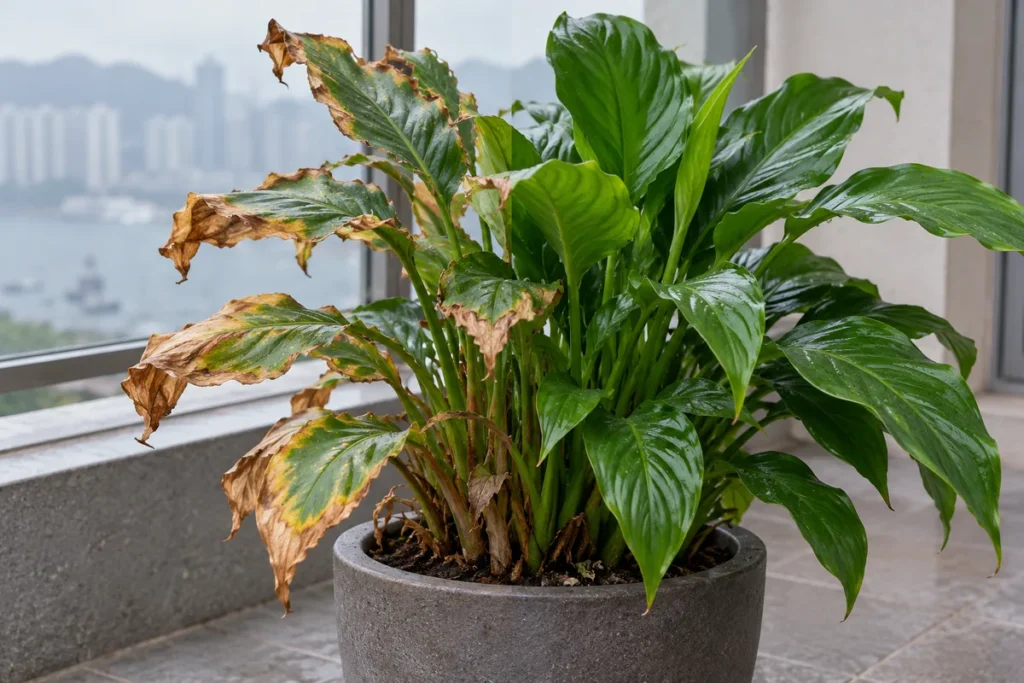
Then look at where and how the damage shows. UF/IFAS Extension compares wind burn to chapped skin on a dry, windy day: wind pulls moisture from leaves, and browning starts at the edges and moves inward [5]. For salt spray, another UF/IFAS Extension page says leaves facing the wind turn brown, while leaves that absorbed salt water show browning at tips or edges later [4].
On a phone, swipe sideways to see every column.
| Clue | Possible cause | Next step |
|---|---|---|
| Brown edges on the windward side, sheltered side still green | Wind burn or salt spray are more likely [4][5] | Water the plant and hold off pruning [4][5] |
| Tips and edges browning gradually, balcony faces the sea | Possibly salt spray, depending on location [4] | Rinse leaves with fresh water when it is safe, then consider flushing the mix [4] |
| Pot knocked over, mix spilled, stem snapped | Physical damage | Stand it up and clear snapped parts; repot quickly if roots were exposed (our suggestion) |
| Yellowing or leaf drop a few days after moving indoors | Light change or watering, possibly both | Check light and mix moisture; see sudden leaf drop |
| Mix stays wet for days, plant droops | Poor drainage or rain build-up, possibly affecting roots | Unpot and check; see root rot |
What should you do for storm-stressed plants, step by step?
Rinse off salt, restore water, then wait a few days before deciding what to cut. The steps below lean on UF/IFAS Extension advice written for landscape plants, so using it for balcony pots is a reasonable extension rather than a tested rule.
- Wait until it is safe to go out to the balcony [1].
- If you suspect salt, rinse early. UF/IFAS says rinsing an affected plant quickly after the worst of the weather can reduce or avoid much of the damage [4]. Use fresh water, and only from a safe spot.
- Water. UF/IFAS says most plants recover from wind burn, and the key is supplemental watering [5]. For pots, check the mix first; heavy watering of a plant with weak roots risks rot. See how to water.
- Hold off pruning. UF/IFAS advises waiting to see how the plant starts to recover before pruning [4]. Keep leaves that are still green.
- Hold off feeding. UF/IFAS notes that fertilisers deliver nutrients in salt form and may further inhibit water uptake [5].
What should you avoid before and after a typhoon?
- Going out to save pots after Signal No. 8 is up. The Observatory wants precautions completed before gales begin [1] and warns against standing near exposed windows [1].
- Going down to look at the damage straight away. Objects falling from height can hit passers-by [2].
- Covering balcony plants with tarpaulin or loose sheeting. A UF/IFAS page mentions tarps or burlap to keep salt off landscape plants [4], but on a high balcony the cover itself can blow away. That risk is our own inference, so we would not do it.
- Feeding straight after the storm [5].
- Cutting every brown leaf at once. UF/IFAS suggests waiting [4].
- Putting pots back on ledges or railings before the weather is stable [1].
How can a Hong Kong household prepare in advance?
Sort the balcony into plants that must come in and plants that can stay. Observatory normals show tropical cyclone signals mostly between April and November, with June to September the busiest [3], so summer and early autumn are when a ready plan matters most.
- Keep pots low rather than on railings or outside window racks. This follows the Fire Services Department’s warning about objects falling from height, and is our inference [2].
- Keep a spot indoors where pots can sit for a day or two. For high-floor conditions, see high-rise balconies.
- For the wider summer routine, see Hong Kong summer plant care.
- Keep plants healthy overall. A UF/IFAS page advises regular watering, feeding and pest control so plants cope better with a storm [4].
When should you give up on a plant or ask for help?
A snapped stem, mostly dried-up leaves or roots exposed for a long time lower the odds of recovery. The sources give no standard cut-off, so give the plant some time; new buds or leaves usually mean it is still alive (a general observation, not a sourced conclusion). See also saving a dying plant.
If the balcony itself is damaged, with broken glass, a loose railing or a displaced planter, leave it to building management or a professional. The Fire Services Department advises that if a window has been blown out you should stay away from it and call 999 [2].
Plants can be replaced. People cannot. Going out to a balcony to rescue a plant is never a good trade.
Frequently asked questions
Should I bring balcony pots in as soon as Signal No. 3 is up?
Yes, start then. At Signal No. 3 the Observatory asks people to secure objects likely to be blown away or take them indoors [1]. Weather can deteriorate quickly after a signal [1], so earlier is safer.
What if I notice a pot still on the balcony after Signal No. 8 is up?
Leave it. At that signal the advice is that precautions should already be complete and that you should avoid standing near exposed windows [1]. You can deal with the plant once winds have eased.
Are brown leaf edges after a typhoon salt damage?
Possibly, but not necessarily. Wind burn and salt spray can both cause browning along the edges [4][5]. Heavier damage on the windward side and a sea-facing balcony make salt more likely. If unsure, rinse, water and wait a few days.
Can I trim the brown leaves straight away?
It is better to wait. UF/IFAS advises seeing how the plant starts to recover before pruning [4]. Leaves that are still partly green may be alive, and cutting too soon adds stress.
Should I fertilise to help recovery?
Not yet. UF/IFAS notes that fertilisers deliver nutrients in salt form and may make water uptake harder [5]. Wait for new growth, then go back to your normal routine.
Sources
- Hong Kong Observatory: “Precautionary Measures when Tropical Cyclone Warning Signals are in force” — Precautions at Signals No. 3, 8 and 9, and staying indoors after the storm passes
- Hong Kong Fire Services Department: “Tropical cyclone (Public Education)” — Loose objects falling from height, hazard to passers-by, not going out after the storm
- Hong Kong Observatory: “Monthly Meteorological Normals for Hong Kong (1991-2020)” — 1991-2020 monthly mean days with tropical cyclone warning signals
- UF/IFAS Extension, Walton County: “What to do About Salt Spray Damage to Plants” — Salt spray symptoms, rinsing quickly after the storm, waiting before pruning (landscape plants)
- UF/IFAS Extension, Sarasota County: “Post-Hurricane Landscaping Tips: Wind Burn, Sea Spray, and Storm Surge” — Appearance and recovery of wind burn, supplemental watering, avoiding fertiliser after the storm (landscape plants)
- Lewis Ginter Botanical Garden: “6 Hurricane Prep Tips” — The garden’s practice of moving potted plants indoors before a hurricane
Further reading
- Back to Plant Doctor
- High-rise balconies: wind, salt and reflected heat
- Hong Kong summer plant care: heat, sun and watering
- Transplant shock: helping a plant settle after a move
- Saving a dying plant: a triage approach
Sources checked: 31 October 2026. This is general guidance, not an on-site diagnosis. Always follow the product label.
