



Level: Intermediate
Hong Kong tap water suits most houseplants. The things to watch are chlorine, fluoride and salt build-up in the pot. Official figures show soft water, so hardness is rarely the main issue. Standing water overnight may reduce chlorine but probably not fluoride.
Key points
- Water Supplies Department figures show average hardness of 36 mg/L (as calcium carbonate) and average fluoride of 0.49 mg/L [1], so salts and fluoride matter more than hardness.
- Letting water stand for 24 hours mainly targets chlorine [4][5]. Fluoride is unlikely to leave that way. That is our inference, and the university sources differ.
- Brown leaf tips are not always a water problem. Rule out dry air and salt build-up first.
- Avoid watering long term with softened water [4]. Flushing the pot every four to six months limits salt build-up [8].
What is in Hong Kong tap water, and why does it matter to plants?
The Water Supplies Department’s report for April 2024 to March 2025 gives total hardness (as calcium carbonate) from below 5 to 62 mg/L, averaging 36 [1]. Calcium averages 13 mg/L and conductivity averages 141 µS/cm [1]. Fluoride ranges from 0.39 to 0.55 mg/L, averaging 0.49, and chlorine from 0.1 to 1.5, averaging 0.8 mg/L [1]. The department also says a small residual chlorine is kept in the water, and fluoride is added [2].
For comparison, the RHS warns that tap water in hard-water areas can lead to nutrient deficiencies or leave calcium deposits on leaves [10]. It gives no threshold. Our own reading is that Hong Kong water does not look like typical hard water, so limescale is probably not the first risk. That is inference, not a finding from the source.
On fluoride, the Department of Health recommends 0.5 mg/L locally, against a WHO guideline value of 1.5 mg/L [3]. Those limits are for drinking, not for plants. A 2009 Penn State news release says sensitive plants can react to fluoride at levels as low as 0.1 ppm, and names the spider plant as an indicator, with spotted leaves or burned tips [4]. That is a general statement. We found no plant trial using Hong Kong water, so treat any link as possible, not proven.
On a phone, swipe sideways to see every column.
| Component | Hong Kong figure | Possible effect on plants |
|---|---|---|
| Chlorine | Average 0.8 mg/L [1] | May scorch tips of sensitive plants [7]; standing or aeration reduces it [4] |
| Fluoride | Average 0.49 mg/L [1] | Dracaena and spider plant are more sensitive; tip burn or spotting possible [4][6][7] |
| Hardness (calcium, magnesium) | Average 36 mg/L [1] | Hard-water areas may see deficiencies or deposits [10]; local figure looks low (inference) |
| Salts (conductivity) | Average 141 µS/cm [1] | The water itself is not very salty, but fertiliser and evaporation build up salts in the pot [8] |
How do I tell if brown tips come from the water?
Brown tips have many causes: dry air, salts, water quality and uneven watering. Leaf tips alone cannot prove tap water is the cause. A more practical test is to compare plants in the same home on the same water. If only the fluoride-sensitive plants named by universities, such as dracaena and spider plant, are affected, the water becomes more plausible [4][5]. Iowa State likewise says too much chlorine or fluoride can brown the tips of sensitive species, and suggests another water source if that is suspected [11].
Next, look at the top of the pot and the rim. Colorado State University Extension lists brown tips, yellowing and unexplained wilting as signs of salt build-up, and mentions a white crust on the surface [8]. If you see a crust, flushing is simpler than changing your water source.
On a phone, swipe sideways to see every column.
| Clue | Possible cause | Next step |
|---|---|---|
| Only sensitive plants such as spider plant or dracaena have brown tips | May involve chlorine or fluoride [4][6][7] | Let water stand overnight and flush the pot, then watch for change |
| White crust on soil or pot rim, several plants with brown tips | May be salt build-up [8] | Follow the flushing steps below [8][9] |
| White chalky marks on the leaf surface, tips fine | May be minerals left by evaporated water [10] | Water the soil, not the leaves; see white spots on leaves |
| Brown tips on plants near an air-conditioning vent | May be dry air; Iowa State calls low humidity the most likely cause [11] | See brown leaf tips; do not blame the water first |
| New leaves yellow with green veins | May be nutrient or pH related | See yellow new leaves with green veins |
Hong Kong note: during the humid season, a pale film on the soil surface is not always salt. Check the soil and roots before blaming the water.
Does leaving tap water overnight help?
UNH Extension suggests letting city water stand for at least 24 hours so some of the chlorine and fluoride escapes, and names dracaena, cordyline and maranta as more susceptible [5]. Penn State only says chlorine can be removed by heating, aeration or standing overnight, and treats fluoride separately [4]. The two sources do not fully agree.
Our inference: standing water makes sense for chlorine, but fluoride is dissolved in the water and does not escape as easily. Neither page measures this, so it is unproven. In practice, standing water is cheap and harmless to try, but do not expect it to fix fluoride or salts.
NC State Extension is blunter for corn plant: if leaves turn brown, try non-fluoridated water and flush salts monthly [6]. Non-fluoridated water is not easy to get in a Hong Kong flat, and the evidence does not go as far as saying you must switch. We suggest trying a flush first.
How do I flush salts from the pot?
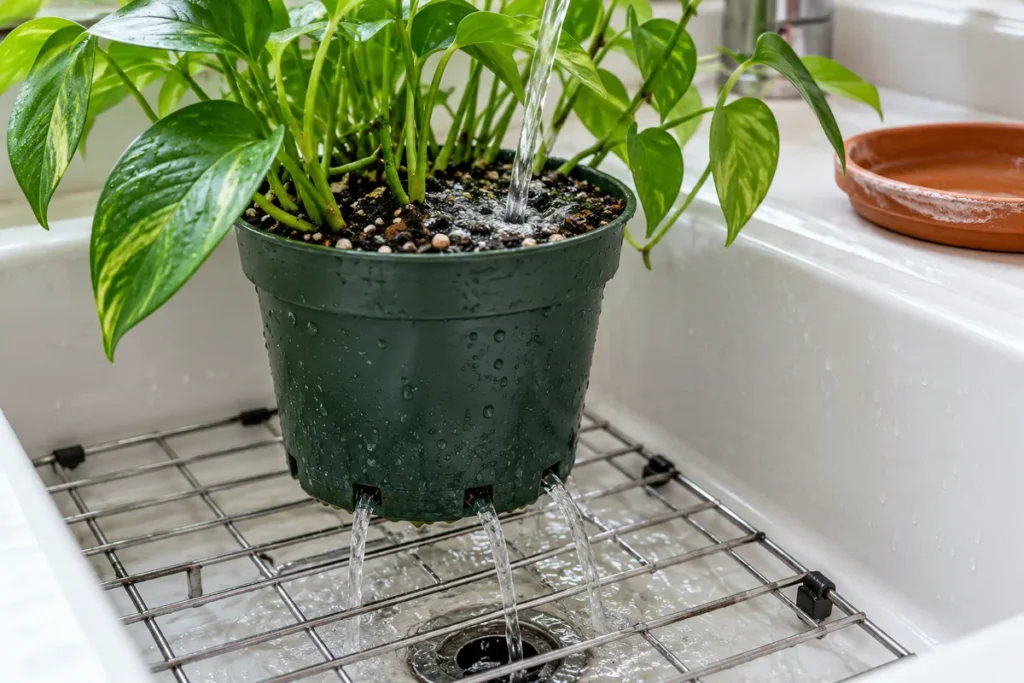
Flushing washes dissolved salts out of the potting mix. It is not a rescue by adding more water. Colorado State University Extension removes the surface crust and some top mix, then fills the pot with water a couple of times, letting it drain between rinses [8].
- Move the pot to a sink or bath, check the drainage holes are open and remove the saucer [8].
- Scrape off any white crust together with about half to one inch of surface mix, taking care not to damage roots [8].
- Fill the pot to the top with room-temperature water a couple of times, letting it drain fully between rinses [8].
- Scrub salt off the pot rim, drainage holes and saucer; wash the saucer with warm soapy water [8].
- Replace the removed mix with fresh mix, water lightly, and water again only when the root ball feels dry [8].
On frequency, Illinois Extension says to leach every four to six months [9], while NC State mentions monthly for corn plant [6]. These are different plants and settings. We suggest flushing when you see a crust, and otherwise every few months.
Safety: have a bucket or sink ready so water does not run onto floors, a neighbour’s unit or electrical items.
What should I avoid?
- Do not water long term with water from an ion-exchange softener. Penn State says softeners swap calcium and magnesium for sodium, which builds up and harms plants and soil structure [4].
- Do not change every plant’s water source because of a few brown tips. Rule out dry air, salts and uneven watering first, which are common causes [10][11].
- Do not add lime to neutralise fluoride unless you know your mix’s pH and the plant’s needs. Penn State mentions a small amount of limestone [4], but we found no other university backing it, and changing pH affects other nutrients (inference).
- Do not treat flushing as extra watering. Water should drain out freely, not sit in the saucer.
How do I prevent water and salt problems?
Beginner: plain tap water is usually fine. Water thoroughly, let the excess drain, and remove any white crust now and then. For plants named as sensitive, such as dracaena and spider plant, letting water stand overnight is an easy extra [5].
Intermediate: fertiliser and evaporation also raise salts, so water is only one source [8]. Check the soil surface after feeding rather than waiting for brown tips. See fertiliser burn and how to water houseplants.
Expert: if you own an EC meter, compare your tap water with the water draining from the pot. A much higher reading from the drainage suggests salts are building up. This is our reasoning from principle, and the sources give no EC threshold, so compare the same plant over time. See pH and EC.
For more on water choices, see our related article Choosing Water for the Plants You Already Have. Jug filters may not remove fluoride, so check the product details (inference).
When should I get help, or accept the damage?
If the tap water itself smells odd or looks discoloured, that is a drinking-water question for your building management or the Water Supplies Department, not a plant-care fix (general advice, not covered by our sources).
If you have flushed the pot, addressed dry air and fixed your watering, and a dracaena or spider plant still has brown tips, you can accept them as cosmetic. Iowa State notes that trimming improves appearance but browning returns if the cause is not addressed [11], so judge by the new leaves. If new leaves also decline, or you see soft rot, a bad smell or pests, move on to root rot or the other targeted guides.
Frequently asked questions
Can I water a newly bought plant straight from the tap?
Usually yes. Average hardness is 36 mg/L and fluoride 0.49 mg/L [1], and we saw no reason to expect trouble for most plants. If you bought a spider plant or dracaena, which universities name as more sensitive [4][6], try letting water stand overnight and watch the leaf tips.
Is boiled and cooled water better?
The sources we read say heating removes chlorine [4], but say nothing about fluoride or salts. Boiling may even concentrate what remains (inference). It is not needed, and hot water brings its own safety risk.
Is filtered water better for plants?
Not necessarily. Filters differ in what they remove, and we found no university trial tying them to plant outcomes. Check what your filter claims to remove and judge by how the plants actually respond.
Is rainwater better than tap water?
The RHS suggests room-temperature rainwater where possible, especially in hard-water areas [10]. Hong Kong tap water looks fairly soft (inference), so the advantage may be small, and stored rainwater can breed mosquitoes.
Does a white crust on the soil always mean bad water?
No. Salt can come from fertiliser as well as from minerals left behind by evaporated tap water [8]. In the humid season a pale film may also be mould. Check the soil and roots before flushing.
Sources
- Water Supplies Department, Hong Kong: “Drinking Water Quality for the Period of April 2024 – March 2025” — Minimum, maximum and average hardness, calcium, conductivity, chlorine and fluoride in Hong Kong drinking water
- Water Supplies Department, Hong Kong: “Water Treatment” — WSD says a small residual chlorine is kept in the water and fluoride is added
- Government of the Hong Kong SAR (Legislative Council question reply): “LCQ (water fluoridation) reply, 14 December 2016” — The Department of Health’s recommended local fluoride level compared with the WHO guideline value
- Penn State College of Agricultural Sciences: “Softened water can cause hard times for indoor plants” — Sodium from softeners, chlorine removal by standing water, and fluoride-sensitive plants
- University of New Hampshire Extension: “Houseplant winter care Q&A” — Advises letting city water stand at least 24 hours and names more sensitive plants
- North Carolina State Extension: “Dracaena fragrans (corn plant) plant toolbox page” — Corn plant is sensitive to fluoride and built-up salts; non-fluoridated water and monthly flushing suggested
- North Carolina State Extension: “Chlorophytum comosum (spider plant) plant toolbox page” — Spider plant tip burn can be linked to chlorine and fluorides
- Colorado State University Extension (PlantTalk Colorado): “Leaching Salts From Potting Mixes” — Signs of salt build-up and the leaching steps
- University of Illinois Extension: “Houseplants: Care” — Leach the pot every four to six months to avoid salt build-up
- Royal Horticultural Society (RHS): “How to help a poorly houseplant” — Tap water in hard-water areas can lead to nutrient deficiencies or leave calcium deposits
- Iowa State University Extension and Outreach: “Why does my houseplant have brown leaf tips and edges?” — Low humidity is the most likely cause; chlorine and fluoride affect sensitive species; trimming only improves appearance
Further reading
- Back to Plant Doctor
- Brown crispy leaf tips and edges: dry air, salts or water quality?
- Fertiliser burn: what to do after overfeeding
- pH and EC for potted plants: when to measure
- How to water houseplants: when and how much
- Choosing Water for the Plants You Already Have
Sources checked: 31 October 2026. This is general guidance, not an on-site diagnosis. Always follow the product label.
